
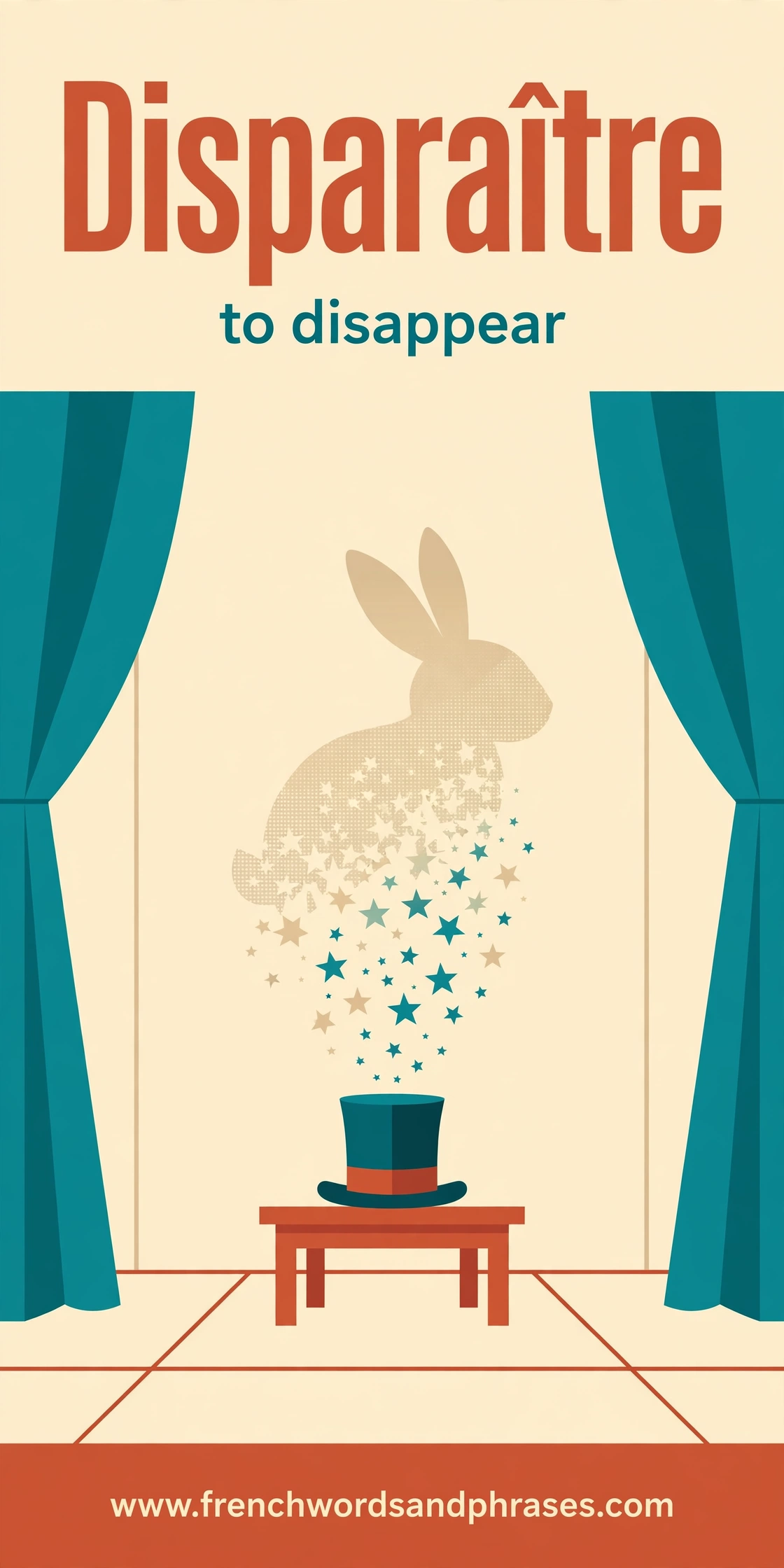
A French Word to Live By
How to Conjugate Disparaître in French
/dis.pa.ʁɛtʁ/
Disparaître means to disappear, to vanish, or to go missing.
One moment something is there, the next it is gone. A cat slips out of the garden, the sun sinks behind the hills, a name fades from memory — that quiet vanishing is disparaître.
In this guide, you’ll learn how to conjugate disparaître in all the major French tenses and moods. Explore complete conjugation tables, French examples, English translations, and practice quizzes.
Understanding the French Verb Disparaître
Disparaître is an irregular French verb belonging to the third group of verbs, those ending in -aître.
It means to disappear, to vanish, or to go missing. It is commonly used for people and things that vanish, for species dying out, and for feelings, pains and customs that fade away.
Verb classification: Third group (irregular -aître verb)
Auxiliary verb: Avoir or être, depending on the construction
Past participle: disparu
Present participle: disparaissant
English equivalents: To disappear, to vanish, to go missing.
One important detail: disparaître conjugates exactly like paraître, but its auxiliary has shifted with modern usage. Today’s French uses avoir for the act of disappearing — le chat a disparu (the cat disappeared). You will still meet être in older or literary writing, where the focus is on the resulting state, the fact of being gone: il est disparu (he is gone, he has vanished). The tables on this page use avoir, the auxiliary of modern French.
Experience the Word
Disparaître is the verb of the empty chair and the vanished footprint — the moment the world notices that something is no longer there.
Imagine a magician on a small theatre stage. A dove sits in a cage; a cloth falls, a hand waves — and when the cloth lifts, the cage is empty.
Nothing was destroyed. It simply disappeared.
How to Conjugate Disparaître: Complete French Conjugation Guide
Let’s explore every major conjugation of disparaître, beginning with the indicative mood.
How to Conjugate Disparaître in the Indicative Mood
The indicative mood is used to express facts, observations, actions, and events.
How to Conjugate Disparaître in the Present Tense (Présent)
Used for actions happening now, habitual actions, and general truths.
| Subject | Conjugation |
|---|---|
| je | disparais |
| tu | disparais |
| il / elle | disparaît |
| nous | disparaissons |
| vous | disparaissez |
| ils / elles | disparaissent |
Example
Le soleil disparaît derrière les collines.
The sun disappears behind the hills.
Quick Quiz 1
Complete the sentence:
Nous ______ derrière la porte.
Reveal the answer
disparaissons
Nous disparaissons derrière la porte.
We disappear behind the door.
How to Conjugate Disparaître in the Passé Composé
Used for completed actions in the past. Disparaître takes the auxiliary verb avoir or être, depending on the construction.
| Subject | Conjugation |
|---|---|
| j’ | ai disparu |
| tu | as disparu |
| il / elle | a disparu |
| nous | avons disparu |
| vous | avez disparu |
| ils / elles | ont disparu |
Example
Le chat a disparu hier soir.
The cat disappeared last night.
How to Conjugate Disparaître in the Imparfait (Imperfect Tense)
Used for habitual past actions, descriptions, and ongoing situations in the past.
| Subject | Conjugation |
|---|---|
| je | disparaissais |
| tu | disparaissais |
| il / elle | disparaissait |
| nous | disparaissions |
| vous | disparaissiez |
| ils / elles | disparaissaient |
Example
Chaque soir, le village disparaissait dans la brume.
Every evening, the village disappeared into the mist.
Quick Quiz 2
Choose the correct form:
The cat disappeared last night.
Le chat ______ hier soir. (a disparu / est disparu)
Reveal the answer
a disparu
Le chat a disparu hier soir.
Modern French uses avoir for the act of disappearing; est disparu is the older, literary way of presenting the result.
How to Conjugate Disparaître in the Plus-que-parfait
Used to describe an action that had already been completed before another past event.
| Subject | Conjugation |
|---|---|
| j’ | avais disparu |
| tu | avais disparu |
| il / elle | avait disparu |
| nous | avions disparu |
| vous | aviez disparu |
| ils / elles | avaient disparu |
Example
Le brouillard avait déjà disparu quand nous sommes partis.
The fog had already disappeared when we left.
How to Conjugate Disparaître in the Passé Simple
Primarily used in formal writing, literature, and historical narratives. It is rarely used in everyday conversation.
| Subject | Conjugation |
|---|---|
| je | disparus |
| tu | disparus |
| il / elle | disparut |
| nous | disparûmes |
| vous | disparûtes |
| ils / elles | disparurent |
Example
Soudain, le navire disparut à l’horizon.
Suddenly, the ship disappeared over the horizon.
How to Conjugate Disparaître in the Passé Antérieur
A literary tense used to express an action completed immediately before another past action, generally in the passé simple.
| Subject | Conjugation |
|---|---|
| j’ | eus disparu |
| tu | eus disparu |
| il / elle | eut disparu |
| nous | eûmes disparu |
| vous | eûtes disparu |
| ils / elles | eurent disparu |
Example
Dès que le soleil eut disparu, il fit froid.
As soon as the sun had disappeared, it turned cold.
How to Conjugate Disparaître in the Future Tense (Futur Simple)
Used to describe actions that will take place in the future.
| Subject | Conjugation |
|---|---|
| je | disparaîtrai |
| tu | disparaîtras |
| il / elle | disparaîtra |
| nous | disparaîtrons |
| vous | disparaîtrez |
| ils / elles | disparaîtront |
Example
La douleur disparaîtra avec le temps.
The pain will disappear with time.
How to Conjugate Disparaître in the Futur Antérieur (Future Perfect)
Used for an action that will have been completed before a particular point in the future.
| Subject | Conjugation |
|---|---|
| j’ | aurai disparu |
| tu | auras disparu |
| il / elle | aura disparu |
| nous | aurons disparu |
| vous | aurez disparu |
| ils / elles | auront disparu |
Example
À la fin de l’été, les traces auront disparu.
By the end of the summer, the traces will have disappeared.
How to Conjugate Disparaître in the Near Future (Futur Proche)
Used to describe something that is going to happen soon. Formed with aller + infinitive.
| Subject | Conjugation |
|---|---|
| je | vais disparaître |
| tu | vas disparaître |
| il / elle | va disparaître |
| nous | allons disparaître |
| vous | allez disparaître |
| ils / elles | vont disparaître |
Example
Le train va disparaître dans le tunnel.
The train is going to disappear into the tunnel.
How to Conjugate Disparaître in the Conditional Mood
The conditional mood expresses what would happen under certain circumstances. It is also frequently used to make polite requests or express wishes.
How to Conjugate Disparaître in the Present Conditional
| Subject | Conjugation |
|---|---|
| je | disparaîtrais |
| tu | disparaîtrais |
| il / elle | disparaîtrait |
| nous | disparaîtrions |
| vous | disparaîtriez |
| ils / elles | disparaîtraient |
Example
Je disparaîtrais volontiers pendant une semaine.
I would gladly disappear for a week.
How to Conjugate Disparaître in the Past Conditional
| Subject | Conjugation |
|---|---|
| j’ | aurais disparu |
| tu | aurais disparu |
| il / elle | aurait disparu |
| nous | aurions disparu |
| vous | auriez disparu |
| ils / elles | auraient disparu |
Example
Le village aurait disparu sous les eaux sans la digue.
The village would have disappeared under the water without the dam.
Disparaître in the Literary Past Conditional Form
This less common literary form uses the imperfect subjunctive of avoir or être, depending on the construction.
| Subject | Conjugation |
|---|---|
| j’ | eusse disparu |
| tu | eusses disparu |
| il / elle | eût disparu |
| nous | eussions disparu |
| vous | eussiez disparu |
| ils / elles | eussent disparu |
Example
Il eût disparu sans laisser de traces si la police n’était pas intervenue.
He would have vanished without a trace if the police had not intervened.
How to Conjugate Disparaître in the Subjunctive Mood
The subjunctive is used to express wishes, emotions, doubts, necessity, and uncertainty. It frequently follows expressions such as il faut que (it is necessary that) or bien que (although).
How to Conjugate Disparaître in the Present Subjunctive
| Subject | Conjugation |
|---|---|
| que je | disparaisse |
| que tu | disparaisses |
| qu’il / qu’elle | disparaisse |
| que nous | disparaissions |
| que vous | disparaissiez |
| qu’ils / qu’elles | disparaissent |
Example
Il faut que cette tache disparaisse.
This stain needs to disappear.
Quick Quiz 3
Complete the sentence using the subjunctive:
Il faut que les déchets ______ de la plage.
Reveal the answer
disparaissent
Il faut que les déchets disparaissent de la plage.
The rubbish needs to disappear from the beach.
How to Conjugate Disparaître in the Imperfect Subjunctive
A literary tense, rarely encountered in modern spoken French.
| Subject | Conjugation |
|---|---|
| que je | disparusse |
| que tu | disparusses |
| qu’il / qu’elle | disparût |
| que nous | disparussions |
| que vous | disparussiez |
| qu’ils / qu’elles | disparussent |
Example
Il craignait que le chemin disparût sous la neige.
He feared that the path would disappear under the snow.
How to Conjugate Disparaître in the Pluperfect Subjunctive
A literary construction used to express an action completed before another past action.
| Subject | Conjugation |
|---|---|
| que j’ | eusse disparu |
| que tu | eusses disparu |
| qu’il / qu’elle | eût disparu |
| que nous | eussions disparu |
| que vous | eussiez disparu |
| qu’ils / qu’elles | eussent disparu |
Example
Il regrettait que les coutumes eussent disparu si vite.
He regretted that the customs had disappeared so quickly.
How to Conjugate Disparaître in the Past Subjunctive
| Subject | Conjugation |
|---|---|
| que j’ | aie disparu |
| que tu | aies disparu |
| qu’il / qu’elle | ait disparu |
| que nous | ayons disparu |
| que vous | ayez disparu |
| qu’ils / qu’elles | aient disparu |
Example
Je suis étonné que le bruit ait disparu.
I am surprised that the noise has disappeared.
How to Conjugate Disparaître in the Imperative
The imperative is used to give commands, instructions, invitations, or suggestions. Subject pronouns are omitted.
How to Conjugate Disparaître in the Present Imperative
| Person | Conjugation |
|---|---|
| (tu) | disparais |
| (nous) | disparaissons |
| (vous) | disparaissez |
Example
Disparaissez, je ne veux plus vous voir !
Disappear, I don’t want to see you any more!
Quick Quiz 4
How would you say Disappear! using the vous form?
Reveal the answer
Disparaissez !
French Participles of Disparaître
Participles are verb forms that can be used in compound tenses and other grammatical constructions.
Present Participle of Disparaître
disparaissant
En disparaissant dans la foule, il a échappé aux regards.
By disappearing into the crowd, he escaped notice.
Past Participle of Disparaître
disparu
Il est disparu depuis trois jours.
He has been missing for three days.
Disparaître in Everyday French: Real-Life Examples
Now that you know the conjugations, let’s see how disparaître appears in everyday French.
Example 1 — Present
La lune disparaît derrière un nuage.
The moon disappears behind a cloud.
Example 2 — Passé composé — avoir
Mes clés ont disparu !
My keys have disappeared!
Example 3 — Passé composé — être
Il est disparu sans laisser d’adresse.
He vanished without leaving an address.
Example 4 — Imparfait
Le chemin disparaissait sous les feuilles.
The path disappeared under the leaves.
Example 5 — Future
Ces traditions disparaîtront un jour.
These traditions will disappear one day.
Example 6 — Conditional
Je disparaîtrais sur une île déserte.
I would disappear to a desert island.
Beyond Translation: The Meaning of Disparaître
English says disappear or vanish. Disparaître covers both, and a little more: it is also the verb for going missing, for species dying out, and for a pain that finally fades.
Gone — but the auxiliary tells the story.
Modern French watches the act: le chat a disparu. Older French lingered on the result: il est disparu, he is gone. Same vanishing, two ways of looking at it.
How to Remember the French Verb Disparaître
Remember it this way: Disparaître is about vanishing — avoir for the act of disappearing, être (literary) for the state of being gone.
- A cat slips away in the night — le chat a disparu: modern French uses avoir for the act of disappearing.
- In a novel you may read il est disparu — être presents the result: he is gone.
- Disparaître follows paraître exactly — je disparais, il disparaît, disparu.
The key idea is vanishing — avoir for the act of disappearing, être (literary) for the state of being gone.
Test Your Knowledge of Disparaître
Let’s see how much you’ve learned. Try answering these questions before revealing the answers.
Question 1
When does disparaître take avoir, and when might you see it with être?
Reveal the answer
Avoir is the auxiliary of modern French for the act of disappearing — le chat a disparu. Être survives in literary use for the resulting state — il est disparu (he is gone).
Question 2
How do you say I will disappear in French?
Reveal the answer
Je disparaîtrai.
Question 3
Translate: The fog disappeared quickly.
Reveal the answer
Le brouillard a disparu rapidement.
Question 4
What is the past participle of disparaître?
Reveal the answer
Disparu.
Question 5
Complete the sentence:
Si la pluie continuait, les traces ______.
Reveal the answer
disparaîtraient
Si la pluie continuait, les traces disparaîtraient.
If the rain kept up, the traces would disappear.
Your Final Challenge
Can You Use It?
How would you say this in French?
Tomorrow, this pain will have disappeared.
Reveal the answer
Demain, cette douleur aura disparu.
Tomorrow, this pain will have disappeared.
A little French. A little curiosity. A richer everyday life.
LEARN FRENCH ONE WORD AT A TIME




