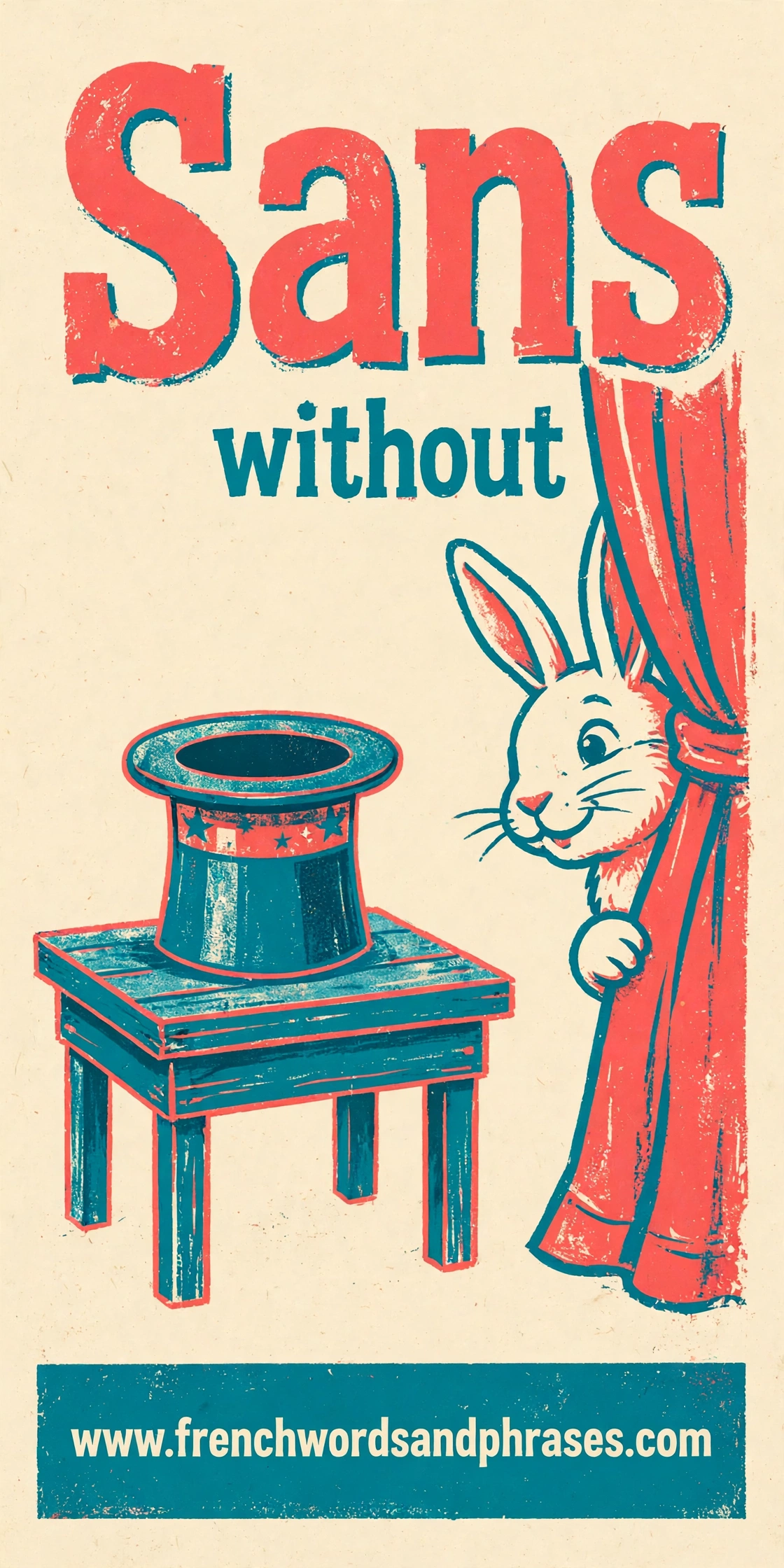
A French Word to Live By
Translate Sans to English
/sɑ̃/
Sans means without.
A waiter places a steaming cup on the table and smiles at the note on the tray: « un café sans sucre, s’il vous plaît » — a coffee without sugar, please. Sans is the French word for the empty place at the table: the thing that is not there, the helper that never came, the mistake that was never made.
Let’s explore how sans works in French, beginning with the whole word on one card.
Understanding the French Preposition Sans
Sans is a French preposition of absence — the exact opposite of avec (with). It says something is missing, and it is also the word French uses for “without doing”: sans parler, without speaking; sans le savoir, without knowing.
It means without. The picture it paints is a hole: coffee with no sugar, a letter with no stamp, a day with no rain. Sans points at what should be there and is not — which is why it pairs so naturally with a verb in the infinitive when the missing thing is an action.
Type: Preposition — absence
Answers the question: Avec quoi ? / Comment ? — With what? / How? (Answer: with nothing, or no action)
What follows it: A noun (usually with no article: sans sucre) or an infinitive (sans parler)
Watch the pair: sans (without) vs avec (with) — sans toi, with no you beside me; avec toi, with you
One important usage detail: sans usually drops the article from its noun — sans sucre, sans chapeau, sans argent (without sugar, without a hat, without money). Keep the article only when the thing is specific: sans le sucre du café (without the sugar of the coffee), sans les clés (without the keys).
Experience the Word
Sans is the preposition of the missing piece — the puzzle with one square gone, and the shape of the gap is the whole story.
Imagine a picnic basket packed for six friends and one of them cycles off sans son chapeau, sans son téléphone, sans le moindre souci — without his hat, without his phone, without the slightest worry.
You have not just said what is absent. You have shown how much room a little emptiness leaves behind.
How to Use Sans in French: Complete Guide
Let’s explore how sans works in French, beginning with the whole word on one card.
Sans at a Glance
The Whole Word on One Card
Meaning, job, pattern and pair — sans in four lines.
| Point | Sans |
|---|---|
| Meaning | without |
| Job | names what is missing — a thing, a person or an action |
| What follows | a noun with no article, or an infinitive — sans sucre, sans parler |
| Its opposite | avec — with |
Example
Elle sort sans son manteau.
She is going out without her coat.
The Pattern in Action: The Missing Thing
Sans links a sentence to the thing that is not in it — or to the action that never happens.
| Pattern | Example |
|---|---|
| sans + noun, no article | un café sans sucre — a coffee without sugar |
| sans + a person | il vit sans sa famille — he lives without his family |
| sans + infinitive (no action) | elle part sans dire au revoir — she leaves without saying goodbye |
| sans + a thing (specific) | il est venu sans les clés — he came without the keys |
Example
Ils ont mangé sans faire de bruit.
They ate without making a noise.
Quick Quiz 1
In un café sans sucre, why is there no article before sucre?
Reveal the answer
Sans usually drops the article — the missing thing is general, not a specific one.
Un café sans sucre, s’il vous plaît.
A coffee without sugar, please.
The Tricky Bit: Sans + Infinitive and Sans + Noun
Sans has two shapes — one for a missing thing, one for a missing action — and each has its own rule.
| Pattern | How it works |
|---|---|
| sans + noun (general) | no article: sans argent, sans peur — without money, without fear |
| sans + noun (specific) | keep the article when the thing is known: sans le passeport — without the passport |
| sans + infinitive | the missing action takes an infinitive, same subject: partir sans manger — to leave without eating |
| sans que + subjunctive | a new subject needs sans que: partir sans que tu le saches — to leave without you knowing |
Example
Il a réussi sans tricher et sans que personne le remarque.
He succeeded without cheating and without anyone noticing.
Where It Goes: Directly Before the Absent Thing
Sans is small and sticky — it hugs the noun or verb it empties, wherever the sentence needs it.
| Position / pattern | Example |
|---|---|
| after the noun it describes | une lettre sans adresse — a letter without an address |
| after the main verb | elle lit sans ses lunettes — she reads without her glasses |
| opening a phrase | sans hésitation, il a accepté — without hesitation, he accepted |
| sans toi / sans moi | with pronouns: sans toi, je suis perdu — without you, I am lost |
Example
Sans lunettes, elle ne peut pas lire les panneaux.
Without glasses, she cannot read the signs.
Quick Quiz 2
“Without knowing” — sans le savoir or sans que je sache? What is the difference?
Reveal the answer
Both work — sans le savoir is the simple infinitive form; sans que + subjunctive is used when the subject changes.
Il est parti sans le savoir.
He left without knowing.
Everyday Expressions with Sans
Sans seasons everyday French — from manners to recipes to the end of the world.
| Expression | In English |
|---|---|
| sans doute | probably, no doubt |
| sans hésitation | without hesitation |
| sans sucre | without sugar |
| sans problème | no problem |
| sans blague | no joke, seriously |
Example
Sans blague, il a gagné au loto !
No joke, he won the lottery!
Close Cousins: Sans, Sans Que, Non, Faute De
Four ways to say no in French — each guards a different kind of absence.
| Word | The difference |
|---|---|
| sans | the working preposition: without a thing or an action — sans argent |
| sans que | without + a clause and a new subject, subjunctive: sans que tu saches |
| non | the plain no: non, merci — no, thank you |
| faute de | for lack of: faute de temps — for lack of time, a formal cousin |
Example
Faute de place, nous avons mangé sans chaise, sans que personne se plaigne.
For lack of space, we ate without chairs, without anyone complaining.
Quick Quiz 3
Which cousin means “for lack of time” — sans or faute de?
Reveal the answer
faute de — faute de temps is the formal phrase for a lack of something.
Faute de temps, il a pris le bus.
For lack of time, he took the bus.
Sans and Its Neighbours
The with-and-without shelf: the words that add things and take them away.
| French | In English |
|---|---|
| avec | with |
| sans | without |
| contre | against |
| malgré | despite |
| chez | at (someone’s house) |
Example
Avec ou sans sucre ? Sans, merci.
With or without sugar? Without, thanks.
Watch Out: The Traps Around Sans
The traps: a smuggled-in article, an English -ing, and the missing subjunctive after sans que.
| Trap | The truth |
|---|---|
| adding an article: ‘sans un sucre’ | general nouns after sans take no article: sans sucre |
| translating ‘without + -ing’ with a participle | French wants the infinitive: sans parler, not sans parlant |
| using the indicative after sans que | sans que demands the subjunctive: sans que tu le saches |
| confusing sans with son / cent | sans (without) vs son (his / its / sound) vs cent (a hundred) — all sound alike in speech |
Example
Elle est sortie sans manteau, sans parapluie et sans que je le remarque.
She went out without a coat, without an umbrella, and without me noticing.
Quick Quiz 4
Complete: Il boit son thé ______ sucre. (He drinks his tea without sugar.)
Reveal the answer
sans — and no article before sucre.
Il boit son thé sans sucre.
He drinks his tea without sugar.
Sans in Everyday French: Real-Life Examples
Now that you know the word, let’s see how sans appears in everyday French.
Example Example 1 — Coffee
Je voudrais un café sans sucre, s’il vous plaît.
I would like a coffee without sugar, please.
Example Example 2 — A trip
Elle voyage sans bagages, juste avec un sac à dos.
She travels without luggage, just with a backpack.
Example Example 3 — An action
Il est parti sans fermer la porte.
He left without closing the door.
Example Example 4 — A friend
Sans toi, je n’aurais jamais réussi.
Without you, I would never have succeeded.
Example Example 5 — Manners
Sans blague, c’est vraiment ton père ?
Seriously, that is really your father?
Example Example 6 — A problem
Sans problème, je t’aiderai demain.
No problem, I will help you tomorrow.
Beyond Translation: The Meaning of Sans
English says “without” and moves on; French sans pauses a little longer on the gap. Sans toi, sans toit, sans foi ni loi — without you, without a roof, without faith or law: the word rings in songs and in proverbs (les Sans-Culottes were once the trouser-less revolutionaries of 1789).
To say sans is to give absence a shape and a name.
And there is comfort in it too: sans problème — no problem — is the answer French gives when it wants to say that nothing is missing after all.
How to Remember the French Preposition Sans
Remember it this way: Remember it this way: Sans is the empty-chair word — it names what is missing, and usually leaves the article behind with it.
- You drop the article — sans sucre, sans argent, sans peur, with no un, no le, no les.
- You reach for the infinitive — missing actions are sans parler, sans manger, never sans parlant.
- You change the subject with sans que — and the verb then goes to the subjunctive: sans que tu saches.
The key idea is sans means without — no article on general nouns, the infinitive for missing actions, and sans que plus the subjunctive when the subject changes.
Test Your Knowledge of Sans
Let’s see how much you’ve learned. Try answering these questions before revealing the answers.
Question 1
What does sans mean?
Reveal the answer
Without — the opposite of avec; it names a missing thing, person or action.
Question 2
Why is there no article in sans sucre?
Reveal the answer
Sans usually drops the article on general nouns — the sugar is not a specific one.
Question 3
Translate: She left without saying goodbye.
Reveal the answer
Elle est partie sans dire au revoir.
Question 4
What form follows sans when the missing thing is an action?
Reveal the answer
The infinitive — sans manger, sans parler, sans fermer.
Question 5
Complete the sentence:
Je bois mon thé ______ sucre. (I drink my tea without sugar.)
Reveal the answer
sans
Je bois mon thé sans sucre.
I drink my tea without sugar.
Your Final Challenge
Can You Use It?
How would you say this in French?
“How would you say this in French?”
Reveal the answer
Un café sans sucre, s’il vous plaît.
A coffee without sugar, please.
A little French. A little curiosity. A richer everyday life.
LEARN FRENCH ONE WORD AT A TIME