A French Word to Live By
Translate Près de to English
/pʁɛ də/
Près de means near (to).
The cottage stands at the end of a sandy lane, close enough to the water that the gulls wake its guests before the alarm clock does. « Notre maison est près de la mer ; on entend les vagues la nuit. » Our house is near the sea; you can hear the waves at night. Près de measures that happy distance — not on top of the thing, not far from it, just close enough to feel it.
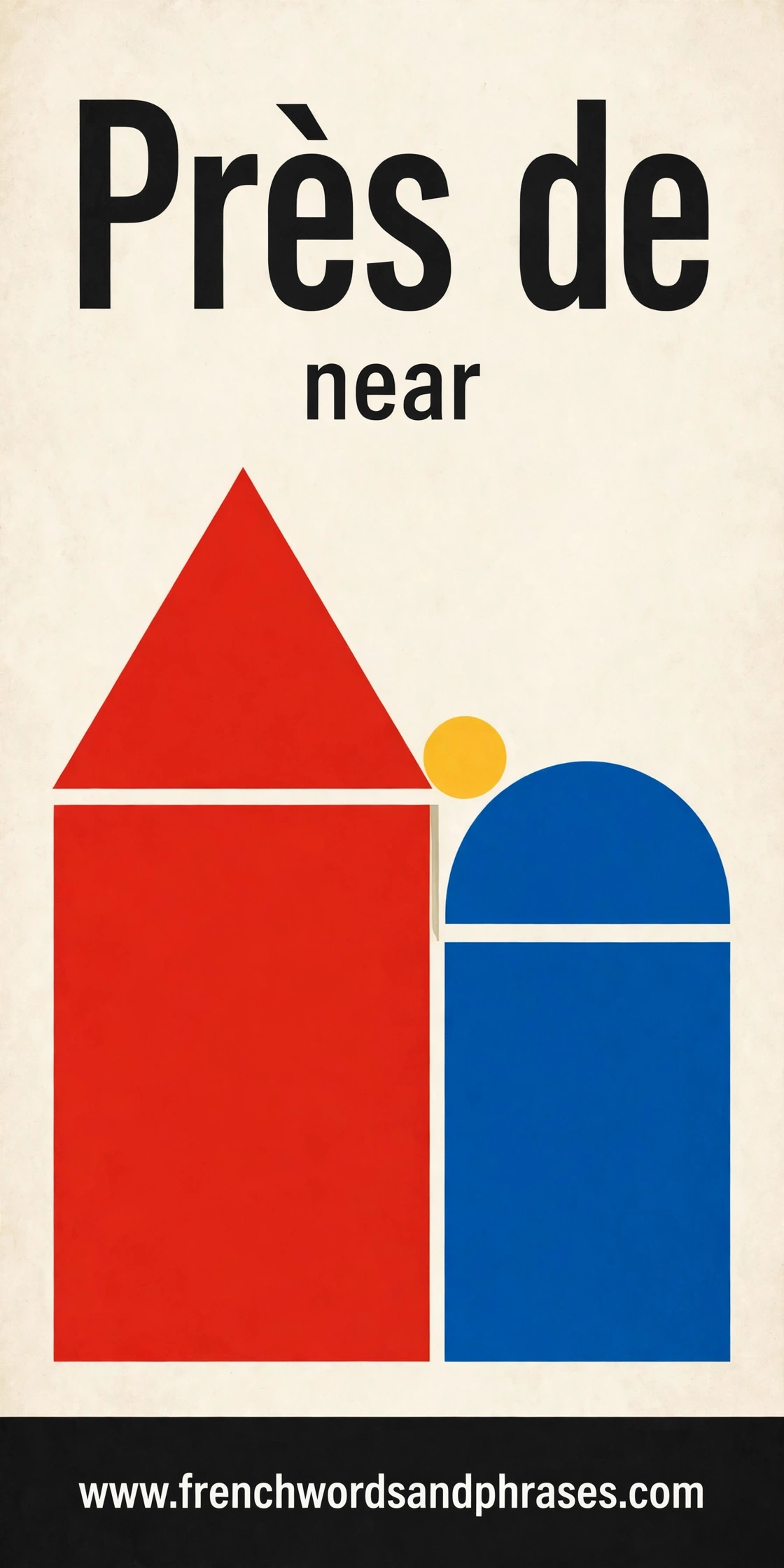
Let’s explore how près de works in French, beginning with the whole phrase on one card.
Understanding the French Preposition Près de
Près de is a French compound preposition of place — près (near, close) + de. It measures a short distance between two things, and it does a second job with numbers, where it softens into nearly or almost. Près itself never changes form: no agreement, no plural, ever.
It means near or close to. Physically, it is the short walk: près de la fenêtre (near the window), près de chez moi (near my house). In time, it approaches an hour: près de minuit (near midnight). And before a number it stops measuring distance at all: près de cent personnes — nearly a hundred people.
Type: Compound preposition — place (short distance); also quantity with numbers
Answers the question: Où ? / À quelle distance ? — Where? / How far? (Answer: a short distance away)
What follows it: A noun or pronoun — and de contracts: près du parc, près des écoles
Watch the pair: près de (distance, never changes) vs proche (adjective, agrees: une gare proche, des amis proches)
One important usage detail: être près de + infinitive means to be about to do something — il est près de partir (he is about to leave). Do not confuse it with être prêt à + infinitive, ready to leave: près is the clock, prêt is the suitcase.
Experience the Word
Près de is the preposition of the short walk home — close enough to hear the sea, see the lights, smell the bread.
Imagine a village bench près de la fontaine, where the same neighbours gather every evening: not in the square exactly, not away from it either — in that warm margin where village life actually happens.
You have not just measured a distance. You have said: close enough to matter.
How to Use Près de in French: Complete Guide
Let’s explore how près de works in French, beginning with the whole phrase on one card.
Près de at a Glance
The Whole Phrase on One Card
Meaning, job, pattern and pair — près de in four lines.
| Point | Près de |
|---|---|
| Meaning | near / close to; with numbers: nearly, almost |
| Job | measures a short distance — in space, time or quantity |
| What follows | a noun or pronoun — de contracts to du / des |
| Its opposite | loin de — far from |
Example
Elle habite près de la plage.
She lives near the beach.
The Pattern in Action: A Short Distance, Three Ways
Près de connects a thing to its landmark — across a street, across an hour, across a count.
| Pattern | Example |
|---|---|
| space | le café est près de la gare — the café is near the station |
| home territory | près de chez moi, il y a un marché — near my house, there is a market |
| time | près de minuit, le village dort — near midnight, the village sleeps |
| quantity | près de deux cents personnes — nearly two hundred people |
Example
Le banc est près de la fontaine.
The bench is near the fountain.
Quick Quiz 1
“Près de mille euros” — is the distance physical here?
Reveal the answer
No — before a number, près de means nearly, almost.
Près de mille euros.
Nearly a thousand euros.
The Tricky Bit: Près de vs Proche, and the Number Trick
Près de has a twin adjective, proche, and a secret life with numbers — here is the whole family business.
| Form | The difference |
|---|---|
| près de + noun | distance, fixed form: près de la gare, près du village — never changes |
| proche (adjective) | agrees with its noun: une école proche, des magasins proches |
| proche de quelqu’un | emotionally close: elle est proche de sa mère — she is close to her mother |
| près de + number | nearly, almost: près de trois heures — nearly three hours |
| près de + infinitive | about to: il est près de partir — he is about to leave |
Example
Une école proche, tout près de la mairie, accueille près de trois cents élèves.
A nearby school, very close to the town hall, welcomes nearly three hundred pupils.
Where It Goes: Before the Landmark, With Its Contractions
Près de stands in front of its landmark — and its de contracts like every other de in French.
| Position / pattern | Example |
|---|---|
| before a noun | près de la fenêtre, près de la mer — near the window, near the sea |
| de + le contracts to du | près du parc — near the park |
| de + les contracts to des | près des écoles — near the schools |
| standing alone (adverb près) | il habite tout près — he lives very nearby |
Example
Le chat dort près du feu.
The cat is sleeping near the fire.
Quick Quiz 2
Which is right for “about to leave”: il est près de partir or il est prêt de partir?
Reveal the answer
près de partir — près de + infinitive means on the point of doing it.
Il est près de partir.
He is about to leave.
Everyday Expressions with Près de
Près de and its family turn up in directions, approximations and village geography.
| Expression | In English |
|---|---|
| tout près | very near, right nearby |
| de près | close up, closely — voir de près, to see close up |
| près de chez moi | near my house, in my neighbourhood |
| à peu près | approximately, more or less — the cousin phrase for guessing numbers |
| près de minuit | near midnight — près de with the clock |
Example
Regarde ce tableau de près, il est magnifique.
Look at this painting close up, it is magnificent.
Close Cousins: The Nearness Family
Four ways to be near — touching distance, a short walk, the general area, and the adjective.
| Word | The difference |
|---|---|
| à côté de | next to — closer still, side by side: à côté de la porte |
| près de | near — a short distance, the everyday choice |
| proche de | close to — the adjective version, agrees with its noun |
| non loin de | not far from — the elegant double negative |
| aux environs de | in the vicinity of — the whole surrounding area |
Example
À côté de la gare, non loin de la plage, un café nous attend.
Next to the station, not far from the beach, a café is waiting for us.
Quick Quiz 3
Which cousin means “next to, side by side” — près de or à côté de?
Reveal the answer
à côté de — it is the closest of the family, shoulder to shoulder.
Le sel est à côté du poivre.
The salt is next to the pepper.
Près de and Its Neighbours
The distance shelf, from shoulder-to-shoulder to far away.
| French | In English |
|---|---|
| à côté de | next to |
| tout près de | very close to |
| près de | near |
| aux alentours de | around, in the area of |
| loin de | far from — the exact opposite |
Example
Près de la maison, mais loin de la ville, le jardin dort.
Near the house, but far from the town, the garden sleeps.
Watch Out: The Traps Around Près de
The traps: the vanishing de, the près/prêt spelling duel, and an agreement that never happens.
| Trap | The truth |
|---|---|
| dropping the de | près de la gare — the de is part of the phrase, never ‘près la gare’ |
| près vs prêt | près de partir = about to leave; prêt à partir = ready to leave — one letter, two meanings |
| making près agree | près never changes: elle est près de la porte, never ‘prèse’ |
| près de for feelings | emotional closeness takes proche: proche de sa famille, close to her family |
Example
Elle est près de la gare et prête à partir.
She is near the station and ready to leave.
Quick Quiz 4
Complete: Elle habite près ______ la plage.
Reveal the answer
de — près is always followed by de before its landmark.
Elle habite près de la plage.
She lives near the beach.
Près de in Everyday French: Real-Life Examples
Now that you know the word, let’s see how près de appears in everyday French.
Example Example 1 — Home
Notre maison est près de la mer.
Our house is near the sea.
Example Example 2 — Town
Il y a une boulangerie près de chez nous.
There is a bakery near our house.
Example Example 3 — Quantity
Près de cent personnes sont venues à la fête.
Nearly a hundred people came to the party.
Example Example 4 — Time
Près de minuit, les rues sont vides.
Near midnight, the streets are empty.
Example Example 5 — Work
Son bureau est près de la fenêtre.
His desk is near the window.
Example Example 6 — About to
Attention, le train est près de partir !
Careful, the train is about to leave!
Beyond Translation: The Meaning of Près de
French près de comes from a Latin word for squeezed, pressed close — and the feeling survives in it: près de is not cold geometry, it is closeness with warmth in it, near enough to hear the waves and smell the bread. Then, with a shrug, the same phrase turns approximator: près de mille euros is not a distance at all, just a number wearing a soft edge.
To say près de is to say: close enough to count, in every sense.
And its eternal duel with prêt — one letter apart, about-to versus ready — is French spelling’s smallest drama, played out at every station platform in the country.
How to Remember the French Preposition Près de
Remember it this way: Remember it this way: Près de is the short-walk word — near enough to feel it, and before a number it simply means nearly.
- You keep the de — près de la gare, always; près without de is the adverb, not the preposition.
- You never make it agree — près is près for everyone; agreement is proche’s job.
- You win the spelling duel — près de partir is the clock (about to), prêt à partir is the suitcase (ready).
The key idea is près de means near and, before numbers, nearly; it never agrees, and près de partir means about to leave.
Test Your Knowledge of Près de
Let’s see how much you’ve learned. Try answering these questions before revealing the answers.
Question 1
What does près de mean?
Reveal the answer
Near / close to — and before a number, nearly or almost.
Question 2
What is the opposite of près de?
Reveal the answer
Loin de — far from. Près and loin are the two ends of the distance scale.
Question 3
Translate: She lives near the beach.
Reveal the answer
Elle habite près de la plage.
Question 4
Près de partir or prêt à partir for ‘ready to leave’?
Reveal the answer
Prêt à partir — prêt means ready; près de partir means about to leave.
Question 5
Complete the sentence:
Le café est ______ ______ la gare. (near the station)
Reveal the answer
près de
Le café est près de la gare.
The café is near the station.
Your Final Challenge
Can You Use It?
How would you say this in French?
“How would you say this in French?”
Reveal the answer
Notre maison est près de la mer.
Our house is near the sea.
A little French. A little curiosity. A richer everyday life.
LEARN FRENCH ONE WORD AT A TIME