
A French Word to Live By
Translate Quoi que to English
/kwa kə/
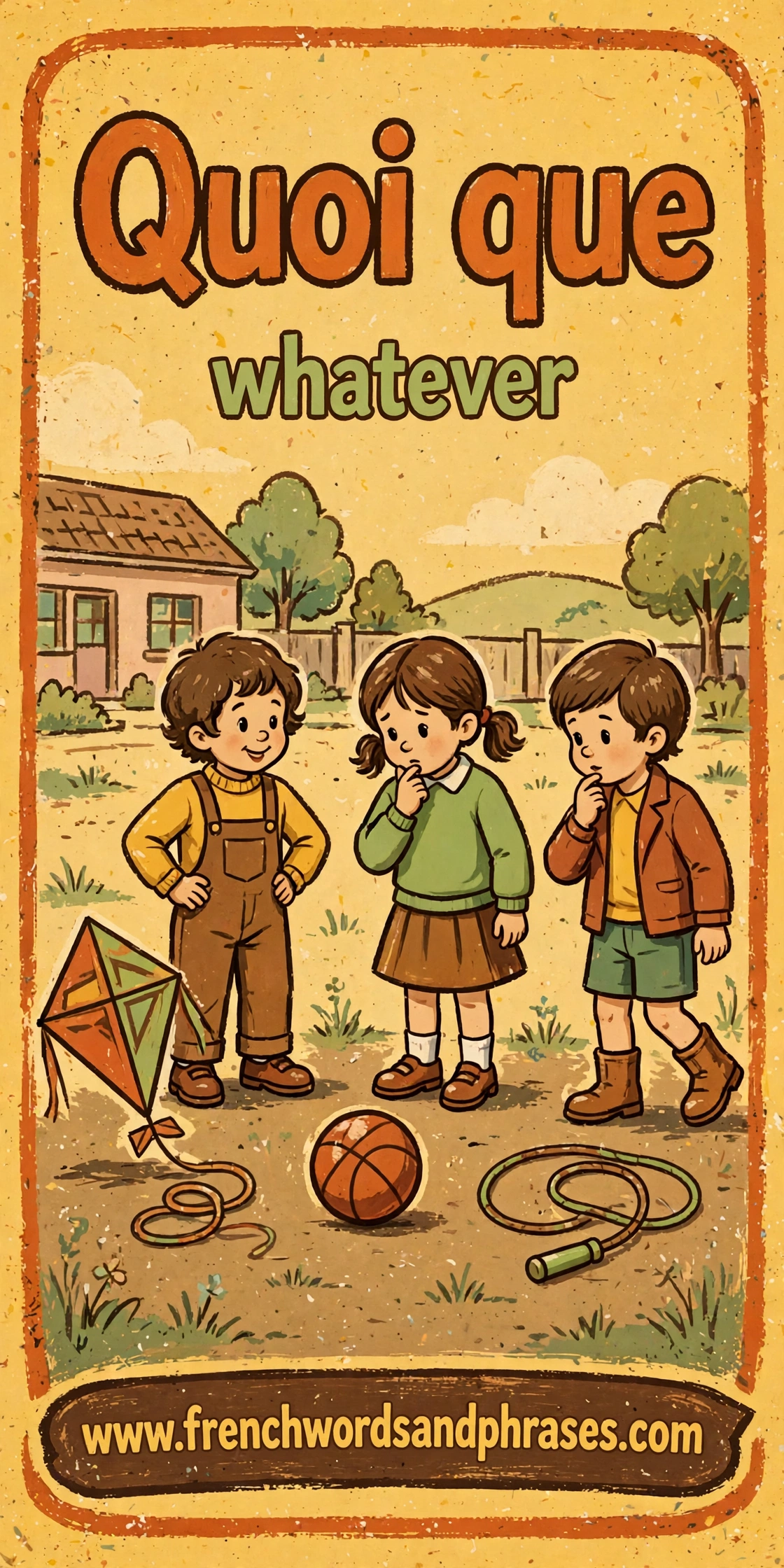
Quoi que means whatever.
A young carpenter shows her master the crooked stool, the split plank, the whole morning’s disasters. He turns the stool over once, nods slowly: « Quoi qu’il arrive dans cet atelier, on répare. » Whatever happens in this workshop, we fix it. Two words, written in two pieces — and woe betide the learner who glues them into one.
In this guide, you’ll learn what quoi que means in English, how it opens a sentence to every possible thing, why the verb after it is always in the subjunctive, and — the great spelling trap — how it differs from quoique, ‘although’, written as one word. Explore French examples, English translations, and practice quizzes.
Understanding the French Conjunction Quoi que
Quoi que is a French subordinating conjunction of indefinite thing — the concessive ‘whatever’. Written as TWO words, it means whatever, no matter what, and the action in its clause can be anything at all.
It means whatever. After quoi que comes a complete clause in the subjunctive, usually with its verb early: quoi que tu fasses, je te soutiendrai — whatever you do, I will support you. Keep it apart from quoique, one word, which means although.
Type: Subordinating conjunction — indefinite thing (concession)
Answers the question: Quoi ? — What? (Answer: anything at all)
What follows it: A full clause: subject + verb
Mood after it: Subjunctive — always
One spelling detail that changes everything: quoi que (two words) = whatever; quoique (one word) = although. Quoi qu’il fasse — whatever he does. Quoiqu’il soit tard — although it is late. The space is the whole difference.
Experience the Word
Quoi que is the conjunction of unconditional support — the word that signs the blank cheque.
Imagine a father at the station, his daughter leaving for her first job abroad: « quoi qu’il arrive, téléphone-moi, je viendrai » — whatever happens, call me, I’ll come.
You have not predicted a single event. You have promised for all of them.
How to Use Quoi que in French: Complete Guide
Let’s explore how quoi que works in French, beginning with the whole word on one card.
Quoi que at a Glance
Before the details, here is the whole word on one card.
The Whole Word on One Card
Meaning, job, pattern and mood — quoi que in four lines.
| Point | Quoi que |
|---|---|
| Meaning | whatever — no matter what |
| Job | opens a clause to every possible thing or action |
| What follows | a full clause — subject + verb |
| Mood | subjunctive, always |
Example
Quoi que tu fasses, je te soutiendrai.
Whatever you do, I’ll support you.
How Quoi que Links: Any Action First, the Promise After
Quoi que leads the sentence with an action left completely open; the main clause then states what holds true regardless of which action it turns out to be.
| Pattern | Example |
|---|---|
| quoi que + clause, + main clause | quoi que tu fasses, je te soutiendrai — whatever you do, I’ll support you |
| with dire | quoi qu’il dise, ne le crois pas trop vite — whatever he says, don’t believe him too quickly |
| with arriver | quoi qu’il arrive, restons calmes — whatever happens, let’s stay calm |
| strengthened with ce soit | quoi que ce soit, achète-le si tu l’aimes — whatever it is, buy it if you love it |
Example
Quoi que vous décidiez, nous suivrons.
Whatever you decide, we’ll follow.
Quick Quiz 1
Quoi que — one word or two?
Reveal the answer
Two words — quoi que means ‘whatever’. One word, quoique, means ‘although’.
Quoi qu’il fasse.
Whatever he does.
The Mood Question: Always the Subjunctive
The action after quoi que is unspecified — any action, every action — so French keeps the verb in the subjunctive. Faire and dire, the two busiest verbs here, are irregular: learn them first.
| Verb | Subjunctive forms after quoi que |
|---|---|
| faire (to do) | que je fasse, que tu fasses, qu’il fasse — quoi que tu fasses |
| dire (to say) | qu’il dise, que vous disiez — quoi qu’il dise |
| arriver (to happen) | qu’il arrive — quoi qu’il arrive (the form looks indicative; it is subjunctive) |
| pouvoir (to be able) | que je puisse — quoi que je puisse faire pour toi |
Example
Quoi qu’elle fasse ce week-end, elle passera nous voir.
Whatever she does this weekend, she’ll come by to see us.
Where Quoi que Goes: Sentence Opener, Verb Close Behind
Quoi que stands at the front, and its verb usually follows immediately — the thing itself is the verb’s action. A comma closes the clause; qu’ elides before a vowel, which is nearly always.
| Position | Example |
|---|---|
| Start of the sentence | quoi qu’il arrive, nous partirons — whatever happens, we’ll leave |
| Verb right after | quoi que tu dises, quoi que tu penses — the action comes at once |
| Elision before a vowel | quoi qu’il fasse — que becomes qu’ |
| After the main clause | je serai là, quoi qu’il arrive — I’ll be there, whatever happens |
Example
Quoi que ce soit, nous trouverons une solution.
Whatever it is, we’ll find a solution.
Quick Quiz 2
Fix the mistake: Quoi que tu fais, je t’aiderai.
Reveal the answer
Quoi que tu fasses, je t’aiderai — faire must be in the subjunctive after quoi que.
Whatever you do, I’ll help you.
Everyday Expressions with Quoi que
Quoi que lives in promises, warnings and the great shrug of acceptance — sentences that cover every outcome at once.
| Expression | In English |
|---|---|
| quoi qu’il arrive | whatever happens |
| quoi que tu en penses | whatever you think of it |
| quoi que ce soit | whatever it may be / anything at all |
| quoi qu’il en coûte | whatever it costs |
| quoi que tu dises | whatever you say |
Example
Quoi qu’il en coûte, nous finirons ce toit avant l’hiver.
Whatever it costs, we’ll finish this roof before winter.
Close Cousins: Quoique, Peu importe ce que, N’importe quoi
One cousin differs by a single space, another by a whole construction — this table is the one to learn by heart.
| Word | The difference |
|---|---|
| quoi que | ‘whatever’ (two words) + subjunctive: quoi que tu fasses |
| quoique | ‘although’ (one word) + subjunctive: quoiqu’il soit tard — it concedes one real fact |
| peu importe ce que | ‘no matter what…’ — ce que is a relative, indicative: peu importe ce que tu fais |
| n’importe quoi | ‘anything at all’ — a pronoun phrase, no clause: il ferait n’importe quoi pour toi |
Example
Quoiqu’il soit tard, quoi que tu fasses ce soir, dors un peu.
Although it’s late, whatever you do tonight, get some sleep.
Quick Quiz 3
‘Although he’s tired’ — quoi que or quoique?
Reveal the answer
quoique — one word, because it means ‘although’ and concedes one real fact.
Quoiqu’il soit fatigué, il continue.
Although he’s tired, he carries on.
Quoi que and Its Neighbours
Around quoi que, the rest of the ‘any-thing’ family — and the precise, single thing that stands opposite them all.
| French | In English |
|---|---|
| peu importe que | no matter that (+ clause, subjunctive) |
| tout ce que | everything that (relative, indicative) |
| n’importe quoi | anything at all |
| quel que soit le problème | whatever the problem may be |
| cette chose précise | this specific thing — the opposite idea |
Example
Tout ce que tu fais est bien fait ; quoi que tu entreprennes, je te suis.
Everything you do is well done; whatever you undertake, I’m with you.
Watch Out: The Traps Around Quoi que
One trap towers over the others — the missing space — but the indicative and the infinitive lie in wait too.
| Trap | The truth |
|---|---|
| writing quoique for quoi que | the classic error: ‘whatever’ is two words (quoi que tu fasses); ‘although’ is one (quoiqu’il pleuve) |
| quoi que + indicative | never: quoi que tu fais is wrong — say quoi que tu fasses |
| quoi que + infinitive | quoi que needs a clause with a subject: quoi que tu décides, not quoi que décider |
| quoi que with a noun | for ‘whatever + noun’ use quel que soit: quel que soit ton choix |
Example
Quel que soit ton choix, quoi que tu décides ensuite, je serai là.
Whatever your choice, whatever you decide next, I’ll be there.
Quick Quiz 4
Complete: Quoi qu’il ____ (arriver), ne panique pas.
Reveal the answer
arrive — the subjunctive of arriver, identical in form to the indicative here.
Quoi qu’il arrive, ne panique pas.
Whatever happens, don’t panic.
Quoi que in Everyday French: Real-Life Examples
Now that you know the word, let’s see how quoi que appears in everyday French.
Example 1 — A promise
Quoi que tu fasses dans la vie, sois honnête.
Whatever you do in life, be honest.
Example 2 — Weather-proof
Quoi qu’il arrive samedi, le concert aura lieu.
Whatever happens on Saturday, the concert will go ahead.
Example 3 — Advice
Quoi que le vendeur dise, compare les prix.
Whatever the salesman says, compare the prices.
Example 4 — Family
Quoi que les enfants choisissent, nous les soutiendrons.
Whatever the children choose, we’ll support them.
Example 5 — Work
Quoi que ce soit, ce dossier peut attendre demain.
Whatever it is, this file can wait until tomorrow.
Example 6 — Courage
Quoi qu’il en coûte, elle dira la vérité.
Whatever it costs, she will tell the truth.
Beyond Translation: The Meaning of Quoi que
English says whatever for the meaning of quoi que — and French splits the word open to show the machinery: quoi, what, held apart from que by a space you can lose a mark over.
That little space is a whole philosophy: quoi que leaves the ‘what’ free, unattached, ready to be anything.
Glue the words together and the freedom vanishes — quoique pins one real fact down and concedes it. Keep them apart, and the sentence promises in advance for events nobody has imagined yet.
How to Remember the French Conjunction Quoi que
Remember it this way: Quoi que is the blank-cheque word — any action at all, covered in advance, in two separate words.
- You write it in TWO words — quoi que whatever; one word, quoique, is ‘although’.
- You always reach for the subjunctive — quoi que tu fasses, quoi qu’il dise.
- You picture the blank cheque — the promise is signed before the action is even named.
The key idea is quoi que means whatever, is written in two words, and always takes the subjunctive.
Test Your Knowledge of Quoi que
Let’s see how much you’ve learned. Try answering these questions before revealing the answers.
Question 1
What does quoi que mean?
Reveal the answer
Whatever — no matter what; any action at all.
Question 2
Which mood follows quoi que?
Reveal the answer
The subjunctive — always: quoi que tu fasses.
Question 3
Translate: Whatever happens, stay calm.
Reveal the answer
Quoi qu’il arrive, reste calme.
Question 4
What is the difference between quoi que and quoique?
Reveal the answer
quoi que (two words) means ‘whatever’; quoique (one word) means ‘although’. Both take the subjunctive.
Question 5
Complete the sentence:
Quoi que vous ______ (dire), je vous écouterai.
Reveal the answer
disiez
Quoi que vous disiez, je vous écouterai.
Whatever you say, I will listen to you.
Your Final Challenge
Can You Use It?
How would you say this in French?
“Whatever happens, stay calm.”
Reveal the answer
Quoi qu’il arrive, reste calme.
Whatever happens, stay calm.
A little French. A little curiosity. A richer everyday life.
LEARN FRENCH ONE WORD AT A TIME




