A French Word to Live By
Translate Voilà to English
/vwa.la/
Voilà means there it is.
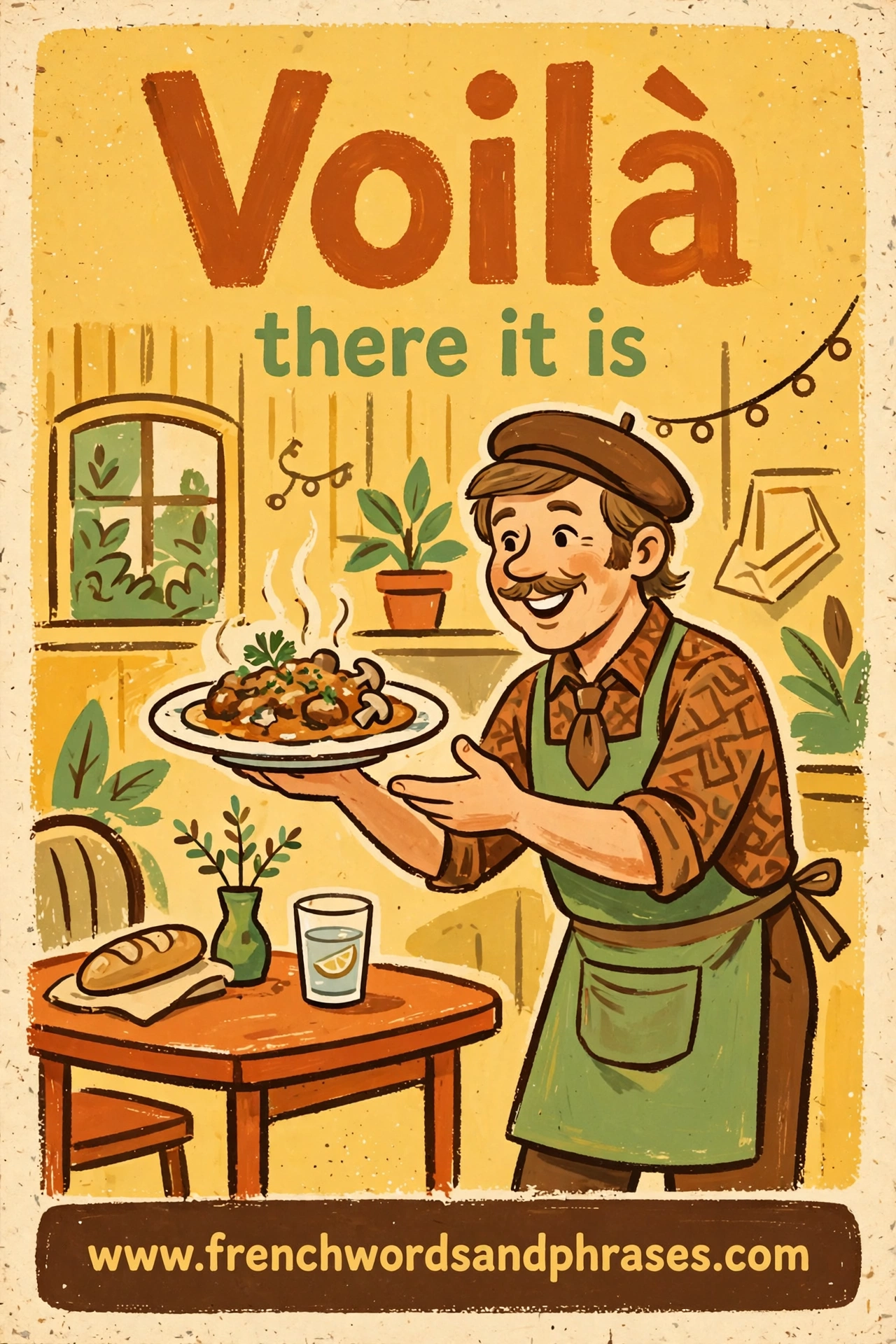
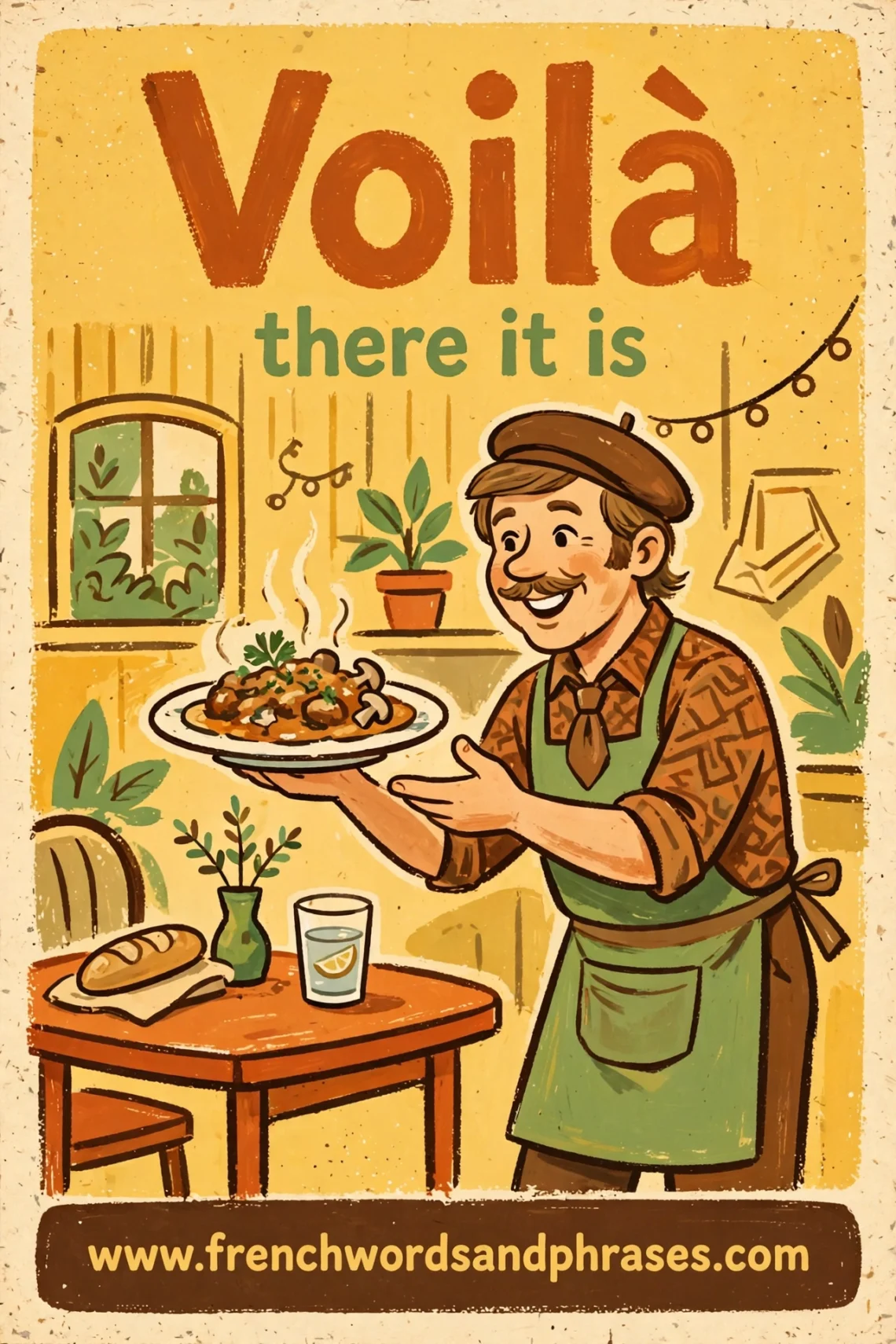
The waiter weaves through the café, tray high, and sets the plate down with a small flourish: « Voilà, monsieur ! » There it is. In France, things do not simply arrive — they are presented, with voilà holding the curtain.
In this guide, you’ll learn what voilà means in English, how it presents people and things, how it builds time expressions with que, and how it differs from its twin voici. Explore French examples, English translations, and practice quizzes.
Understanding the French Conjunction Voilà
Voilà is not a conjunction — it is a French presentative, a word whose whole job is to point. It is built from vois (see!) and là (there): literally ‘see there’. It presents something to your eyes or to your attention.
It means there it is, there you are, here is — depending on the moment. Voilà introduces a noun, a pronoun, or a whole scene: voilà le train — there’s the train. It does not join clauses; it unveils them.
Type: Presentative — a pointing word
Built from: vois (see!) + là (there)
What follows it: A noun, a pronoun, or a clause with qui / que
Mood after it: No mood of its own — clauses stay indicative
One important usage detail: voilà que opens a little drama in storytelling — « je marchais tranquillement, et voilà qu’il arrive ! » (I was walking quietly, and then — there he comes!). And a bare « et voilà ! », said with a gesture, means ‘and there you go — done!’
Experience the Word
Voilà is the presentative of the grand reveal — the word French uses to hand the world to you on a tray.
Imagine a magician on a small theatre stage. The scarf flutters, the hands open, empty a second ago and now holding a dove: « Voilà ! » The audience applauds the bird — but they are also applauding the word that presented it.
You have not described a thing. You have pointed, and the thing has appeared.
How to Use Voilà in French: Complete Guide
Let’s explore how voilà works in French, beginning with the whole word on one card.
Voilà at a Glance
Before the details, here is the whole word on one card.
The Whole Word on One Card
Meaning, job, pattern and mood — voilà in four lines.
| Point | Voilà |
|---|---|
| Meaning | there it is, there you are |
| Job | presents or points at a person, thing or fact |
| What follows | a noun, a pronoun, or a clause with qui / que |
| Mood | no mood of its own |
Example
Voilà ton café, bien chaud.
There’s your coffee, nice and hot.
How Voilà Links: It Presents, It Does Not Join
Voilà stands in front of what it presents. Pronouns jump in front of it — me voilà, le voilà — and clauses attach themselves with qui or que.
| Pattern | Example |
|---|---|
| voilà + noun | voilà le bus — there’s the bus |
| pronoun + voilà | me voilà ! — here I am! / le voilà ! — there he is! |
| voilà + noun + qui + clause | voilà le facteur qui arrive — there’s the postman arriving |
| voilà + que + clause (surprise) | et voilà qu’il pleut ! — and then, down comes the rain! |
Example
Les voilà, nos amis, devant la gare.
There they are, our friends, in front of the station.
Quick Quiz 1
« Le voilà ! » — where does the pronoun le go: before or after voilà?
Reveal the answer
Before — pronouns always precede voilà.
Le voilà ! La voilà ! Les voilà !
There he is! There she is! There they are!
The Mood Question: No Mood — but a Famous Time Trick
Voilà takes no subjunctive and triggers nothing. But it hides a treasure: voilà + length of time + que + present tense does the work of the English perfect — ‘it has been … for …’.
| Structure | Meaning |
|---|---|
| voilà + noun | presentation — voilà la réponse, there’s the answer |
| voilà + time + que + present | voilà trois jours qu’il pleut — it has been raining for three days |
| voilà + time + que + past (point in time) | voilà deux ans qu’il est parti — he left two years ago |
| voilà que + clause | indicative — et voilà que tout change, and then everything changes |
Example
Voilà une heure que nous attendons.
We have been waiting for an hour.
Where Voilà Goes: Front of the Stage
Voilà almost always stands first, like a presenter stepping out before the curtain. Alone, with a gesture, it hands things over; at the end of a task, et voilà signs the work off.
| Position | Example |
|---|---|
| Start of the sentence | voilà notre rue — there’s our street |
| Standalone, handing over | — Voilà ! — There you are! (here you go) |
| End of a demonstration | tu tournes, tu pousses… et voilà ! — you turn, you push… and there you go! |
| Before a conclusion | voilà pourquoi je pars — that’s why I am leaving |
Example
Voilà, c’est fini.
There — it’s finished.
Quick Quiz 2
Translate the pattern: « Voilà deux ans que j’apprends le français. » — how long?
Reveal the answer
Two years — voilà + time + que measures duration.
Voilà deux ans que j’apprends le français.
I have been learning French for two years.
Everyday Expressions with Voilà
Voilà is the soundtrack of French service, storytelling and conclusions — you will hear it a hundred times a day.
| Expression | In English |
|---|---|
| et voilà ! | and there you go! / done! |
| voilà tout | that’s all |
| voilà pourquoi | that’s why |
| me voilà ! | here I am! |
| voilà ce que je pense | here is what I think |
Example
Un peu de sel, un peu de poivre… et voilà !
A little salt, a little pepper… and there you go!
Close Cousins: Voilà, Voici, Tiens, Ça y est
Four presenting words — the difference is distance, surprise and whether the job is done.
| Word | The difference |
|---|---|
| voilà | ‘there is/are’ — for what is pointed at, arriving, or just mentioned |
| voici | ‘here is/are’ — for what is near, or about to be presented (voici mon frère) |
| tiens ! | ‘here! take this’ — handing something over; also ‘oh! well!’ in surprise |
| ça y est | ‘that’s it, done’ — the moment a task clicks into place |
Example
Voici ma sœur, et voilà mon frère qui arrive.
Here is my sister, and there’s my brother arriving.
Quick Quiz 3
You hand a friend her umbrella. Which word fits the gesture: voilà or tiens?
Reveal the answer
tiens — tiens is the handing-over word (voilà works too, tiens is the classic).
Tiens, ton parapluie !
Here, your umbrella!
Voilà and Its Neighbours
Presenting and concluding travel together — here are voilà’s neighbours on the shelf.
| French | In English |
|---|---|
| voici | here is / here are |
| tiens | here (take this) / well! |
| ça y est | that’s it, it’s done |
| enfin | finally (when the awaited thing arrives) |
| c’est ça | that’s it, exactly |
Example
Enfin, le voilà — ça y est, nous pouvons partir.
Finally, there he is — that’s it, we can leave.
Watch Out: The Traps Around Voilà
Voilà is generous but particular: it refuses bare verbs, it owns an accent, and it is not a dictionary translation of ‘there is’.
| Trap | The truth |
|---|---|
| voilà + bare verb | a clause needs qui or que: voilà le train qui arrive — never voilà le train arrive |
| voila without the accent | the à keeps its grave accent: voilà |
| voilà for every ‘there is/are’ | for neutral existence, French uses il y a: il y a un problème |
| voici/voilà panic | in modern speech voilà does most jobs; voici survives for presentations and lists — do not sweat the border |
Example
Il y a un train à cinq heures ; le voilà qui entre en gare.
There is a train at five; here it comes into the station.
Quick Quiz 4
« Voilà le train arrive » or « voilà le train qui arrive »?
Reveal the answer
voilà le train qui arrive — the clause needs qui.
Voilà le train qui arrive.
There’s the train arriving.
Voilà in Everyday French: Real-Life Examples
Now that you know the word, let’s see how voilà appears in everyday French.
Example 1 — At the café
Voilà votre thé, madame.
There’s your tea, madam.
Example 2 — Arrival
Me voilà enfin à la maison !
Here I am at home at last!
Example 3 — Spotting
Regarde, voilà Marie qui traverse la place.
Look, there’s Marie crossing the square.
Example 4 — Duration
Voilà six mois que nous habitons ici.
We have been living here for six months.
Example 5 — A demonstration
Tu appuies ici, tu tournes… et voilà !
You press here, you turn… and there you go!
Example 6 — A conclusion
Voilà pourquoi je préfère le train.
That’s why I prefer the train.
Beyond Translation: The Meaning of Voilà
English says there it is for the meaning of voilà — but the French word is an invitation disguised as a statement: vois, see! It does not tell you a thing exists; it asks your eyes to witness it arriving.
Voilà is the smallest theatre in French — one word, and the curtain goes up.
That is why waiters, magicians, grandmothers and tour guides all live on it. To present is a French art form, and voilà is its bow.
How to Remember the French Conjunction Voilà
Remember it this way: Voilà is the pointing word — pronouns before it, qui and que after it, and a stopwatch hidden inside.
- You hear the pointing — vois + là, ‘see there’: voilà presents, it does not join.
- You park pronouns in front — me voilà, le voilà, les voilà.
- You use its stopwatch — voilà deux ans que… means ‘for two years now’.
The key idea is voilà presents — there it is, with pronouns in front.
Test Your Knowledge of Voilà
Let’s see how much you’ve learned. Try answering these questions before revealing the answers.
Question 1
What does voilà mean?
Reveal the answer
There it is / there you are — it presents a person, thing or fact.
Question 2
Where do pronouns go with voilà?
Reveal the answer
Before it — me voilà, le voilà, les voilà.
Question 3
Translate: There’s our bus!
Reveal the answer
Voilà notre bus !
Question 4
How do you say ‘I have been waiting for an hour’ with voilà?
Reveal the answer
Voilà une heure que j’attends — voilà + time + que + present tense.
Question 5
Complete the sentence:
______ le facteur qui arrive.
Reveal the answer
Voilà
Voilà le facteur qui arrive.
There’s the postman arriving.
Your Final Challenge
Can You Use It?
How would you say this in French?
“There’s our bus!”
Reveal the answer
Voilà notre bus !
There’s our bus!
A little French. A little curiosity. A richer everyday life.
LEARN FRENCH ONE WORD AT A TIME