A French Word to Live By
Translate Dès que to English
/dɛ kə/
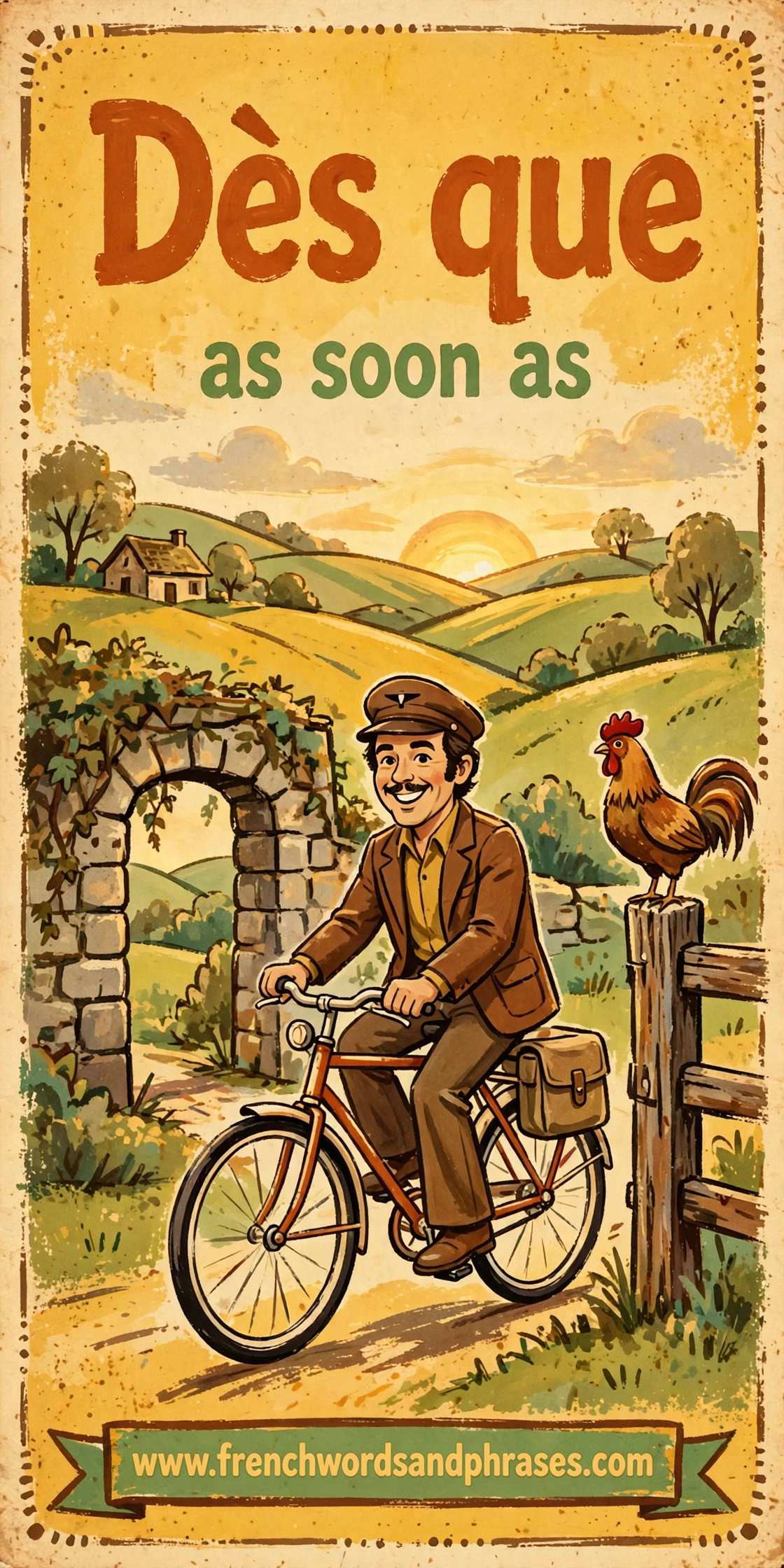
Dès que means as soon as.
Dès que la cloche sonne, les enfants courent dans la cour. Dès que la porte s’ouvre, le chien est déjà dehors. Dès que is the starter’s pistol of French time — no gap, no delay, the second event leaps out of the first like a spark from a flint.
In this guide, you’ll learn what dès que means in English, how it welds two events together with no gap between them, why it takes the indicative — and the famous rule that puts the future tense after it, where English uses the present. Explore French examples, English translations, and practice quizzes.
Understanding the French Conjunction Dès que
Dès que is a French subordinating conjunction of time. It introduces the trigger event: the moment it happens, the main event follows immediately, with no space in between.
It means as soon as. After dès que comes a complete clause with its own subject and verb: dès que tu arrives, nous mangeons — as soon as you arrive, we eat. One event is the spark; the other is the flame.
Type: Subordinating conjunction — time (immediate sequence)
Answers the question: Quand ? — When, exactly?
What follows it: A full clause: subject + verb
Mood after it: Indicative — with the future tense for future events
One important usage detail — the rule English speakers always break: when the main clause looks to the future, the dès que clause takes the future too. Je t’appellerai dès qu’il arrivera — I will call you as soon as he arrives (French literally says ‘as soon as he will arrive’). And before a vowel: dès qu’il.
Experience the Word
Dès que is the conjunction of no waiting — the word of the door that opens and the dog already running.
Imagine a village bakery at dawn: the baker turns the sign, and dès que the smell reaches the street, the first customer is already crossing the square, baguette money in hand. Nothing in the sentence dawdles. The trigger and the response touch each other.
You have not just linked two clauses. You have removed the gap between a moment and its consequence.
How to Use Dès que in French: Complete Guide
Let’s explore how dès que works in French, beginning with the whole word on one card.
Dès que at a Glance
Before the details, here is the whole word on one card.
The Whole Word on One Card
Meaning, job, pattern and mood — dès que in four lines.
| Point | Dès que |
|---|---|
| Meaning | as soon as — the very moment that |
| Job | welds a trigger event to an immediate response |
| What follows | a full clause — subject + verb |
| Mood | indicative, always (future tense for the future) |
Example
Dès qu’il arrive, nous partons.
As soon as he arrives, we leave.
How Dès que Links: The Spark and the Flame
Dès que joins two events in a tight sequence: the clause after it is the trigger, and the main clause fires the instant the trigger is pulled.
| Pattern | Example |
|---|---|
| a habit: trigger + response | dès que le réveil sonne, elle se lève — as soon as the alarm rings, she gets up |
| a finished trigger in the past | dès qu’il a vu la mer, il a souri — as soon as he saw the sea, he smiled |
| a future trigger: future in both clauses | dès que tu arriveras, nous dînerons — as soon as you arrive, we will have dinner |
| a trigger completed first (future perfect) | dès qu’il aura fini, il sortira — as soon as he has finished, he will go out |
Example
Dès que la pluie s’arrête, les enfants sortent jouer.
As soon as the rain stops, the children go out to play.
Quick Quiz 1
What does dès que add that plain quand (when) does not — a reason, or the idea of ‘immediately, no gap’?
Reveal the answer
‘Immediately, no gap’ — dès que is quand with the waiting removed.
Dès que je peux, je viens.
As soon as I can, I come.
The Mood Question: The Indicative — and the Future Rule
Dès que never takes the subjunctive: its events are real points on the timeline. Its one special rule is about tense, not mood — the future of the main clause pulls the future into the dès que clause too.
| Situation | After dès que |
|---|---|
| A habit (present) | dès qu’il rentre, il dîne — as soon as he gets home, he has dinner |
| A past event | dès qu’elle est arrivée, nous avons mangé — as soon as she arrived, we ate |
| A future event | dès qu’elle arrivera, nous mangerons — as soon as she arrives, we will eat |
| Finished before the main event (future perfect) | dès que tu auras fini, tu partiras — as soon as you have finished, you will leave |
Example
Je te téléphonerai dès que je serai à la maison.
I will phone you as soon as I am home.
Where Dès que Goes: The Trigger Leads or Follows
The dès que clause can open the sentence — trigger first, response after, with a comma between them — or follow the main clause, with no comma.
| Position | Example |
|---|---|
| Start of the sentence + comma | dès que le train arrive, nous montons — as soon as the train arrives, we get on |
| After the main clause | nous montons dès que le train arrive — we get on as soon as the train arrives |
| Elision before a vowel | dès qu’il, dès qu’elle — the final -e of que drops |
| The future rule, both ways round | the future tense appears in the dès que clause wherever the clause sits |
Example
Dès que le magasin ouvre, il y a déjà la queue.
As soon as the shop opens, there is already a queue.
Quick Quiz 2
Say it in French: ‘I will write to you as soon as I arrive.’ Does the verb after dès que go in the present or the future?
Reveal the answer
The future — French puts the future in both clauses, where English uses the present.
Je t’écrirai dès que j’arriverai.
I will write to you as soon as I arrive.
Everyday Expressions with Dès que
Dès que is the word of promises, doorbells and first sips of coffee — here are its familiar shapes.
| Expression | In English |
|---|---|
| dès que possible | as soon as possible |
| dès que tu peux | as soon as you can |
| dès qu’il fait beau | as soon as the weather is nice |
| dès que la cloche sonne | as soon as the bell rings |
| dès que j’ai une minute | as soon as I have a minute |
Example
Réponds-moi dès que possible, s’il te plaît.
Answer me as soon as possible, please.
Close Cousins: Dès que, Aussitôt que, Quand, Une fois que
Four ways to pin one event to another. Dès que and aussitôt que are twins; quand is looser; une fois que waits for the finish line.
| Word | The difference |
|---|---|
| dès que | as soon as — the everyday word for an instant sequence |
| aussitôt que | the same meaning, a shade more formal and written |
| quand | when — a point in time, without the ‘no gap’ spark |
| une fois que | once — only after the first event is fully complete: une fois que tu auras lu, tu comprendras |
Example
Aussitôt que le film commence, le silence se fait.
As soon as the film begins, silence falls.
Quick Quiz 3
Which cousin of dès que means the same thing in a slightly more formal style — aussitôt que or avant que?
Reveal the answer
aussitôt que — the same instant sequence, in a more written coat. Avant que means ‘before’ and takes the subjunctive.
Aussitôt qu’il entre, tout le monde se tait.
As soon as he comes in, everyone falls silent.
Dès que and Its Neighbours
Around dès que live the other words of the instant — and its mirror image, the word for ‘before’.
| French | In English |
|---|---|
| aussitôt | immediately (an adverb — no clause) |
| immédiatement | immediately |
| à peine… que | hardly… when (à peine arrivé, il repart — hardly arrived, he leaves again) |
| dès + noun | from, since (dès demain — from tomorrow: a different job) |
| avant que | before (the other edge of the moment, + subjunctive) |
Example
À peine le soleil levé, les oiseaux chantent.
Hardly has the sun risen than the birds sing.
Watch Out: The Traps Around Dès que
One trap is famous above all: the English present tense trying to sneak into a French future. Two more wait behind it.
| Trap | The truth |
|---|---|
| the present after dès que, for the future | the classic error: je viendrai dès que je peux is wrong for a promise — je viendrai dès que je pourrai |
| the subjunctive after dès que | never: its events are real, so the indicative rules |
| dès confused with depuis | dès + a starting point (dès lundi, from Monday); depuis = since/for a duration that continues (depuis lundi, since Monday) |
| dès que + noun | never: it needs a clause — for a noun, dès alone: dès l’aube, from dawn |
Example
Dès que tu seras prêt, nous partirons.
As soon as you are ready, we will leave.
Quick Quiz 4
Spot the error in this promise: nous mangerons dès qu’il arrive.
Reveal the answer
The dès que clause needs the future too: dès qu’il arrivera.
Nous mangerons dès qu’il arrivera.
We will eat as soon as he arrives.
Dès que in Everyday French: Real-Life Examples
Now that you know the word, let’s see how dès que appears in everyday French.
Example 1 — A promise
Je t’appellerai dès que j’arriverai à Paris.
I’ll call you as soon as I arrive in Paris.
Example 2 — When the rain stops
Dès que la pluie s’arrêtera, nous sortirons le chien.
As soon as the rain stops, we’ll take the dog out.
Example 3 — Home at last
Elle se détend dès qu’elle rentre à la maison.
She relaxes as soon as she gets home.
Example 4 — The shop door
Dès que la boulangerie ouvre, les clients entrent.
As soon as the bakery opens, the customers come in.
Example 5 — The baby
Le bébé sourit dès qu’il voit sa mère.
The baby smiles as soon as he sees his mother.
Example 6 — Exam results
Dès que les résultats arriveront, je te les enverrai.
As soon as the results arrive, I’ll send them to you.
Beyond Translation: The Meaning of Dès que
English says as soon as for the meaning of dès que — but the French word hides a small surprise: dès on its own means ‘from, starting at’, the very beginning of something. Dès que does not just follow an event; it stands at the event’s first instant, at its dawn.
French even bends the future tense for this word — the trigger is so certain that it gets conjugated as if it were already on the calendar.
It is the tense of doorbells, of kettles clicking off, of the first croissant of the day: a whole philosophy of promptness packed into two syllables, dɛ-kə.
How to Remember the French Conjunction Dès que
Remember it this way: Dès que is the spark word — picture a flint struck once, and the flame already there.
- You give it a full clause — dès qu’elle arrive, the trigger with its own subject.
- You keep the indicative — and for the future, you use the future in BOTH clauses.
- You feel the gap close — if waiting is allowed, quand is enough; dès que means now.
The key idea is dès que removes the gap between trigger and response — and takes the future for the future.
Test Your Knowledge of Dès que
Let’s see how much you’ve learned. Try answering these questions before revealing the answers.
Question 1
What does dès que mean?
Reveal the answer
As soon as — the very moment that something happens.
Question 2
Which mood follows dès que?
Reveal the answer
The indicative — always. Its events are real points on the timeline.
Question 3
Translate: I’ll call you as soon as I arrive.
Reveal the answer
Je t’appellerai dès que j’arriverai. — the future in both clauses.
Question 4
What is the difference between dès que and quand?
Reveal the answer
Dès que insists on immediacy — no gap between the events. Quand just says ‘when’.
Question 5
Complete the sentence:
Nous partirons ______ tu seras prêt.
Reveal the answer
dès que
Nous partirons dès que tu seras prêt.
We will leave as soon as you are ready.
Your Final Challenge
Can You Use It?
How would you say this in French?
“I’ll call you as soon as I arrive.”
Reveal the answer
Je t’appellerai dès que j’arriverai.
I’ll call you as soon as I arrive.
A little French. A little curiosity. A richer everyday life.
LEARN FRENCH ONE WORD AT A TIME