A French Word to Live By
Translate Alors que to English
/a.lɔʁ kə/
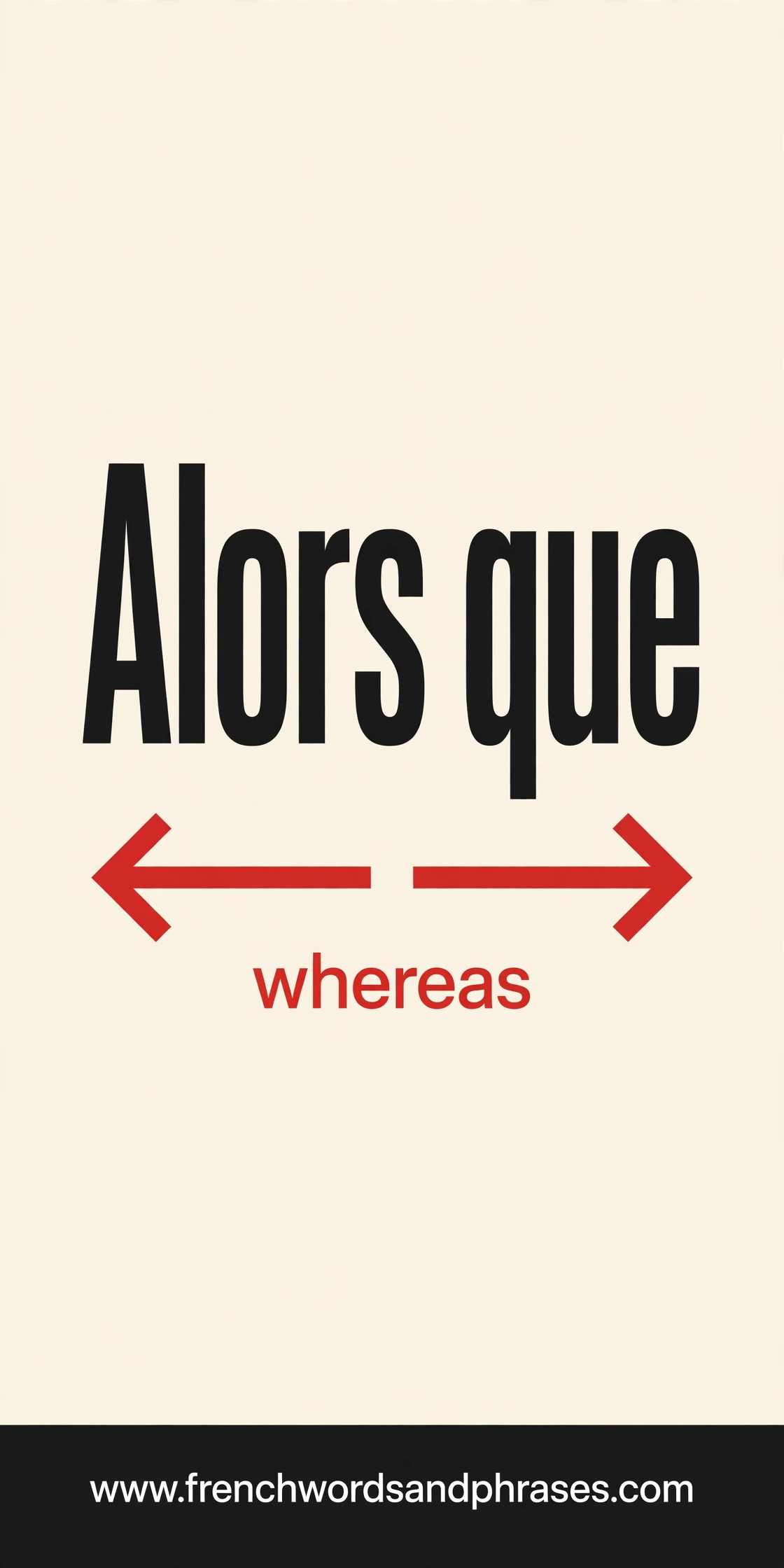
Alors que means whereas.
Le nord se lève tôt, alors que le sud déjeune tard. One sentence, two Frances, held apart by a small hinge of a word. Alors que is the conjunction of the balanced scales — this on one side, that on the other, and you are invited to compare.
In this guide, you’ll learn what alors que means in English, how it contrasts two facts or runs them side by side in time, why the verb after it stays in the indicative, and how it differs from its twin tandis que and from plain alors. Explore French examples, English translations, and practice quizzes.
Understanding the French Conjunction Alors que
Alors que is a French subordinating conjunction with two jobs: contrast — whereas — and simultaneity — while. The contrast is its signature: it sets two facts face to face and lets the difference speak.
It means whereas, or while. After alors que comes a complete clause with its own subject and verb: il aime la ville, alors qu’elle préfère la campagne — he loves the city, whereas she prefers the countryside. The two clauses are equals, weighed against each other.
Type: Subordinating conjunction — contrast and time
Answers the question: What is the other side of the picture?
What follows it: A full clause: subject + verb
Mood after it: Indicative — always
One important usage detail: alors que is not alors. Alors on its own is an adverb meaning so or then — alors, on y va ? The que changes everything: alors que introduces a whole clause and sets it against another. And before a vowel: alors qu’elle.
Experience the Word
Alors que is the conjunction of the two-sided truth — the word that refuses to let one fact stand alone.
Imagine two brothers at the market: one fills his basket with cheese, the other only with fruit. One adores the mountains, the other dreams of the sea. French looks at the pair, smiles, and reaches for alors que — the hinge that lets opposites share a sentence without fighting.
You have not just linked two clauses. You have built a balance and put a fact on each side.
How to Use Alors que in French: Complete Guide
Let’s explore how alors que works in French, beginning with the whole word on one card.
Alors que at a Glance
Before the details, here is the whole word on one card.
The Whole Word on One Card
Meaning, job, pattern and mood — alors que in four lines.
| Point | Alors que |
|---|---|
| Meaning | whereas — and also: while |
| Job | contrasts two facts, or runs them together in time |
| What follows | a full clause — subject + verb |
| Mood | indicative, always |
Example
Il rit alors qu’elle pleure.
He laughs whereas she cries.
How Alors que Links: Two Facts Face to Face
Alors que joins two complete clauses and invites you to compare them. In its contrast job the two sides pull in opposite directions; in its time job they simply happen together.
| Pattern | Example |
|---|---|
| contrast: two opposite tastes | il adore le thé, alors qu’elle ne boit que du café — he loves tea, whereas she drinks only coffee |
| contrast: two opposite facts | le train était vide, alors que le bus était plein — the train was empty, whereas the bus was full |
| time: two actions together | elle téléphonait alors qu’il conduisait — she was phoning while he was driving |
| a surprising contrast | il a réussi alors qu’il n’avait pas étudié — he passed whereas he had not studied |
Example
Tu aimes le bruit, alors que je cherche le calme.
You like noise, whereas I look for calm.
Quick Quiz 1
What is the main job of alors que — giving a reason, or setting two facts against each other?
Reveal the answer
Setting two facts against each other — alors que is the contrast word (it can also mean a simple ‘while’).
Il fait chaud ici, alors qu’il neige là-bas.
It is hot here, whereas it is snowing over there.
The Mood Question: Always the Indicative
Both sides of an alors que sentence are presented as real facts, so the verb stays in the ordinary indicative on both sides of the hinge.
| Tense after alors que | Example |
|---|---|
| Present | alors qu’il fait beau — whereas the weather is nice |
| Imperfect | alors que nous étions enfants — while we were children |
| Passé composé | alors qu’elle a tout préparé — whereas she prepared everything |
| Future | alors que tu seras loin — while you will be far away |
Example
Il travaille le dimanche, alors que ses amis se reposent.
He works on Sundays, whereas his friends rest.
Where Alors que Goes: The Hinge in the Middle
In its contrast job, alors que sits in the middle, exactly on the hinge between the two facts, usually with a comma before it. In its time job it can also open the sentence, followed by a comma.
| Position | Example |
|---|---|
| Middle, with a comma before it | elle est calme, alors que lui est nerveux — she is calm, whereas he is nervous |
| Start of the sentence (time sense) | alors que nous dînions, il a téléphoné — while we were having dinner, he phoned |
| Elision before a vowel | alors qu’il, alors qu’elle — the final -e of que drops |
| Never on its own | alors que cannot answer a question or stand alone like parce que can |
Example
Alors que je fermais la porte, le chat est sorti.
While I was closing the door, the cat slipped out.
Quick Quiz 2
True or false: alors que is followed by the subjunctive when it means ‘whereas’.
Reveal the answer
False — alors que always takes the indicative, in both its jobs.
Il est riche, alors qu’il travaille peu.
He is rich, whereas he works little.
Everyday Expressions with Alors que
Alors que has a few characteristic turns of phrase for pointing out how different — or how unfair — things are.
| Expression | In English |
|---|---|
| alors que moi, je… | whereas me, I… (pointing at yourself, the other side) |
| alors qu’il suffit de… | when all it takes is… / when you only need to… |
| alors que pas du tout ! | when that’s not the case at all! |
| alors même que | even though (a stronger, more literary cousin) |
| et alors que tout allait bien… | and just when everything was going well… |
Example
Alors que moi, je préfère rester à la maison.
Whereas me, I prefer to stay at home.
Close Cousins: Alors que, Tandis que, Pendant que, Mais
The contrast family is crowded. Alors que and tandis que are near-twins; pendant que drops the contrast; mais changes the grammar entirely.
| Word | The difference |
|---|---|
| alors que | whereas / while — everyday contrast, spoken and written |
| tandis que | the same two jobs, a touch more formal and written |
| pendant que | while — pure simultaneity, no contrast promised |
| mais | but — joins two main clauses, no subordinate clause: il est riche mais généreux |
Example
Elle parle beaucoup, tandis que son mari écoute.
She talks a lot, whereas her husband listens.
Quick Quiz 3
Which word is the near-twin of alors que, just a little more formal — tandis que or parce que?
Reveal the answer
tandis que — it does the same two jobs (whereas / while) in a slightly more written style.
Il reste, tandis qu’elle part.
He stays, whereas she leaves.
Alors que and Its Neighbours
Contrast has a whole toolbox in French: here are the words that live next door to alors que.
| French | In English |
|---|---|
| par contre | on the other hand (an adverb phrase — new sentence or clause) |
| en revanche | on the other hand, in return |
| au contraire | on the contrary |
| contrairement à | unlike (+ noun) |
| de la même façon | in the same way (the opposite direction — agreement) |
Example
Il est petit ; par contre, il est très fort.
He is small; on the other hand, he is very strong.
Watch Out: The Traps Around Alors que
The biggest trap is a family resemblance: alors without que is a different word doing a different job.
| Trap | The truth |
|---|---|
| confusing alors and alors que | alors = so, then (adverb); alors que = whereas / while + a full clause |
| the subjunctive after alors que | never: both sides are facts, so the indicative rules |
| alors que + noun | never: it needs a clause — for a noun, contrairement à : contrairement à son frère |
| using alors que for ‘although’ | for a true concession (although + subjunctive), French uses bien que : bien qu’il soit riche |
Example
Alors, on commence ? Le premier travaille, alors que l’autre regarde.
So, shall we start? The first one works, whereas the other watches.
Quick Quiz 4
‘So, let’s go!’ — alors que or plain alors?
Reveal the answer
Plain alors — ‘so / then’ is the adverb, with no que and no clause after it.
Alors, on y va !
So, let’s go!
Alors que in Everyday French: Real-Life Examples
Now that you know the word, let’s see how alors que appears in everyday French.
Example 1 — Weather report
Il pleut dans le nord, alors qu’il fait soleil dans le sud.
It is raining in the north, whereas it is sunny in the south.
Example 2 — Two sisters
Ma sœur adore danser, alors que je préfère lire.
My sister loves dancing, whereas I prefer reading.
Example 3 — City and country
La ville ne dort jamais, alors que le village se couche tôt.
The city never sleeps, whereas the village goes to bed early.
Example 4 — At the market
Les tomates sont chères, alors que les pommes sont bon marché.
The tomatoes are expensive, whereas the apples are cheap.
Example 5 — Two colleagues
Il arrive toujours en retard, alors qu’elle est là à huit heures.
He always arrives late, whereas she is there at eight.
Example 6 — An interruption
Alors que nous regardions le film, quelqu’un a frappé à la porte.
While we were watching the film, someone knocked at the door.
Beyond Translation: The Meaning of Alors que
English says whereas for the main meaning of alors que — a slightly legal, courtroom word in English, but an everyday word in French. Alors que carries its history openly: alors, ‘at that time’, plus que — the word began by comparing moments and grew into comparing everything.
To use alors que is to be fair to both sides of a story — each fact gets its own clause, its own subject, its own verb.
French conversation loves the balance: le thé alors que le café, Paris alors que la province. The hinge word lets a whole culture argue gently, one balanced sentence at a time.
How to Remember the French Conjunction Alors que
Remember it this way: Alors que is the balance word — picture old-fashioned scales, a fact on each pan, the word itself as the beam.
- You give both sides a full clause — il rit, alors qu’elle pleure.
- You keep the indicative on both sides — facts, weighed as facts.
- You never drop the que — plain alors means ‘so, then’ and does another job entirely.
The key idea is alors que weighs two facts against each other, both in the indicative.
Test Your Knowledge of Alors que
Let’s see how much you’ve learned. Try answering these questions before revealing the answers.
Question 1
What does alors que mean?
Reveal the answer
Whereas — and also ‘while’, when two actions simply run together.
Question 2
What follows alors que?
Reveal the answer
A full clause — a subject and a verb: alors qu’elle préfère la campagne.
Question 3
Translate: He loves the city, whereas she prefers the countryside.
Reveal the answer
Il adore la ville, alors qu’elle préfère la campagne.
Question 4
Which mood follows alors que?
Reveal the answer
The indicative — always, in both its contrast and its time jobs.
Question 5
Complete the sentence:
Tu travailles le samedi, ______ je me repose.
Reveal the answer
alors que
Tu travailles le samedi, alors que je me repose.
You work on Saturdays, whereas I rest.
Your Final Challenge
Can You Use It?
How would you say this in French?
“He loves the city, whereas she prefers the countryside.”
Reveal the answer
Il adore la ville, alors qu’elle préfère la campagne.
He loves the city, whereas she prefers the countryside.
A little French. A little curiosity. A richer everyday life.
LEARN FRENCH ONE WORD AT A TIME