A French Word to Live By
Translate Simple to English
/sɛ̃pl/
Simple means simple.
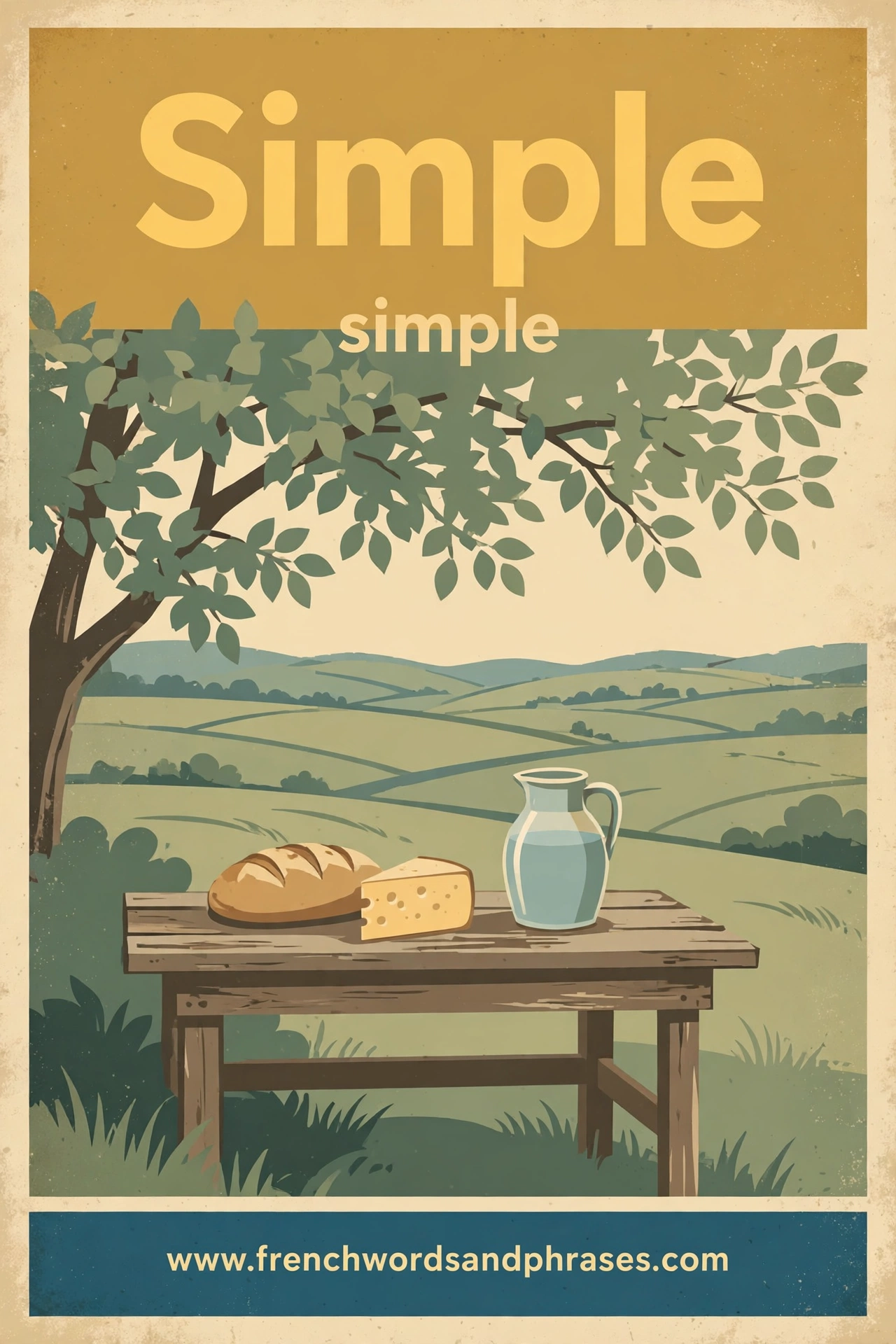
A mountain refuge at the end of a long path: a wooden table, a pot of soup, bread, cheese, and nothing else — and nobody wants anything else. After a day of climbing, the finest restaurant in the world could not compete. Some things are better simple.
In this guide, you’ll learn what simple means in English, why its form never changes between masculine and feminine, the ticket hidden in un aller simple, and when simple before the noun means nothing more than ‘mere’. Explore French examples, English translations, and practice quizzes.
Understanding the French Adjective Simple
Simple is a French adjective of quality — the adjective of the unadorned. It already ends in -e, so masculine and feminine share one form; the plural adds a silent -s. It praises what is easy, plain and unpretentious.
It means simple — easy to understand, plain, without decoration or difficulty: une explication simple, un repas simple. But simple also counts: in a station it means single — un aller simple, a one-way ticket, the journey with no return planned.
Type: Adjective of quality — simplicity
Answers the question: What is it like? — simple, plain, easy
Changes form: Barely — simple for him and her; simples in the plural
English equivalents: Simple; plain; easy; single (a ticket).
One important usage detail: simple usually follows the noun — une question simple. In front of the noun it shrinks the thing to ‘mere, just’: un simple soldat is not a simple soldier but a mere private, an ordinary soldier. Position decides which compliment — or which reduction — you are paying.
Experience the Word
Simple is the adjective of clear water and plain bread — of everything that does not need to shout.
Imagine a grandmother explaining a recipe she has made for sixty years: « c’est simple, regarde » — three gestures, no measures, no fuss, and the dish is perfect.
You have not just called something easy. You have praised it for needing nothing more.
How to Use Simple in French: Complete Guide
Let’s explore how simple works in French, beginning with the whole word on one card.
Simple at a Glance
Before the details, here is the whole word on one card.
The Whole Word on One Card
Meaning, type, position and forms — simple in four lines.
| Point | Simple |
|---|---|
| Meaning | simple |
| Type | adjective of quality — simplicity |
| Usual position | after the noun — une question simple |
| Form | simple / simple / simples / simples — one form for him and her |
Example
La recette est simple et délicieuse.
The recipe is simple and delicious.
The Four Forms of Simple
Simple ends in -e, so the feminine is free; only the plural adds its silent -s.
| Form | Simple | Example |
|---|---|---|
| Masculine singular | simple | un exercice simple — a simple exercise |
| Feminine singular | simple | une question simple — a simple question |
| Masculine plural | simples | des exercices simples — simple exercises |
| Feminine plural | simples | des questions simples — simple questions |
Example
Des mots simples et des phrases simples, voilà le secret.
Simple words and simple sentences — that’s the secret.
Quick Quiz 1
Which form of simple goes with question (feminine)?
Reveal the answer
simple — the same as the masculine; the word already ends in -e.
Une question simple.
A simple question.
The Feminine: Nothing to Add
Simple already ends in -e, so masculine and feminine are one and the same word. The plural -s is the whole of your work.
| Situation | Example |
|---|---|
| Masculine singular | un plat simple — a simple dish |
| Feminine singular | une robe simple — the same word, nothing added |
| Both plurals | des plats simples, des robes simples — just add -s |
| After être | tout est simple — everything is simple |
Example
La robe est simple et la cérémonie est simple aussi.
The dress is simple and the ceremony is simple too.
Where Simple Goes: After for Plain, Before for Mere
After the noun, simple describes: plain, easy. Before the noun, it demotes: un simple + noun means a mere, ordinary one — a favourite device of French understatement.
| Pattern | Example |
|---|---|
| After the noun — plain | un repas simple — a simple meal |
| After the noun — easy | une règle simple — a simple rule |
| Before the noun — mere | un simple soldat — a mere private |
| Fixed phrase | un aller simple — a one-way ticket |
Example
Un simple employé a trouvé la solution la plus simple.
A mere employee found the simplest solution.
Quick Quiz 2
Un simple soldat — is the soldier simple, or a mere private?
Reveal the answer
A mere private — before the noun, simple means ‘mere, just, ordinary’.
Un simple soldat.
A mere private.
Simpler: Comparing with Simple
Simple compares in the regular way — and its superlative is one of the most useful sentences in problem-solving.
| Degree | Example |
|---|---|
| As simple as | aussi simple que — as simple as |
| Simpler | plus simple — simpler |
| Less simple | moins simple — less simple |
| The simplest (masc.) | le plus simple — le chemin le plus simple |
| The simplest (fem.) | la plus simple — la solution la plus simple |
Example
La solution la plus simple est souvent la meilleure.
The simplest solution is often the best.
Everyday Expressions with Simple
Simple hides in railway stations, tennis courts and one of the great French understatements.
| Expression | In English |
|---|---|
| un aller simple | a one-way ticket |
| simple comme bonjour | easy as pie (literally: simple as hello) |
| ce n’est pas simple | it’s not easy (a classic understatement) |
| une chambre simple | a single room |
| en simple | in singles (tennis) |
| simple d’esprit | simple-minded |
Example
Un aller simple pour Marseille, s’il vous plaît.
A one-way ticket to Marseille, please.
Quick Quiz 3
What is un aller simple?
Reveal the answer
A one-way ticket
Un aller simple, sans retour.
A one-way ticket, no return.
Simple and Its Neighbours
Simplicity shades into ease and clarity on one side — and into complication on the other.
| French | In English |
|---|---|
| facile | easy (the job is easy) |
| élémentaire | elementary, basic |
| clair | clear, easy to follow |
| basique | basic (informal) |
| compliqué | complicated — the opposite |
| complexe | complex — the opposite |
Example
Clair et facile, l’exercice paraît simple à tout le monde.
Clear and easy, the exercise seems simple to everyone.
Watch Out: The Traps Around Simple
Simple’s traps are a ticket, an insult that is not one, and an understatement that means the opposite of easy.
| Trap | The truth |
|---|---|
| aller simple | one-way; the return ticket is un aller-retour — buying the wrong one is an expensive lesson |
| simple d’esprit | means simple-minded — never use it as a compliment about a person |
| ce n’est pas simple | understatement: it usually means the thing is genuinely difficult |
| a simple person | une personne simple in French is unpretentious, down-to-earth — a compliment, not an insult |
Example
Elle est simple et naturelle, tout le monde l’adore.
She is unpretentious and natural, everyone adores her.
Quick Quiz 4
A one-way ticket — un aller simple or un aller retour?
Reveal the answer
un aller simple
Simple means single here; aller-retour is the return ticket.
Un aller simple pour Lyon. — A one-way ticket to Lyon.
Simple in Everyday French: Real-Life Examples
Now that you know the word, let’s see how simple appears in everyday French.
Example 1 — At the station
Un aller simple pour Bordeaux, s’il vous plaît.
A one-way ticket to Bordeaux, please.
Example 2 — In class
L’explication est simple : regardez le tableau.
The explanation is simple: look at the board.
Example 3 — In the kitchen
Ce soir, un repas simple : une soupe et une salade.
Tonight, a simple meal: soup and a salad.
Example 4 — Honest talk
Ce n’est pas simple, mais on va trouver une solution.
It’s not easy, but we’ll find a solution.
Example 5 — A compliment
C’est une personne simple, elle dit ce qu’elle pense.
She’s an unpretentious person, she says what she thinks.
Example 6 — Easy as pie
Le montage est simple comme bonjour, dix minutes suffisent.
Putting it together is easy as pie, ten minutes is enough.
Beyond Translation: The Meaning of Simple
English says simple for the meaning of simple — the same word, carried across the Channel centuries ago. But French simple has kept a modesty that English simple sometimes loses: une personne simple is no fool, but someone refreshingly without pretence.
To call something simple in French is to honour the art of leaving things out.
And the language signs its philosophy in a railway station: un aller simple — the ticket of those who travel light, with no return arranged.
How to Remember the French Adjective Simple
Remember it this way: Simple is the adjective that asks for nothing — not even a different feminine form.
- You see the pair standing still — simple, simple — masculine and feminine identical.
- You park it after the noun — une question simple, un repas simple.
- You watch it shrink things in front — un simple soldat, a mere private.
The key idea is simple follows the noun and never changes for gender; before the noun it means mere.
Test Your Knowledge of Simple
Let’s see how much you’ve learned. Try answering these questions before revealing the answers.
Question 1
What does simple mean?
Reveal the answer
Simple — plain, easy; and single, for a ticket.
Question 2
What are the forms of simple?
Reveal the answer
simple, simple, simples, simples — the same for masculine and feminine.
Question 3
Translate: a one-way ticket.
Reveal the answer
Un aller simple.
Question 4
What does simple mean in un simple soldat?
Reveal the answer
Mere — a mere private, an ordinary soldier.
Question 5
Complete the sentence:
La solution la plus ______ est souvent la meilleure.
Reveal the answer
simple
La solution la plus simple est souvent la meilleure.
The simplest solution is often the best.
Your Final Challenge
Can You Use It?
How would you say this in French?
“A one-way ticket, please — and keep the explanation simple.”
Reveal the answer
Un aller simple, s’il vous plaît — et gardez l’explication simple.
A one-way ticket, please — and keep the explanation simple.
A little French. A little curiosity. A richer everyday life.
LEARN FRENCH ONE WORD AT A TIME