A French Word to Live By
Translate Rapide to English
/ʁa.pid/
Rapide means fast.
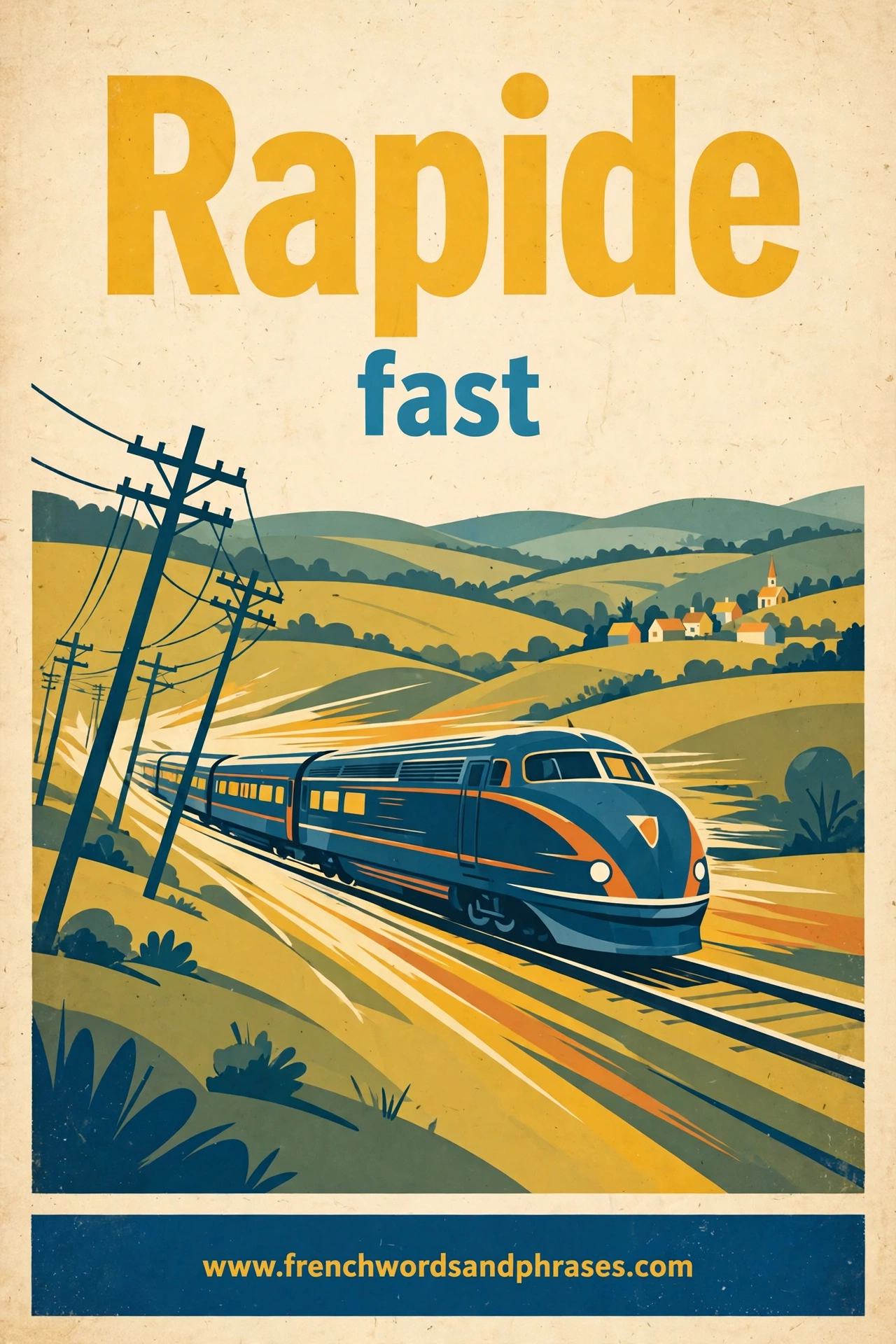
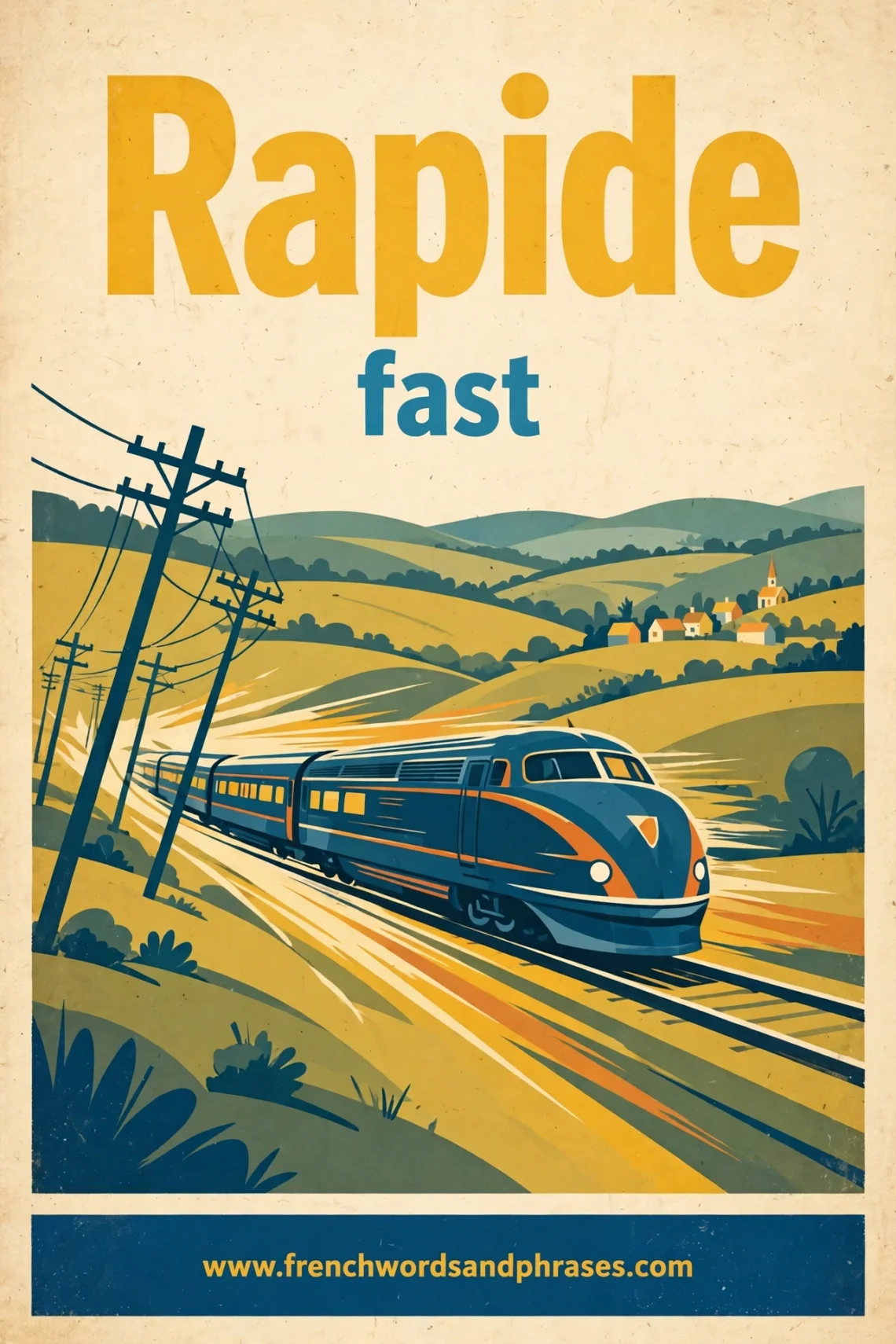
A platform, a whistle, a train that does not so much arrive as appear — one long silver line and a rush of air. The doors open for ninety seconds. Some trains stop for a coffee; this one barely stops at all. It is rapide.
In this guide, you’ll learn what rapide means in English, why its form never changes between masculine and feminine, where it stands after the noun, and how it differs from its fast-moving cousin vite. Explore French examples, English translations, and practice quizzes.
Understanding the French Adjective Rapide
Rapide is a French adjective of quality — the adjective of speed. It already ends in -e, so masculine and feminine share one form; the plural adds a silent -s. It describes trains and answers, glances and heartbeats.
It means fast, quick, rapid — moving or happening in very little time. Rapide almost always follows the noun: un train rapide, une réponse rapide. Where English splits fast and quick, French rapide covers both with one word.
Type: Adjective of quality — speed
Answers the question: What is it like? — fast, quick
Changes form: Barely — rapide for him and her; rapides in the plural
English equivalents: Fast; quick; rapid; swift.
One important usage detail: rapide follows the noun — une décision rapide. Its cousin vite looks similar but is an adverb, not an adjective: il court vite, he runs fast. Adjective for things, adverb for actions: une voiture rapide, elle conduit vite.
Experience the Word
Rapide is the adjective of the express train and the raised eyebrow — of everything that arrives before you expected it.
Imagine a waiter in a busy brasserie: order called, plates turning, a tray balanced like a circus act, and your coffee is in front of you before you have finished folding your newspaper.
You have not just measured a speed. You have felt time fold itself in half.
How to Use Rapide in French: Complete Guide
Let’s explore how rapide works in French, beginning with the whole word on one card.
Rapide at a Glance
Before the details, here is the whole word on one card.
The Whole Word on One Card
Meaning, type, position and forms — rapide in four lines.
| Point | Rapide |
|---|---|
| Meaning | fast |
| Type | adjective of quality — speed |
| Usual position | after the noun — un train rapide |
| Form | rapide / rapide / rapides / rapides — one form for him and her |
Example
Le train rapide part à midi.
The fast train leaves at noon.
The Four Forms of Rapide
Rapide ends in -e, so gender costs you nothing: the same word serves the train and the car. Only the plural adds its quiet -s.
| Form | Rapide | Example |
|---|---|---|
| Masculine singular | rapide | un train rapide — a fast train |
| Feminine singular | rapide | une voiture rapide — a fast car |
| Masculine plural | rapides | des trains rapides — fast trains |
| Feminine plural | rapides | des voitures rapides — fast cars |
Example
Des réponses rapides et des décisions rapides, voilà son style.
Quick answers and quick decisions — that’s her style.
Quick Quiz 1
Which form of rapide goes with voiture (feminine)?
Reveal the answer
rapide — the same as the masculine; the word already ends in -e.
Une voiture rapide.
A fast car.
The Feminine: Nothing to Add
Adjectives ending in -e keep exactly the same form in the feminine, and rapide is one of them. Only the plural -s needs your attention.
| Situation | Example |
|---|---|
| Masculine singular | un service rapide — fast service |
| Feminine singular | une livraison rapide — the same word, nothing added |
| Both plurals | des services rapides, des livraisons rapides — just add -s |
| After être | le métro est rapide — the metro is fast |
Example
La livraison est rapide et le service est rapide aussi.
The delivery is fast and the service is fast too.
Where Rapide Goes: After the Noun
Rapide is a follower, not a leader: it comes after the noun, or after être. In front of the noun it sounds wrong to French ears.
| Pattern | Example |
|---|---|
| After the noun | une réponse rapide — a quick answer |
| After être | ce train est rapide — this train is fast |
| With très | un examen très rapide — a very quick check |
| Before the noun | une rapide réponse — no: rapide follows |
Example
Elle a donné une réponse rapide et claire.
She gave a quick, clear answer.
Quick Quiz 2
A fast train — un rapide train or un train rapide?
Reveal the answer
un train rapide
Rapide follows the noun.
Un train rapide — a fast train.
Faster: Comparing with Rapide
Speed loves a race: rapide compares with plus and le plus, and its superlative is the promise on every timetable.
| Degree | Example |
|---|---|
| As fast as | aussi rapide que — as fast as |
| Faster | plus rapide — faster |
| Less fast | moins rapide — less fast |
| The fastest (masc.) | le plus rapide — le train le plus rapide |
| The fastest (fem.) | la plus rapide — la voiture la plus rapide |
Example
C’est le moyen le plus rapide pour aller au centre.
It’s the fastest way to get to the centre.
Everyday Expressions with Rapide
Rapide slips into glances, replies, meals and progress reports — and even names the wildest part of a river.
| Expression | In English |
|---|---|
| rapide comme l’éclair | as quick as lightning |
| un coup d’œil rapide | a quick glance |
| une réponse rapide | a quick reply |
| un progrès rapide | rapid progress |
| un repas rapide | a quick meal |
| les rapides | the rapids (of a river) |
Example
Il a jeté un coup d’œil rapide à sa montre.
He took a quick glance at his watch.
Quick Quiz 3
What does rapide comme l’éclair mean?
Reveal the answer
As quick as lightning
Elle a disparu, rapide comme l’éclair.
She vanished, quick as lightning.
Rapide and Its Neighbours
Speed has registers, from the literary véloce to the everyday lent waiting at the other end of the line.
| French | In English |
|---|---|
| prompt | prompt, swift (formal) |
| expéditif | speedy, brisk (getting things done) |
| véloce | swift (literary) |
| vif | lively, brisk: un pas vif, a brisk pace |
| lent | slow — the opposite |
| à pas de tortue | at a snail’s pace (idiom) |
Example
Prompt et rapide, le service a fini en dix minutes.
Prompt and fast, the service was done in ten minutes.
Watch Out: The Traps Around Rapide
The great trap around rapide is its cousin vite — same neighbourhood, different job. One describes things, the other actions.
| Trap | The truth |
|---|---|
| vite | is an ADVERB, not the adjective: une voiture rapide (thing), elle conduit vite (action) |
| un rapide | as a noun, an old express train — and les rapides are river rapids |
| fast in English | covers rapide and vite: check whether you describe a thing or an action |
| the plural -s | rapides in writing, silent in speech |
Example
Ce train rapide va très vite.
This fast train goes very fast.
Quick Quiz 4
She drives fast — rapide or vite?
Reveal the answer
vite — driving is an action, so French uses the adverb.
Elle conduit vite, dans une voiture rapide.
She drives fast, in a fast car.
Rapide in Everyday French: Real-Life Examples
Now that you know the word, let’s see how rapide appears in everyday French.
Example 1 — At the station
Le train rapide pour Lyon part dans dix minutes.
The fast train to Lyon leaves in ten minutes.
Example 2 — At work
Merci pour votre réponse rapide, c’est parfait.
Thank you for your quick reply, that’s perfect.
Example 3 — On the road
C’est une voiture rapide, mais elle consomme beaucoup.
It’s a fast car, but it uses a lot of fuel.
Example 4 — In conversation
Il a jeté un coup d’œil rapide au menu et il a commandé.
He took a quick glance at the menu and ordered.
Example 5 — At school
Elle fait des progrès rapides en français.
She is making rapid progress in French.
Example 6 — In the kitchen
Ce soir, un repas rapide : une salade et du pain.
Tonight, a quick meal: a salad and some bread.
Beyond Translation: The Meaning of Rapide
English says fast for the meaning of rapide — and rapide comes from the Latin rapidus, snatching, sweeping away, like a river in flood.
To call something rapide is to say it does not keep you waiting — it respects your time.
French even trusts it with the landscape: les rapides, the rapids, where the river itself hurries. Speed, in this word, is a kind of courtesy.
How to Remember the French Adjective Rapide
Remember it this way: Rapide is the adjective that never keeps you waiting — one form for him, one for her, and its feet always behind the noun.
- You see the pair standing still — rapide, rapide — masculine and feminine identical.
- You park it after the noun — un train rapide, une réponse rapide.
- You split the English word in two — rapide for things, vite for actions.
The key idea is rapide follows the noun and never changes for gender; vite does the same job for verbs.
Test Your Knowledge of Rapide
Let’s see how much you’ve learned. Try answering these questions before revealing the answers.
Question 1
What does rapide mean?
Reveal the answer
Fast — also quick, rapid.
Question 2
What are the forms of rapide?
Reveal the answer
rapide, rapide, rapides, rapides — the same for masculine and feminine.
Question 3
Translate: a fast car.
Reveal the answer
Une voiture rapide.
Question 4
Which word describes an action — rapide or vite?
Reveal the answer
vite — il court vite, he runs fast. Rapide describes things.
Question 5
Complete the sentence:
C’est le train le plus ______ de la région.
Reveal the answer
rapide
C’est le train le plus rapide de la région.
It’s the fastest train in the region.
Your Final Challenge
Can You Use It?
How would you say this in French?
“The fast train leaves at noon — be quick!”
Reveal the answer
Le train rapide part à midi — dépêche-toi !
The fast train leaves at noon — be quick!
A little French. A little curiosity. A richer everyday life.
LEARN FRENCH ONE WORD AT A TIME