A French Word to Live By
Translate Ouvert to English
/u.vɛʁ/
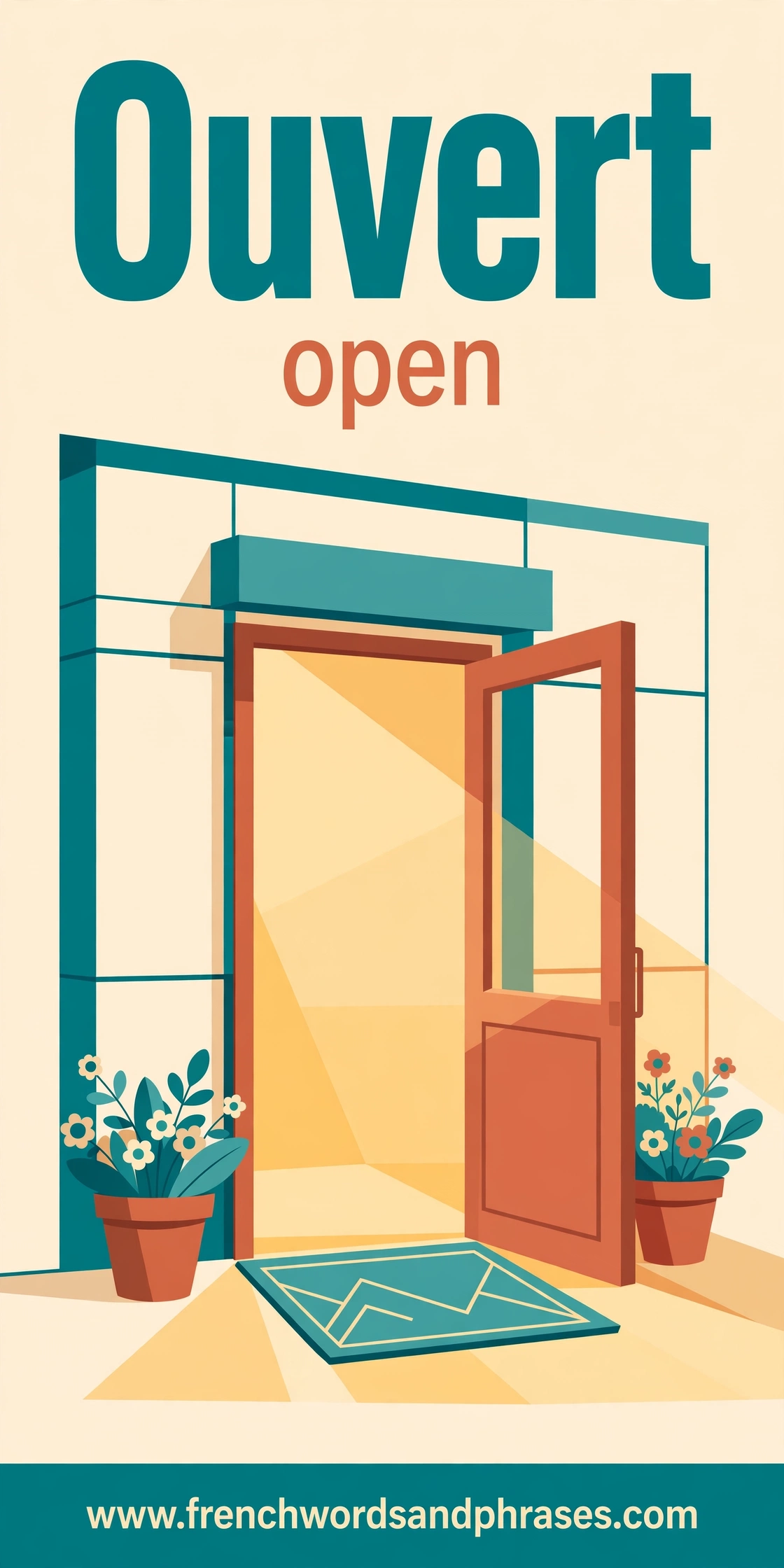
Ouvert means open.
Sunday morning, and the little bakery has its shutters up at last: light in the windows, the smell of warm bread rolling into the street, and a small queue already forming on the pavement. After the long closed night, the most hopeful sight in France: a shop that is ouvert.
In this guide, you’ll learn what ouvert means in English, its four forms, why it follows the noun, and how one word opens doors, shops, minds and hearts. Explore French examples, English translations, and practice quizzes.
Understanding the French Adjective Ouvert
Ouvert is a French adjective of state — like occupé, it began life as a past participle, this time of the verb ouvrir, ‘to open’. It agrees with its noun, and its feminine, ouverte, is one of the most useful word-shapes in everyday French.
It means open — not closed: la porte est ouverte, the door is open; le magasin est ouvert, the shop is open. And French stretches it kindly to people: un esprit ouvert, an open mind; une personne ouverte, an open, approachable person.
Type: Adjective of state — openness
Answers the question: Is it open or closed? — open
Changes form: Yes — ouvert, ouverte, ouverts, ouvertes
English equivalents: Open; open-minded (for people).
One important usage detail: ouvert FOLLOWS the noun and loves the company of être — la fenêtre est ouverte. Its opposite, fermé, follows exactly the same pattern, so the pair is best learned together.
Experience the Word
Ouvert is the adjective of welcome — the door left ajar, the shop lit up, the arms spread wide.
Imagine arriving in a strange village at dusk, tired and hungry, and seeing one window glowing at the end of the street. The café door stands open, music and warm air drifting out. That single glowing word — ouvert — feels like the whole village saying: come in.
You have not just said open. You have said: you are welcome here.
How to Use Ouvert in French: Complete Guide
Let’s explore how ouvert works in French, beginning with the whole word on one card.
Ouvert at a Glance
Before the details, here is the whole word on one card.
The Whole Word on One Card
Meaning, type, position and forms — ouvert in four lines.
| Point | Ouvert |
|---|---|
| Meaning | open |
| Type | adjective of state — openness |
| Usual position | after the noun / after être — la porte est ouverte |
| Form | ouvert / ouverte / ouverts / ouvertes |
Example
Le musée est ouvert le dimanche.
The museum is open on Sundays.
The Four Forms of Ouvert
Ouvert agrees with the noun it describes. The feminine adds -e, and with it the final t — silent in ouvert — steps forward and speaks.
| Form | Ouvert | Example |
|---|---|---|
| Masculine singular | ouvert | un magasin ouvert — an open shop |
| Feminine singular | ouverte | une porte ouverte — an open door |
| Masculine plural | ouverts | des magasins ouverts — open shops |
| Feminine plural | ouvertes | des portes ouvertes — open doors |
Example
Toutes les fenêtres sont ouvertes ce matin.
All the windows are open this morning.
Quick Quiz 1
Which form of ouvert goes with porte (feminine)?
Reveal the answer
ouverte
Une porte ouverte.
An open door.
Forming the Feminine: ouvert → ouverte
Ouvert forms its feminine by adding -e — and the sleeping t wakes up, exactly as it does for méchant and parfait. One small change of sound, thousands of doors opened.
| Step | Example |
|---|---|
| Masculine | ouvert — le magasin est ouvert |
| Add -e | ouverte — la boutique est ouverte |
| The t wakes up | ouverte ends with a clear t sound |
| Plurals | ouverts / ouvertes — les magasins sont ouverts, les boutiques sont ouvertes |
Example
La boulangerie est ouverte dès sept heures.
The bakery is open from seven o’clock.
Where Ouvert Goes: After the Noun
Ouvert describes a state, so it follows the noun and être. Its one set phrase, journées portes ouvertes, keeps that order even in the name of the event.
| Pattern | Example |
|---|---|
| After être | la porte est ouverte — the door is open |
| After the noun | un livre ouvert — an open book |
| Set phrase | les journées portes ouvertes — open days |
| Before the noun | never in everyday French |
Example
Laissez le livre ouvert sur la table.
Leave the book open on the table.
Quick Quiz 2
Where does ouvert stand — before or after the noun?
Reveal the answer
After
Un livre ouvert, une porte ouverte.
An open book, an open door.
More Open: Comparing with Ouvert
Ouvert compares the regular way — and French adds a flourish for the widest openings of all: grand ouvert, wide open, where grand itself agrees.
| Degree | Example |
|---|---|
| As open as | aussi ouvert que — as open as |
| More open | plus ouvert — more open |
| Less open | moins ouvert — less open |
| The most open (masc.) | le plus ouvert — le plus ouvert des deux |
| Wide open | grand ouvert — la porte grande ouverte, the door wide open |
Example
Elle laisse toujours la porte grande ouverte.
She always leaves the door wide open.
Everyday Expressions with Ouvert
Ouvert opens far more than doors — arms, minds, hearts and whole institutions take their turn in these everyday phrases.
| Expression | In English |
|---|---|
| les journées portes ouvertes | open days — open-house days at schools and businesses |
| à bras ouverts | with open arms — accueillir à bras ouverts |
| un esprit ouvert | an open mind |
| ouvert d’esprit | open-minded |
| à cœur ouvert | open-heart — une opération à cœur ouvert, open-heart surgery |
| les yeux grands ouverts | eyes wide open |
Example
Ils nous ont accueillis à bras ouverts.
They welcomed us with open arms.
Quick Quiz 3
What does à bras ouverts mean?
Reveal the answer
With open arms
The warmest welcome French can give.
On vous attend à bras ouverts. — We’re waiting for you with open arms.
Ouvert and Its Neighbours
Around ouvert gathers the vocabulary of welcome and refusal — from the half-open door to the firmly closed one, fermé, its inseparable opposite.
| French | In English |
|---|---|
| fermé | closed — the opposite |
| entre-ouvert | half-open, ajar |
| accueillant | welcoming |
| tolérant | tolerant |
| disponible | available |
| libre | free |
Example
La porte n’est pas fermée, elle est entre-ouverte.
The door isn’t closed, it’s ajar.
Watch Out: The Traps Around Ouvert
A verb that looks like its adjective, an agreement that hides after être, and the opening hours on every shop door in France — small traps, daily stakes.
| Trap | The truth |
|---|---|
| ouvert vs ouvrir | ouvert is the adjective (open); ouvrir is the verb (to open) |
| agreement after être | la fenêtre est ouverte — the feminine is easy to forget after être |
| open-minded people | un esprit ouvert or ouvert d’esprit — both work |
| opening hours | shop doors announce it: ouvert de 9h à 19h — open from 9 to 7 |
Example
Ouvre la fenêtre, elle n’est pas ouverte.
Open the window, it isn’t open.
Quick Quiz 4
Which is the adjective — ouvrir or ouvert?
Reveal the answer
ouvert
Ouvrir is the verb, to open. Ouvert is the adjective, open.
La porte est ouverte. — The door is open.
Ouvert in Everyday French: Real-Life Examples
Now that you know the word, let’s see how ouvert appears in everyday French.
Example 1 — At the shop
Le magasin est ouvert jusqu’à vingt heures le samedi.
The shop is open until eight o’clock on Saturdays.
Example 2 — At home
Qui a laissé la porte ouverte ? Le chat est sorti !
Who left the door open? The cat has got out!
Example 3 — An open day
Samedi, c’est portes ouvertes à l’école des enfants.
On Saturday, it’s open day at the children’s school.
Example 4 — A welcome
Les voisins nous ont reçus à bras ouverts.
The neighbours welcomed us with open arms.
Example 5 — An open mind
C’est un professeur ouvert, il écoute toutes les idées.
He’s an open-minded teacher, he listens to every idea.
Example 6 — Wide open
L’enfant écoute, les yeux grands ouverts.
The child listens, eyes wide open.
Beyond Translation: The Meaning of Ouvert
English says open for the meaning of ouvert — the same welcoming word. But French lets it travel further: from the bakery door to the open mind, from open arms to open-heart surgery, ouvert is the shape of everything that does not shut the world out.
To call a person ouvert is one of the warmest compliments in French — their door, like their mind, is never locked.
And every spring, schools and workshops across France hold their journées portes ouvertes — open-door days — as if the whole country agreed that good things should be seen with the doors open.
How to Remember the French Adjective Ouvert
Remember it this way: Ouvert is the past participle of ouvrir wearing an adjective’s coat — the door, the shop and the mind, all standing open.
- You see the bakery light at dawn — le magasin est ouvert.
- You wake the t for her — une porte ouverte, des fenêtres ouvertes.
- You welcome with it — à bras ouverts, with open arms.
The key idea is ouvert follows the noun and être; ouverte for her; the opposite is fermé.
Test Your Knowledge of Ouvert
Let’s see how much you’ve learned. Try answering these questions before revealing the answers.
Question 1
What does ouvert mean?
Reveal the answer
Open — the opposite of fermé, closed.
Question 2
What are the forms of ouvert?
Reveal the answer
ouvert, ouverte, ouverts, ouvertes.
Question 3
Translate: the door is open.
Reveal the answer
La porte est ouverte.
Question 4
What are les journées portes ouvertes?
Reveal the answer
Open days — the open-house days held by schools, universities and businesses.
Question 5
Complete the sentence:
Les magasins sont ______ le dimanche matin.
Reveal the answer
ouverts
Les magasins sont ouverts le dimanche matin.
The shops are open on Sunday mornings.
Your Final Challenge
Can You Use It?
How would you say this in French?
“The shop is open, the door is wide open — come in!”
Reveal the answer
Le magasin est ouvert, la porte est grande ouverte — entrez !
The shop is open, the door is wide open — come in!
A little French. A little curiosity. A richer everyday life.
LEARN FRENCH ONE WORD AT A TIME