A French Word to Live By
Translate Question to English
/kɛs.tjɔ̃/
La question means a question.
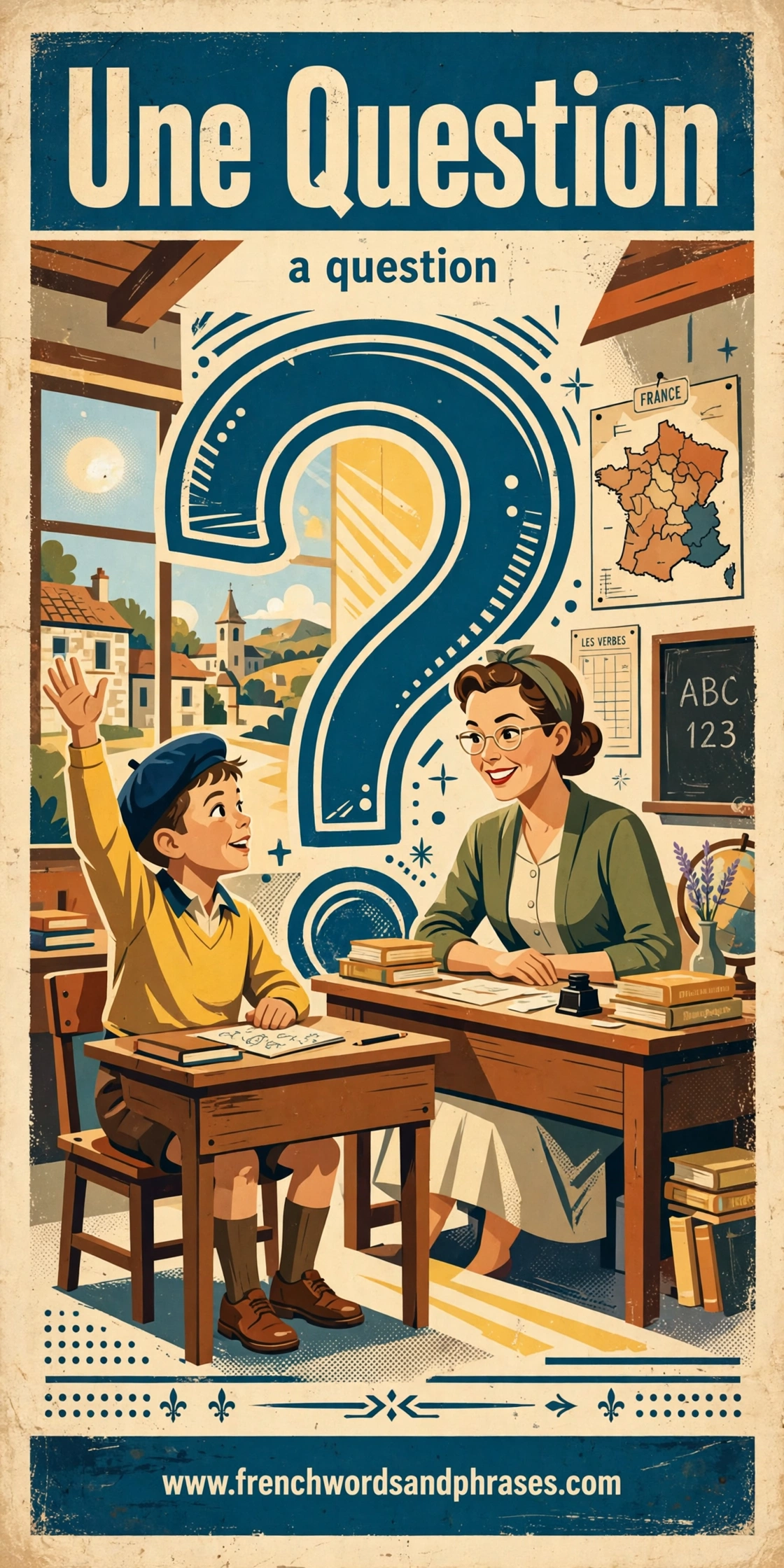
The teacher stops, chalk in hand, and looks at the class. Thirty hands hesitate — and one small hand rises, slowly, with the bravest word in any language: une question.
In this guide, you’ll learn what question means in English, how to use it with its articles, how to form its plural, and how it appears in everyday French. Explore French examples, English translations, and practice quizzes.
Understanding the French Noun Question
Question is a feminine French noun. Like every French noun, it has a gender, and it is learned together with its article: la question.
It means a question — what you ask when you want to know. But it is also the abstract word for a matter, an issue: une question de temps is not something you ask, it is a question (a matter) of time.
Gender: Feminine
Definite article: la — la question (the question)
Indefinite article: une — une question (a question)
Plural: les questions (the questions)
English equivalents: A question; a matter, an issue.
One important usage detail: to ask a question, French says poser une question — literally, to put down a question: elle a posé une question au directeur, she asked the director a question. Never build the phrase word for word from English: demander une question is a classic mistake — demander is for asking for things, while questions are posed.
Experience the Word
Question is more than a sentence with a question mark. It is curiosity with courage — the start of every discovery.
Imagine the child in the back seat, the student after class, the traveller at the station window: everything they will ever learn begins with one small, brave question.
You have not just asked. You have opened a door.
How to Use Question in French: Complete Guide
Let’s explore how question works in French, beginning with its articles.
Question and Its Articles
French nouns are almost never used alone. The small word in front of the noun — the article — does a great deal of work.
Question with the Definite Article (La, Les)
Used for a particular question both speakers know about.
| Number | French |
|---|---|
| Singular | la question |
| Plural | les questions |
Example
La question est difficile, réfléchissez bien.
The question is difficult, think carefully.
Question with the Indefinite Article (Une, Des)
Used for one question among others, or questions in general.
| Number | French |
|---|---|
| Singular | une question |
| Plural | des questions |
Example
J’ai une question pour le professeur.
I have a question for the teacher.
Question with Poser (To Ask a Question)
Question is a count noun with no partitive article — its life is with the verb poser. Learn these patterns as blocks.
| Meaning | French |
|---|---|
| to ask a question | poser une question |
| to ask someone a question | poser une question à quelqu’un |
| a question about something | une question sur quelque chose |
| the answer to the question | la réponse à la question |
Example
Les enfants posent beaucoup de questions.
Children ask a lot of questions.
Quick Quiz 1
How do you say to ask a question in French?
Reveal the answer
poser une question
À la fin du cours, elle pose une question au professeur.
At the end of the lesson, she asks the teacher a question.
The Plural of Question
Like most French nouns, question simply adds an -s in the plural.
| Number | French |
|---|---|
| Singular | la question |
| Plural | les questions |
Example
Il reste des questions après le cours.
There are still questions after the lesson.
Question with Possessive Adjectives (Ma, Ta, Sa…)
Possessives agree with the noun, not with the owner — and question is feminine, so it takes ma, ta, sa.
| Owner | French |
|---|---|
| my | ma question |
| your (tu) | ta question |
| his / her | sa question |
| our | notre question |
| your (vous) | votre question |
| their | leur question |
Example
Ma question concerne les horaires du train.
My question is about the train times.
Quick Quiz 2
Complete the sentence:
Les élèves ______ beaucoup de questions au professeur.
Reveal the answer
posent
Les élèves posent beaucoup de questions au professeur.
The pupils ask the teacher a lot of questions.
Question with Demonstrative Adjectives (Cette, Ces)
Used to point: this question here, those questions there.
| Number | French |
|---|---|
| Singular | cette question |
| Plural | ces questions |
Example
Cette question revient chaque année à l’examen.
This question comes up every year in the exam.
Question with Adjectives
Adjectives agree with question — feminine forms — and most come after the noun, while bonne comes before it.
| Adjective | With Question |
|---|---|
| bonne (good) | une bonne question |
| difficile (difficult) | une question difficile |
| simple (simple) | une question simple |
| personnelle (personal) | une question personnelle |
| indiscrète (nosy) | une question indiscrète |
| fréquente (frequent) | une question fréquente |
Example
Bonne question! Je n’y avais pas pensé.
Good question! I had not thought of that.
Quick Quiz 3
Complete the sentence:
C’est une question ______: je ne sais pas répondre. (difficult)
Reveal the answer
difficile
C’est une question difficile: je ne sais pas répondre.
It is a difficult question: I do not know how to answer.
Everyday Expressions with Question
Question stretches far beyond the classroom — it names the great matters of life too.
| Expression | In English |
|---|---|
| poser une question | to ask a question |
| une question de temps | a matter of time |
| il est question de… | it is about…, the subject is… |
| remettre en question | to call into question, to challenge |
| une question piège | a trick question |
| la question qui se pose | the question that arises |
Example
Ce n’est pas un problème d’argent, c’est une question de temps.
It is not a money problem, it is a matter of time.
Words from the Same Family as Question
Learn these together and every conversation falls into place.
| French | In English |
|---|---|
| une réponse | an answer |
| demander | to ask (for) |
| un problème | a problem |
| un doute | a doubt |
| répondre | to answer |
| une interrogation | a test; a questioning |
Example
À chaque question, il y a une réponse.
For every question, there is an answer.
Quick Quiz 4
What does une question de temps mean?
Reveal the answer
A matter of time
Ne t’inquiète pas: c’est une question de temps.
Do not worry: it is a matter of time.
Question in Everyday French: Real-Life Examples
Now that you know the word, let’s see how question appears in everyday French.
Example 1 — In class
À la fin du cours, un élève lève la main pour poser une question.
At the end of the lesson, a pupil raises his hand to ask a question.
Example 2 — A good question
Bonne question! Je vais vérifier.
Good question! I will check.
Example 3 — Many questions
Les enfants posent des questions sur tout.
Children ask questions about everything.
Example 4 — At the meeting
Il reste une question importante à discuter.
There is one important question left to discuss.
Example 5 — A matter of time
Pour apprendre le français, c’est une question de temps.
For learning French, it is a matter of time.
Example 6 — Watch out, a trick
Attention, c’est une question piège!
Careful, it is a trick question!
Beyond Translation: The Meaning of Question
English says question for the meaning of question — the words are twins, separated only by their sound. But French adds a second gift: the same word names the great matters of life — une question de temps, une question d’honneur.
To say question is to say curiosity — and everything that matters.
It evokes the raised hand, the child’s endless pourquoi, and the examiner’s favourite trap: behind every question, another question is hiding.
How to Remember the French Noun Question
Remember it this way: Question goes everywhere with its partner poser — poser une question, always.
- You raise your hand — tu poses une question.
- You praise a classmate — bonne question!
- You wait patiently — c’est une question de temps.
The key idea is poser une question, and la réponse will follow.
Test Your Knowledge of Question
Let’s see how much you’ve learned. Try answering these questions before revealing the answers.
Question 1
Is question masculine or feminine?
Reveal the answer
Feminine — la question.
Question 2
How do you say to ask a question in French?
Reveal the answer
Poser une question.
Question 3
Translate: He asks a question about the price.
Reveal the answer
Il pose une question sur le prix.
Question 4
What does remettre en question mean?
Reveal the answer
To call into question — to challenge something accepted.
Question 5
Complete the sentence:
J’ai une ______ pour le professeur.
Reveal the answer
question
J’ai une question pour le professeur.
I have a question for the teacher.
Your Final Challenge
Can You Use It?
How would you say this in French?
“Before the visit, write down your questions.”
Reveal the answer
Avant la visite, notez vos questions.
Before the visit, write down your questions.
A little French. A little curiosity. A richer everyday life.
LEARN FRENCH ONE WORD AT A TIME