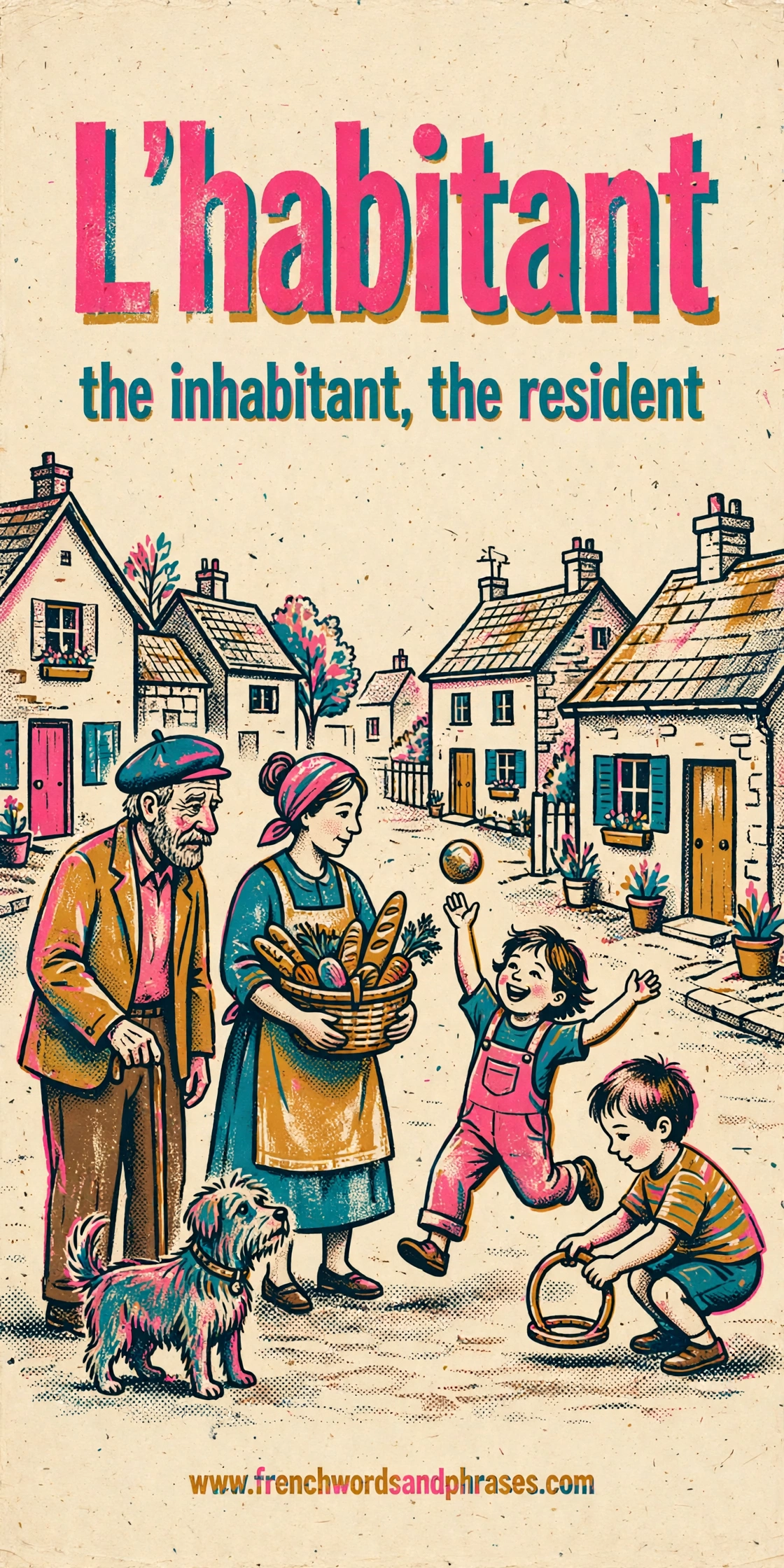
A French Word to Live By
Translate Habitant to English
/a.bi.tɑ̃/
L’habitant means the inhabitant, the resident.
The little town at the foot of the mountain counts itself the way it has for a thousand years: « Le village a trois cents habitants. » The habitant is the person who lives in a place — the inhabitant of a village, a town, a country — the human unit by which French measures every map.
In this guide, you’ll learn what habitant means in English, how to use it with its articles, how to form its plural, and how it appears in everyday French. Explore French examples, English translations, and practice quizzes.
Understanding the French Noun Habitant
Habitant is a masculine French noun with a regular feminine: l’habitant, un habitant; l’habitante, une habitante — the h is silent, so the articles elide. From habiter, to live in, it names the resident of any place, from the last farm of a valley to a continent: les habitants de la Terre, the inhabitants of the Earth.
It means the inhabitant, the resident: les habitants du village, the village’s inhabitants; une ville de deux millions d’habitants, a town of two million inhabitants; les habitants du quartier, the local residents. French counts places in habitants the way English counts in population: Paris a plus de deux millions d’habitants. The word is warm where population is cold — habitants have faces, streets and opinions about the new road.
Gender: Masculine — l’habitant (feminine: l’habitante)
Definite article: l’ — l’habitant (the inhabitant)
Indefinite article: un — un habitant (an inhabitant)
Plural: les habitants — regular, with a simple -s
Spelling note: silent h: l’habitant, les habitants — from habiter, to live in
Close neighbour: un résident — a resident, the administrative word
English equivalents: The inhabitant; the resident.
Habitant is the counter of geography: every French town sign and schoolbook gives the figure — tant d’habitants. For a neighbourhood’s people, les habitants du quartier is the warm, local word, the one petitions are signed in: les habitants s’opposent au projet, the residents oppose the project. The feminine habitante is regular and common: une habitante du village.
Experience the Word
Habitant is population with a heartbeat — the person counted by the map and known by the street.
Imagine the census letter arriving at the farm at the valley’s end: name, age, profession, one line on a form. La fermière signe : elle est la trois centième habitante du village — she is the village’s three-hundredth inhabitant. A statistic abroad, a neighbour at home: habitant holds both truths in one word.
You have not just counted a person. You have placed them in their place — l’habitant, the inhabitant.
How to Use Habitant in French: Complete Guide
Let’s explore how habitant works in French, beginning with its articles — l’habitant, un habitant, les habitants du village.
Habitant with the Definite Article (L’, Les)
Used for a specific resident — the h is silent, so le and la both elide to l’.
| Form | French |
|---|---|
| Masculine singular | l’habitant |
| Feminine singular | l’habitante |
| Plural | les habitants |
Example
L’habitant de la dernière maison connaît tous les chemins.
The inhabitant of the last house knows all the paths.
Habitant with the Indefinite Article (Un, Une, Des)
Used for a resident in general — any person of the place.
| Form | French |
|---|---|
| Masculine singular | un habitant |
| Feminine singular | une habitante |
| Plural | des habitants |
Example
Une habitante du village a retrouvé le chien perdu.
A resident of the village found the lost dog.
Habitant with Quantities (Un, Deux, Assez de…)
Inhabitants are counted by the census — villages in hundreds, cities in millions.
| Quantity | French |
|---|---|
| one inhabitant | un habitant |
| three hundred inhabitants | trois cents habitants |
| enough inhabitants | assez d’habitants |
| too many inhabitants | trop d’habitants |
| millions of inhabitants | des millions d’habitants |
Example
La ville compte deux millions d’habitants.
The town has two million inhabitants.
Quick Quiz 1
Complete the sentence:
______ habitant de la dernière maison connaît tous les chemins. (the)
Reveal the answer
L’
L’habitant de la dernière maison connaît tous les chemins.
The inhabitant of the last house knows all the paths — the h is silent, so le elides to l’.
The Plural of Habitant
Habitant takes a regular plural in -s — the form the word lives in, since places are counted in crowds.
| Number | French |
|---|---|
| Singular | l’habitant |
| Plural | les habitants |
Example
Les habitants du village se réunissent sur la place.
The village’s inhabitants gather on the square.
Habitant with Possessive Adjectives (Mon, Ton, Son…)
Before the silent h, possessives behave as before a vowel: mon habitant, son habitante.
| Owner | French |
|---|---|
| my | mon habitant / mon habitante |
| your (tu) | ton habitant / ton habitante |
| his / her | son habitant / son habitante |
| our | notre habitant / notre habitante |
| your (vous) | votre habitant / votre habitante |
| their | leur habitant / leur habitante |
Example
Leur plus vieille habitante a cent deux ans.
Their oldest resident is a hundred and two.
Quick Quiz 2
Complete the sentence:
______ habitants du village se réunissent sur la place. (the)
Reveal the answer
Les
Les habitants du village se réunissent sur la place.
The village’s inhabitants gather on the square.
Habitant with Demonstrative Adjectives (Cet, Cette, Ces)
Before the silent h, ce becomes cet: cet habitant, cette habitante.
| Form | French |
|---|---|
| Masculine singular | cet habitant |
| Feminine singular | cette habitante |
| Plural | ces habitants |
Example
Cet habitant habite ici depuis toujours.
This resident has lived here forever.
Habitant with Adjectives
Adjectives agree in the regular way: un habitant ancien, une habitante nouvelle.
| Adjective | With Habitant |
|---|---|
| ancien (long-standing) | un habitant ancien |
| nouveau / nouvelle (new) | un nouvel habitant, une nouvelle habitante |
| du village (of the village) | les habitants du village |
| du quartier (local) | les habitants du quartier |
| de la Terre (of the Earth) | les habitants de la Terre |
Example
Les habitants du quartier s’opposent au projet.
The local residents oppose the project.
Quick Quiz 3
What is the feminine of habitant?
Reveal the answer
habitante — a regular feminine in -ante: une habitante du village.
Une habitante du village a retrouvé le chien perdu.
A resident of the village found the lost dog.
Everyday Expressions with Habitant
Censuses, petitions and town signs — the habitant phrases of daily life.
| Expression | In English |
|---|---|
| les habitants du village | the village’s inhabitants |
| une ville de deux millions d’habitants | a town of two million inhabitants |
| les habitants du quartier | the local residents |
| par habitant | per inhabitant — per capita |
| les habitants de la Terre | the inhabitants of the Earth |
Example
La consommation par habitant baisse chaque année.
Consumption per inhabitant falls every year.
Words from the Same Family as Habitant
Living in places — the words that travel with habitant.
| French | In English |
|---|---|
| habiter | to live in (the verb) |
| une habitation | a dwelling, housing |
| la population | the population — the cold statistic |
| un villageois | a villager |
| un citoyen | a citizen |
Example
Elle habite le village depuis toujours, comme tous les habitants.
She has lived in the village forever, like all the inhabitants.
Quick Quiz 4
What does par habitant mean?
Reveal the answer
Per inhabitant — per capita, the statistician’s phrase.
Le revenu par habitant augmente lentement.
Income per inhabitant is rising slowly.
Habitant in Everyday French: Real-Life Examples
Now that you know the word, let’s see how habitant appears in everyday French.
Example 1 — The village
Les habitants du village se réunissent sur la place.
The village’s inhabitants gather on the square.
Example 2 — Counting
La ville compte deux millions d’habitants.
The town has two million inhabitants.
Example 3 — The neighbourhood
Les habitants du quartier s’opposent au projet.
The local residents oppose the project.
Example 4 — A resident
Une habitante du village a retrouvé le chien perdu.
A resident of the village found the lost dog.
Example 5 — Always here
Cet habitant habite ici depuis toujours.
This resident has lived here forever.
Example 6 — Statistics
La consommation par habitant baisse chaque année.
Consumption per inhabitant falls every year.
Beyond Translation: The Meaning of Habitant
Habitant is habiter made human: the verb of dwelling, given a face. French geography runs on the word — every commune in the republic is introduced by its name and its number of habitants, and the count is a point of pride, mourned when it falls, celebrated when a village gains its three-hundredth soul. Population is what a country has; habitants are who a place is.
To say habitant is to count people as neighbours, not numbers.
It evokes town signs, census forms and petition lists — everywhere belonging is measured in people.
How to Remember the French Noun Habitant
Remember it this way: Habitant is the inhabitant — masculine with a silent h, a regular feminine habitante, and a place always attached.
- Silent h — l’habitant, un habitant, les habitants : l’article s’élide toujours.
- The feminine is regular — une habitante, des habitantes du village.
- The counting word — une ville de deux millions d’habitants, le chiffre de chaque commune.
The key idea is l’habitant — the inhabitant, the resident; feminine habitante; counted in every town.
Test Your Knowledge of Habitant
Let’s see how much you’ve learned. Try answering these questions before revealing the answers.
Question 1
Is habitant masculine or feminine?
Reveal the answer
Masculine — l’habitant; the feminine is l’habitante.
Question 2
How do you say the local residents?
Reveal the answer
Les habitants du quartier.
Question 3
Translate: The town has two million inhabitants.
Reveal the answer
La ville compte deux millions d’habitants.
Question 4
Why is it l’habitant and not le habitant?
Reveal the answer
The h is silent — habitant begins with a vowel sound, so the article elides.
Question 5
Complete the sentence:
______ habitants du quartier s’opposent au projet. (the)
Reveal the answer
Les
Les habitants du quartier s’opposent au projet.
The local residents oppose the project.
Your Final Challenge
Can You Use It?
How would you say this in French?
“The village’s inhabitants gather on the square.”
Reveal the answer
Les habitants du village se réunissent sur la place.
The village’s inhabitants gather on the square.
A little French. A little curiosity. A richer everyday life.
LEARN FRENCH ONE WORD AT A TIME