A French Word to Live By
How to Conjugate Peser in French
/pə.ze/
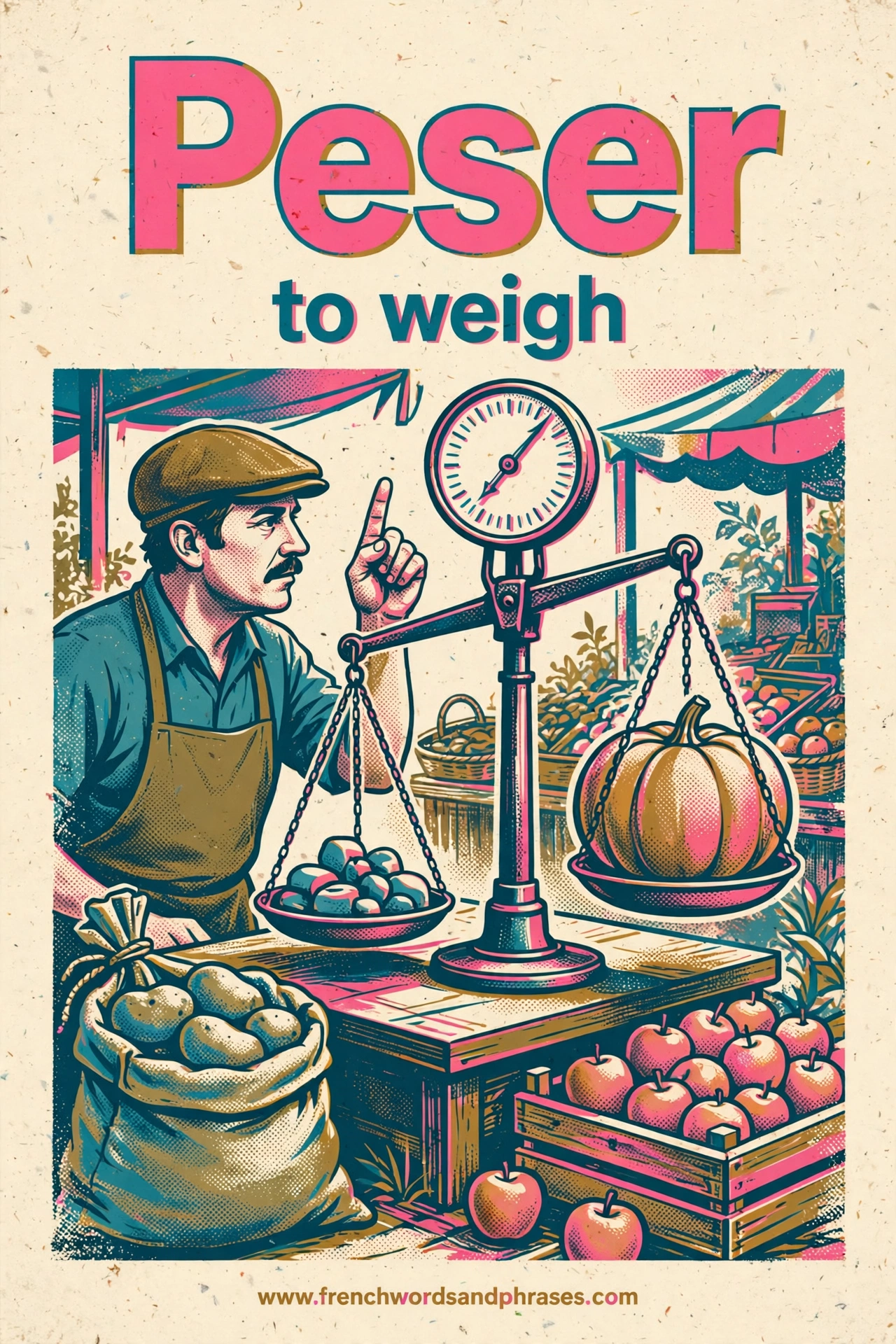
Peser means to weigh — to find out how heavy something is, to be heavy, and, figuratively, to weigh on minds and to weigh up decisions: peser un colis, peser soixante kilos, peser sur la conscience, peser le pour et le contre.
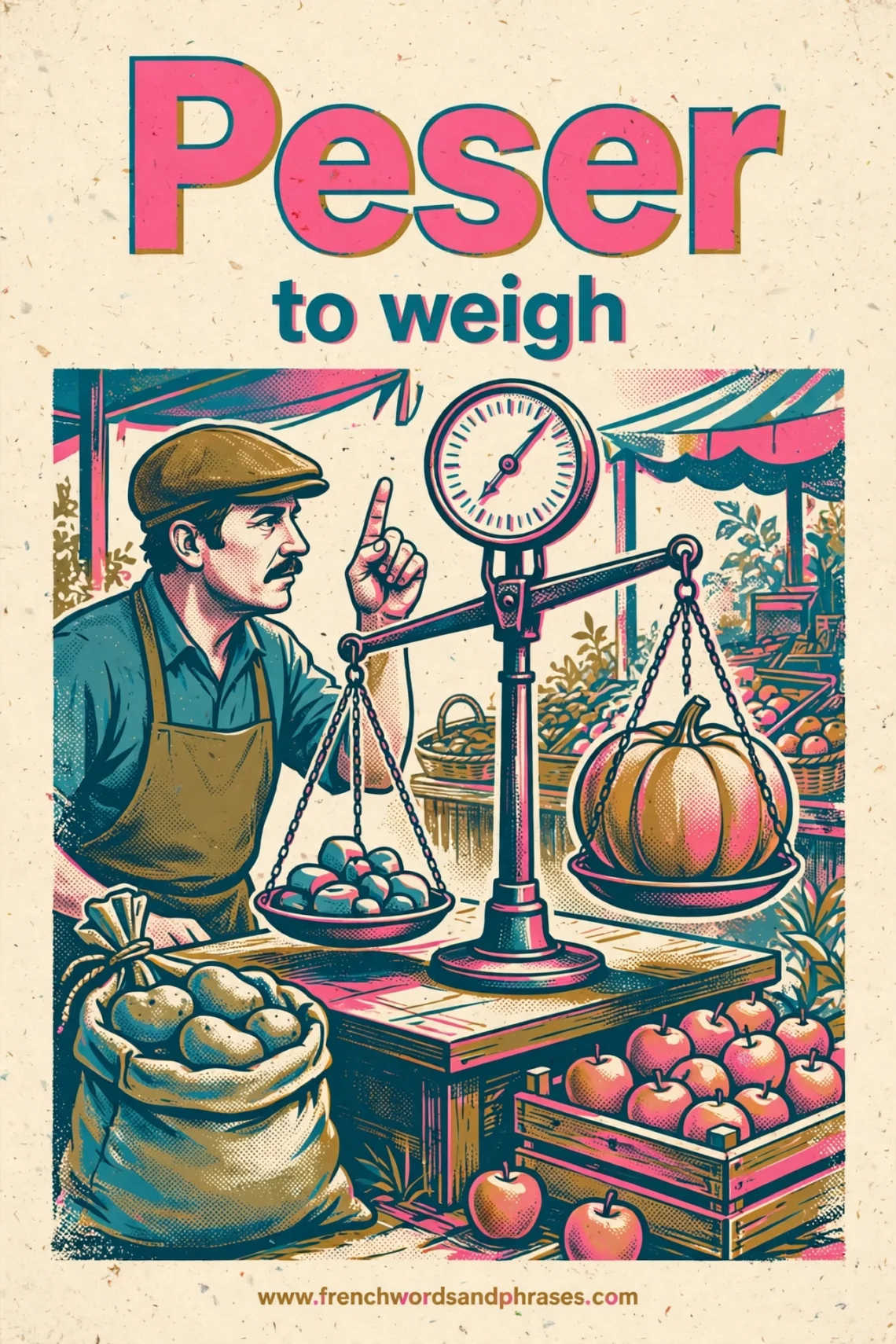
A grocer’s thumb on the old brass scale, a suitcase hoisted before the flight, a secret that grows heavier every year — peser is the verb of weight in every sense: kilos, luggage, guilt and decisions.
In this guide, you’ll learn how to conjugate peser in all the major French tenses and moods. Explore complete conjugation tables, French examples, English translations, and practice quizzes.
Understanding the French Verb Peser
Peser is a regular French verb belonging to the first group of verbs, those ending in-er.
It means to weigh. Peser works three ways: transitive (peser les pommes — weigh the apples), as a measure (le sac pèse dix kilos — the bag weighs ten kilos, where English needs no object), and figurative (ce secret me pèse — this secret weighs on me; peser sur une décision — to influence a decision). The instrument is la balance or le pèse-personne, and the noun for weight itself is le poids.
Verb classification: First group (-er)
Auxiliary verb: Avoir
Past participle: pesé
Present participle: pesant
English equivalents: To weigh, to weigh up; peser un colis — to weigh a parcel; peser soixante kilos — to weigh sixty kilos; peser sur — to weigh on, to bear down on; peser le pour et le contre — to weigh the pros and cons; peser ses mots — to weigh one’s words.
One important detail: peser is a mute-e stem verb, like acheter: the stem e becomes è wherever the ending is silent or the tense is built on the future stem — je pèse, tu pèses, il pèse, ils pèsent, subjunctive que je pèse, imperative pèse, and throughout the future and conditional: je pèserai, je pèserais. But the e stays plain before a sounded vowel: nous pesons, vous pesez, je pesais. Past participle: pesé.
Experience the Word
Peser is the verb of the scale’s small trembling needle — everything, sooner or later, is put on it: fruit, luggage, words and consciences.
Imagine the market stall on Saturday morning. The grocer’s hand hovers, adds one more tomato, removes half of one: elle pèse les tomates au gramme près, because her customers weigh her honesty at the same time, and a grocer’s reputation pèse lourd in a small town.
Fruit, reputations, secrets. Peser — to put on the scale, and to feel the scale push back.
How to Conjugate Peser: Complete French Conjugation Guide
Let’s explore every major conjugation of peser, beginning with the indicative mood.
How to Conjugate Peser in the Indicative Mood
The indicative mood is used to express facts, observations, actions, and events.
How to Conjugate Peser in the Present Tense (Présent)
Used for actions happening now, habitual actions, and general truths.
| Subject | Conjugation |
|---|---|
| je | pèse |
| tu | pèses |
| il / elle | pèse |
| nous | pesons |
| vous | pesez |
| ils / elles | pèsent |
Example
Elle pèse les pommes avant de les vendre.
She weighs the apples before selling them.
Quick Quiz 1
Complete the sentence:
Le sac ______ dix kilos exactement.
Reveal the answer
pèse
Le sac pèse dix kilos exactement.
The bag weighs exactly ten kilos.
How to Conjugate Peser in the Passé Composé
Used for completed actions in the past. Peser takes the auxiliary verb avoir.
| Subject | Conjugation |
|---|---|
| j’ | ai pesé |
| tu | as pesé |
| il / elle | a pesé |
| nous | avons pesé |
| vous | avez pesé |
| ils / elles | ont pesé |
Example
Nous avons pesé les valises avant le départ.
We weighed the suitcases before leaving.
How to Conjugate Peser in the Imparfait (Imperfect Tense)
Used for habitual past actions, descriptions, and ongoing situations in the past.
| Subject | Conjugation |
|---|---|
| je | pesais |
| tu | pesais |
| il / elle | pesait |
| nous | pesions |
| vous | pesiez |
| ils / elles | pesaient |
Example
Autrefois, on pesait le pain à la main, sans balance.
In the old days, bread was weighed by hand, without scales.
Quick Quiz 2
Choose the correct form:
We weighed the suitcases.
Nous ______ les valises. (avons pesé / sommes pesés)
Reveal the answer
avons pesé
Nous avons pesé les valises.
Peser takes avoir.
How to Conjugate Peser in the Plus-que-parfait
Used to describe an action that had already been completed before another past event.
| Subject | Conjugation |
|---|---|
| j’ | avais pesé |
| tu | avais pesé |
| il / elle | avait pesé |
| nous | avions pesé |
| vous | aviez pesé |
| ils / elles | avaient pesé |
Example
Il avait pesé le pour et le contre pendant des semaines.
He had weighed the pros and cons for weeks.
How to Conjugate Peser in the Passé Simple
Primarily used in formal writing, literature, and historical narratives. It is rarely used in everyday conversation.
| Subject | Conjugation |
|---|---|
| je | pesai |
| tu | pesas |
| il / elle | pesa |
| nous | pesâmes |
| vous | pesâtes |
| ils / elles | pesèrent |
Example
Le marchand pesa l’or devant le client.
The merchant weighed the gold in front of the customer.
How to Conjugate Peser in the Passé Antérieur
A literary tense used to express an action completed immediately before another past action, generally in the passé simple.
| Subject | Conjugation |
|---|---|
| j’ | eus pesé |
| tu | eus pesé |
| il / elle | eut pesé |
| nous | eûmes pesé |
| vous | eûtes pesé |
| ils / elles | eurent pesé |
Example
Quand elle eut pesé le colis, elle l’envoya à la poste.
When she had weighed the parcel, she sent it to the post office.
How to Conjugate Peser in the Future Tense (Futur Simple)
Used to describe actions that will take place in the future.
| Subject | Conjugation |
|---|---|
| je | pèserai |
| tu | pèseras |
| il / elle | pèsera |
| nous | pèserons |
| vous | pèserez |
| ils / elles | pèseront |
Example
Demain, je pèserai les ingrédients avant de cuisiner.
Tomorrow, I will weigh the ingredients before cooking.
How to Conjugate Peser in the Futur Antérieur (Future Perfect)
Used for an action that will have been completed before a particular point in the future.
| Subject | Conjugation |
|---|---|
| j’ | aurai pesé |
| tu | auras pesé |
| il / elle | aura pesé |
| nous | aurons pesé |
| vous | aurez pesé |
| ils / elles | auront pesé |
Example
À la fin du marché, elle aura pesé cent kilos de tomates.
By the end of the market, she will have weighed a hundred kilos of tomatoes.
How to Conjugate Peser in the Near Future (Futur Proche)
Used to describe something that is going to happen soon. Formed with aller + infinitive.
| Subject | Conjugation |
|---|---|
| je | vais peser |
| tu | vas peser |
| il / elle | va peser |
| nous | allons peser |
| vous | allez peser |
| ils / elles | vont peser |
Example
Je vais peser ma valise, elle semble trop lourde.
I am going to weigh my suitcase, it seems too heavy.
How to Conjugate Peser in the Conditional Mood
The conditional mood expresses what would happen under certain circumstances. It is also frequently used to make polite requests or express wishes.
How to Conjugate Peser in the Present Conditional
| Subject | Conjugation |
|---|---|
| je | pèserais |
| tu | pèserais |
| il / elle | pèserait |
| nous | pèserions |
| vous | pèseriez |
| ils / elles | pèseraient |
Example
Sans la balance, je pèserais les légumes au jugé.
Without the scales, I would weigh the vegetables by guesswork.
How to Conjugate Peser in the Past Conditional
| Subject | Conjugation |
|---|---|
| j’ | aurais pesé |
| tu | aurais pesé |
| il / elle | aurait pesé |
| nous | aurions pesé |
| vous | auriez pesé |
| ils / elles | auraient pesé |
Example
Il aurait pesé ses mots s’il avait su la vérité.
He would have weighed his words if he had known the truth.
Peser in the Literary Past Conditional Form
This less common literary form uses the imperfect subjunctive of avoir.
| Subject | Conjugation |
|---|---|
| j’ | eusse pesé |
| tu | eusses pesé |
| il / elle | eût pesé |
| nous | eussions pesé |
| vous | eussiez pesé |
| ils / elles | eussent pesé |
Example
Le juge eût pesé chaque preuve avant de décider.
The judge would have weighed every piece of evidence before deciding.
How to Conjugate Peser in the Subjunctive Mood
The subjunctive is used to express wishes, emotions, doubts, necessity, and uncertainty. It frequently follows expressions such as il faut que (it is necessary that) or bien que (although).
How to Conjugate Peser in the Present Subjunctive
| Subject | Conjugation |
|---|---|
| que je | pèse |
| que tu | pèses |
| qu’il / qu’elle | pèse |
| que nous | pesions |
| que vous | pesiez |
| qu’ils / qu’elles | pèsent |
Example
Il faut que tu pèses le bébé chaque semaine.
You must weigh the baby every week.
Quick Quiz 3
Complete the sentence using the subjunctive:
Je suis content que tu ______ le pour et le contre.
Reveal the answer
aies pesé
Je suis content que tu aies pesé le pour et le contre.
I am glad you weighed the pros and cons.
How to Conjugate Peser in the Imperfect Subjunctive
A literary tense, rarely encountered in modern spoken French.
| Subject | Conjugation |
|---|---|
| que je | pesasse |
| que tu | pesasses |
| qu’il / qu’elle | pesât |
| que nous | pesassions |
| que vous | pesassiez |
| qu’ils / qu’elles | pesassent |
Example
Elle cherchait une balance qui pesât juste.
She was looking for scales that weighed accurately.
How to Conjugate Peser in the Pluperfect Subjunctive
A literary construction used to express an action completed before another past action.
| Subject | Conjugation |
|---|---|
| que j’ | eusse pesé |
| que tu | eusses pesé |
| qu’il / qu’elle | eût pesé |
| que nous | eussions pesé |
| que vous | eussiez pesé |
| qu’ils / qu’elles | eussent pesé |
Example
On doutait qu’il eût pesé les conséquences de son acte.
People doubted he had weighed the consequences of his action.
How to Conjugate Peser in the Past Subjunctive
| Subject | Conjugation |
|---|---|
| que j’ | aie pesé |
| que tu | aies pesé |
| qu’il / qu’elle | ait pesé |
| que nous | ayons pesé |
| que vous | ayez pesé |
| qu’ils / qu’elles | aient pesé |
Example
Je suis content que tu aies pesé le pour et le contre.
I am glad you weighed the pros and cons.
How to Conjugate Peser in the Imperative
The imperative is used to give commands, instructions, invitations, or suggestions. Subject pronouns are omitted.
How to Conjugate Peser in the Present Imperative
| Person | Conjugation |
|---|---|
| (tu) | pèse |
| (nous) | pesons |
| (vous) | pesez |
Example
Pèse tes mots avant de répondre !
Weigh your words before answering!
Quick Quiz 4
How would you say Weigh your words (tu form)?
Reveal the answer
Pèse tes mots !
French Participles of Peser
Participles are verb forms that can be used in compound tenses and other grammatical constructions.
Present Participle of Peser
pesant
En pesant le colis, elle a vu qu’il dépassait la limite.
While weighing the parcel, she saw it was over the limit.
Past Participle of Peser
pesé
Pesées une à une, les pommes remplissent le panier.
Weighed one by one, the apples fill the basket.
Peser in Everyday French: Real-Life Examples
Now that you know the conjugations, let’s see how peser appears in everyday French.
Example 1 — Present
Elle pèse les pommes au marché.
She weighs the apples at the market.
Example 2 — Passé composé
Nous avons pesé les valises.
We weighed the suitcases.
Example 3 — Imparfait
On pesait le pain sans balance.
Bread was weighed without scales.
Example 4 — Future
Je pèserai les ingrédients demain.
I will weigh the ingredients tomorrow.
Example 5 — Conditional
Je pèserais les légumes au jugé.
I would weigh the vegetables by guesswork.
Example 6 — Imperative
Pèse tes mots !
Weigh your words!
Beyond Translation: The Meaning of Peser
Peser descends from the Latin pensare — to weigh, and also to think: the same word gives French penser, to think.
To think, in this family, is to weigh.
That is why French weighs its words (peser ses mots), weighs decisions (peser le pour et le contre) and feels secrets weighing on the chest (un secret qui pèse): every judgement is a scale, every thought a small weighing.
How to Remember the French Verb Peser
Remember it this way: Peser is about the grocer’s hand over the brass scale, weighing tomatoes and her reputation together.
- Mute-e stem: je pèse, ils pèsent — and je pèserai, je pèserais: the è runs through the future and conditional too.
- But nous pesons, je pesais keep the plain e before a sounded vowel.
- Three jobs: peser les pommes (weigh), peser dix kilos (be heavy), peser sur la conscience (weigh on).
The key idea is the grocer’s hand over the brass scale, weighing tomatoes and her reputation together.
Test Your Knowledge of Peser
Let’s see how much you’ve learned. Try answering these questions before revealing the answers.
Question 1
Where does the è appear in peser?
Reveal the answer
In the present singular and third plural, the subjunctive singular and third plural, the tu imperative — and throughout the future and conditional: je pèse, je pèserai, je pèserais.
Question 2
How do you say She weighs the apples before selling them in French?
Reveal the answer
Elle pèse les pommes avant de les vendre.
Question 3
Translate: We weighed the suitcases before leaving.
Reveal the answer
Nous avons pesé les valises avant le départ.
Question 4
What is the past participle of peser?
Reveal the answer
Pesé.
Question 5
Complete the sentence:
Il faut que tu ______ le bébé chaque semaine.
Reveal the answer
pèses
Il faut que tu pèses le bébé chaque semaine.
You must weigh the baby every week.
Your Final Challenge
Can You Use It?
How would you say this in French?
She weighs the tomatoes to the nearest gram, because at the market, trust is weighed too.
Reveal the answer
Elle pèse les tomates au gramme près, parce qu’au marché, la confiance aussi se pèse.
She weighs the tomatoes to the nearest gram, because at the market, trust is weighed too.
A little French. A little curiosity. A richer everyday life.
LEARN FRENCH ONE WORD AT A TIME