A French Word to Live By
Translate Fou to English
/fu/
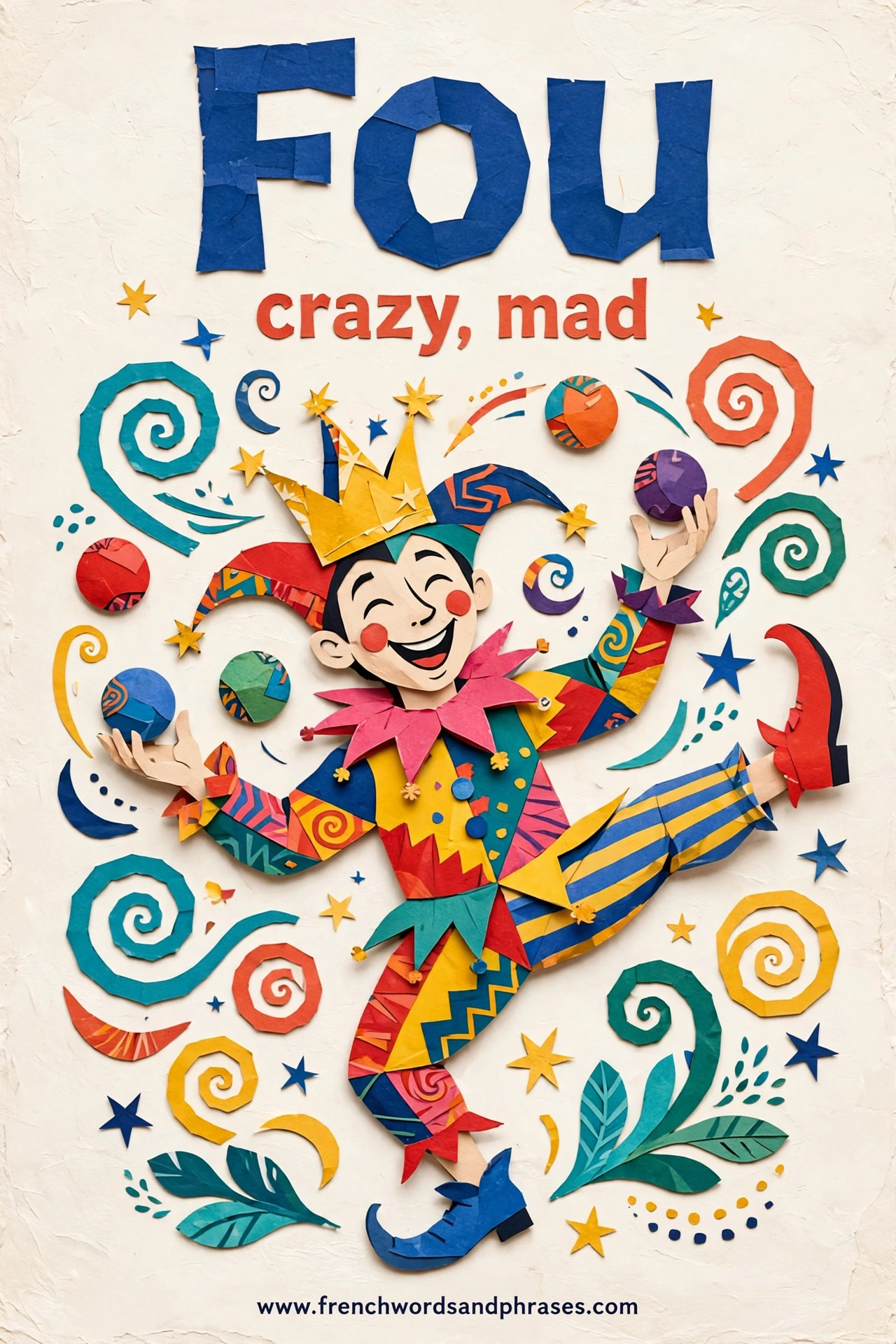
Fou means crazy, mad.
He has cycled across the desert in August, proposed marriage after one week, and bought a boat before learning to swim. « Il est fou ! » says his mother — half horrified, half proud. Fou is the adjective of madness in all its French shades: insane, crazy, wild, and enormous.
In this guide, you’ll learn what fou means in English, how its feminine folle and its special form fol are formed, where it stands in the sentence, and why un monde fou is not a mad world. Explore French examples, English translations, and practice quizzes.
Understanding the French Adjective Fou
Fou is a French adjective of madness and excess, everyday and expressive. Its feminine is folle: un homme fou, une femme folle. Before a masculine noun beginning with a vowel, fou becomes fol: un fol espoir, a mad hope — the same trick as beau/bel and nouveau/nouvel. It comes from the Latin follis, a bellows, then an empty head: the fool’s head, blown up with wind.
It means mad, crazy — first of minds: il est devenu fou, he has gone mad; un fou rire, uncontrollable laughter, a fit of the giggles. Then of behaviour and things, where it softens into wild and incredible: une histoire folle, a crazy story; c’est fou !, it’s incredible! And in set phrases it measures quantity: un monde fou, a huge crowd — literally a mad world of people; un temps fou, a tremendous amount of time; un succès fou, a tremendous success.
Type: Adjective of madness and excess — everyday, expressive
Answers the question: What is it like? — mad, crazy, wild; (quantities) enormous
Changes form: Feminine folle; special masculine fol before a vowel — fou / fol / folle
English equivalents: Mad; crazy; wild; (un monde fou) a huge crowd.
One important usage detail: before a masculine singular noun starting with a vowel or silent h, fou becomes fol — un fol espoir, un fol amour in literary French — exactly like bel for beau. After the noun and after être, fou keeps its normal form: il est fou, un rire fou. And as a noun, un fou is a madman or a jester, and in chess, the bishop.
Experience the Word
Fou is the adjective of the head full of wind — reason blown away, and energy rushing in to fill the space.
Imagine the village fête at midnight: the mayor dancing on the bandstand, the priest winning the sack race, grandmothers queueing for the dodgems. C’était une soirée folle, everyone agrees on the walk home — mad, and the best night of the summer.
You have not just called something insane. You have measured its excess — fou, beyond reason and beyond counting.
How to Use Fou in French: Complete Guide
Let’s explore how fou works in French, beginning with the whole word on one card.
Fou at a Glance
Before the details, here is the whole word on one card.
The Whole Word on One Card
Meaning, type, position and forms — fou in four lines.
| Point | Fou |
|---|---|
| Meaning | mad, crazy, wild — and, of crowds and sums, enormous |
| Type | adjective of madness and excess — expressive |
| Usual position | after the noun — un rire fou; fol before a vowel: un fol espoir |
| Form | fou / folle — fol before a masculine vowel; plurals fous / folles |
Example
Un fou rire a saisi toute la classe.
A fit of the giggles seized the whole class.
The Four Forms of Fou
Fou is one of the adjectives with a special form: fol appears before a masculine noun beginning with a vowel.
| Form | Fou | Example |
|---|---|---|
| Masculine singular | fou | un homme fou — a mad man |
| Masculine before a vowel | fol | un fol espoir — a mad hope |
| Feminine singular | folle | une femme folle — a mad woman |
| Plurals | fous / folles | des projets fous, des idées folles — mad plans, mad ideas |
Example
Des idées folles naissent parfois de grands projets.
Mad ideas sometimes give birth to great projects.
Quick Quiz 1
What is the feminine of fou?
Reveal the answer
folle
Une histoire folle — the feminine doubles the l: folle.
A crazy story.
The Feminine of Fou: Folle
Folle is formed from the old stem foll-: the l doubles and the feminine -e is added, as in molle from mou.
| Situation | Example |
|---|---|
| Masculine | un succès fou — a tremendous success |
| Feminine | une réussite folle — a tremendous success |
| Why | the old stem foll- takes the feminine -e: folle |
| The plural | add s — des réussites folles, tremendous successes |
Example
Une envie folle de partir l’a saisi un matin.
A mad urge to leave seized him one morning.
Where Fou Goes: After the Noun — and Fol Before It
Fou usually follows the noun, but in its quantity phrases it often stands before it, and before a vowel it becomes fol.
| Pattern | Example |
|---|---|
| After the noun | un homme fou — a mad man |
| Before the noun (quantity) | un monde fou — a huge crowd |
| Before a vowel | un fol espoir — a mad hope |
| After être | il est fou — he is mad |
Example
Il y avait un monde fou au marché ce matin.
There was a huge crowd at the market this morning.
Quick Quiz 2
How do you say ‘a mad hope’ — un fou espoir or un fol espoir?
Reveal the answer
un fol espoir
Before a masculine noun beginning with a vowel, fou becomes fol.
A mad hope.
More Fou: Comparing with Fou
Fou compares the regular way, with plus, moins and aussi — though madness usually refuses all measure.
| Degree | Example |
|---|---|
| As mad as | aussi fou que — as mad as |
| Madder | plus fou — madder, crazier |
| Less mad | moins fou — less mad |
| The maddest (masc.) | le plus fou — le plus fou des inventeurs |
| The maddest (fem.) | la plus folle — la plus folle des idées |
Example
C’est l’idée la plus folle de l’année, et elle marche.
It is the maddest idea of the year, and it works.
Everyday Expressions with Fou
Fou runs through daily French wherever reason is left behind — laughter, crowds and love.
| Expression | In English |
|---|---|
| un fou rire | a fit of the giggles, uncontrollable laughter |
| un monde fou | a huge crowd |
| c’est fou ! | it’s incredible! it’s crazy! |
| fou de joie | mad with joy |
| un temps fou | a tremendous amount of time |
| être fou de quelqu’un | to be mad about someone |
Example
Elle est folle de joie depuis la nouvelle.
She has been mad with joy since the news.
Quick Quiz 3
What does un monde fou mean?
Reveal the answer
A huge crowd
Un monde fou — literally a mad world of people: monde here means people, and fou measures the quantity.
A huge crowd.
Fou and Its Neighbours
Fou keeps company with the other words of reason lost — and its chess and court doubles.
| French | In English |
|---|---|
| dément | demented, insane — the clinical cousin |
| insensé | senseless, insane — literary |
| dingue | crazy, nuts — the familiar cousin |
| raisonnable | reasonable, sensible — the opposite |
| le fou | the madman; the jester; the bishop (chess) |
| la folie | madness, folly — the noun |
Example
Dingue entre amis, fou partout : les deux disent la même folie.
Dingue among friends, fou everywhere: both say the same madness.
Watch Out: The Traps Around Fou
The traps here are the fol form, the feminine folle, and the quantity phrases where fou means enormous, not mad.
| Trap | The truth |
|---|---|
| Before a vowel | un fol espoir — fou becomes fol before a masculine vowel |
| The feminine | une femme folle — double l: folle, never foue |
| Quantities | un monde fou, un temps fou — fou measures amount: huge, tremendous |
| The noun | un fou is a madman, a jester — and the bishop in chess |
Example
Il y avait un monde fou, et un fou rire nous a pris en voyant la file.
There was a huge crowd, and a fit of the giggles seized us at the sight of the queue.
Quick Quiz 4
How do you say ‘mad ideas’?
Reveal the answer
des idées folles
Fou agrees with the feminine plural noun: folles.
Mad ideas.
Fou in Everyday French: Real-Life Examples
Now that you know the word, let’s see how fou appears in everyday French.
Example 1 — Incredible
C’est fou, ce qu’il a réussi à faire !
It’s incredible, what he managed to do!
Example 2 — Laughter
Un fou rire a saisi les élèves.
A fit of the giggles seized the pupils.
Example 3 — A crowd
Il y avait un monde fou dans le train.
There was a huge crowd on the train.
Example 4 — Love
Il est fou d’elle depuis le premier jour.
He has been mad about her since the first day.
Example 5 — Joy
Les enfants sont fous de joie.
The children are mad with joy.
Example 6 — Time
J’ai passé un temps fou à chercher mes clés.
I spent a tremendous amount of time looking for my keys.
Beyond Translation: The Meaning of Fou
Fou comes from follis, the bellows: a head full of air, blown up and empty — the Roman picture of the fool. French kept the picture and widened the word until it measures everything reason cannot contain: laughter (un fou rire), love (fou d’amour), crowds (un monde fou) and prices (des prix fous). The court kept its own fou — the jester, the only man licensed to tell the king the truth — and chess borrowed him too: le fou is the bishop, gliding diagonally like a man with a licence.
Fou is the adjective of excess — madness first, then everything too big to count.
Learn it beside folle and fol, and beside dingue for the playground, and you hold the whole French scale of craziness.
How to Remember the French Adjective Fou
Remember it this way: Fou is the mad adjective — fou for him, folle for her, fol before a vowel, and a secret second job measuring crowds and time.
- You learn the trio together — fou, fol devant voyelle, folle au féminin.
- You keep the laughter — un fou rire, la crise de rire incontrôlable.
- You count with it — un monde fou, un temps fou : énorme, pas insensé.
The key idea is fou / fol / folle means mad, crazy; un monde fou = a huge crowd.
Test Your Knowledge of Fou
Let’s see how much you’ve learned. Try answering these questions before revealing the answers.
Question 1
What does fou mean?
Reveal the answer
Mad, crazy — and, of crowds and quantities, enormous.
Question 2
What is the feminine of fou?
Reveal the answer
folle — with a double l.
Question 3
Translate: It’s incredible!
Reveal the answer
C’est fou !
Question 4
Complete the sentence:
Il nourrit un ______ espoir de gagner. (mad)
Reveal the answer
fol
Il nourrit un fol espoir de gagner.
He harbours a mad hope of winning — fol before the vowel.
Question 5
In chess, what is le fou?
Reveal the answer
The bishop — the piece that moves diagonally; le fou is also the madman and the jester.
Your Final Challenge
Can You Use It?
How would you say this in French?
“There was a huge crowd at the market this morning.”
Reveal the answer
Il y avait un monde fou au marché ce matin.
There was a huge crowd at the market this morning.
A little French. A little curiosity. A richer everyday life.
LEARN FRENCH ONE WORD AT A TIME