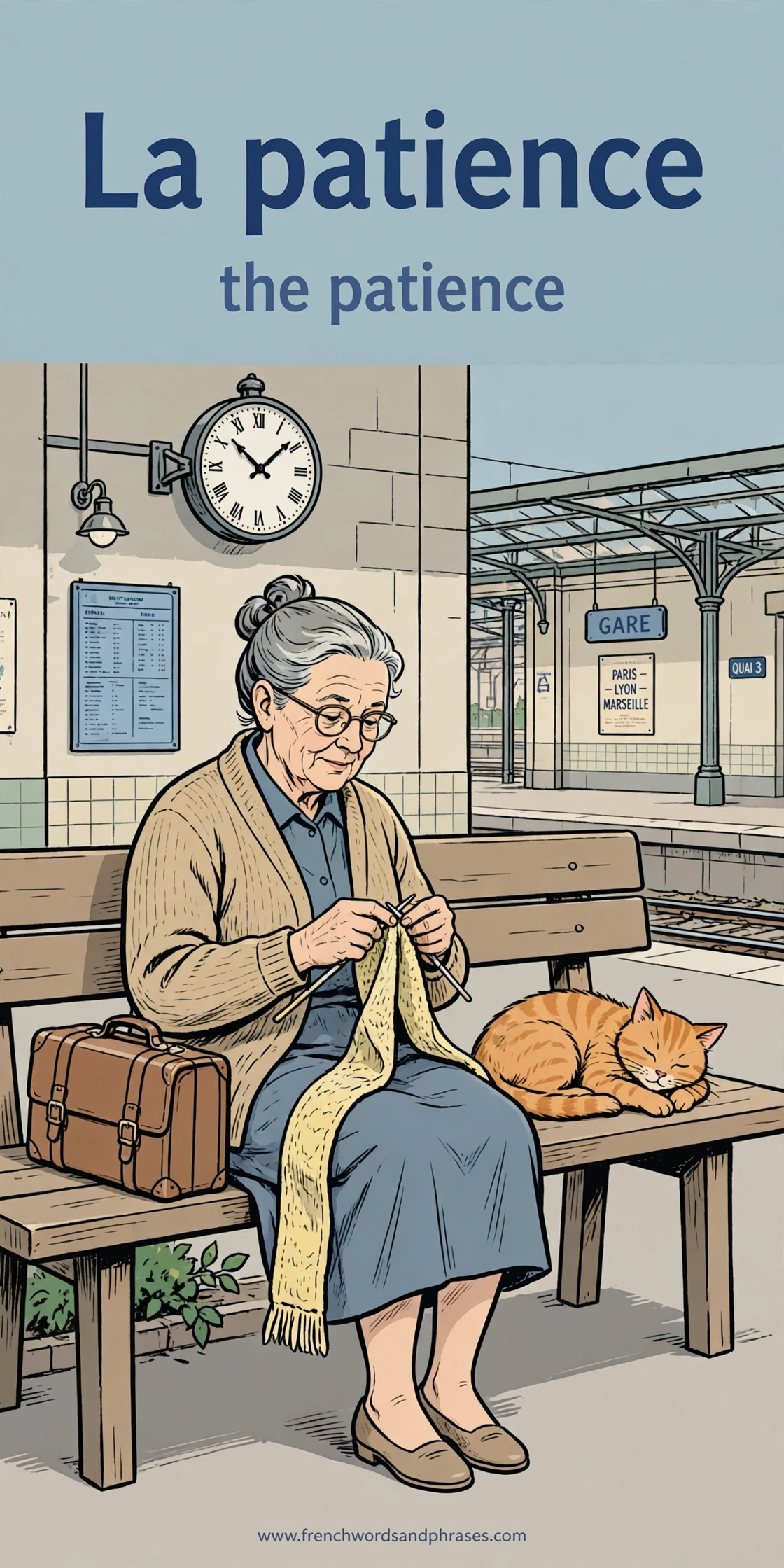
A French Word to Live By
Translate Patience to English
/pa.sjɑ̃s/
La patience means the patience.
The queue does not move, the toddler asks the same question for the ninth time, the sauce must not be hurried — and someone breathes out slowly and smiles: la patience, patience, the quiet strength French praises as a virtue and tests a dozen times a day.
In this guide, you’ll learn what patience means in English, how to use it with its articles, how to form its plural, and how it appears in everyday French. Explore French examples, English translations, and practice quizzes.
Understanding the French Noun Patience
Patience is a feminine French noun, learned with its article: la patience, la patience in its abstract life has no plural that matters. It comes from the Latin patientia, endurance, from pati, to suffer or to bear — patience, in the word’s own memory, is suffering carried calmly. The same Latin root gives French un patient, the hospital patient: the one who bears and waits.
It means patience — the calm endurance of delay, difficulty or provocation: avoir de la patience, to have patience, perdre patience, to lose patience, avec patience, patiently, with patience. The word has two charming second lives: une patience is also a game of solitaire played with cards — faire une patience, to play a game of patience — and in the garden, la patience is a dock plant, a cousin of sorrel.
Gender: Feminine — la patience
Definite article: la — la patience (the patience)
Indefinite article: de la — avoir de la patience (to have patience, partitive)
Plural: les patiences — used for the card games, not for the virtue
Spelling note: from Latin patientia, from pati, to bear — the same root as un patient at the hospital
Second life: une patience — a game of solitaire with cards
English equivalents: The patience.
As a virtue, patience is a mass word: French measures it with the partitive — avoir de la patience, beaucoup de patience, un peu de patience. You lose it with perdre patience and keep it with prendre patience, to wait patiently, a gentle order to oneself. The teacher’s classic line is patience et longueur de temps font plus que force ni que rage — patience and time do more than force or rage, straight from La Fontaine.
Experience the Word
Patience is strength standing still — the virtue of the fisherman, the gardener and everyone who has ever taught a child to tie a shoelace.
Imagine the grandmother at the kitchen table after lunch, cards laid out in careful rows, the whole house quiet around her game: elle fait une patience, and time itself slows to her rhythm.
You have not just named a quality. You have named calm under pressure — la patience, the art of waiting without breaking.
How to Use Patience in French: Complete Guide
Let’s explore how patience works in French, beginning with its articles — la patience, de la patience, perdre patience.
Patience with the Definite Article (La, Les)
Used for patience as a named quality — the patience of a teacher, of a saint.
| Form | French |
|---|---|
| Feminine singular | la patience |
| Plural | les patiences (the card games) |
Example
La patience de la maîtresse est célèbre dans toute l’école.
The teacher’s patience is famous throughout the school.
Patience with the Partitive (De la patience…)
Patience the virtue is measured, not counted: some patience, a lot of patience, no patience at all.
| Form | French |
|---|---|
| Feminine singular | de la patience |
| Plural | des patiences (games of solitaire) |
Example
Il faut de la patience pour apprendre le piano.
You need patience to learn the piano.
Patience with Quantities (Beaucoup de patience…)
French doses patience like a medicine — a little, a lot, the whole supply.
| Quantity | French |
|---|---|
| a lot of patience | beaucoup de patience |
| a little patience | un peu de patience |
| no patience (after negation) | pas de patience |
| with patience | avec patience |
| to lose patience | perdre patience |
Example
Avec des jumeaux, il faut beaucoup de patience.
With twins, you need a lot of patience.
Quick Quiz 1
Complete the sentence:
______ patience est une vertu. (the)
Reveal the answer
La
La patience est une vertu.
Patience is a virtue — patience is feminine, so la.
The Plural of Patience
The virtue has no real plural; les patiences belongs to the card table — games of solitaire, one after another.
| Number | French |
|---|---|
| Singular | la patience |
| Plural | les patiences (card games) |
Example
Elle fait des patiences en attendant le train.
She plays games of solitaire while waiting for the train.
Patience with Possessive Adjectives (Ma, Ta, Sa…)
Possessives agree with the noun: patience is feminine, so ma, ta, sa in the singular.
| Owner | French |
|---|---|
| my | ma patience |
| your (tu) | ta patience |
| his / her | sa patience |
| our | notre patience |
| your (vous) | votre patience |
| their | leur patience |
Example
Tu mets ma patience à l’épreuve.
You are testing my patience.
Quick Quiz 2
Complete the sentence:
Ne perds pas ______ patience, on arrive bientôt. (your)
Reveal the answer
ta
Ne perds pas ta patience, on arrive bientôt.
Don’t lose your patience, we’ll be there soon — ta, because patience is feminine.
Patience with Demonstrative Adjectives (Cette, Ces)
Used to point at a quality on display: cette patience, this patience of hers.
| Form | French |
|---|---|
| Feminine singular | cette patience |
| Plural | ces patiences |
Example
Cette patience avec les enfants est admirable.
This patience with children is admirable.
Patience with Adjectives
Adjectives agree with patience — feminine singular: une patience infinie, une grande patience.
| Adjective | With Patience |
|---|---|
| infinie (infinite) | une patience infinie |
| grande (great) | une grande patience |
| douce (gentle) | une douce patience |
| à toute épreuve (unshakeable) | une patience à toute épreuve |
Example
Elle écoute les élèves avec une patience infinie.
She listens to the pupils with infinite patience.
Quick Quiz 3
Complete the sentence:
Il répond avec une patience ______. (infinite)
Reveal the answer
infinie
Il répond avec une patience infinie.
He answers with infinite patience — infinie, feminine, to agree with patience.
Everyday Expressions with Patience
Queues, classrooms and card tables — the patience phrases of daily life.
| Expression | In English |
|---|---|
| avoir de la patience | to have patience |
| perdre patience | to lose patience |
| prendre patience | to wait patiently |
| faire une patience | to play a game of solitaire |
| la patience a des limites | patience has its limits |
Example
Prends patience, le médecin arrive.
Be patient, the doctor is coming.
Words from the Same Family as Patience
Bearing and waiting — the words that travel with patience.
| French | In English |
|---|---|
| patient / patiente | patient (the adjective) |
| un patient | a patient at the hospital — the one who bears |
| patiemment | patiently (the adverb) |
| s’impatienter | to grow impatient, to fidget with impatience |
| l’impatience | impatience — the opposite |
Example
Le patient attend le médecin avec patience.
The patient waits for the doctor with patience.
Quick Quiz 4
What does faire une patience mean?
Reveal the answer
To play a game of solitaire — patience is also the name of the card game.
Elle fait une patience après le déjeuner.
She plays a game of solitaire after lunch.
Patience in Everyday French: Real-Life Examples
Now that you know the word, let’s see how patience appears in everyday French.
Example 1 — In the queue
Il faut de la patience, la file est longue.
You need patience, the queue is long.
Example 2 — With children
Elle a une patience infinie avec les petits.
She has infinite patience with the little ones.
Example 3 — Losing it
Ne me fais pas perdre patience !
Don’t make me lose my patience!
Example 4 — The card game
Grand-mère fait une patience après le repas.
Grandmother plays a game of solitaire after the meal.
Example 5 — Gardening
Le jardinier travaille avec patience.
The gardener works patiently.
Example 6 — Limits
Ma patience a des limites, tu sais.
My patience has its limits, you know.
Beyond Translation: The Meaning of Patience
Patience carries its philosophy in its root: Latin pati means to suffer and to endure, so French patience is not mere waiting — it is bearing, calmly, what cannot be hurried. La Fontaine gave the virtue its motto in Le Lion et le Rat: patience et longueur de temps font plus que force ni que rage — patience and length of time accomplish more than force or fury. And the language smiles at its own virtue by lending the word to a card game played alone, slowly, against chance: the perfect emblem of the quality itself.
To say patience is to praise the strength that does not push.
It evokes fishing lines, gardens, grandmothers with cards — everything in French life that ripens at its own speed.
How to Remember the French Noun Patience
Remember it this way: Patience is the virtue — feminine, measured with the partitive: de la patience, beaucoup de patience.
- Always feminine — la patience, ma patience, cette patience.
- A mass word — avoir de la patience, to have patience; perdre patience, to lose it.
- The card game — faire une patience, to play solitaire.
The key idea is la patience — the patience, feminine; de la patience, and une patience = a game of solitaire.
Test Your Knowledge of Patience
Let’s see how much you’ve learned. Try answering these questions before revealing the answers.
Question 1
Is patience masculine or feminine?
Reveal the answer
Feminine — la patience, ma patience.
Question 2
How do you say to have patience?
Reveal the answer
Avoir de la patience.
Question 3
Translate: Don’t lose your patience.
Reveal the answer
Ne perds pas ta patience.
Question 4
What else can une patience be, besides the virtue?
Reveal the answer
A game of solitaire — a card game played alone: faire une patience.
Question 5
Complete the sentence:
Il faut ______ patience pour apprendre le piano. (some)
Reveal the answer
de la
Il faut de la patience pour apprendre le piano.
You need patience to learn the piano — the partitive de la.
Your Final Challenge
Can You Use It?
How would you say this in French?
“You need patience to learn the piano.”
Reveal the answer
Il faut de la patience pour apprendre le piano.
You need patience to learn the piano.
A little French. A little curiosity. A richer everyday life.
LEARN FRENCH ONE WORD AT A TIME