A French Word to Live By
Translate Jeunesse to English
/ʒœ.nɛs/
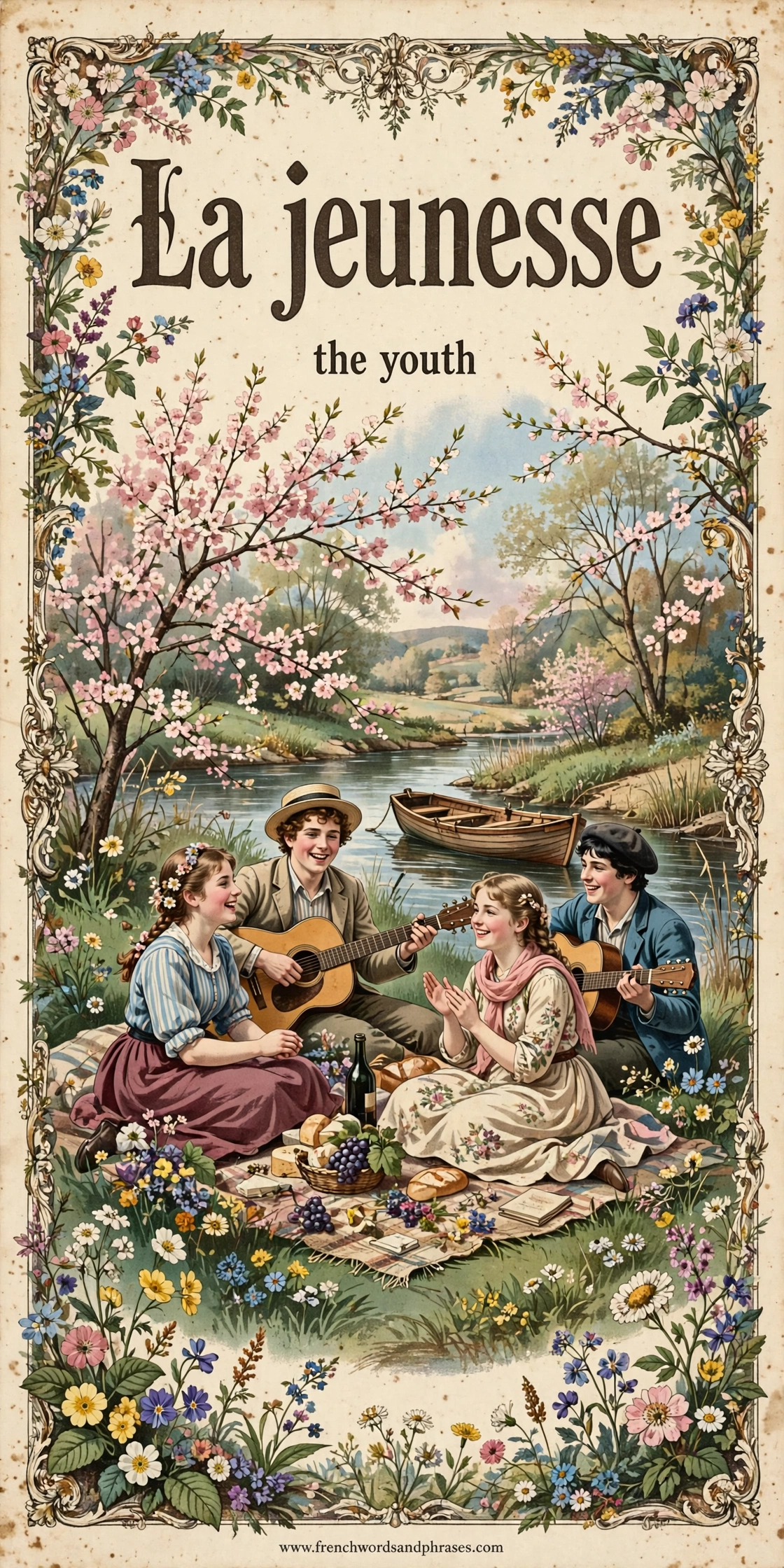
La jeunesse means the youth.
Schoolbags on shoulders, music too loud, the whole future still unwritten: la jeunesse, youth — in French one word holds both the season of life itself and the young people living it, la jeunesse d’aujourd’hui, the youth of today.
In this guide, you’ll learn what jeunesse means in English, how to use it with its articles, how to form its plural, and how it appears in everyday French. Explore French examples, English translations, and practice quizzes.
Understanding the French Noun Jeunesse
Jeunesse is a feminine French noun, learned with its article: la jeunesse, une jeunesse. It is built on the adjective jeune, young, with the suffix -esse that turns a quality into a state — the same ending as richesse (wealth) and tristesse (sadness). It almost always lives in the singular: youth is a collective country, not a pile of separate things.
It means youth in two linked senses. First, the period of life: passer sa jeunesse à Paris, to spend one’s youth in Paris, les souvenirs de jeunesse, memories of youth. Second, the young people themselves, as a group: la jeunesse d’aujourd’hui, today’s youth, la jeunesse du village, the young people of the village. For one young person, French uses un jeune or une jeune — jeunesse itself is never a single teenager.
Gender: Feminine — la jeunesse
Definite article: la — la jeunesse (the youth)
Indefinite article: une — une jeunesse (a youth, a young life)
Plural: les jeunesses — rare; jeunesse is usually a singular collective
Spelling note: jeune + -esse, the suffix of states: richesse, tristesse, jeunesse
Close neighbour: les jeunes — young people; un jeune, one young person
English equivalents: The youth.
Jeunesse behaves like a mass word: you speak of la jeunesse as a whole, the way English speaks of youth. To say what someone did when young, French says dans sa jeunesse, in his/her youth, and the famous warning runs si jeunesse savait, si vieillesse pouvait — if youth knew, if old age could. A youth hostel is une auberge de jeunesse.
Experience the Word
Jeunesse is the one country everyone has lived in and nobody can move back to — French names it with tenderness and a little envy.
Imagine the village square on a July evening: the jeunesse has taken the café terraces, the scooters lean by the fountain, and the old men at the pétanque court watch their own past playing in front of them.
You have not just named an age. You have named the springtime of a life — la jeunesse, youth, brief and blazing.
How to Use Jeunesse in French: Complete Guide
Let’s explore how jeunesse works in French, beginning with its articles — la jeunesse, une jeunesse, la jeunesse d’aujourd’hui.
Jeunesse with the Definite Article (La, Les)
Used for youth as a whole — the generation, the season of life.
| Form | French |
|---|---|
| Feminine singular | la jeunesse |
| Plural | les jeunesses (rare) |
Example
La jeunesse d’aujourd’hui voyage beaucoup.
Today’s youth travels a lot.
Jeunesse with the Indefinite Article (Une, Des)
Une jeunesse presents one young life as a whole story — a happy youth, a difficult youth.
| Form | French |
|---|---|
| Feminine singular | une jeunesse |
| Plural | des jeunesses (rare) |
Example
Il a eu une jeunesse heureuse à la campagne.
He had a happy youth in the countryside.
Jeunesse in Set Phrases (Sa jeunesse, Toute la jeunesse…)
Jeunesse is measured in lives and generations, not in countable pieces.
| Quantity | French |
|---|---|
| his / her youth | sa jeunesse |
| all the young people | toute la jeunesse |
| a second youth | une seconde jeunesse |
| the village youth | la jeunesse du village |
| a youth hostel | une auberge de jeunesse |
Example
Elle a passé sa jeunesse à Lyon.
She spent her youth in Lyon.
Quick Quiz 1
Complete the sentence:
______ jeunesse d’aujourd’hui adore la musique. (the)
Reveal the answer
La
La jeunesse d’aujourd’hui adore la musique.
Today’s youth loves music — jeunesse is feminine, so la.
The Plural of Jeunesse
The plural jeunesses exists but is rare — it compares the young generations of different eras or places.
| Number | French |
|---|---|
| Singular | la jeunesse |
| Plural | les jeunesses |
Example
Les jeunesses des deux pays se rencontrent chaque été.
The young people of the two countries meet every summer.
Jeunesse with Possessive Adjectives (Ma, Ta, Sa…)
Possessives agree with the noun: jeunesse is feminine, so ma, ta, sa in the singular.
| Owner | French |
|---|---|
| my | ma jeunesse |
| your (tu) | ta jeunesse |
| his / her | sa jeunesse |
| our | notre jeunesse |
| your (vous) | votre jeunesse |
| their | leur jeunesse |
Example
Il raconte souvent sa jeunesse à ses petits-enfants.
He often tells his grandchildren about his youth.
Quick Quiz 2
Complete the sentence:
Dans ______ jeunesse, mon grand-père travaillait aux champs. (his)
Reveal the answer
sa
Dans sa jeunesse, mon grand-père travaillait aux champs.
In his youth, my grandfather worked in the fields — sa, because jeunesse is feminine.
Jeunesse with Demonstrative Adjectives (Cette, Ces)
Used to point at a generation: cette jeunesse, this youth of ours.
| Form | French |
|---|---|
| Feminine singular | cette jeunesse |
| Plural | ces jeunesses |
Example
Cette jeunesse est pleine d’énergie.
This generation of young people is full of energy.
Jeunesse with Adjectives
Adjectives agree with jeunesse — feminine singular: la jeunesse dorée, the gilded youth.
| Adjective | With Jeunesse |
|---|---|
| dorée (gilded) | la jeunesse dorée |
| d’aujourd’hui (of today) | la jeunesse d’aujourd’hui |
| heureuse (happy) | une jeunesse heureuse |
| difficile (difficult) | une jeunesse difficile |
| éternelle (eternal) | la jeunesse éternelle |
Example
Elle cherche le secret de la jeunesse éternelle.
She is looking for the secret of eternal youth.
Quick Quiz 3
Complete the sentence:
Il a eu une jeunesse très ______. (happy)
Reveal the answer
heureuse
Il a eu une jeunesse très heureuse.
He had a very happy youth — heureuse, feminine, to agree with jeunesse.
Everyday Expressions with Jeunesse
Generations, hostels and proverbs — the jeunesse phrases of daily life.
| Expression | In English |
|---|---|
| la jeunesse d’aujourd’hui | today’s youth |
| passer sa jeunesse | to spend one’s youth |
| les souvenirs de jeunesse | memories of youth |
| une auberge de jeunesse | a youth hostel |
| si jeunesse savait… | if youth only knew… (proverb) |
Example
Nous dormons dans une auberge de jeunesse à Paris.
We are staying in a youth hostel in Paris.
Words from the Same Family as Jeunesse
Being young — the words that travel with jeunesse.
| French | In English |
|---|---|
| jeune | young (the adjective) |
| un jeune | a young person |
| les jeunes | young people |
| la vieillesse | old age — the opposite shore |
| rajeunir | to look younger, to rejuvenate |
Example
Les jeunes du quartier jouent au foot le soir.
The young people of the neighbourhood play football in the evening.
Quick Quiz 4
What is une auberge de jeunesse?
Reveal the answer
A youth hostel — cheap lodgings for young travellers.
L’auberge de jeunesse est complète en juillet.
The youth hostel is fully booked in July.
Jeunesse in Everyday French: Real-Life Examples
Now that you know the word, let’s see how jeunesse appears in everyday French.
Example 1 — Generations
La jeunesse d’aujourd’hui ne vit pas comme nous.
Today’s youth does not live like we did.
Example 2 — Memories
Il parle de sa jeunesse avec un sourire.
He talks about his youth with a smile.
Example 3 — Travel
Ils dorment dans une auberge de jeunesse.
They are staying in a youth hostel.
Example 4 — The village
La jeunesse du village organise la fête.
The young people of the village are organising the festival.
Example 5 — A second spring
À soixante ans, elle vit une seconde jeunesse.
At sixty, she is enjoying a second youth.
Example 6 — The proverb
Si jeunesse savait, si vieillesse pouvait !
If youth only knew, if old age only could!
Beyond Translation: The Meaning of Jeunesse
Jeunesse is one half of French’s great pair of shores: la jeunesse and la vieillesse, youth and old age, with a whole life flowing between them. The language treats youth as a place you inhabit and then leave — on passe sa jeunesse quelque part, one spends one’s youth somewhere, the way one spends money or time. La Fontaine’s proverb keeps the accounts: si jeunesse savait, si vieillesse pouvait — youth has the strength but not the knowledge, age has the knowledge but not the strength.
To say jeunesse is to name the spring of a life — and everyone listening remembers their own.
It evokes schoolbags, first loves and village festivals — the season when everything is still possible.
How to Remember the French Noun Jeunesse
Remember it this way: Jeunesse is youth — the season of life and the young people together: la jeunesse, and it lives in the singular.
- Always feminine — la jeunesse, une jeunesse, ma jeunesse.
- A collective — la jeunesse is all the young together; one young person is un jeune.
- The hostel phrase — une auberge de jeunesse, a youth hostel.
The key idea is la jeunesse — the youth, feminine; collective singular, from jeune + -esse.
Test Your Knowledge of Jeunesse
Let’s see how much you’ve learned. Try answering these questions before revealing the answers.
Question 1
Is jeunesse masculine or feminine?
Reveal the answer
Feminine — la jeunesse, une jeunesse.
Question 2
How do you say today’s youth?
Reveal the answer
La jeunesse d’aujourd’hui.
Question 3
Translate: She spent her youth in Lyon.
Reveal the answer
Elle a passé sa jeunesse à Lyon.
Question 4
How do you say one young person?
Reveal the answer
Un jeune / une jeune — jeunesse itself names the whole group or the season of life, never one teenager.
Question 5
Complete the sentence:
______ jeunesse du village organise la fête. (the)
Reveal the answer
La
La jeunesse du village organise la fête.
The young people of the village are organising the festival.
Your Final Challenge
Can You Use It?
How would you say this in French?
“Today’s youth travels a lot.”
Reveal the answer
La jeunesse d’aujourd’hui voyage beaucoup.
Today’s youth travels a lot.
A little French. A little curiosity. A richer everyday life.
LEARN FRENCH ONE WORD AT A TIME