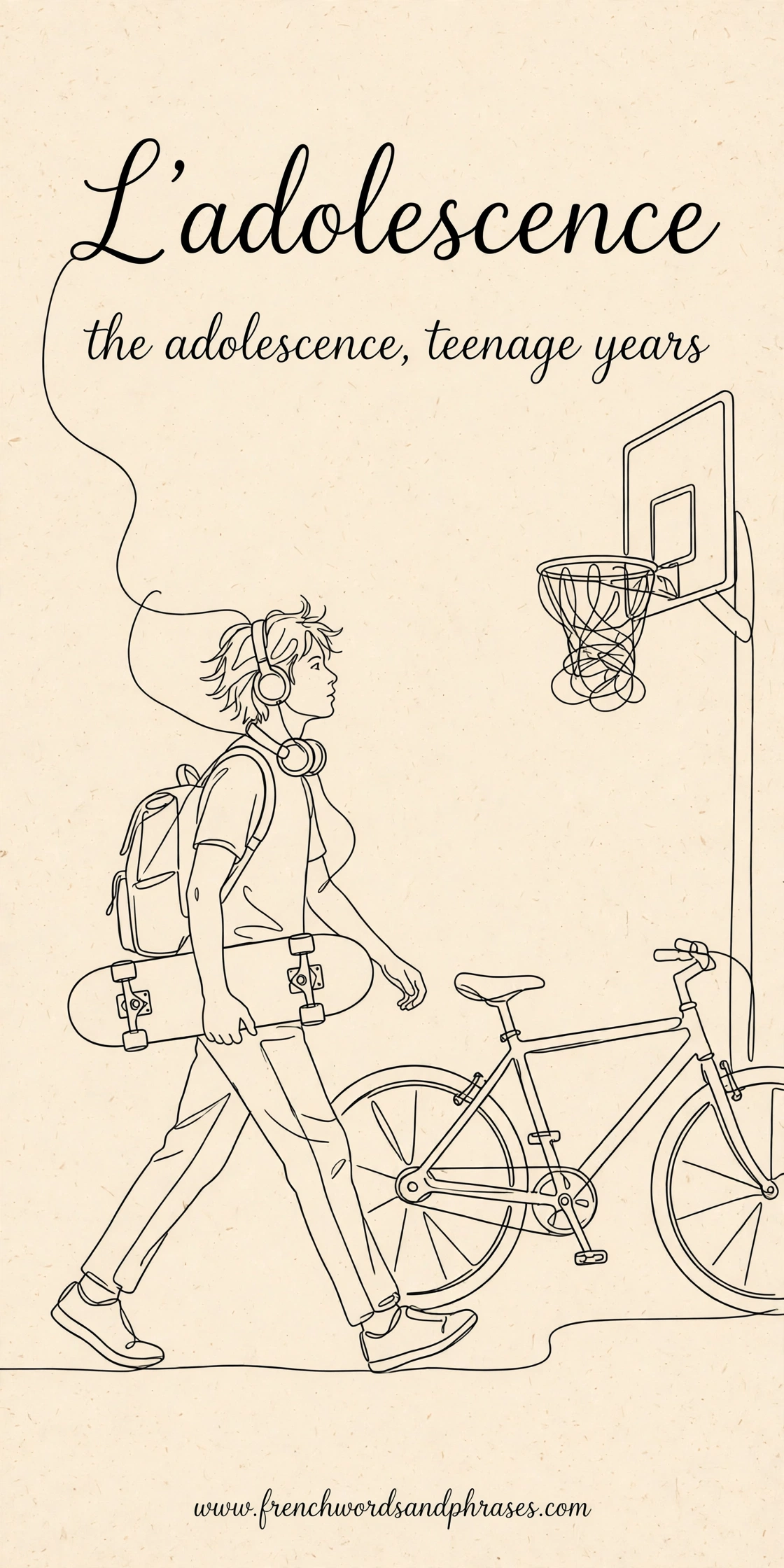
A French Word to Live By
Translate Adolescence to English
/a.dɔ.le.sɑ̃s/
L’adolescence means the adolescence, teenage years.
Too tall for the children’s table, too young for the adults’ conversation, growing out of shoes and certainties at the same speed: l’adolescence, adolescence — the teenage years, that bright and stormy corridor between childhood and adulthood where the French themselves were once, as every parent sighs, « en pleine adolescence ».
In this guide, you’ll learn what adolescence means in English, how to use it with its articles, how to form its plural, and how it appears in everyday French. Explore French examples, English translations, and practice quizzes.
Understanding the French Noun Adolescence
Adolescence is a feminine French noun, learned with its article: l’adolescence, (rarely) une adolescence. It comes from the Latin adolescentia, from adolescere, to grow up. It is a period word, almost always singular — one does not count adolescences, one survives them. The person inside it is un adolescent, une adolescente — l’ado in the family’s shorthand.
It means adolescence, the teenage years — roughly the years between childhood and adulthood: pendant mon adolescence, during my adolescence; l’adolescence est un âge difficile, adolescence is a difficult age; il est en pleine adolescence, he is in the middle of his teens, with all the slammed doors the phrase implies. French also gives it to other growing things by metaphor: un pays en pleine adolescence, a country in its turbulent youth.
Gender: Feminine — l’adolescence
Definite article: l’ — l’adolescence (adolescence)
Indefinite article: une — une adolescence (an adolescence, rare and literary)
Plural: almost never used — a period, not a countable thing
The person: un adolescent, une adolescente — l’ado (familiar)
Key phrase: en pleine adolescence — in the middle of the teenage years
English equivalents: Adolescence; the teenage years.
Adolescence names the period; adolescent names the person — never swap them: « mon fils est un adolescent », not « une adolescence ». For the years themselves French also says les années d’adolescence or, warmly, ses années de lycée. Parents use en pleine adolescence as a complete explanation — for the moods, the music, the fridge emptied at midnight — and no further detail is required.
Experience the Word
Adolescence is the corridor of the house of life — nobody lives there, everybody passes through, and the doors slam beautifully.
Imagine the family photograph five years apart: the same boy, but the second picture has a stranger’s height, a deeper voice and opinions about everything. Entre les deux photos : l’adolescence, le pays des tempêtes et des premières libertés.
You have not just named some years. You have named the growing season itself — l’adolescence.
How to Use Adolescence in French: Complete Guide
Let’s explore how adolescence works in French, beginning with its articles — l’adolescence, pendant l’adolescence, en pleine adolescence.
Adolescence with the Definite Article (L’, Les)
The article elides before the vowel: l’adolescence — the period itself, almost always singular.
| Form | French |
|---|---|
| Feminine singular | l’adolescence |
| Plural | — (periods are not counted) |
Example
L’adolescence commence vers douze ans.
Adolescence begins around the age of twelve.
Adolescence with the Indefinite Article (Une, Des)
Une adolescence appears in memoirs and novels — one person’s particular growing years.
| Form | French |
|---|---|
| Feminine singular | une adolescence (literary) |
| Plural | — |
Example
Elle raconte une adolescence heureuse à la campagne.
She recounts a happy adolescence in the country.
Adolescence with Quantities (Un, Deux, Assez de…)
Adolescence resists counting — French measures it in years and phases instead.
| Quantity | French |
|---|---|
| the whole of adolescence | toute l’adolescence |
| the beginning of adolescence | le début de l’adolescence |
| the end of adolescence | la fin de l’adolescence |
| the middle of it | la pleine adolescence |
| years of adolescence | des années d’adolescence |
Example
Il a passé toute son adolescence au bord de la mer.
He spent his whole adolescence by the sea.
Quick Quiz 1
Complete the sentence:
______ adolescence est un âge de changements. (the)
Reveal the answer
L’
L’adolescence est un âge de changements.
Adolescence is an age of changes — the article elides before the vowel.
The Plural of Adolescence
There is effectively no plural: adolescence is a season of life, and seasons are lived one at a time.
| Number | French |
|---|---|
| Singular | l’adolescence |
| Plural | — (use les années d’adolescence instead) |
Example
Les années d’adolescence passent vite, dit-elle.
The teenage years pass quickly, she says.
Adolescence with Possessive Adjectives (Mon, Ton, Son…)
Possessives agree with the noun: adolescence is feminine but starts with a vowel, so mon, ton, son — as for masculine nouns.
| Owner | French |
|---|---|
| my | mon adolescence |
| your (tu) | ton adolescence |
| his / her | son adolescence |
| our | notre adolescence |
| your (vous) | votre adolescence |
| their | leur adolescence |
Example
Mon adolescence s’est passée dans un petit village.
My adolescence was spent in a small village.
Quick Quiz 2
Complete the sentence:
Elle raconte ______ adolescence dans son livre. (her)
Reveal the answer
son
Elle raconte son adolescence dans son livre.
She recounts her adolescence in her book — son, because adolescence begins with a vowel.
Adolescence with Demonstrative Adjectives (Cette, Ces)
Used to point: cette adolescence, this adolescence — the one being remembered or survived.
| Form | French |
|---|---|
| Feminine singular | cette adolescence |
| Plural | — |
Example
Cette adolescence-là fut libre et joyeuse.
That adolescence was free and joyful.
Adolescence with Adjectives
Adjectives agree with adolescence — feminine; they colour the corridor: stormy, happy, endless.
| Adjective | With Adolescence |
|---|---|
| heureuse (happy) | une adolescence heureuse |
| difficile (difficult) | une adolescence difficile |
| pleine (full, mid-) | en pleine adolescence |
| longue (long) | une longue adolescence |
| parisienne (Parisian) | une adolescence parisienne |
Example
En pleine adolescence, il écoute de la musique toute la journée.
In the middle of his teens, he listens to music all day.
Quick Quiz 3
Who is en pleine adolescence — a toddler or a teenager?
Reveal the answer
A teenager — en pleine adolescence means right in the middle of the teenage years.
À quinze ans, on est en pleine adolescence. — At fifteen, you are in the middle of adolescence.
Everyday Expressions with Adolescence
Parents’ sighs, memoirs and school reports — the adolescence phrases of daily life.
| Expression | In English |
|---|---|
| en pleine adolescence | in the middle of the teenage years |
| pendant mon adolescence | during my adolescence |
| la crise d’adolescence | the teenage crisis, the adolescent phase |
| sortir de l’adolescence | to come out of adolescence, to grow up |
| les années d’adolescence | the teenage years |
Example
La crise d’adolescence, ça passera, dit le médecin en souriant.
The teenage phase will pass, says the doctor, smiling.
Words from the Same Family as Adolescence
The growing shelf — adolescence’s family of French words.
| French | In English |
|---|---|
| un adolescent / une adolescente | a teenager, an adolescent |
| l’ado | the teen (familiar short form) |
| l’enfance | childhood — the season before |
| la jeunesse | youth — the wider season |
| grandir | to grow up (the verb) |
Example
Après l’enfance vient l’adolescence, puis la jeunesse.
After childhood comes adolescence, then youth.
Quick Quiz 4
What is the difference between adolescence and adolescent?
Reveal the answer
Adolescence is the period; adolescent is the person — un adolescent vit son adolescence.
L’adolescent traverse l’adolescence. — The teenager goes through adolescence.
Adolescence in Everyday French: Real-Life Examples
Now that you know the word, let’s see how adolescence appears in everyday French.
Example 1 — Parents
Il est en pleine adolescence, patience !
He’s in the middle of his teens, patience!
Example 2 — Memories
Pendant mon adolescence, j’habitais à Nantes.
During my adolescence, I lived in Nantes.
Example 3 — School
L’adolescence est l’âge des grandes amitiés.
Adolescence is the age of great friendships.
Example 4 — Growing up
Elle sort doucement de l’adolescence.
She is slowly coming out of adolescence.
Example 5 — The crisis
La crise d’adolescence secoue toute la maison.
The teenage phase is shaking the whole house.
Example 6 — Metaphor
Ce jeune journal est encore en pleine adolescence.
This young newspaper is still in its adolescence.
Beyond Translation: The Meaning of Adolescence
Adolescence is a modern country: the Romans had the word (adolescentia) but not the long school-kept season we mean by it. Compulsory schooling built the corridor — years between the child’s world and the worker’s — and the twentieth century furnished it with its music, its clothes and its beautiful storms. French marks the season’s person with ado, the affectionate clipping every family uses.
To say adolescence is to name the growing season — the corridor everyone crosses and nobody forgets.
Before it, l’enfance; after it, la jeunesse and then the adult shore: adolescence is the ferry between.
How to Remember the French Noun Adolescence
Remember it this way: Adolescence is the teenage season — feminine, elided, almost always singular, with adolescent for the person inside it.
- Always feminine — l’adolescence, mon adolescence (voyelle !), cette adolescence.
- The period, not the person — l’adolescence est la saison ; l’adolescent est la personne.
- The parent’s phrase — en pleine adolescence explique tout.
The key idea is l’adolescence — adolescence, the teenage years; un adolescent = a teenager; en pleine adolescence = mid-teens.
Test Your Knowledge of Adolescence
Let’s see how much you’ve learned. Try answering these questions before revealing the answers.
Question 1
Is adolescence masculine or feminine?
Reveal the answer
Feminine — l’adolescence, cette adolescence.
Question 2
How do you say in the middle of the teenage years?
Reveal the answer
En pleine adolescence.
Question 3
Translate: During my adolescence, I lived in Nantes.
Reveal the answer
Pendant mon adolescence, j’habitais à Nantes.
Question 4
What is a teenager called in French?
Reveal the answer
Un adolescent / une adolescente — l’ado in familiar speech.
Question 5
Complete the sentence:
______ adolescence commence vers douze ans. (the)
Reveal the answer
L’
L’adolescence commence vers douze ans.
Adolescence begins around the age of twelve.
Your Final Challenge
Can You Use It?
How would you say this in French?
“He’s in the middle of his teens, patience!”
Reveal the answer
Il est en pleine adolescence, patience !
He’s in the middle of his teens, patience!
A little French. A little curiosity. A richer everyday life.
LEARN FRENCH ONE WORD AT A TIME