A French Word to Live By
Translate Nièce to English
/njɛs/
La nièce means the niece.
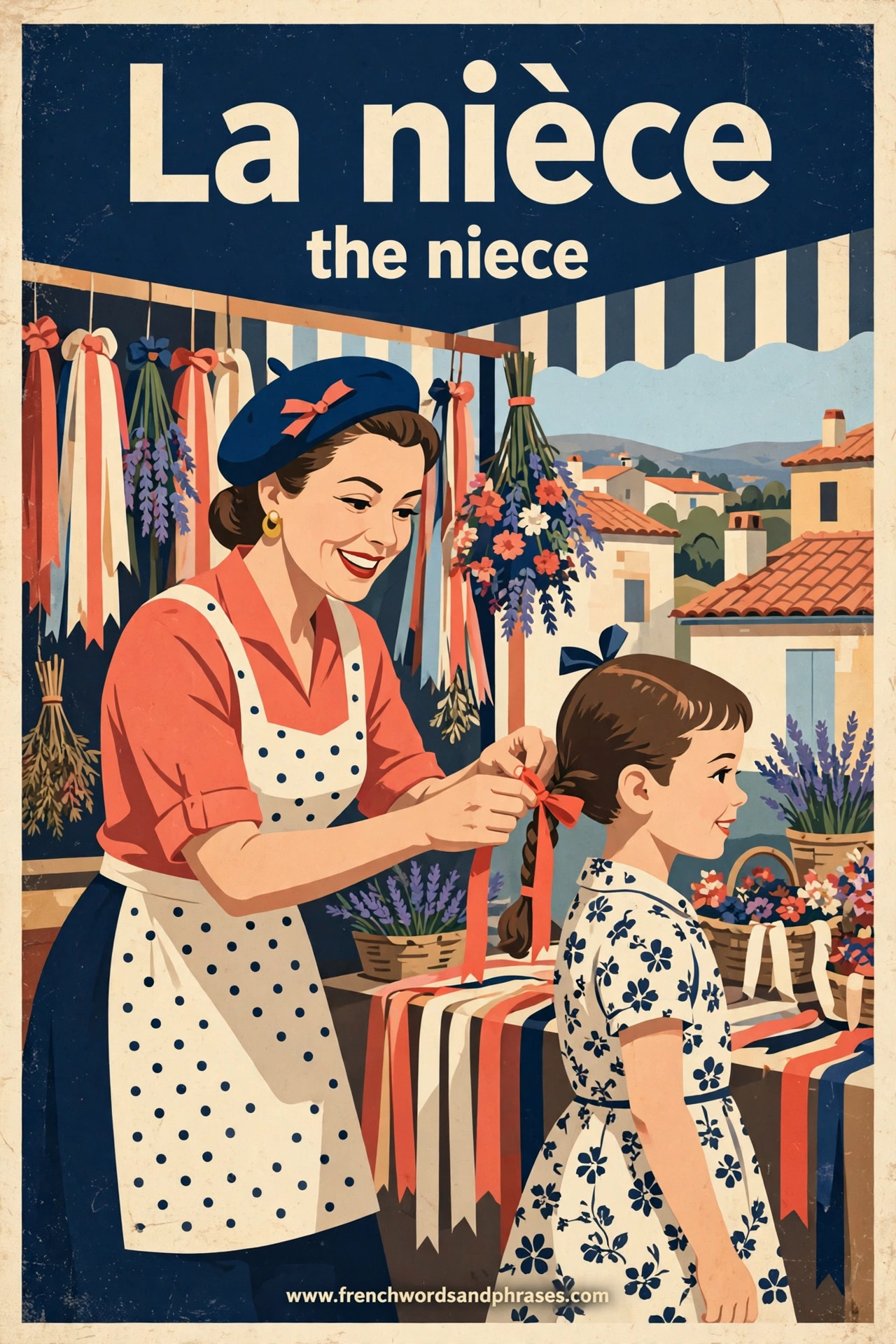
She has her aunt’s laugh, her uncle’s stubborn chin, and a standing invitation to every holiday the family holds: la nièce, the niece — your brother’s or sister’s daughter, the girl of the family who is yours by the side door of love.
In this guide, you’ll learn what nièce means in English, how to use it with its articles, how to form its plural, and how it appears in everyday French. Explore French examples, English translations, and practice quizzes.
Understanding the French Noun Nièce
Nièce is a feminine French noun, learned with its article: la nièce, une nièce. It descends, like neveu, from the Latin nepos family — nièce comes through the feminine line of the same root, with its spelling settled by the è of modern French. The plural is regular: les nièces. Its masculine is le neveu, and the two together fill the phrase mes neveux et nièces, the whole side branch in one breath.
It means a niece — the daughter of your brother or your sister: ma nièce, la fille de mon frère, my niece, my brother’s daughter. A spouse’s niece joins the word by marriage. French aunts and uncles wear the relationship proudly: je suis sa tante, I am her aunt — and the nièce is the one who gets the confidences, the recipes and, in story after story, the inheritance of the heart.
Gender: Feminine — la nièce
Definite article: la — la nièce (the niece)
Indefinite article: une — une nièce (a niece)
Plural: les nièces — regular, with a simple -s
Masculine: le neveu — the nephew
Spelling note: è grave in nièce — one syllable, /njɛs/
English equivalents: The niece.
As with neveu, the possessive does the daily work: ma nièce carries the whole relationship. Aunts by marriage and uncles by marriage claim the word equally — French kinship is generous down the side branches. In address, ma nièce can be warmly old-fashioned; most families simply use her first name and keep nièce for introductions: « Je te présente ma nièce. »
Experience the Word
Nièce is the daughter of the side door — not raised in your house, but at home in your kitchen, your jokes and your will of the heart.
Imagine the aunt who teaches her what no school offers: how to choose a melon, how to end an argument, how their grandmother laughed. La nièce écoute, et la famille continue par cette porte-là.
You have not just named a relative. You have named the side branch’s daughter — la nièce.
How to Use Nièce in French: Complete Guide
Let’s explore how nièce works in French, beginning with its articles — la nièce, une nièce, ma nièce.
Nièce with the Definite Article (La, Les)
Used for the specific niece — yours, his, the one in the photograph.
| Form | French |
|---|---|
| Feminine singular | la nièce |
| Plural | les nièces |
Example
La nièce de Paul joue du piano.
Paul’s niece plays the piano.
Nièce with the Indefinite Article (Une, Des)
Used for a niece in general — one being announced or described.
| Form | French |
|---|---|
| Feminine singular | une nièce |
| Plural | des nièces |
Example
Elle est une nièce adorable, disent ses tantes.
She is an adorable niece, say her aunts.
Nièce with Quantities (Une, Deux, Assez de…)
Nièces are counted across the brothers and sisters — the side branches add up.
| Quantity | French |
|---|---|
| one niece | une nièce |
| two nieces | deux nièces |
| three nieces | trois nièces |
| several nieces | plusieurs nièces |
| all my nieces | toutes mes nièces |
Example
Il a deux nièces, les filles de son frère.
He has two nieces, his brother’s daughters.
Quick Quiz 1
Complete the sentence:
______ nièce arrive par le train de midi. (the)
Reveal the answer
La
La nièce arrive par le train de midi.
The niece arrives on the midday train — nièce is feminine, so la.
The Plural of Nièce
Nièce takes a regular plural in -s — the è stays, the spelling is calm.
| Number | French |
|---|---|
| Singular | la nièce |
| Plural | les nièces |
Example
Mes nièces adorent les crêpes de leur tante.
My nieces love their aunt’s crêpes.
Nièce with Possessive Adjectives (Ma, Ta, Sa…)
Possessives agree with the noun: nièce is feminine, so ma, ta, sa in the singular.
| Owner | French |
|---|---|
| my | ma nièce |
| your (tu) | ta nièce |
| his / her | sa nièce |
| our | notre nièce |
| your (vous) | votre nièce |
| their | leur nièce |
Example
Ma nièce commence l’école cette année.
My niece is starting school this year.
Quick Quiz 2
Complete the sentence:
Il emmène ______ nièce à la piscine. (his)
Reveal the answer
sa
Il emmène sa nièce à la piscine.
He takes his niece to the pool — sa, because nièce is feminine.
Nièce with Demonstrative Adjectives (Cette, Ces)
Used to point: cette nièce, this niece — the artist, the athlete, the storyteller.
| Form | French |
|---|---|
| Feminine singular | cette nièce |
| Plural | ces nièces |
Example
Cette nièce-là dessine comme une artiste.
That niece draws like an artist.
Nièce with Adjectives
Adjectives agree with nièce — feminine singular, feminine plural for several.
| Adjective | With Nièce |
|---|---|
| aînée (eldest) | la nièce aînée |
| jeune (young) | une jeune nièce |
| préférée (favourite) | ma nièce préférée |
| petite (little) | une petite nièce |
| grandes (grown-up, plural) | des nièces grandes |
Example
Ma nièce préférée m’écrit chaque semaine.
My favourite niece writes to me every week.
Quick Quiz 3
What is the masculine of la nièce?
Reveal the answer
le neveu — the nephew; together they are les neveux et nièces.
Mon neveu et ma nièce arrivent. — My nephew and my niece are coming.
Everyday Expressions with Nièce
Visits, confidences and family pride — the nièce phrases of daily life.
| Expression | In English |
|---|---|
| ma nièce et mon neveu | my niece and my nephew |
| être la tante de quelqu’un | to be someone’s aunt |
| recevoir sa nièce | to have one’s niece to stay |
| la nièce de quelqu’un | someone’s niece |
| une nièce par alliance | a niece by marriage |
Example
Je reçois ma nièce pendant les vacances.
I’m having my niece to stay during the holidays.
Words from the Same Family as Nièce
The side branches of the family tree — nièce’s shelf of French kinship.
| French | In English |
|---|---|
| le neveu | the nephew |
| la tante | the aunt |
| l’oncle | the uncle |
| la cousine | the (female) cousin |
| les neveux et nièces | the nephews and nieces — the whole side branch |
Example
La tante prépare un gâteau pour sa nièce.
The aunt is making a cake for her niece.
Quick Quiz 4
Who is ma nièce?
Reveal the answer
My brother’s or sister’s daughter — the child of my sibling.
Ma nièce est la fille de mon frère. — My niece is my brother’s daughter.
Nièce in Everyday French: Real-Life Examples
Now that you know the word, let’s see how nièce appears in everyday French.
Example 1 — A visit
Ma nièce vient passer le week-end chez moi.
My niece is coming to spend the weekend at my place.
Example 2 — School
Ma nièce commence l’école cette année.
My niece is starting school this year.
Example 3 — Pride
Ma nièce a gagné le concours de dessin.
My niece won the drawing competition.
Example 4 — Confidences
Ma nièce me raconte tout, c’est notre secret.
My niece tells me everything, it’s our secret.
Example 5 — Introductions
Je te présente ma nièce, Léa.
Let me introduce my niece, Léa.
Example 6 — Several
Mes nièces remplissent la maison de rires.
My nieces fill the house with laughter.
Beyond Translation: The Meaning of Nièce
Nièce and neveu are the two French heirs of Latin nepos, split by gender where Latin had blurred the generations. The word carries an old warmth: in French literature the nièce is the confidante, the heiress of the heart, the one the childless aunt raises like a daughter — Molière and Balzac are full of uncles and aunts whose nièces hold the plot together.
To say nièce is to name the family’s side-line daughter — loved through a brother or a sister, directly.
With neveu, she completes the side branch: les neveux et nièces, the generation a family watches grow from one step to the side.
How to Remember the French Noun Nièce
Remember it this way: Nièce is your sibling’s daughter — feminine, regular plural, and neveu for her brother.
- Always feminine — la nièce, une nièce, ma nièce.
- Regular plural — les nièces, avec un simple s.
- The sibling test — la fille de mon frère ou de ma sœur, c’est ma nièce.
The key idea is la nièce — the niece (brother’s or sister’s daughter); masculine le neveu.
Test Your Knowledge of Nièce
Let’s see how much you’ve learned. Try answering these questions before revealing the answers.
Question 1
Is nièce masculine or feminine?
Reveal the answer
Feminine — la nièce, une nièce.
Question 2
How do you say my niece?
Reveal the answer
Ma nièce.
Question 3
Translate: My niece is starting school this year.
Reveal the answer
Ma nièce commence l’école cette année.
Question 4
What is the masculine of nièce?
Reveal the answer
Le neveu — the nephew.
Question 5
Complete the sentence:
______ nièces adorent les crêpes. (the)
Reveal the answer
Les
Les nièces adorent les crêpes.
The nieces love crêpes.
Your Final Challenge
Can You Use It?
How would you say this in French?
“My niece is coming to spend the weekend at my place.”
Reveal the answer
Ma nièce vient passer le week-end chez moi.
My niece is coming to spend the weekend at my place.
A little French. A little curiosity. A richer everyday life.
LEARN FRENCH ONE WORD AT A TIME