A French Word to Live By
Translate Pendant to English
/pɑ̃.dɑ̃/
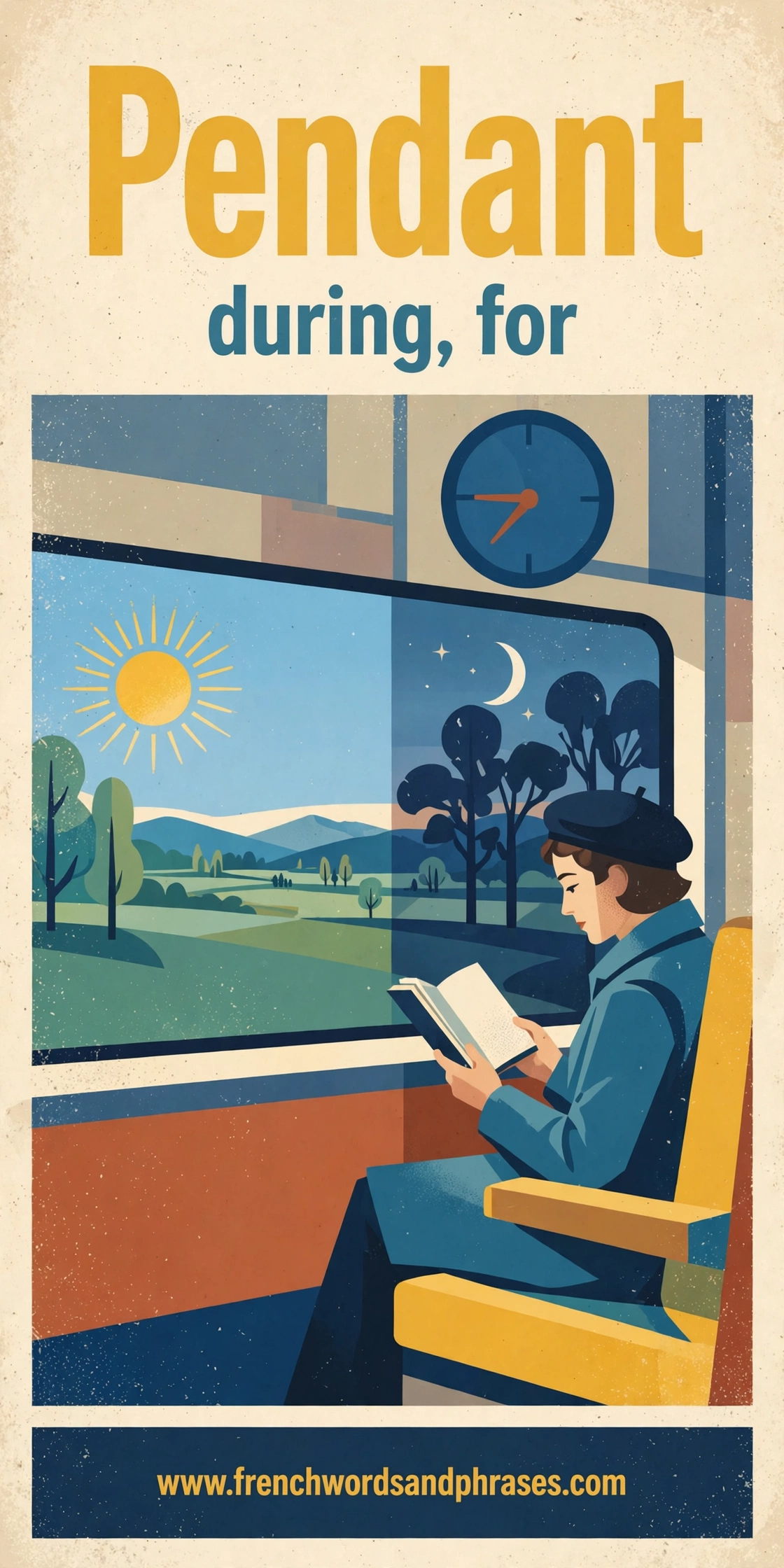
Pendant means during, for — throughout a period of time.
The rain drums on the café window for an hour, and inside, nobody moves: pendant la pluie, pendant le repas, pendant tout l’été — pendant is the word that stretches across a stretch of time and holds both ends of it.
Let’s explore how pendant works in French, beginning with the whole word on one card.
Understanding the French Preposition Pendant
Pendant is a French preposition of time. It comes from the present participle of pendre, to hang — pendant le repas is, in the old picture, « while the meal hangs », while it is going on. Placed before a period of time, it means during, throughout: pendant la nuit, pendant les vacances, pendant deux heures. Followed by que, it becomes a conjunction: pendant que, while.
It means during, for — covering a whole period from end to end: il a plu pendant trois jours, it rained for three days; pendant la guerre, during the war; je t’attendrai pendant une heure, I will wait for you for an hour. English splits the work between during (with an event) and for (with a length of time); French pendant covers both, as long as the period is whole and finished or framed. For lengths of time reaching into the present, French prefers depuis — pendant is the closed box, depuis is the open one.
Type: Preposition of time — also a conjunction in pendant que (while)
Answers the question: Combien de temps ? / Quand ? — How long? / When?
Covers: A whole period, end to end: pendant deux heures, pendant l’été
Watch the pair: pendant (closed period) vs depuis (from then until now)
One important usage detail: pendant never changes and never takes an article of its own — the period brings its own: pendant le repas, pendant les vacances, pendant une heure. And pendant que needs two clauses with two verbs: pendant que tu dors, je travaille — while you sleep, I work. Alone before a noun, it is always the preposition.
Experience the Word
Pendant is the word of the long middle: not the start of the rain, not the end of it, but the whole wet afternoon in between.
Imagine the lighthouse keeper in 1900, writing his log by lamplight: « Pendant la tempête, aucun bateau. » During the storm, no boats. Pendant holds those three days of storm in two syllables, from the first gust to the last.
You have not just named a moment. You have named duration itself — pendant, the word that sits inside time and stays there.
How to Use Pendant in French: Complete Guide
Let’s explore how pendant works in French, beginning with the whole word on one card.
Pendant at a Glance
The Whole Word on One Card
Meaning, job, coverage and family — pendant in four lines.
| Point | Pendant |
|---|---|
| Meaning | during, for — throughout a whole period |
| Job | stands before a period of time and covers it end to end |
| Form | never changes; the period keeps its own article: pendant le repas |
| Its family | pendant que (while), pendant ce temps (meanwhile), depuis (since, until now) |
Example
Il a neigé pendant toute la nuit.
It snowed during the whole night.
The Pattern in Action: Pendant + Period
Pendant takes any stretch of time — an hour, a season, a war, a meal.
| Pattern | Example |
|---|---|
| with a length | pendant deux heures — for two hours |
| with an event | pendant le repas — during the meal |
| with a season | pendant l’été — during the summer |
| with tout | pendant toute la journée — all day long |
Example
Pendant le repas, personne ne parle du travail.
During the meal, nobody talks about work.
Quick Quiz 1
Which word covers a finished period end to end — pendant or depuis?
Reveal the answer
Pendant — depuis runs from a starting point up to now.
Il a plu pendant trois jours.
It rained for three days.
Pendant que: The Word Grows a Clause
Add que and pendant joins two actions happening at the same time.
| Pattern | Example |
|---|---|
| two presents | pendant que tu dors, je lis — while you sleep, I read |
| two pasts | pendant qu’il parlait, elle écoutait — while he spoke, she listened |
| the short form | pendant ce temps — meanwhile |
| the question | tu fais quoi, pendant ce temps ? — what are you doing meanwhile? |
Example
Pendant que les enfants dorment, les parents se reposent.
While the children sleep, the parents rest.
Pendant in Its Sentences: Whole Periods
Finished holidays, long waits, whole wars — pendant frames them all.
| Form | French | In English |
|---|---|---|
| Present | il travaille pendant la nuit | he works during the night |
| Passé composé | elle a attendu pendant une heure | she waited for an hour |
| Imparfait | pendant l’hiver, on restait à la maison | during the winter, we stayed at home |
| Future | je garderai les enfants pendant ton absence | I will look after the children during your absence |
Example
Nous avons voyagé pendant tout l’été.
We travelled during the whole summer.
Quick Quiz 2
Complete it: ______ que tu cuisines, je mets la table (while)
Reveal the answer
Pendant — pendant que joins two simultaneous actions.
Pendant que tu cuisines, je mets la table.
While you cook, I lay the table.
Everyday Expressions with Pendant
Pendant turns up in the phrases French speakers use to fill and frame time.
| Expression | In English |
|---|---|
| pendant ce temps | meanwhile, in the meantime |
| pendant que | while — joining two clauses |
| pendant les vacances | during the holidays |
| pendant des années | for years |
| pendant longtemps | for a long time |
Example
Ils ont vécu à la campagne pendant des années.
They lived in the country for years.
Close Cousins: Durant, Depuis, Lors de
The time prepositions divide the work — the closed period, the open one, and the occasion.
| Word | The difference |
|---|---|
| pendant | during, for — the everyday word for a whole period |
| durant | during — the same, slightly more formal or written |
| depuis | since, for — from a starting point up to now: depuis 2020 |
| lors de | on the occasion of, during (an event) — formal: lors de la réunion |
Example
Il habite ici depuis dix ans, et pendant tout ce temps, il a écrit trois livres.
He has lived here for ten years, and during all that time, he has written three books.
Quick Quiz 3
‘I have lived here since 2020’ — pendant or depuis?
Reveal the answer
Depuis — the period is still open and running up to now.
J’habite ici depuis 2020.
I have lived here since 2020.
Pendant and Its Neighbours
The time shelf around the word — middles, means and whiles.
| French | In English |
|---|---|
| durant | during (more formal twin) |
| depuis | since, for (up to now) |
| entre-temps | in the meantime |
| tandis que | while, whereas — with a contrast |
| un pendant | a matching piece; also a pendant (the noun!) |
Example
Durant la réunion, et pendant tout ce temps, il n’a rien dit.
During the meeting, and during all that time, he said nothing.
Watch Out: The Traps Around Pendant
The traps: depuis for pendant, a missing que, and the noun that shares the name.
| Trap | The truth |
|---|---|
| pendant for « since » | an open period reaching now takes depuis: j’attends depuis une heure |
| pendant + verb directly | a verb needs que: pendant que tu dors — never « pendant tu dors » |
| un pendant | the noun un pendant is a matching piece or a jewel — same spelling, different word |
| during with no period | for a point in time, French uses à or en: à midi, en 2020 |
Example
Pendant que j’attends depuis une heure, il dort.
While I have been waiting for an hour, he is asleep.
Quick Quiz 4
How do you say ‘for three days’ about a finished trip — with pendant?
Reveal the answer
pendant trois jours
The period is closed and finished, so pendant covers it end to end.
Nous sommes restés pendant trois jours. — We stayed for three days.
Pendant in Everyday French: Real-Life Examples
Now that you know the word, let’s see how pendant appears in everyday French.
Example 1 — Weather
Il a plu pendant toute la journée.
It rained during the whole day.
Example 2 — Waiting
Je t’ai attendu pendant une heure.
I waited for you for an hour.
Example 3 — Meanwhile
Pendant ce temps, les enfants jouent dehors.
Meanwhile, the children are playing outside.
Example 4 — While
Pendant que je travaille, il dort.
While I work, he sleeps.
Example 5 — Holidays
Pendant les vacances, on se repose.
During the holidays, we rest.
Example 6 — Years
Ils se connaissent pendant… non, depuis des années !
They have known each other for years (depuis, because it is still true)!
Beyond Translation: The Meaning of Pendant
Pendant began as a picture: the present participle of pendre, to hang. Pendant le repas was the meal « hanging » — suspended, in progress, not yet fallen. French kept the hanging word for time and let the literal one go, and the family still shows the thread: un pendant is a thing that hangs (an earring, a lamp) or a thing that matches, a counterpart — ce tableau est le pendant de l’autre. And in pendant ce temps, meanwhile, you can still feel the old image: time hanging full and heavy while something else happens inside it.
To say pendant is to step inside a stretch of time and close the door.
It evokes the long meal, the whole storm, the endless summer afternoon — duration, held.
How to Remember the French Preposition Pendant
Remember it this way: Pendant is during, for — the closed box of time, covered end to end; depuis is the open one that runs until now.
- The closed period — pendant deux heures, pendant l’été: finished or framed, end to end.
- The conjunction — pendant que + clause: pendant que tu dors, je travaille.
- The rival — still true now? Then depuis: depuis 2020, depuis une heure.
The key idea is pendant = during, for (closed period); pendant que = while; depuis = since/until now.
Test Your Knowledge of Pendant
Let’s see how much you’ve learned. Try answering these questions before revealing the answers.
Question 1
What does pendant mean?
Reveal the answer
During, for — throughout a whole period of time.
Question 2
How do you say while you sleep, I read?
Reveal the answer
Pendant que tu dors, je lis.
Question 3
Translate: It rained for three days.
Reveal the answer
Il a plu pendant trois jours.
Question 4
Complete the sentence:
J’habite ici ______ 2020. (since)
Reveal the answer
depuis
J’habite ici depuis 2020.
I have lived here since 2020 — the period is still open.
Question 5
What is pendant ce temps?
Reveal the answer
Meanwhile — in the meantime, while the other thing happens.
Your Final Challenge
Can You Use It?
How would you say this in French?
“It snowed during the whole night.”
Reveal the answer
Il a neigé pendant toute la nuit.
It snowed during the whole night.
A little French. A little curiosity. A richer everyday life.
LEARN FRENCH ONE WORD AT A TIME