
A French Word to Live By
How to Conjugate Réserver in French
/ʁe.zɛʁ.ve/
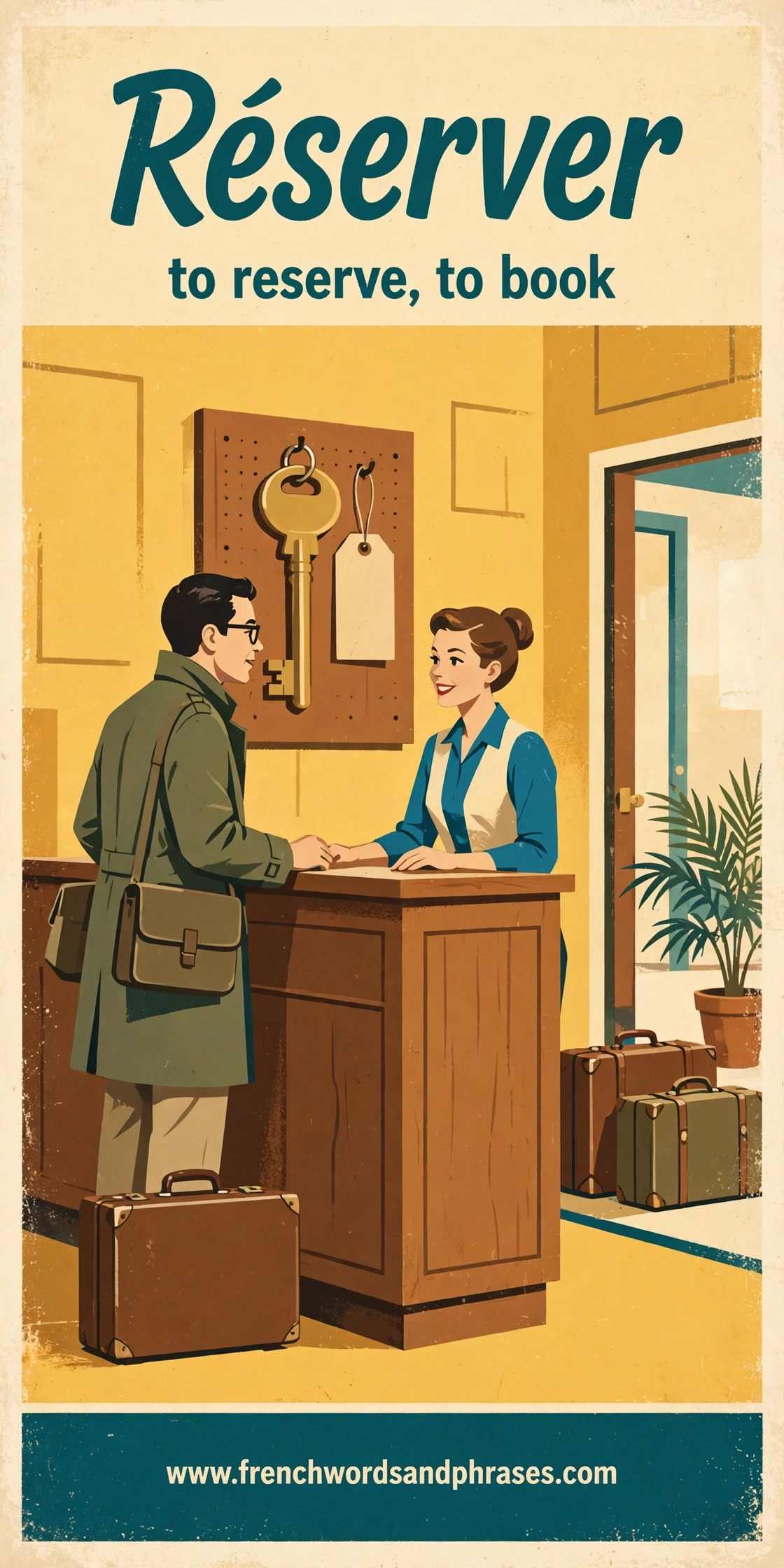
Réserver means to reserve, to book — to set something aside in advance so it is waiting for you: a table at a restaurant, a room at a hotel, a seat on a train, tickets for a concert.
A phone call to the little restaurant before the guests arrive, a few clicks for the hotel by the sea, a name written in the book at the desk — réserver is the verb of the plan made in advance, the small ceremony that turns hope into a booking.
In this guide, you’ll learn how to conjugate réserver in all the major French tenses and moods. Explore complete conjugation tables, French examples, English translations, and practice quizzes.
Understanding the French Verb Réserver
Réserver is a regular French verb belonging to the first group of verbs, those ending in-er.
It means to reserve, to book. Réserver works for anything set aside ahead of time: you réservez a table, a room, a taxi, a court, a date. It also keeps things for people — réserver une part de gâteau à quelqu’un, to save someone a slice of cake — and fate itself can do the reserving: on ne sait pas ce que l’avenir nous réserve, we don’t know what the future has in store for us.
Verb classification: First group (-er)
Auxiliary verb: Avoir
Past participle: réservé
Present participle: réservant
English equivalents: To reserve, to book, to set aside; réserver une table — to book a table; réserver une chambre — to book a room; réserver des billets — to book tickets; réserver quelque chose à quelqu’un — to keep something for someone; se réserver — to save oneself, to keep oneself (for later).
One important detail: réserver is perfectly regular — despite its é, it is NOT an espérer-type verb: the é never opens to è, because it sits too far from the ending. Say je réserve, tu réserves, nous réservons, future je réserverai, past participle réservé — é everywhere, in every tense.
Experience the Word
Réserver is the verb of the quiet triumph of the organised: while others queue and hope, your name is already in the book.
Imagine the small hotel in the mountains in February. The snow is falling, the dining room glows, and the owner turns the pages of a paper register: « Vous avez réservé pour deux nuits ? Parfait. » Reserved in October, welcomed in February — that is réserver, a promise kept across the seasons.
The room is warm, the table is yours, the tickets are in your pocket. That is réserver — the future, held for you by name.
How to Conjugate Réserver: Complete French Conjugation Guide
Let’s explore every major conjugation of réserver, beginning with the indicative mood.
How to Conjugate Réserver in the Indicative Mood
The indicative mood is used to express facts, observations, actions, and events.
How to Conjugate Réserver in the Present Tense (Présent)
Used for actions happening now, habitual actions, and general truths.
| Subject | Conjugation |
|---|---|
| je | réserve |
| tu | réserves |
| il / elle | réserve |
| nous | réservons |
| vous | réservez |
| ils / elles | réservent |
Example
Je réserve une table pour samedi soir.
I am booking a table for Saturday evening.
Quick Quiz 1
Complete the sentence:
Je ______ une chambre pour le week-end.
Reveal the answer
réserve
Je réserve une chambre pour le week-end.
I am booking a room for the weekend — réserver is regular, its é never changes.
How to Conjugate Réserver in the Passé Composé
Used for completed actions in the past. Réserver takes the auxiliary verb avoir.
| Subject | Conjugation |
|---|---|
| j’ | ai réservé |
| tu | as réservé |
| il / elle | a réservé |
| nous | avons réservé |
| vous | avez réservé |
| ils / elles | ont réservé |
Example
Nous avons réservé une chambre avec vue sur la mer.
We booked a room with a sea view.
How to Conjugate Réserver in the Imparfait (Imperfect Tense)
Used for habitual past actions, descriptions, and ongoing situations in the past.
| Subject | Conjugation |
|---|---|
| je | réservais |
| tu | réservais |
| il / elle | réservait |
| nous | réservions |
| vous | réserviez |
| ils / elles | réservaient |
Example
Autrefois, on réservait par téléphone.
In the old days, people booked by phone.
Quick Quiz 2
Choose the correct form:
We booked a table for eight.
Nous ______ une table pour huit. (avons réservé / sommes réservés)
Reveal the answer
avons réservé
Nous avons réservé une table pour huit.
Réserver takes avoir.
How to Conjugate Réserver in the Plus-que-parfait
Used to describe an action that had already been completed before another past event.
| Subject | Conjugation |
|---|---|
| j’ | avais réservé |
| tu | avais réservé |
| il / elle | avait réservé |
| nous | avions réservé |
| vous | aviez réservé |
| ils / elles | avaient réservé |
Example
Elle avait réservé ses billets trois mois à l’avance.
She had booked her tickets three months in advance.
How to Conjugate Réserver in the Passé Simple
Primarily used in formal writing, literature, and historical narratives. It is rarely used in everyday conversation.
| Subject | Conjugation |
|---|---|
| je | réservai |
| tu | réservas |
| il / elle | réserva |
| nous | réservâmes |
| vous | réservâtes |
| ils / elles | réservèrent |
Example
Il réserva la plus belle chambre de l’hôtel.
He booked the finest room in the hotel.
How to Conjugate Réserver in the Passé Antérieur
A literary tense used to express an action completed immediately before another past action, generally in the passé simple.
| Subject | Conjugation |
|---|---|
| j’ | eus réservé |
| tu | eus réservé |
| il / elle | eut réservé |
| nous | eûmes réservé |
| vous | eûtes réservé |
| ils / elles | eurent réservé |
Example
Quand il eut réservé la salle, il envoya les invitations.
When he had booked the hall, he sent the invitations.
How to Conjugate Réserver in the Future Tense (Futur Simple)
Used to describe actions that will take place in the future.
| Subject | Conjugation |
|---|---|
| je | réserverai |
| tu | réserveras |
| il / elle | réservera |
| nous | réserverons |
| vous | réserverez |
| ils / elles | réserveront |
Example
Je réserverai le restaurant dès demain.
I will book the restaurant first thing tomorrow.
How to Conjugate Réserver in the Futur Antérieur (Future Perfect)
Used for an action that will have been completed before a particular point in the future.
| Subject | Conjugation |
|---|---|
| j’ | aurai réservé |
| tu | auras réservé |
| il / elle | aura réservé |
| nous | aurons réservé |
| vous | aurez réservé |
| ils / elles | auront réservé |
Example
À midi, ils auront réservé toutes les places.
By noon, they will have booked all the seats.
How to Conjugate Réserver in the Near Future (Futur Proche)
Used to describe something that is going to happen soon. Formed with aller + infinitive.
| Subject | Conjugation |
|---|---|
| je | vais réserver |
| tu | vas réserver |
| il / elle | va réserver |
| nous | allons réserver |
| vous | allez réserver |
| ils / elles | vont réserver |
Example
Je vais réserver un taxi pour cinq heures.
I am going to book a taxi for five o’clock.
How to Conjugate Réserver in the Conditional Mood
The conditional mood expresses what would happen under certain circumstances. It is also frequently used to make polite requests or express wishes.
How to Conjugate Réserver in the Present Conditional
| Subject | Conjugation |
|---|---|
| je | réserverais |
| tu | réserverais |
| il / elle | réserverait |
| nous | réserverions |
| vous | réserveriez |
| ils / elles | réserveraient |
Example
À ta place, je réserverais une table près de la fenêtre.
In your place, I would book a table near the window.
How to Conjugate Réserver in the Past Conditional
| Subject | Conjugation |
|---|---|
| j’ | aurais réservé |
| tu | aurais réservé |
| il / elle | aurait réservé |
| nous | aurions réservé |
| vous | auriez réservé |
| ils / elles | auraient réservé |
Example
Nous aurions réservé plus tôt si nous avions su.
We would have booked earlier if we had known.
Réserver in the Literary Past Conditional Form
This less common literary form uses the imperfect subjunctive of avoir.
| Subject | Conjugation |
|---|---|
| j’ | eusse réservé |
| tu | eusses réservé |
| il / elle | eût réservé |
| nous | eussions réservé |
| vous | eussiez réservé |
| ils / elles | eussent réservé |
Example
Elle eût réservé la chambre sans ce retard du train.
She would have booked the room if not for the train’s delay.
How to Conjugate Réserver in the Subjunctive Mood
The subjunctive is used to express wishes, emotions, doubts, necessity, and uncertainty. It frequently follows expressions such as il faut que (it is necessary that) or bien que (although).
How to Conjugate Réserver in the Present Subjunctive
| Subject | Conjugation |
|---|---|
| que je | réserve |
| que tu | réserves |
| qu’il / qu’elle | réserve |
| que nous | réservions |
| que vous | réserviez |
| qu’ils / qu’elles | réservent |
Example
Il faut que tu réserves avant vendredi.
You must book before Friday.
Quick Quiz 3
Complete the sentence using the subjunctive:
Il faut que tu ______ tes billets ce soir.
Reveal the answer
réserves
Il faut que tu réserves tes billets ce soir.
You must book your tickets tonight.
How to Conjugate Réserver in the Imperfect Subjunctive
A literary tense, rarely encountered in modern spoken French.
| Subject | Conjugation |
|---|---|
| que je | réservasse |
| que tu | réservasses |
| qu’il / qu’elle | réservât |
| que nous | réservassions |
| que vous | réservassiez |
| qu’ils / qu’elles | réservassent |
Example
Il fallait qu’il réservât une table pour dix personnes.
He had to book a table for ten people.
How to Conjugate Réserver in the Pluperfect Subjunctive
A literary construction used to express an action completed before another past action.
| Subject | Conjugation |
|---|---|
| que j’ | eusse réservé |
| que tu | eusses réservé |
| qu’il / qu’elle | eût réservé |
| que nous | eussions réservé |
| que vous | eussiez réservé |
| qu’ils / qu’elles | eussent réservé |
Example
Je doutais qu’ils eussent réservé à temps.
I doubted they had booked in time.
How to Conjugate Réserver in the Past Subjunctive
| Subject | Conjugation |
|---|---|
| que j’ | aie réservé |
| que tu | aies réservé |
| qu’il / qu’elle | ait réservé |
| que nous | ayons réservé |
| que vous | ayez réservé |
| qu’ils / qu’elles | aient réservé |
Example
Je suis content que vous ayez réservé ce guide.
I am glad you booked this guide.
How to Conjugate Réserver in the Imperative
The imperative is used to give commands, instructions, invitations, or suggestions. Subject pronouns are omitted.
How to Conjugate Réserver in the Present Imperative
| Person | Conjugation |
|---|---|
| (tu) | réserve |
| (nous) | réservons |
| (vous) | réservez |
Example
Réserve les billets ce soir, ils partent vite !
Book the tickets tonight, they go fast!
Quick Quiz 4
How would you say Book a table (tu form)?
Reveal the answer
Réserve une table !
French Participles of Réserver
Participles are verb forms that can be used in compound tenses and other grammatical constructions.
Present Participle of Réserver
réservant
En réservant tôt, on paie moins cher.
By booking early, you pay less.
Past Participle of Réserver
réservé
La table réservée est près de la fenêtre.
The booked table is near the window.
Réserver in Everyday French: Real-Life Examples
Now that you know the conjugations, let’s see how réserver appears in everyday French.
Example 1 — Present
Je réserve une table pour deux.
I am booking a table for two.
Example 2 — Passé composé
Nous avons réservé l’hôtel en janvier.
We booked the hotel in January.
Example 3 — Imparfait
Il réservait toujours la même chambre.
He always used to book the same room.
Example 4 — Future
Je réserverai les billets demain.
I will book the tickets tomorrow.
Example 5 — Conditional
Je réserverais une chambre plus grande.
I would book a bigger room.
Example 6 — Imperative
Réserve une table pour ce soir !
Book a table for this evening!
Beyond Translation: The Meaning of Réserver
Réserver comes from the Latin reservare — to keep back, to hold in store — and the holding-back is still the heart of it: a reserved table is a table the restaurant refuses to give to anyone else. French uses the same verb for fate’s storeroom: ce que la vie nous réserve, what life has in store for us. And the family keeps the theme of holding back: réservé as an adjective describes a shy, quiet person — someone who keeps himself in reserve.
To réserver is to put your name on the future and trust it to wait for you.
It evokes the register at the desk, the confirmation number, and the small pleasure of walking past the queue.
How to Remember the French Verb Réserver
Remember it this way: Réserver is about je réserve — regular -er, é never changes; réserver = to book, to reserve.
- Regular, not espérer-type: je réserve, nous réservons, past participle réservé — the é stays everywhere.
- The booking verb — réserver une table, une chambre, des billets: if you can book it, réserver does it.
- Fate books too — ce que l’avenir nous réserve, what the future has in store for us.
The key idea is je réserve — regular -er, é never changes; réserver = to book, to reserve.
Test Your Knowledge of Réserver
Let’s see how much you’ve learned. Try answering these questions before revealing the answers.
Question 1
Does the é of réserver ever change to è?
Reveal the answer
Never — réserver is regular, not an espérer-type verb: je réserve, je réserverai, réservé.
Question 2
How do you say I am booking a table for two in French?
Reveal the answer
Je réserve une table pour deux.
Question 3
Translate: We booked the hotel in January.
Reveal the answer
Nous avons réservé l’hôtel en janvier.
Question 4
What is the past participle of réserver?
Reveal the answer
Réservé.
Question 5
Complete the sentence:
Il faut que vous ______ avant vendredi.
Reveal the answer
réserviez
Il faut que vous réserviez avant vendredi.
You must book before Friday.
Your Final Challenge
Can You Use It?
How would you say this in French?
I will book the tickets tomorrow.
Reveal the answer
Je réserverai les billets demain.
I will book the tickets tomorrow.
A little French. A little curiosity. A richer everyday life.
LEARN FRENCH ONE WORD AT A TIME




