A French Word to Live By
Translate Serpent to English
/sɛʁ.pɑ̃/
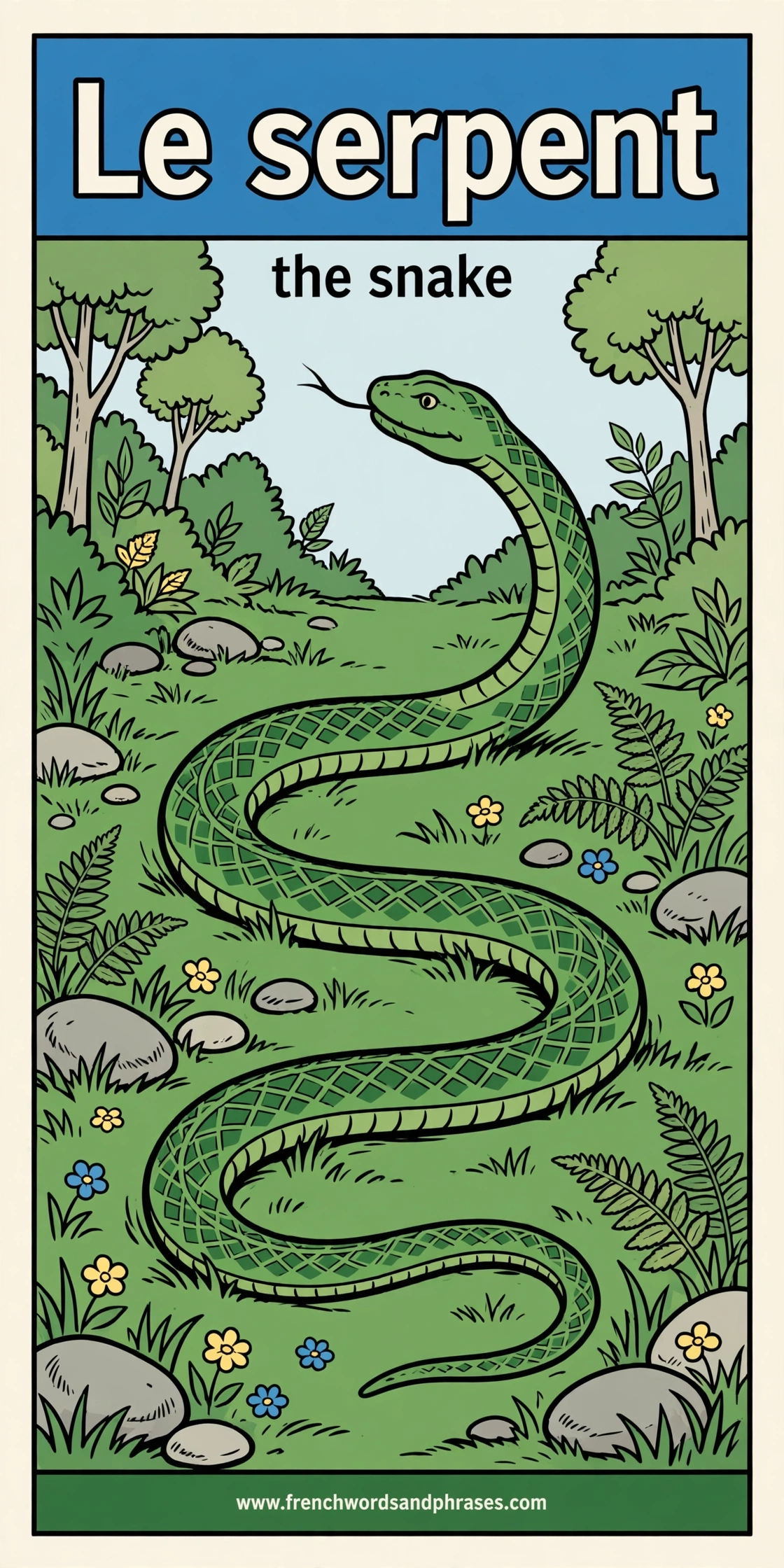
Le serpent means the snake.
A ribbon of scales through the grass, a tongue tasting the air, not a sound: le serpent, the snake — the animal of the garden’s first story, feared, fascinating, and silent as a secret.
In this guide, you’ll learn what serpent means in English, how to use it with its articles, how to form its plural, and how it appears in everyday French. Explore French examples, English translations, and practice quizzes.
Understanding the French Noun Serpent
Serpent is a masculine French noun, learned with its article: le serpent, un serpent. It comes from the Latin serpens, the creeping one, from serpere, to crawl. The final t is silent: serpent says itself « ser-pan ». In France the harmless grass snake of the fields is la couleuvre, and the one viper to respect is la vipère — le serpent is the general word that covers them all.
It means a snake — the long, legless reptile that slides and coils: un serpent venimeux, a venomous snake, un serpent à sonnettes, a rattlesnake, la peau du serpent, the snake’s skin, shed whole in the famous mue. The word slithers into figurative French too: le serpent de mer is a story that keeps resurfacing in the news and never dies, and avoir une langue de serpent is to have a sharp, wounding tongue.
Gender: Masculine — le serpent
Definite article: le — le serpent (the snake)
Indefinite article: un — un serpent (a snake)
Plural: les serpents — regular, with a simple -s
Spelling note: from Latin serpens, the creeping one — the final t is silent
The harmless cousin: la couleuvre — the grass snake; la vipère is the viper
English equivalents: The snake.
Name the kinds with care: un serpent venimeux is dangerous, une couleuvre is not. The snake’s arts have their verbs: ramper, to crawl, siffler, to hiss, muer, to shed its skin. And keep the figurative pair in your pocket: le serpent de mer for the eternal news story, une langue de serpent for the gossip whose words bite.
Experience the Word
Serpent is movement without legs, silence with a shape — the animal that turns a path through grass into a line of pure intention.
Imagine the stone wall at noon, warm in the sun, and along its top a green ribbon sliding without a sound, tasting the air, master of a world at ankle height.
You have not just named a reptile. You have named the oldest character in the garden — le serpent, the snake, beautiful and not to be trusted.
How to Use Serpent in French: Complete Guide
Let’s explore how serpent works in French, beginning with its articles — le serpent, un serpent, un serpent à sonnettes.
Serpent with the Definite Article (Le, Les)
Used for a specific snake — the one in the grass, the one behind the glass.
| Form | French |
|---|---|
| Masculine singular | le serpent |
| Plural | les serpents |
Example
Le serpent glisse entre les pierres chaudes.
The snake is gliding between the warm stones.
Serpent with the Indefinite Article (Un, Des)
Used for a snake in general — one ribbon of scales among the grass.
| Form | French |
|---|---|
| Masculine singular | un serpent |
| Plural | des serpents |
Example
Un serpent traverse le chemin devant nous.
A snake is crossing the path in front of us.
Kinds of Serpent (À sonnettes, venimeux, de mer…)
Snakes are named by their weapons and their waters — the kinds to know, real and figurative.
| Kind | French |
|---|---|
| a rattlesnake | un serpent à sonnettes |
| a venomous snake | un serpent venimeux |
| a water snake | un serpent d’eau |
| a pet snake | un serpent domestique |
| a sea serpent (a recurring news story) | un serpent de mer |
Example
Le serpent à sonnettes avertit avant d’attaquer.
The rattlesnake warns before attacking.
Quick Quiz 1
Complete the sentence:
______ serpent glisse dans l’herbe haute. (the)
Reveal the answer
Le
Le serpent glisse dans l’herbe haute.
The snake is gliding through the tall grass — serpent is masculine, so le.
The Plural of Serpent
Serpent takes a regular plural in -s — the vivarium’s whole silent population.
| Number | French |
|---|---|
| Singular | le serpent |
| Plural | les serpents |
Example
Les serpents changent de peau plusieurs fois par an.
Snakes shed their skin several times a year.
Serpent with Possessive Adjectives (Mon, Ton, Son…)
Possessives agree with the noun: serpent is masculine, so mon, ton, son in the singular.
| Owner | French |
|---|---|
| my | mon serpent |
| your (tu) | ton serpent |
| his / her | son serpent |
| our | notre serpent |
| your (vous) | votre serpent |
| their | leur serpent |
Example
Son serpent vit dans un grand terrarium.
His snake lives in a large terrarium.
Quick Quiz 2
Complete the sentence:
Il nourrit ______ serpent une fois par semaine. (his)
Reveal the answer
son
Il nourrit son serpent une fois par semaine.
He feeds his snake once a week — son, because serpent is masculine.
Serpent with Demonstrative Adjectives (Ce, Ces)
Used to point: ce serpent, this snake — from a respectful distance.
| Form | French |
|---|---|
| Masculine singular | ce serpent |
| Plural | ces serpents |
Example
Ce serpent est inoffensif, c’est une couleuvre.
This snake is harmless, it’s a grass snake.
Serpent with Adjectives
Adjectives agree with serpent — masculine singular: un serpent venimeux, un long serpent.
| Adjective | With Serpent |
|---|---|
| venimeux (venomous) | un serpent venimeux |
| long (long) | un long serpent |
| inoffensif (harmless) | un serpent inoffensif |
| vert (green) | un serpent vert |
| dangereux (dangerous) | un serpent dangereux |
Example
Un long serpent vert se repose sur la branche.
A long green snake is resting on the branch.
Quick Quiz 3
Complete the sentence:
Attention, c’est un serpent ______. (venomous)
Reveal the answer
venimeux
Attention, c’est un serpent venimeux.
Careful, it’s a venomous snake — venimeux, masculine, to agree with serpent.
Everyday Expressions with Serpent
Gardens, gossip and eternal news — the serpent phrases of daily life.
| Expression | In English |
|---|---|
| un serpent à sonnettes | a rattlesnake |
| le serpent de mer | a story that keeps resurfacing in the news |
| avoir une langue de serpent | to have a sharp, wounding tongue |
| la mue du serpent | the snake’s shedding of its skin |
| siffler comme un serpent | to hiss like a snake |
Example
Ce projet de pont est un vrai serpent de mer.
That bridge project is a real ever-recurring story.
Words from the Same Family as Serpent
Sliding and hissing — the words that travel with serpent.
| French | In English |
|---|---|
| la couleuvre | the grass snake — harmless |
| la vipère | the viper — the one to respect |
| ramper | to crawl (the verb) |
| siffler | to hiss, to whistle (the verb) |
| la peau | the skin — shed whole at the mue |
Example
La couleuvre est un serpent inoffensif des jardins.
The grass snake is a harmless snake of gardens.
Quick Quiz 4
What is un serpent de mer, in the figurative sense?
Reveal the answer
A story that keeps resurfacing — an eternal news topic that never gets resolved.
La réforme revient chaque année, un vrai serpent de mer.
The reform comes back every year, a real recurring story.
Serpent in Everyday French: Real-Life Examples
Now that you know the word, let’s see how serpent appears in everyday French.
Example 1 — On the path
Un serpent traverse le chemin, attention.
A snake is crossing the path, careful.
Example 2 — Harmless
Ce serpent est une couleuvre, il est inoffensif.
This snake is a grass snake, it’s harmless.
Example 3 — The skin
Le serpent a laissé sa peau près des pierres.
The snake left its skin near the stones.
Example 4 — Figurative
Cette histoire est un serpent de mer des journaux.
That story is an ever-recurring tale in the papers.
Example 5 — The sharp tongue
Méfie-toi, elle a une langue de serpent.
Watch out, she has a sharp tongue.
Example 6 — At the vivarium
Les serpents du vivarium dorment sous les lampes.
The snakes in the vivarium sleep under the lamps.
Beyond Translation: The Meaning of Serpent
The serpent is the animal French met first in a garden, in the oldest story of all, and the language has kept a respectful distance ever since: he is beautiful, silent, and never quite innocent. Yet the word works hard beyond the fable — journalists feed on serpents de mer, stories that surface every summer and sink again unresolved, and every village knows a langue de serpent whose gossip wounds. Against the fear stands the couleuvre, the harmless grass snake of French fields, proof that the word serpent judges no one in advance.
To say serpent is to lower your voice a little.
It evokes the warm stones, the flickering tongue and the skin left empty in the grass — mystery, moving at ankle height.
How to Remember the French Noun Serpent
Remember it this way: Serpent is the snake — masculine: le serpent, un serpent. The final t is silent.
- Always masculine — le serpent, un serpent, mon serpent.
- The kinds — la couleuvre is harmless, la vipère is the viper.
- The figurative pair — le serpent de mer, the recurring story; une langue de serpent, a sharp tongue.
The key idea is le serpent — the snake, masculine; serpent de mer = recurring story.
Test Your Knowledge of Serpent
Let’s see how much you’ve learned. Try answering these questions before revealing the answers.
Question 1
Is serpent masculine or feminine?
Reveal the answer
Masculine — le serpent, un serpent.
Question 2
How do you say a rattlesnake?
Reveal the answer
Un serpent à sonnettes.
Question 3
Translate: A snake is crossing the path.
Reveal the answer
Un serpent traverse le chemin.
Question 4
What is la couleuvre?
Reveal the answer
The grass snake — the harmless snake of French gardens and fields.
Question 5
Complete the sentence:
______ serpents changent de peau au printemps. (the)
Reveal the answer
Les
Les serpents changent de peau au printemps.
Snakes shed their skin in spring.
Your Final Challenge
Can You Use It?
How would you say this in French?
“A snake is crossing the path in front of us.”
Reveal the answer
Un serpent traverse le chemin devant nous.
A snake is crossing the path in front of us.
A little French. A little curiosity. A richer everyday life.
LEARN FRENCH ONE WORD AT A TIME