A French Word to Live By
Translate Poubelle to English
/pu.bɛl/
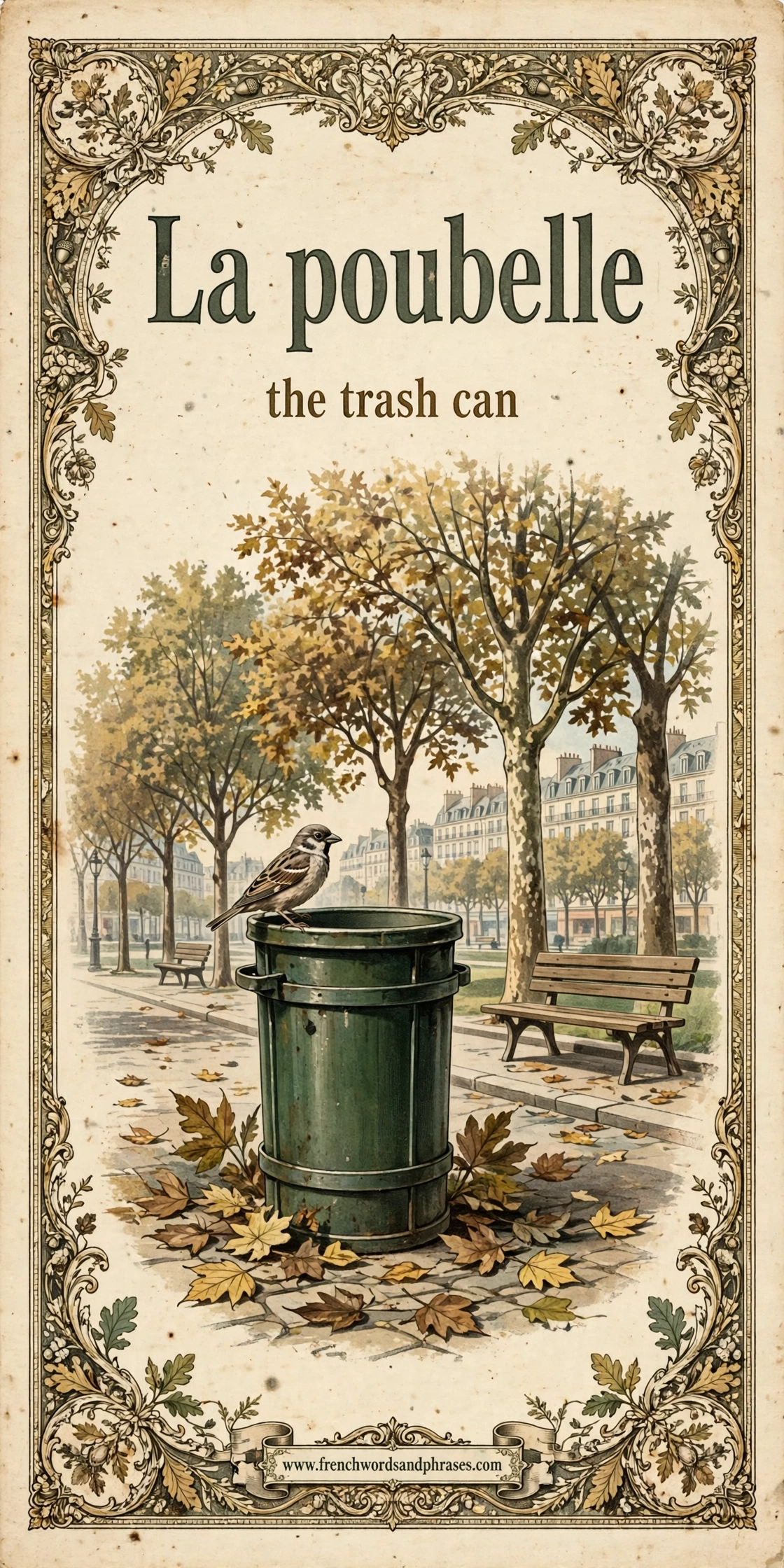
La poubelle means the trash can.
Under the kitchen sink, at the street corner on collection morning, beside every office desk: la poubelle, the trash can — the humble bin that carries a man’s name, because a Paris prefect invented it and Paris named it after him.
In this guide, you’ll learn what poubelle means in English, how to use it with its articles, how to form its plural, and how it appears in everyday French. Explore French examples, English translations, and practice quizzes.
Understanding the French Noun Poubelle
Poubelle is a feminine French noun, learned with its article: la poubelle, une poubelle. It is one of the rare common nouns that is a person’s name: Eugène Poubelle, prefect of the Seine, ordered Paris landlords in 1883 to provide covered bins for household waste — and the city immortalised him in the object itself.
It means a trash can, a dustbin, a waste bin — the container for rubbish: mettre à la poubelle, to throw in the bin, sortir la poubelle, to put the bin out, la poubelle de la cuisine, the kitchen bin. Modern France sorts its waste into coloured poubelles: la poubelle jaune for recycling, la poubelle verte for glass, and the word extends to any rubbish container, from the desk bin to the street litter bin.
Gender: Feminine — la poubelle
Definite article: la — la poubelle (the trash can)
Indefinite article: une — une poubelle (a trash can, a bin)
Plural: les poubelles — regular, with a simple -s
Spelling note: named after Eugène Poubelle, the Paris prefect who imposed the bin in 1883
Key ritual: sortir les poubelles — to put the bins out for collection
English equivalents: The trash can, the dustbin, the waste bin.
Rubbish itself is les déchets or les ordures; la poubelle is the container. You throw things à la poubelle and you take the bin out with sortir la poubelle — le jour des poubelles is collection day, when the pavements of France line up in green, yellow and grey.
Experience the Word
Poubelle is the least loved and most necessary object in the house: invisible when it works, unforgettable when it is forgotten.
Imagine a Paris street at dawn on collection day — rows of poubelles along the kerb in the blue half-light, the éboueurs moving down the line, the whole city’s yesterday being carried away before breakfast.
You have not just named a bin. You have named a prefect’s immortality — la poubelle, the trash can that made Paris clean.
How to Use Poubelle in French: Complete Guide
Let’s explore how poubelle works in French, beginning with its articles — la poubelle, une poubelle, sortir la poubelle.
Poubelle with the Definite Article (La, Les)
Used for a specific bin — the kitchen one, the one at the corner.
| Form | French |
|---|---|
| Feminine singular | la poubelle |
| Plural | les poubelles |
Example
La poubelle de la cuisine est pleine.
The kitchen bin is full.
Poubelle with the Indefinite Article (Une, Des)
Used for a bin in general — any container for rubbish.
| Form | French |
|---|---|
| Feminine singular | une poubelle |
| Plural | des poubelles |
Example
Il y a une poubelle à chaque coin de rue.
There is a bin on every street corner.
The Sorting Poubelles (Jaune, Verte, Grise…)
France sorts its waste by colour — the modern poubelle family.
| Kind | French |
|---|---|
| the recycling bin | la poubelle jaune |
| the glass bin | la poubelle verte |
| the household waste bin | la poubelle grise |
| the kitchen bin | la poubelle de la cuisine |
| a street litter bin | une poubelle de rue |
Example
Les bouteilles en plastique vont dans la poubelle jaune.
Plastic bottles go in the yellow bin.
Quick Quiz 1
Complete the sentence:
______ poubelle est encore sur le trottoir. (the)
Reveal the answer
La
La poubelle est encore sur le trottoir.
The bin is still on the pavement — poubelle is feminine, so la.
The Plural of Poubelle
Poubelle takes a regular plural in -s — bins line every French pavement on collection morning.
| Number | French |
|---|---|
| Singular | la poubelle |
| Plural | les poubelles |
Example
Les poubelles sont ramassées le mardi matin.
The bins are collected on Tuesday morning.
Poubelle with Possessive Adjectives (Ma, Ta, Sa…)
Possessives agree with the noun: poubelle is feminine, so ma, ta, sa in the singular.
| Owner | French |
|---|---|
| my | ma poubelle |
| your (tu) | ta poubelle |
| his / her | sa poubelle |
| our | notre poubelle |
| your (vous) | votre poubelle |
| their | leur poubelle |
Example
Ma poubelle a disparu pendant la nuit !
My bin disappeared during the night!
Quick Quiz 2
Complete the sentence:
N’oublie pas de sortir ______ poubelle ce soir. (your)
Reveal the answer
ta
N’oublie pas de sortir ta poubelle ce soir.
Don’t forget to put your bin out tonight — ta, because poubelle is feminine.
Poubelle with Demonstrative Adjectives (Cette, Ces)
Used to point: cette poubelle, this bin — this one, overflowing.
| Form | French |
|---|---|
| Feminine singular | cette poubelle |
| Plural | ces poubelles |
Example
Cette poubelle déborde depuis deux jours.
This bin has been overflowing for two days.
Poubelle with Adjectives
Adjectives agree with poubelle — feminine singular: une poubelle pleine, une grande poubelle.
| Adjective | With Poubelle |
|---|---|
| pleine (full) | une poubelle pleine |
| grande (big) | une grande poubelle |
| jaune (yellow, recycling) | la poubelle jaune |
| propre (clean) | une poubelle propre |
| nouvelle (new) | une poubelle nouvelle |
Example
Une poubelle pleine attire les chats du quartier.
A full bin attracts the neighbourhood cats.
Quick Quiz 3
Complete the sentence:
C’est une poubelle très ______, il faut la vider. (full)
Reveal the answer
pleine
C’est une poubelle très pleine, il faut la vider.
It’s a very full bin, it needs emptying — pleine, feminine, to agree with poubelle.
Everyday Expressions with Poubelle
Collection days and clean kitchens — the poubelle phrases of daily life.
| Expression | In English |
|---|---|
| mettre à la poubelle | to throw in the bin |
| sortir la poubelle | to put the bin out |
| vider la poubelle | to empty the bin |
| le jour des poubelles | bin collection day |
| les éboueurs | the refuse collectors |
Example
Ce vieux journal va directement à la poubelle.
This old newspaper is going straight in the bin.
Words from the Same Family as Poubelle
Waste and sorting — the words that travel with poubelle.
| French | In English |
|---|---|
| les déchets | waste, rubbish |
| les ordures | household refuse |
| le tri | sorting (of waste) |
| recycler | to recycle (the verb) |
| un sac-poubelle | a bin bag, a trash bag |
Example
Le tri des déchets commence à la cuisine.
Sorting waste begins in the kitchen.
Quick Quiz 4
Who was Poubelle?
Reveal the answer
Eugène Poubelle, prefect of the Seine — he imposed the household bin on Paris in 1883, and the bin took his name.
La poubelle porte le nom d’un préfet de Paris.
The bin bears the name of a Paris prefect.
Poubelle in Everyday French: Real-Life Examples
Now that you know the word, let’s see how poubelle appears in everyday French.
Example 1 — In the kitchen
La poubelle est sous l’évier.
The bin is under the sink.
Example 2 — Collection day
Sors la poubelle, c’est demain le ramassage.
Put the bin out, collection is tomorrow.
Example 3 — Throwing away
Jette ce papier à la poubelle.
Throw that paper in the bin.
Example 4 — Sorting
Le verre va dans la poubelle verte.
Glass goes in the green bin.
Example 5 — At the office
Il y a une poubelle sous chaque bureau.
There is a bin under every desk.
Example 6 — Full up
La poubelle déborde, vide-la, s’il te plaît.
The bin is overflowing, empty it, please.
Beyond Translation: The Meaning of Poubelle
Very few objects carry a civil servant’s name into every kitchen on earth — but in 1883 Eugène Poubelle, prefect of the Seine, decreed that Paris landlords must supply covered receptacles for rubbish, with separate boxes for paper, glass and oyster shells: the original sorting bins. Parisians grumbled, then named the box after him, and la poubelle outlived every other thing he did. It remains the perfect French monument: practical, compulsory, and named by the people rather than by the state.
To say poubelle is to remember that cleanliness in Paris began with a decree — and a name.
It evokes dawn collections, coloured lids and the small daily discipline of sorting.
How to Remember the French Noun Poubelle
Remember it this way: Poubelle is the trash can — feminine: la poubelle, named after the Paris prefect who invented the system in 1883.
- Always feminine — la poubelle, une poubelle, ma poubelle.
- The rituals — sortir la poubelle, to put the bin out; mettre à la poubelle, to throw in the bin.
- The colours — poubelle jaune for recycling, poubelle verte for glass.
The key idea is la poubelle — the trash can, feminine; named after Prefect Eugène Poubelle.
Test Your Knowledge of Poubelle
Let’s see how much you’ve learned. Try answering these questions before revealing the answers.
Question 1
Is poubelle masculine or feminine?
Reveal the answer
Feminine — la poubelle, une poubelle.
Question 2
How do you say to put the bin out?
Reveal the answer
Sortir la poubelle.
Question 3
Translate: The kitchen bin is full.
Reveal the answer
La poubelle de la cuisine est pleine.
Question 4
What goes in la poubelle jaune?
Reveal the answer
Recycling — plastic, cardboard and metal packaging.
Question 5
Complete the sentence:
______ poubelles sont ramassées le vendredi. (the)
Reveal the answer
Les
Les poubelles sont ramassées le vendredi.
The bins are collected on Fridays.
Your Final Challenge
Can You Use It?
How would you say this in French?
“Don’t forget to put the bin out tonight.”
Reveal the answer
N’oublie pas de sortir la poubelle ce soir.
Don’t forget to put the bin out tonight.
A little French. A little curiosity. A richer everyday life.
LEARN FRENCH ONE WORD AT A TIME