A French Word to Live By
Translate Ticket to English
/ti.kɛ/
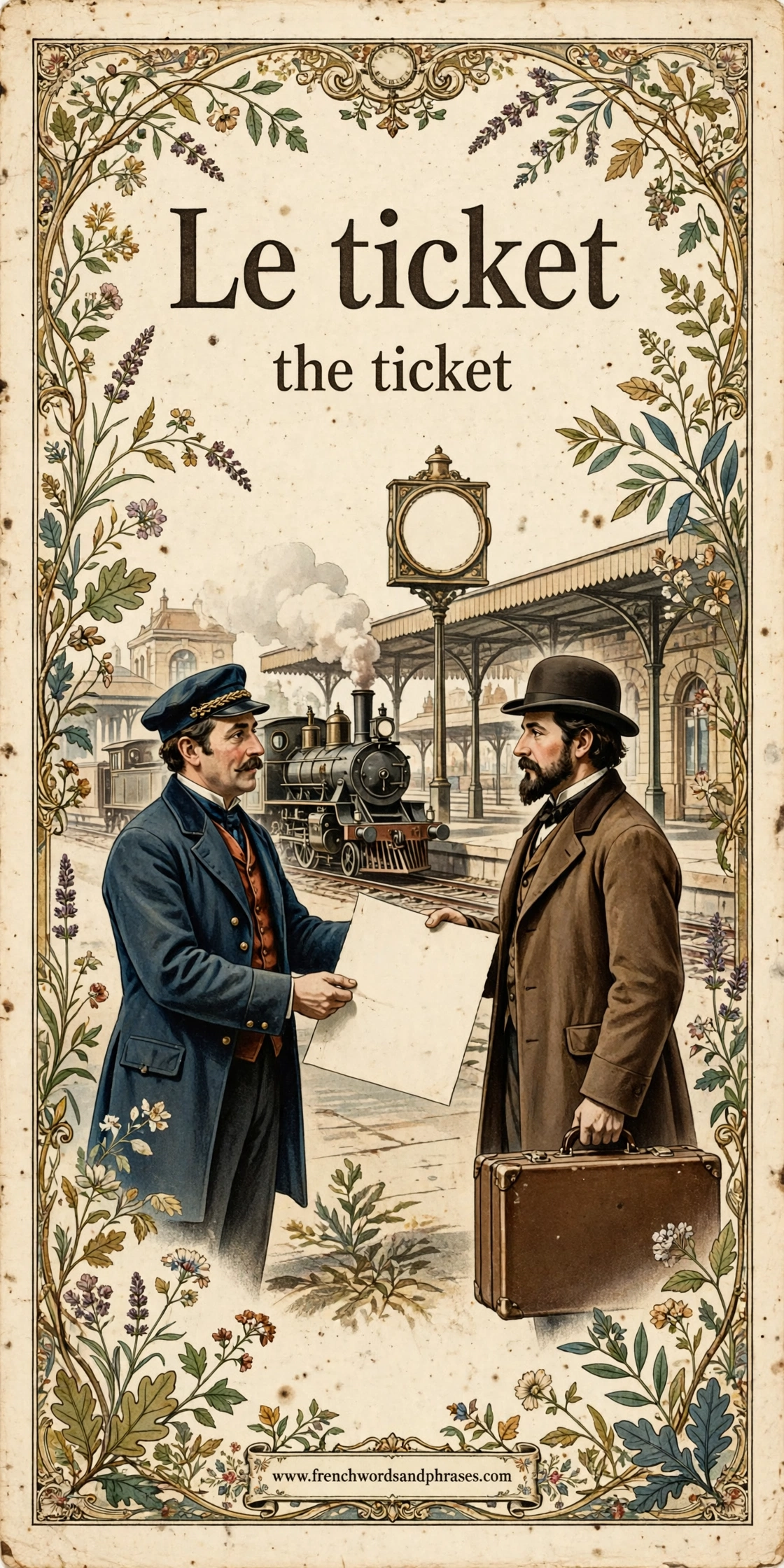
Le ticket means the ticket.
Two small rectangles rule a French day: the one the bus validates with a beep, and the one the shop hands you folded over your change — le ticket. One proves you may travel; the other proves what you paid. Same word, same pocket, two small paper passports.
In this guide, you’ll learn what ticket means in English, how to use it with its articles, how to form its plural, and how it appears in everyday French. Explore French examples, English translations, and practice quizzes.
Understanding the French Noun Ticket
Le ticket is a masculine French noun, borrowed from English long ago and fully naturalised. It means the ticket in two everyday senses: a travel or entry ticket (un ticket de métro, un ticket de cinéma) and a shop receipt (un ticket de caisse). Its plural is les tickets. For grand journeys — trains and planes — French prefers un billet.
It means the ticket — and the receipt. The travel sense: acheter un ticket de bus, to buy a bus ticket; valider son ticket, to validate one’s ticket. The till sense: le ticket de caisse, the receipt; garder le ticket pour échanger l’article, to keep the receipt to exchange the item. Context tells you which paper is meant: at the métro gates it admits you; at the shop door, the guard may ask to see it as proof.
French: le ticket
Gender: Masculine
Plural: les tickets
Pronounced: /ti.kɛ/
Article (singular): le ticket
Article (plural): les tickets
Two senses: travel ticket — and shop receipt (ticket de caisse)
One important usage detail: choose ticket or billet by the journey. Bus, métro, tram, cinema, museum: un ticket. Train, plane, theatre seat: un billet. And never throw the other one away too fast — le ticket de caisse is your only proof for an exchange or a refund.
Experience the Word
Le ticket is the smallest contract in daily life — a slip of paper that says: you paid, you may pass.
Imagine the morning commuter at the métro gate, ticket in hand, the familiar beep, the doors sighing open. And in the same coat pocket, folded small, the ticket de caisse from lunch — the day’s two journeys, both proved in paper.
You have not just kept scraps. You have kept your proofs — le ticket, the pocket-sized archive of a day.
How to Use Ticket in French: Complete Guide
Let’s explore how le ticket is used in French, beginning with the definite article.
Le ticket — The Ticket
The definite article le (the) shows that ticket is masculine. French uses the definite article far more than English, and here le is the natural way to talk about the ticket you hold.
| French | In English |
|---|---|
| le ticket | the ticket |
| Le ticket est dans ma poche. | The ticket is in my pocket. |
| Montrez le ticket au contrôleur. | Show the ticket to the inspector. |
Example
Le ticket de caisse fait foi pour l’échange.
The receipt is your proof for the exchange.
Un ticket — A Ticket
The indefinite article un (a / an) picks out one ticket, not yet identified: a ticket bought at the machine, a receipt handed over the counter.
| French | In English |
|---|---|
| un ticket | a ticket |
| Je voudrais un ticket de métro, s’il vous plaît. | I would like a metro ticket, please. |
| La caissière m’a donné un ticket. | The cashier gave me a receipt. |
Example
Un ticket, un aller simple pour le centre.
One ticket, a single to the centre.
The Two Lives of Ticket
One word, two papers: the ticket that lets you travel, and the ticket that proves you paid. The words after ticket tell you which.
| French | In English |
|---|---|
| un ticket de métro / de bus | a metro / bus ticket |
| un ticket de cinéma | a cinema ticket |
| un ticket de caisse | a receipt (from the till) |
| un ticket de parking | a parking ticket (the pay-and-display slip) |
Example
Garde ton ticket de caisse et valide ton ticket de bus.
Keep your receipt and validate your bus ticket.
Quick Quiz 1
How do you say ‘the ticket’ in French?
Reveal the answer
le ticket
Le ticket est dans ma poche.
The ticket is in my pocket.
Les tickets — Tickets
The plural of le ticket is les tickets: a carnet of them in the métro days, a shoebox of receipts at tax time.
| French | In English |
|---|---|
| les tickets | the tickets |
| J’ai acheté dix tickets de bus. | I bought ten bus tickets. |
| Elle garde tous ses tickets de caisse. | She keeps all her receipts. |
Example
Les tickets sont compostés à l’entrée.
The tickets are validated at the entrance.
Possessive Adjectives with Ticket
Ticket is masculine, so ‘my’ is mon in the singular: mon ticket. In the plural it is mes tickets.
| French | In English |
|---|---|
| mon ticket | my ticket |
| ton ticket | your ticket |
| son ticket | his / her ticket |
| notre ticket | our ticket |
| votre ticket | your ticket |
| leur ticket | their ticket |
Example
J’ai perdu mon ticket de bus, je dois en racheter un.
I have lost my bus ticket, I must buy another.
Quick Quiz 2
What is the plural of le ticket?
Reveal the answer
les tickets
J’ai acheté dix tickets de bus.
I bought ten bus tickets.
Demonstrative Adjectives with Ticket
Ticket is masculine and begins with a consonant, so ‘this’ is ce: ce ticket.
| French | In English |
|---|---|
| ce ticket | this ticket |
| ce ticket-ci | this ticket (here) |
| ce ticket-là | that ticket (there) |
Example
Ce ticket-là est périmé, il faut en acheter un autre.
That ticket is expired, we need to buy another.
Common Adjectives with Ticket
Adjectives agree with ticket in gender and number: masculine singular, and masculine plural with -s. Most descriptive adjectives follow the noun.
| French | In English |
|---|---|
| un ticket valable | a valid ticket |
| un ticket périmé | an expired ticket |
| un ticket déchiré | a torn ticket |
| les tickets gagnants | the winning tickets |
Example
Un ticket périmé ne passe pas au portique.
An expired ticket will not work at the gate.
Quick Quiz 3
How do you say ‘my ticket’ in French?
Reveal the answer
mon ticket
J’ai perdu mon ticket de bus.
I have lost my bus ticket.
Everyday Expressions with Ticket
Ticket appears at gates, tills and theatre doors — wherever a small paper opens the way or closes the account.
| Expression | In English |
|---|---|
| valider son ticket | to validate one’s ticket |
| un ticket aller-retour | a return ticket |
| le ticket de caisse | the receipt |
| composter son ticket | to punch / validate one’s ticket |
Example
N’oublie pas de valider ton ticket en montant.
Don’t forget to validate your ticket when you get on.
The Ticket Family
Ticket keeps company with the papers of travel and proof — and with billet, its grander sibling.
| French | In English |
|---|---|
| un billet | a (train / plane) ticket, a banknote |
| un aller simple | a single (one-way) ticket |
| un abonnement | a season ticket, a pass |
| le contrôleur | the ticket inspector |
Example
Un billet de train pour Lyon, et deux tickets de bus pour le retour.
A train ticket to Lyon, and two bus tickets for the way back.
Quick Quiz 4
What is un ticket de caisse?
Reveal the answer
A receipt
Garde le ticket de caisse pour l’échange.
Keep the receipt for the exchange.
Ticket in Everyday French: Real-Life Examples
Now that you know the word, let’s see how ticket appears in everyday French.
Example 1 — The métro
Je voudrais un ticket de métro, s’il vous plaît.
I would like a metro ticket, please.
Example 2 — Validating
Valide ton ticket en montant dans le bus.
Validate your ticket when you get on the bus.
Example 3 — The receipt
Gardez le ticket de caisse pour l’échange.
Keep the receipt for the exchange.
Example 4 — Lost
J’ai perdu mon ticket, le contrôleur arrive…
I have lost my ticket, the inspector is coming…
Example 5 — The cinema
Deux tickets de cinéma pour la séance de vingt heures.
Two cinema tickets for the eight o’clock showing.
Example 6 — Expired
Ce ticket est périmé, il n’est plus valable.
This ticket has expired, it is no longer valid.
Beyond Translation: The Meaning of Ticket
Ticket is English by birth — from the old French étiquette’s cousin, a little note — but French adopted it so completely that it now does double duty no English ticket does: it is the receipt too. The French even gave it a verb-era ritual: composter son ticket, to punch it in the orange machines of the old métro, a small ceremony generations performed without thinking.
One borrowed word, two papers, a whole day proved.
Remember the border: ticket for the short hop and the till, billet for the grand departure.
How to Remember the French Noun Ticket
Remember it this way: Le ticket is masculine — the small paper that admits you (métro, cinéma) and the one that proves you paid (ticket de caisse).
- It travels short — un ticket de métro, de bus, de cinéma; trains and planes take un billet.
- It proves payment — le ticket de caisse, the receipt, to keep for exchanges.
- It gets validated — valider / composter son ticket when you board.
The key idea is le ticket is masculine — the ticket, and the receipt (ticket de caisse).
Test Your Knowledge of Ticket
Let’s see how much you’ve learned. Try answering these questions before revealing the answers.
Question 1
What gender is ticket in French?
Reveal the answer
Masculine — le ticket, un ticket.
Question 2
How do you say the ticket in French?
Reveal the answer
Le ticket.
Question 3
Translate: I would like a metro ticket, please.
Reveal the answer
Je voudrais un ticket de métro, s’il vous plaît.
Question 4
Complete the sentence:
Valide ______ ticket en montant dans le bus.
Reveal the answer
ton
Valide ton ticket en montant dans le bus.
Validate your ticket when you get on the bus.
Question 5
What is the difference between un ticket and un billet?
Reveal the answer
Un ticket is for bus, métro, cinema — and receipts; un billet is for trains, planes and grand journeys.
Your Final Challenge
Can You Use It?
How would you say this in French?
“Keep the receipt for the exchange.”
Reveal the answer
Gardez le ticket de caisse pour l’échange.
Keep the receipt for the exchange.
A little French. A little curiosity. A richer everyday life.
LEARN FRENCH ONE WORD AT A TIME