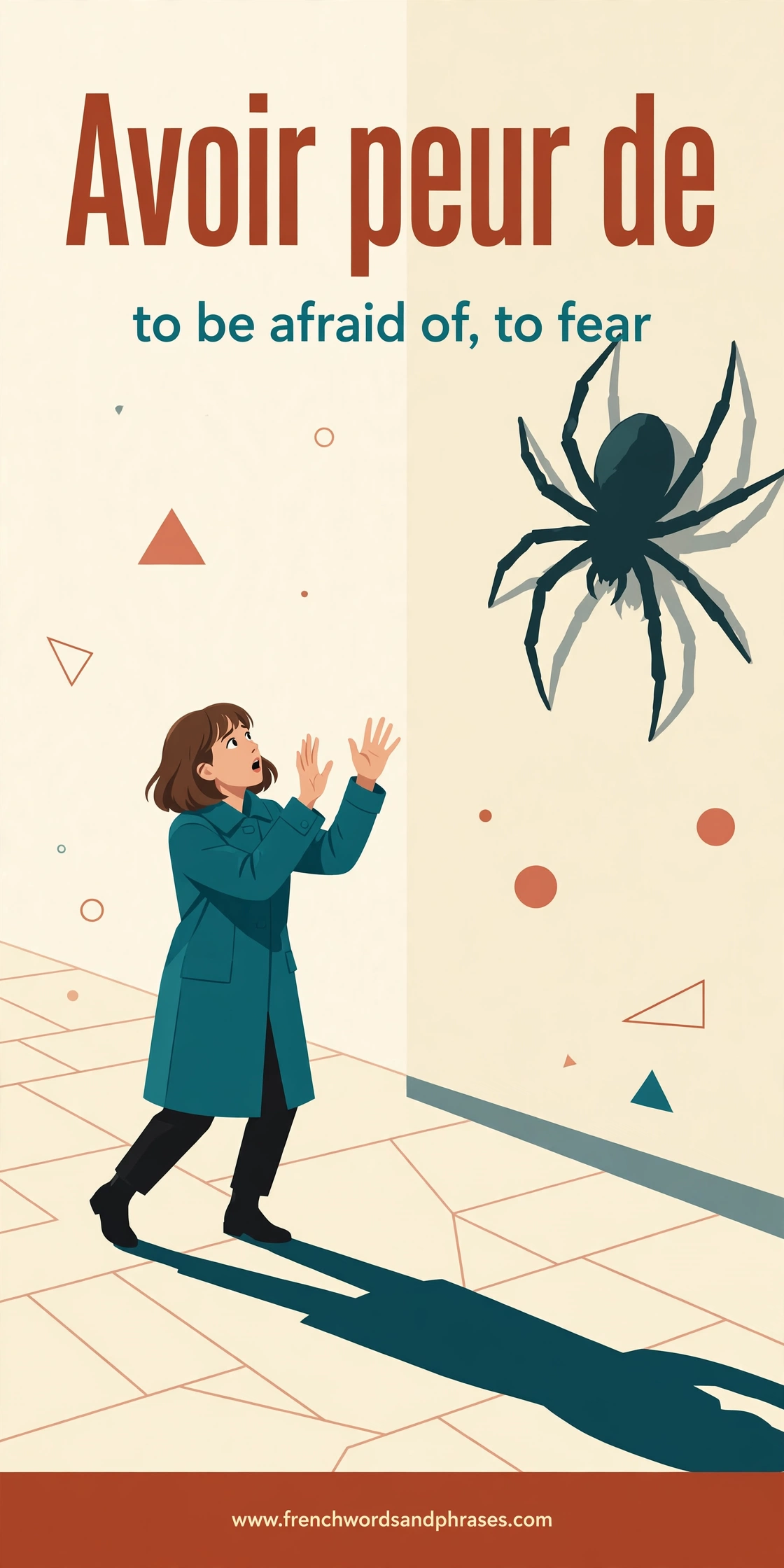
A French Word to Live By
Translate Avoir peur de to English
/a.vwaʁ pœʁ də/
Avoir peur de means to be afraid of, to fear — to feel fear of something or someone.
The little girl stands at the edge of the diving board, toes curled over the blue drop, and whispers it to herself: « J’ai peur de sauter. » Avoir peur de is how French says to be afraid: fear is not something you are, it is something you have — a possession you carry, and can put down.
Let’s explore how avoir peur de works in French, beginning with the whole phrase on one card.
Understanding the French Phrase Avoir peur de
Avoir peur de is a French verbal phrase built from avoir (to have — a verb that has its own page on this site), the noun peur, fear, and the preposition de. Word for word it is « to have fear of »: French treats fear as a thing held, like hunger (avoir faim) or cold (avoir froid). The feared thing follows de; a feared action follows as an infinitive: avoir peur de tomber, to be afraid of falling.
It means to be afraid of, to fear. J’ai peur des araignées — I am afraid of spiders. Elle a peur de l’avion — she is afraid of flying, of the plane. Avoir peur de + infinitive fears an action: il a peur de rater son examen, he is afraid of failing his exam. And with que + the subjunctive, it fears an event: j’ai peur qu’il pleuve, I am afraid it will rain.
Type: Verbal phrase — emotion (avoir + noun + de)
Answers the need: Saying what or whom you fear, and what you fear doing
Register: Universal — the everyday way to be afraid in French
Strength: Honest and plain — from a child’s spiders to real dread
One important usage detail: peur never changes inside the phrase, and avoir does all the conjugating — j’ai peur, tu as peur, nous avons peur. The feared noun takes de, which melts before vowels and articles: peur des chiens (de + les), peur du noir (de + le), peur de l’eau. Before an infinitive nothing melts: avoir peur de nager, to be afraid of swimming.
Experience the Word
Avoir peur de is the phrase of fear carried in the hands — a thing you hold for a while, not a thing you are.
Imagine the boy at the dentist’s door, cap twisted in his fingers. He is not a fearful boy; he simply has, this morning, a fear — il a peur de la piqûre — and by lunch it will be gone, spent like the coins in his pocket.
English makes fear an identity: I am afraid. French makes it a possession: j’ai peur — I have fear, today, of this, and tomorrow perhaps of nothing.
How to Use Avoir peur de in French: Complete Guide
Let’s explore how avoir peur de works in French, beginning with the whole phrase on one card.
Avoir peur de at a Glance
The Whole Phrase on One Card
Real meaning, literal picture, English twin and register — avoir peur de in five lines.
| Point | Avoir peur de |
|---|---|
| What it really means | to be afraid of, to fear |
| Word for word | to have fear of — fear as a possession |
| English equivalent | to be afraid of; to be scared of; to fear |
| Register | universal, everyday French |
| Use it for | things, animals, people, actions and events you fear |
Example
J’ai peur des araignées depuis l’enfance.
I have been afraid of spiders since childhood.
Word by Word: Building the Phrase
Three pieces — the great holder avoir, the noun peur, and the little de that points at the feared thing.
| Word | Literal meaning | Its job in the phrase |
|---|---|---|
| avoir | to have | the engine: it conjugates — j’ai peur, nous avons peur |
| peur | fear | the thing held: it never changes inside the phrase |
| de | of, from | the pointer: it introduces what is feared |
Example
Elle a peur de l’eau depuis toujours.
She has always been afraid of water.
Quick Quiz 1
Word for word, does j’ai peur say « I am afraid » or « I have fear »?
Reveal the answer
I have fear — French holds fear like an object: avoir peur. The meaning is « I am afraid ».
J’ai peur du noir.
I am afraid of the dark.
When You Say It: The Fearful Moments
Avoir peur de turns up at moments like these — wherever something is dreaded, large or small.
| Situation | Example |
|---|---|
| An animal | avoir peur des chiens — to be afraid of dogs |
| A place | avoir peur du noir — to be afraid of the dark |
| A person | avoir peur du professeur — to be afraid of the teacher |
| An action | avoir peur de tomber — to be afraid of falling |
| An event | avoir peur de rater le train — to be afraid of missing the train |
Example
Le petit a peur des gros chiens du voisin.
The little boy is afraid of the neighbour’s big dogs.
Make It Yours: The Phrase in Its Frames
Avoir conjugates through the tenses while peur stands still — and the feared thing follows de.
| Form | French | In English |
|---|---|---|
| Present | j’ai peur des araignées | I am afraid of spiders |
| Passé composé | elle a eu peur du bruit | she got a fright from the noise |
| Imparfait | nous avions peur du noir | we were afraid of the dark |
| Future | tu n’auras plus peur | you will not be afraid any more |
| With que | j’ai peur qu’il pleuve | I am afraid it will rain (subjunctive) |
Example
Enfant, nous avions peur des orages d’été.
As children, we were afraid of summer storms.
Quick Quiz 2
Complete it: elle a ______ des chiens
Reveal the answer
peur — the phrase is avoir peur de, and peur never changes.
Elle a peur des chiens.
She is afraid of dogs.
Everyday Expressions: Building on the Fear
Avoir peur de slots into these frames — each one ready to use as it stands.
| Frame | In English |
|---|---|
| avoir peur de quelqu’un | to be afraid of someone |
| avoir peur de + infinitive | to be afraid of doing something |
| avoir peur que + subjunctive | to be afraid that something will happen |
| avoir une peur bleue de | to be scared stiff of (familiar) |
| ne pas avoir peur de | to be not afraid of, to dare |
Example
Il a une peur bleue des piqûres.
He is scared stiff of injections.
Close Cousins: The Other Ways to Fear
French has a shelf of fear words — here is how they divide the work.
| Expression | The difference |
|---|---|
| craindre | to fear — the single verb, more formal and written |
| être effrayé par | to be frightened by — fear already landed, sudden |
| s’inquiéter de | to worry about — fear before the fact, quieter |
| redouter | to dread — formal, for looming events |
| avoir le trac | to have stage fright, butterflies |
Example
Elle craint l’examen, mais c’est du noir qu’elle a vraiment peur.
She fears the exam, but it is the dark she is really afraid of.
Quick Quiz 3
Which cousin is the single formal verb meaning « to fear » — craindre or s’inquiéter?
Reveal the answer
Craindre — to fear. S’inquiéter is to worry, a quieter, earlier unease.
Il craint le jugement de son père.
He fears his father’s judgement.
Avoir peur de and Its Neighbours
The fear shelf around the phrase — the feeling, its degrees and its opposite.
| French | In English |
|---|---|
| la peur | fear — the noun at the phrase’s heart |
| effrayé | frightened, scared — the adjective |
| la crainte | fear, apprehension — the formal noun |
| courageux | brave — the opposite character |
| sans peur | fearless, without fear |
Example
Sans peur devant le chien, le petit garçon avance doucement.
Fearless before the dog, the little boy steps forward slowly.
Watch Out: The Traps Around Avoir peur de
The traps: translating « I am » word for word, losing the de, and the subjunctive after peur que.
| Trap | The truth |
|---|---|
| « Je suis peur » | never — French has fear, it is not fear: j’ai peur |
| Losing the de | avoir peur de quelque chose — the de is part of the phrase |
| Peur que | j’ai peur qu’il pleuve takes the subjunctive: pleuve, not pleut |
| De before vowels | peur de l’eau, peur d’échouer — de melts to d’ before a vowel |
Example
J’ai peur qu’il échoue, mais il n’a pas peur d’essayer.
I am afraid he will fail, but he is not afraid to try.
Quick Quiz 4
How do you say ‘I am afraid of spiders’ with this phrase?
Reveal the answer
J’ai peur des araignées
Avoir peur de + les araignées gives peur des araignées.
I am afraid of spiders.
Avoir peur de in Everyday French: Real-Life Examples
Now that you know the word, let’s see how avoir peur de appears in everyday French.
Example 1 — Animals
J’ai peur des araignées, même des petites.
I am afraid of spiders, even the small ones.
Example 2 — The dark
Le petit a peur du noir, il veut une veilleuse.
The little boy is afraid of the dark, he wants a night light.
Example 3 — Flying
Elle a peur de l’avion, elle prend le train.
She is afraid of flying, she takes the train.
Example 4 — Falling
Ne regarde pas en bas si tu as peur de tomber.
Don’t look down if you are afraid of falling.
Example 5 — Exams
Les élèves ont peur de rater l’examen.
The pupils are afraid of failing the exam.
Example 6 — Weather
J’ai peur qu’il pleuve pendant la fête.
I am afraid it will rain during the party.
Beyond Translation: The Meaning of Avoir peur de
Avoir peur belongs to French’s great family of avoir phrases, where feelings are things you hold: avoir faim (to be hungry, « to have hunger »), avoir soif, avoir froid, avoir honte. English turned these into states of being; French kept them as possessions — which is quietly optimistic, because what you hold, you can set down.
Avoir peur de is the phrase of the portable fear — French for the dread you carry for a while, name precisely, and one day leave behind.
Learn it beside craindre, its formal single-verb cousin: the child a peur des chiens, the minister craint les conséquences — same fear, different clothes.
How to Remember the French Phrase Avoir peur de
Remember it this way: Avoir peur de is the fear phrase — avoir conjugates, peur stands still, and de points at the feared thing.
- You hold the fear — j’ai peur, jamais « je suis peur ».
- You keep the de — avoir peur de quelqu’un, peur des chiens, peur du noir.
- You switch for events — avoir peur que + subjonctif : j’ai peur qu’il pleuve.
The key idea is avoir peur de = to be afraid of; avoir conjugates, peur never changes.
Test Your Knowledge of Avoir peur de
Let’s see how much you’ve learned. Try answering these questions before revealing the answers.
Question 1
What does avoir peur de mean?
Reveal the answer
To be afraid of, to fear — literally, to have fear of.
Question 2
How do you say I am afraid?
Reveal the answer
J’ai peur — French has fear; it never says « je suis peur ».
Question 3
Translate: She is afraid of dogs.
Reveal the answer
Elle a peur des chiens.
Question 4
Complete the sentence:
Nous ______ peur du noir quand nous étions petits.
Reveal the answer
avions
Nous avions peur du noir quand nous étions petits.
We were afraid of the dark when we were little.
Question 5
Which mood follows avoir peur que?
Reveal the answer
The subjunctive — j’ai peur qu’il pleuve, I am afraid it will rain.
Your Final Challenge
Can You Use It?
How would you say this in French?
“I have been afraid of spiders since childhood.”
Reveal the answer
J’ai peur des araignées depuis l’enfance.
I have been afraid of spiders since childhood.
A little French. A little curiosity. A richer everyday life.
LEARN FRENCH ONE WORD AT A TIME