A French Word to Live By
Translate Prénom to English
/pʁe.nɔ̃/
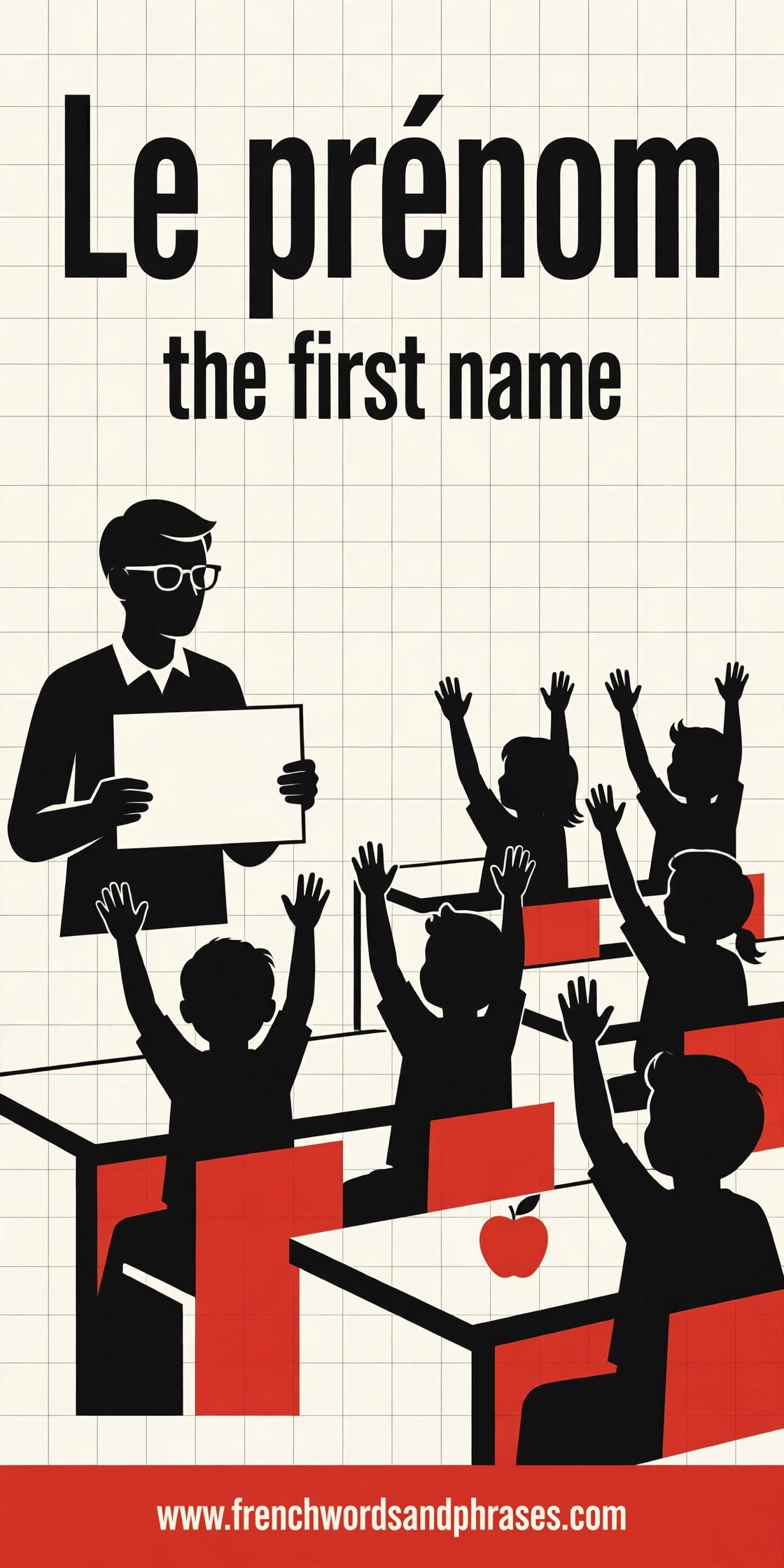
Le prénom means the first name.
The name your mother calls across the kitchen, the one your friends shorten and your grandmother never does: le prénom, the first name — the personal half of your identity, the half that comes first in France in every sense.
In this guide, you’ll learn what prénom means in English, how to use it with its articles, how to form its plural, and how it appears in everyday French. Explore French examples, English translations, and practice quizzes.
Understanding the French Noun Prénom
Prénom is a masculine French noun, learned with its article: le prénom, un prénom. It is built from pré-, before, and nom, name — literally the before-name, the name that stands in front of the family name. French draws the line cleanly: the nom (or nom de famille) is inherited, the prénom is chosen, usually by your parents, in the first days of your life.
It means a first name, a given name — the Christian name of older English: un prénom français, a French first name, un prénom composé, a double first name like Jean-Pierre or Marie-Claire. Parents choose it, friends use it, and the administration prints it second: French forms read NOM first, PRÉNOM after. To address someone by it is appeler quelqu’un par son prénom — a small ceremony of familiarity: Appelez-moi par mon prénom, call me by my first name.
Gender: Masculine — le prénom
Definite article: le — le prénom (the first name)
Indefinite article: un — un prénom (a first name)
Plural: les prénoms — regular, with a simple -s
Spelling note: pré- (before) + nom (name): the name that comes first
The pair: le nom is inherited (surname); le prénom is chosen (first name)
English equivalents: The first name, the given name.
Using someone’s prénom is a social signal in France: colleagues may work together for months on vous and surnames before someone proposes On se tutoie ? and first names follow. Babies often receive two or three prénoms — the extras live on official papers and are rarely spoken. A prénom composé, hyphenated, is used whole: Jean-Luc is never just Jean.
Experience the Word
Prénom is the name of affection: the nom belongs to the state and the family tree, the prénom belongs to the kitchen table.
Imagine the maternity ward notebook — grandparents suggesting, parents hesitating between Léa and Chloé: choosing un prénom is the first gift, and the first argument, of a child’s life.
You have not just named a word on a form. You have named the personal name — le prénom, the first name, the one love and friendship use.
How to Use Prénom in French: Complete Guide
Let’s explore how prénom works in French, beginning with its articles — le prénom, un prénom, par son prénom.
Prénom with the Definite Article (Le, Les)
Used for a specific first name — hers, his, the one on the doorbell.
| Form | French |
|---|---|
| Masculine singular | le prénom |
| Plural | les prénoms |
Example
Le prénom de sa fille est Zoé.
His daughter’s first name is Zoé.
Prénom with the Indefinite Article (Un, Des)
Used for a first name in general — a name to choose, a name to guess.
| Form | French |
|---|---|
| Masculine singular | un prénom |
| Plural | des prénoms |
Example
Ils cherchent un prénom pour le bébé.
They are looking for a first name for the baby.
Kinds of Prénom (Composé, Deuxième, Ancien…)
First names come in families of their own — chosen, doubled, inherited.
| Kind | French |
|---|---|
| a double first name | un prénom composé |
| a second first name | un deuxième prénom |
| an old-fashioned first name | un prénom ancien |
| a rare first name | un prénom rare |
| a fashionable first name | un prénom à la mode |
Example
Jean-Pierre est un prénom composé très classique.
Jean-Pierre is a very classic double first name.
Quick Quiz 1
Complete the sentence:
______ prénom de mon frère est Hugo. (the)
Reveal the answer
Le
Le prénom de mon frère est Hugo.
My brother’s first name is Hugo — prénom is masculine, so le.
The Plural of Prénom
Prénom takes a regular plural in -s — lists of names for twins, classes and teams.
| Number | French |
|---|---|
| Singular | le prénom |
| Plural | les prénoms |
Example
Les prénoms des jumeaux sont Léo et Léa.
The twins’ first names are Léo and Léa.
Prénom with Possessive Adjectives (Mon, Ton, Son…)
Possessives agree with the noun: prénom is masculine, so mon, ton, son in the singular.
| Owner | French |
|---|---|
| my | mon prénom |
| your (tu) | ton prénom |
| his / her | son prénom |
| our | notre prénom |
| your (vous) | votre prénom |
| their | leur prénom |
Example
Tout le monde connaît mon prénom ici.
Everyone knows my first name here.
Quick Quiz 2
Complete the sentence:
Appelez-moi par ______ prénom, s’il vous plaît. (my)
Reveal the answer
mon
Appelez-moi par mon prénom, s’il vous plaît.
Call me by my first name, please — mon, because prénom is masculine.
Prénom with Demonstrative Adjectives (Ce, Ces)
Used to point: ce prénom, this first name — this choice, this spelling.
| Form | French |
|---|---|
| Masculine singular | ce prénom |
| Plural | ces prénoms |
Example
Ce prénom est très à la mode cette année.
This first name is very fashionable this year.
Prénom with Adjectives
Adjectives agree with prénom — masculine singular: un prénom rare, un beau prénom.
| Adjective | With Prénom |
|---|---|
| beau (beautiful) | un beau prénom |
| rare (rare) | un prénom rare |
| ancien (old-fashioned) | un prénom ancien |
| composé (double) | un prénom composé |
| court (short) | un prénom court |
Example
Camille est un beau prénom pour une fille ou un garçon.
Camille is a beautiful first name for a girl or a boy.
Quick Quiz 3
Complete the sentence:
Marie-Claire est un prénom ______. (double)
Reveal the answer
composé
Marie-Claire est un prénom composé.
Marie-Claire is a double first name — composé, masculine, to agree with prénom.
Everyday Expressions with Prénom
Babies, forms and first-name terms — the prénom phrases of daily life.
| Expression | In English |
|---|---|
| appeler quelqu’un par son prénom | to call someone by their first name |
| un prénom composé | a double first name |
| choisir un prénom | to choose a first name |
| être en prénom | to be on first-name terms (rare, formal) |
| le prénom usuel | the usual first name (administration) |
Example
Le directeur nous appelle par nos prénoms.
The director calls us by our first names.
Words from the Same Family as Prénom
Names and naming — the words that travel with prénom.
| French | In English |
|---|---|
| le nom | the name, the surname |
| le nom de famille | the family name |
| un surnom | a nickname |
| nommer | to name (the verb) |
| le diminutif | the short form — Léo for Léonard |
Example
Son surnom est Béa, mais son prénom est Béatrice.
Her nickname is Béa, but her first name is Béatrice.
Quick Quiz 4
What is un prénom composé?
Reveal the answer
A double first name — two names joined by a hyphen and used together.
Jean-Luc et Marie-Claire sont des prénoms composés.
Jean-Luc and Marie-Claire are double first names.
Prénom in Everyday French: Real-Life Examples
Now that you know the word, let’s see how prénom appears in everyday French.
Example 1 — Choosing a name
Ils ont choisi le prénom du bébé : ce sera Noah.
They chose the baby’s first name: it will be Noah.
Example 2 — On a form
Prénom : Camille. Nom : Martin.
First name: Camille. Surname: Martin.
Example 3 — First-name terms
Appelez-moi par mon prénom, je vous en prie.
Call me by my first name, please.
Example 4 — Twins
Les prénoms des jumeaux se ressemblent.
The twins’ first names are similar.
Example 5 — Fashion
Le prénom Jade est très à la mode.
The first name Jade is very fashionable.
Example 6 — A nickname
Son prénom est Alexandre, son surnom Alex.
His first name is Alexandre, his nickname Alex.
Beyond Translation: The Meaning of Prénom
Prénom is a small lesson in French values: the family name is received, but the first name is a free choice, and for centuries the choice was not entirely free — until 1993, French parents had to pick from an official calendar of saints’ and historical names. Today almost anything goes, and the yearly statistics of prénoms are a national sport: newspapers announce the winning names like election results. The hyphenated prénom composé — Jean-Pierre, Marie-Claire — is France’s elegant compromise between tradition and individuality.
To say prénom is to name the name that was chosen just for you.
It evokes the birth announcement, the classroom register and the moment a colleague becomes a first-name friend.
How to Remember the French Noun Prénom
Remember it this way: Prénom is the first name — masculine: le prénom. It is chosen; the nom de famille is inherited.
- Always masculine — le prénom, un prénom, mon prénom.
- The order on forms — NOM first, then PRÉNOM: surname, then first name.
- The double — un prénom composé like Jean-Pierre is used whole, never shortened to Jean.
The key idea is le prénom — the first name, masculine; pré- + nom, the before-name.
Test Your Knowledge of Prénom
Let’s see how much you’ve learned. Try answering these questions before revealing the answers.
Question 1
Is prénom masculine or feminine?
Reveal the answer
Masculine — le prénom, un prénom.
Question 2
What is the difference between le nom and le prénom?
Reveal the answer
Le nom is the surname you inherit; le prénom is the first name you are given.
Question 3
Translate: Call me by my first name.
Reveal the answer
Appelez-moi par mon prénom.
Question 4
How do you say a double first name?
Reveal the answer
Un prénom composé — like Jean-Pierre or Marie-Claire.
Question 5
Complete the sentence:
______ prénoms des élèves sont écrits au tableau. (the)
Reveal the answer
Les
Les prénoms des élèves sont écrits au tableau.
The pupils’ first names are written on the board.
Your Final Challenge
Can You Use It?
How would you say this in French?
“Call me by my first name, please.”
Reveal the answer
Appelez-moi par mon prénom, s’il vous plaît.
Call me by my first name, please.
A little French. A little curiosity. A richer everyday life.
LEARN FRENCH ONE WORD AT A TIME