
A French Word to Live By
Translate Collègue to English
/kɔ.lɛɡ/
Le collègue means the colleague.
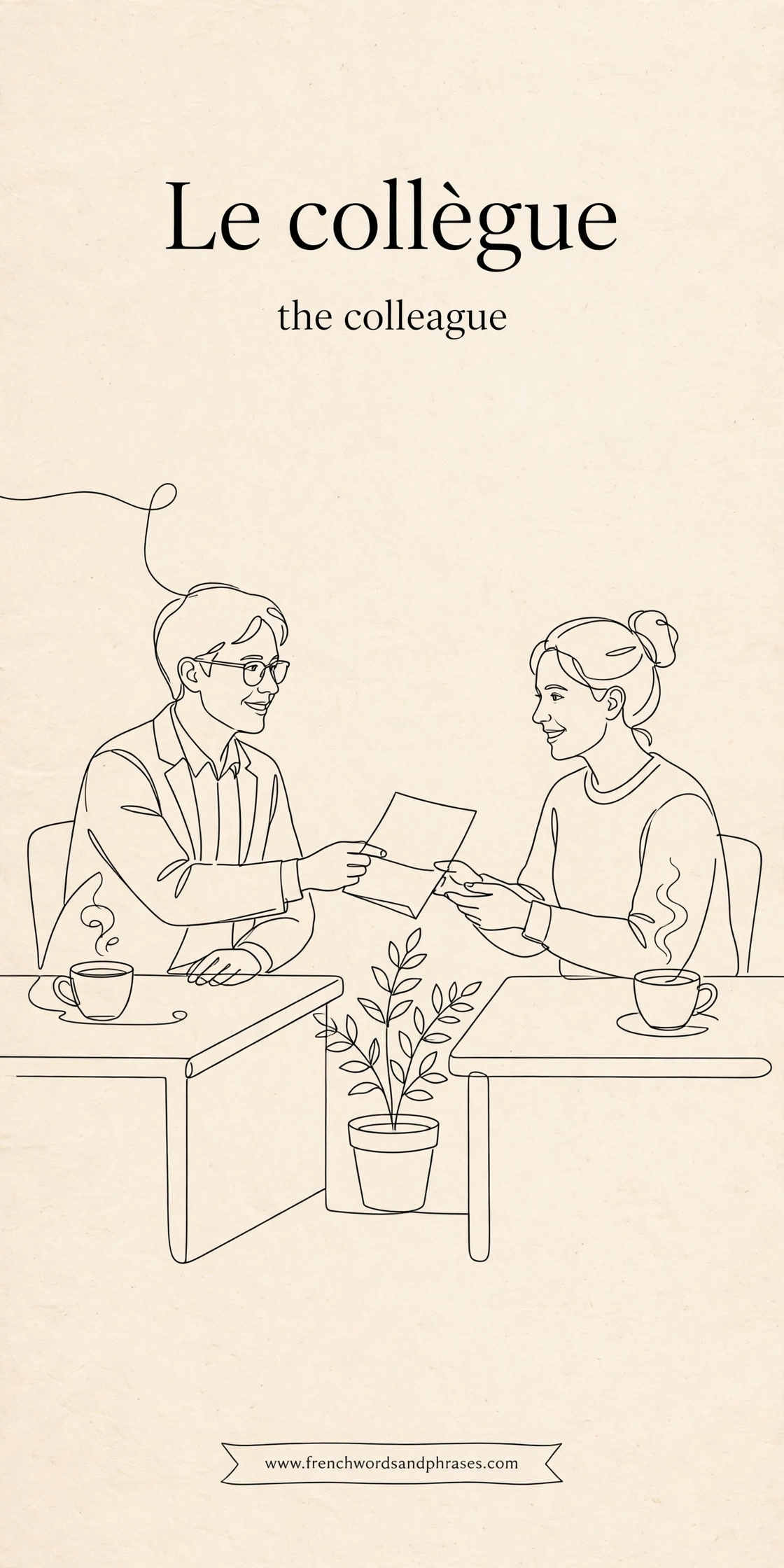
She holds the door of the meeting room, he saves you a seat and the last croissant from the training day: le collègue, the colleague — the person who shares your work, your corridor and your coffee machine, the fellow professional who is neither boss nor friend, but something French in between.
In this guide, you’ll learn what collègue means in English, how to use it with its articles, how to form its plural, and how it appears in everyday French. Explore French examples, English translations, and practice quizzes.
Understanding the French Noun Collègue
Collègue is an epicene French noun — one form for both sexes: le collègue for a man, la collègue for a woman, un collègue, une collègue. Only the article changes; the word itself never does. It comes from the Latin collega, a partner in office — col-, together, plus legere, to choose: the one chosen to serve alongside you. Its plural is les collègues.
It means colleague, coworker — someone who works in the same place or profession: ma collègue de bureau, my office colleague; un collègue de travail, a work colleague. The word carries professional respect: a collègue is a peer, addressed by name, greeted every morning, and defended in meetings. Teachers, doctors and lawyers extend it to the whole profession: un collègue can be a fellow teacher in another town.
Gender: Epicene — le collègue (a man), la collègue (a woman); the word never changes
Definite article: le / la — le collègue, la collègue (the colleague)
Indefinite article: un / une — un collègue, une collègue (a colleague)
Plural: les collègues — regular, with a simple -s
Spelling note: the è keeps its grave accent; collègue ends in -e for everyone
Workplace twin: un collègue de travail — a work colleague; un collègue de bureau — an office colleague
English equivalents: The colleague.
Collègue names a relationship of work, and French uses it with care: your collègue is not your copain (friend) nor your chef (boss), and calling the boss un collègue would be a small act of rebellion. With a woman, say la collègue, une collègue, ma collègue — the article and the agreements around the word carry the feminine; the word collègue itself stands still.
Experience the Word
Collègue is the diplomacy of the corridor — a word that gives every workmate a rank of equality, from the newest recruit to the oldest hand.
Imagine the first morning in a new office: a dozen strangers rise between the desks, and the manager makes the introductions — « vos collègues » — and by the magic of the word, the strangers are already a team, and one of them is already showing you where the coffee hides.
You have not just named a coworker. You have named a peer — le collègue, the colleague, the one chosen to serve alongside.
How to Use Collègue in French: Complete Guide
Let’s explore how collègue works in French, beginning with its articles — le collègue, la collègue, un collègue, une collègue.
Collègue with the Definite Article (Le, La, Les)
The article carries the sex: le collègue for a man, la collègue for a woman.
| Form | French |
|---|---|
| Masculine singular | le collègue |
| Feminine singular | la collègue |
| Plural | les collègues |
Example
La collègue de Paul présente le projet.
Paul’s colleague is presenting the project.
Collègue with the Indefinite Article (Un, Une, Des)
Un or une collègue — one word, two articles, for colleagues in general.
| Form | French |
|---|---|
| Masculine singular | un collègue |
| Feminine singular | une collègue |
| Plural | des collègues |
Example
Une collègue m’aide avec le dossier.
A colleague is helping me with the file.
Collègue with Quantities (Un, Deux, Beaucoup de…)
Colleagues are counted in teams — offices, staffrooms, whole professions.
| Quantity | French |
|---|---|
| one colleague | un collègue |
| two colleagues | deux collègues |
| all my colleagues | tous mes collègues |
| many colleagues | beaucoup de collègues |
| a new colleague | un nouveau collègue |
Example
Tous mes collègues viennent à la réunion.
All my colleagues are coming to the meeting.
Quick Quiz 1
Complete the sentence:
______ collègue de Léa est très gentille. (the — her colleague is a woman)
Reveal the answer
La
La collègue de Léa est très gentille.
Léa’s colleague is very kind — the article carries the feminine: la collègue.
The Plural of Collègue
Collègue takes a regular plural in -s — les collègues, the whole team.
| Number | French |
|---|---|
| Singular | le collègue / la collègue |
| Plural | les collègues |
Example
Les collègues déjeunent ensemble à midi.
The colleagues have lunch together at noon.
Collègue with Possessive Adjectives (Mon, Ma, Mes…)
Possessives follow the colleague’s sex: mon collègue for a man, ma collègue for a woman.
| Owner | French |
|---|---|
| my (m / f) | mon collègue / ma collègue |
| your (tu) (m / f) | ton collègue / ta collègue |
| his / her (m / f) | son collègue / sa collègue |
| our | notre collègue |
| your (vous) | votre collègue |
| their | leur collègue |
Example
Ma collègue partage mon bureau.
My colleague shares my office.
Quick Quiz 2
Complete the sentence:
Il travaille avec ______ collègue Marie tous les jours. (his)
Reveal the answer
sa
Il travaille avec sa collègue Marie tous les jours.
He works with his colleague Marie every day — sa, because Marie is a woman: sa collègue.
Collègue with Demonstrative Adjectives (Ce, Cette, Ces)
Used to point: ce collègue, cette collègue — the one by the window, the one speaking.
| Form | French |
|---|---|
| Masculine singular | ce collègue |
| Feminine singular | cette collègue |
| Plural | ces collègues |
Example
Cette collègue connaît bien le dossier.
This colleague knows the file well.
Collègue with Adjectives
Adjectives agree with the colleague’s sex — nouveau collègue, nouvelle collègue — while collègue itself never changes.
| Adjective | With Collègue |
|---|---|
| nouveau / nouvelle (new) | un nouveau collègue, une nouvelle collègue |
| jeune (young) | un jeune collègue |
| ancien / ancienne (long-standing, former) | un ancien collègue, une ancienne collègue |
| proche (close) | un collègue proche |
| formidable (wonderful) | une collègue formidable |
Example
Notre nouvelle collègue commence lundi.
Our new colleague starts on Monday.
Quick Quiz 3
Complete the sentence:
C’est une collègue très ______, elle aide tout le monde. (kind)
Reveal the answer
gentille
C’est une collègue très gentille, elle aide tout le monde.
She is a very kind colleague, she helps everyone — gentille, feminine, agreeing with the woman, while collègue itself stands still.
Everyday Expressions with Collègue
Corridors, staffrooms and coffee machines — the collègue phrases of daily life.
| Expression | In English |
|---|---|
| un collègue de travail | a work colleague, a coworker |
| un collègue de bureau | an office colleague |
| mes collègues | my colleagues — the team |
| un ancien collègue | a former colleague |
| entre collègues | between colleagues, among workmates |
Example
Entre collègues, on se dit bonjour tous les matins.
Between colleagues, we say hello every morning.
Words from the Same Family as Collègue
The workplace circle — the words that travel with collègue.
| French | In English |
|---|---|
| le travail | work |
| le bureau | the office; the desk |
| le chef | the boss — not a collègue |
| un employé | an employee |
| une équipe | a team |
Example
Notre équipe compte dix collègues et un chef.
Our team has ten colleagues and one boss.
Quick Quiz 4
What makes collègue an epicene noun?
Reveal the answer
One form serves both sexes — le collègue, la collègue: only the article and the agreements change, never the word.
Un collègue arrive, une collègue aussi.
A (male) colleague is arriving, a (female) colleague too.
Collègue in Everyday French: Real-Life Examples
Now that you know the word, let’s see how collègue appears in everyday French.
Example 1 — At the office
Ma collègue partage mon bureau.
My colleague shares my office.
Example 2 — Lunch
Les collègues mangent ensemble à la cantine.
The colleagues eat together in the canteen.
Example 3 — A new arrival
Un nouveau collègue commence lundi.
A new colleague starts on Monday.
Example 4 — Helping
Mon collègue m’aide avec le rapport.
My colleague is helping me with the report.
Example 5 — A former colleague
Je déjeune avec un ancien collègue demain.
I’m having lunch with a former colleague tomorrow.
Example 6 — The team
Entre collègues, on se soutient.
Between colleagues, we support each other.
Beyond Translation: The Meaning of Collègue
Collègue is a small republic in a word: Latin collega named those chosen together for an office — equals by election, partners in a charge. French kept the equality and made it the default word of working life, a title every employee holds and no boss can grant or remove. In a country attentive to the gradations of address, collègue performs a daily miracle: it places the director’s assistant and the senior engineer, for the length of a corridor greeting, on exactly the same step.
To say collègue is to declare a peer — chosen, like you, to serve alongside.
It evokes the morning round of bonjours, the shared coffee, and the seat saved in the meeting room.
How to Remember the French Noun Collègue
Remember it this way: Collègue is epicene — one word for a man or a woman; the article does the talking: le collègue, la collègue.
- One word, two articles — un collègue, une collègue : le mot ne bouge jamais.
- The agreements follow the person — ma collègue est gentille ; mon collègue est gentil.
- A peer, not a boss — le collègue est un égal ; le chef n’en est pas un.
The key idea is le / la collègue — the colleague, epicene; plural les collègues.
Test Your Knowledge of Collègue
Let’s see how much you’ve learned. Try answering these questions before revealing the answers.
Question 1
How do you say the colleague for a woman?
Reveal the answer
La collègue — the word never changes; the article carries the feminine.
Question 2
How do you say my colleagues?
Reveal the answer
Mes collègues.
Question 3
Translate: A new colleague starts on Monday.
Reveal the answer
Un nouveau collègue commence lundi.
Question 4
Complete the sentence:
______ collègues déjeunent ensemble. (the)
Reveal the answer
Les
Les collègues déjeunent ensemble.
The colleagues are having lunch together.
Question 5
Is your boss your collègue?
Reveal the answer
Not in careful French — a collègue is a peer, an equal; the boss is le chef.
Your Final Challenge
Can You Use It?
How would you say this in French?
“My colleague is helping me with the report.”
Reveal the answer
Mon collègue m’aide avec le rapport.
My colleague is helping me with the report.
A little French. A little curiosity. A richer everyday life.
LEARN FRENCH ONE WORD AT A TIME




