A French Word to Live By
Translate Pardon to English
/paʁ.dɔ̃/
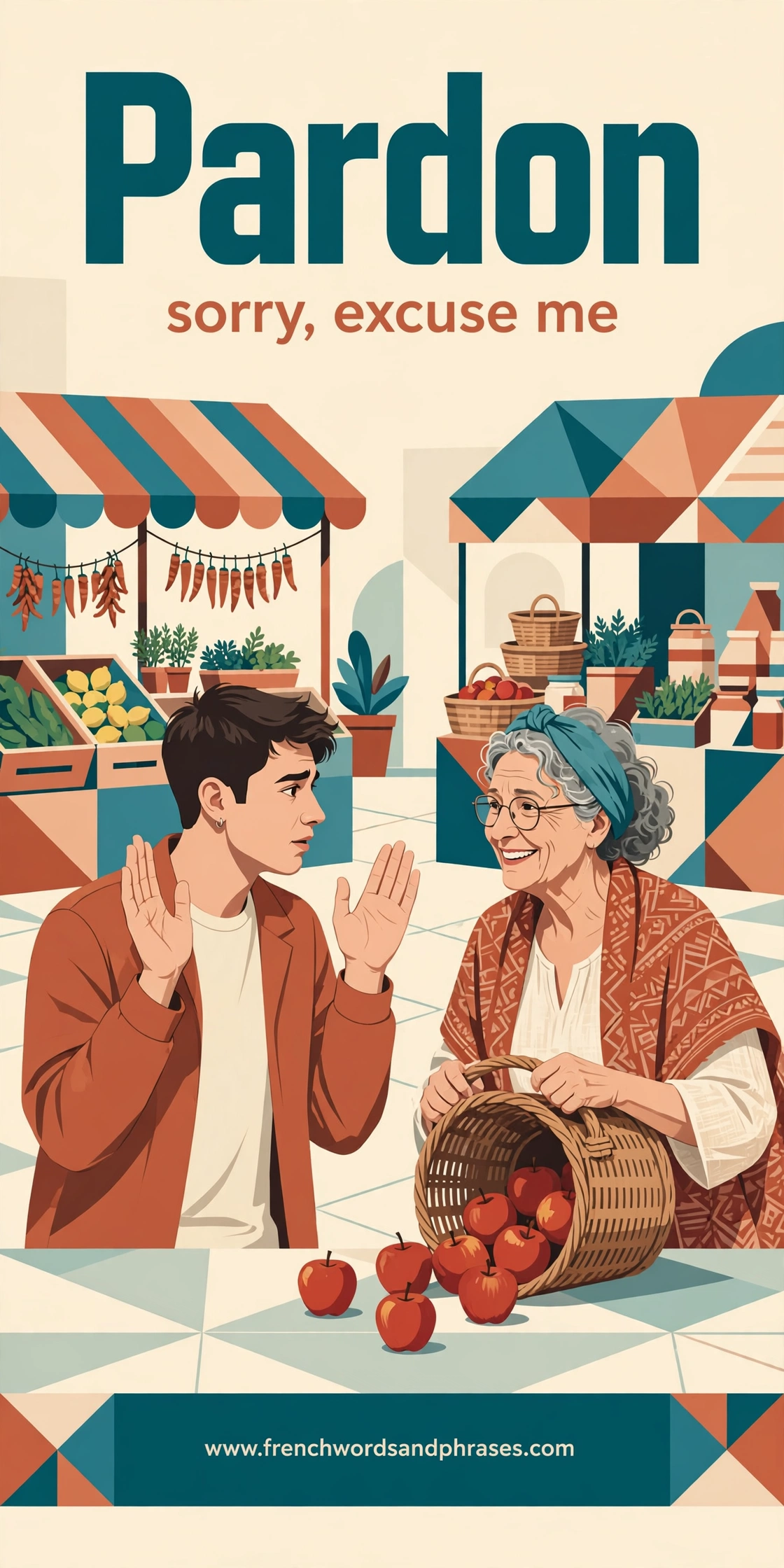
Pardon means sorry, excuse me.
Your bag clips a stranger’s shoulder in the métro, a cup rattles, and the word is out before you have even turned round: « Pardon ! » Pardon is the all-purpose small apology of French — sorry for the bump, excuse me for the passage, and, with a rising tune, the word for « what did you say? » — one syllable-pair that oils a hundred moments a day.
Let’s explore how pardon works in French, beginning with the whole word on one card.
Understanding the French Interjection Pardon
Pardon is a French interjection — the universal light apology — and also a noun, le pardon, forgiveness itself. As an interjection it covers three daily jobs: sorry for a small physical mishap, excuse me when passing or interrupting, and « pardon ? » — sorry, what was that? — when you did not hear. It is neutral in register, safe everywhere, and shorter than all its rivals.
It means sorry and excuse me, in the light social sense. « Pardon, je ne vous avais pas vu » — sorry, I hadn’t seen you. « Pardon, je passe » — excuse me, I’m coming through. « Pardon ? » — sorry? (please repeat). For a genuine fault, pardon deepens into je vous demande pardon or je suis désolé; the bare interjection is for the small change of daily friction.
Type: Interjection — the universal light apology; also a noun, forgiveness
Answers the need: Small bumps, passages, interruptions, and not hearing
Register: Neutral — safe with everyone, in every setting
Strength: Light and instant — one word, debt paid
One important usage detail: tone is everything. Flat and quick — « Pardon » — it apologises or squeezes past. Rising — « Pardon ? » — it asks for a repetition, and is politer than quoi ?, which can sound blunt. And pardon can sharpen into polite disbelief — « Pardon, mais ce n’est pas possible » — where it means excuse me, but…, a courteous way to contradict.
Experience the Word
Pardon is the smallest coin in the currency of courtesy — spent a dozen times a day, and never missed from the purse.
Imagine the Saturday market, shoulder to shoulder between the cheese stall and the flowers: pardon… pardon… pardon… — the word travels down the aisle like a zip opening, each person paying it forward until the crowd has let you through.
You have not made a speech of regret. You have kept the peace in one breath.
How to Use Pardon in French: Complete Guide
Let’s explore how pardon works in French, beginning with the whole word on one card.
Pardon at a Glance
The Whole Word on One Card
Meaning, job, register and strength — pardon in four lines.
| Point | Pardon |
|---|---|
| Meaning | sorry, excuse me — and « pardon ? », what was that? |
| Job | absorbs small bumps, opens passages, asks for repeats |
| Register | neutral — everyone, everywhere |
| Strength | light and instant; deepens only with company (je vous demande pardon) |
Example
Pardon, monsieur, je ne vous avais pas vu.
Sorry, sir, I hadn’t seen you.
Word by Word: Building the Word
One word, one root — the act of forgiving, shrunk to a syllable-pair.
| Word | Literal meaning | Its job |
|---|---|---|
| pardon | forgiveness (from pardonner, to forgive) | the whole apology in one word |
| pardon ? | sorry? | with a rising tone: please say that again |
| je vous demande pardon | I beg your pardon | the deep form, for real faults |
Example
Pardon ? Vous pouvez répéter ?
Sorry? Can you repeat that?
Quick Quiz 1
True or false: pardon ? with a rising tone means « please repeat that ».
Reveal the answer
True — the rising pardon is the polite way to say you did not hear.
Pardon ? — Je disais, le train part à midi.
Sorry? — I was saying, the train leaves at noon.
When You Say It: The Friction Moments
Pardon fires at the small collisions of the day — physical, social, and auditory.
| Situation | Example |
|---|---|
| A bump in the crowd | pardon, je suis désolé |
| Squeezing past | pardon, je passe |
| Interrupting | pardon, vous avez une minute ? |
| Not hearing | pardon ? vous pouvez répéter ? |
| Polite contradiction | pardon, mais je ne suis pas d’accord |
Example
Pardon, je passe, mon train arrive.
Excuse me, I’m coming through, my train is arriving.
Make It Yours: Pardon in Its Frames
Pardon stands alone or grows company — the frame sets the depth of the apology.
| Form | French | In English |
|---|---|---|
| Alone | pardon ! | sorry! / excuse me! |
| Rising | pardon ? | sorry? (please repeat) |
| With a reason | pardon, je ne regardais pas | sorry, I wasn’t looking |
| Deeper | je vous demande pardon | I beg your pardon |
| Contradicting gently | pardon, mais… | excuse me, but… |
Example
Je vous demande pardon pour ce retard.
I beg your pardon for this delay.
Quick Quiz 2
Complete it: ______ ? Je n’ai pas bien entendu.
Reveal the answer
Pardon — the rising pardon asks for the repetition, politely.
Pardon ? Je n’ai pas bien entendu.
Sorry? I didn’t quite hear.
Everyday Expressions with Pardon
Pardon slots into these frames — each one ready to use as it stands.
| Frame | In English |
|---|---|
| pardon ? | sorry? — please repeat |
| pardon, je passe | excuse me, I’m coming through |
| je vous demande pardon | I beg your pardon |
| demander pardon à quelqu’un | to ask someone’s forgiveness |
| le pardon | forgiveness — the noun, in church and in families |
Example
Elle a demandé pardon à sa sœur.
She asked her sister for forgiveness.
Close Cousins: The Other Apologies
The apology ladder, from the coin to the banknote — pardon is the coin.
| Expression | The difference |
|---|---|
| pardon | sorry, excuse me — the light universal word |
| excusez-moi | excuse me — before questions and passages, a touch more formal |
| je suis désolé | I’m sorry — real regret for real faults |
| je vous demande pardon | I beg your pardon — deep, formal apology |
| toutes mes excuses | my apologies — formal, often written |
Example
Un choc : pardon. Une faute : je suis désolé.
A bump: pardon. A fault: je suis désolé.
Quick Quiz 3
You did not hear what the ticket inspector said. Give the polite response.
Reveal the answer
Pardon ?
The rising pardon — politer than quoi ?, which can sound blunt.
Pardon ? — Votre billet, s’il vous plaît. — Sorry? — Your ticket, please.
Pardon and Its Neighbours
The words around pardon — forgiving, faults, and the people who grant both.
| French | In English |
|---|---|
| pardonner | to forgive (the verb) |
| une faute | a fault, a mistake |
| une excuse | an excuse; an apology |
| désolé | sorry, regretful — the adjective of regret |
| s’excuser | to apologise |
Example
Pardonner est parfois plus difficile que demander pardon.
Forgiving is sometimes harder than asking forgiveness.
Watch Out: The Traps Around Pardon
The traps: the flat word for a deep fault, and quoi ? where pardon belongs.
| Trap | The truth |
|---|---|
| Pardon for a serious wrong | too light alone — add désolé or je vous demande pardon |
| Quoi ? for ‘pardon?’ | quoi ? can sound rude to a stranger; pardon ? is the polite repeat |
| Pardon as hello | pardon never greets; it repairs |
| The noun mix-up | le pardon is forgiveness itself — a grand word in church and family life |
Example
Pardon pour les chocs, désolé pour les fautes.
Pardon for bumps, désolé for faults.
Quick Quiz 4
Your trolley bumps a stranger’s ankle in the supermarket. What do you say?
Reveal the answer
Pardon !
One word, instantly — the small apology for the small collision.
Pardon, je ne vous avais pas vu. — Sorry, I hadn’t seen you.
Pardon in Everyday French: Real-Life Examples
Now that you know the word, let’s see how pardon appears in everyday French.
Example 1 — In the métro
Pardon, je descends ici.
Excuse me, I’m getting off here.
Example 2 — A bump
Pardon, monsieur, je suis désolé.
Sorry, sir, I do apologise.
Example 3 — Not hearing
Pardon ? Vous pouvez répéter, s’il vous plaît ?
Sorry? Can you repeat that, please?
Example 4 — Interrupting
Pardon, vous avez l’heure ?
Excuse me, do you have the time?
Example 5 — Gentle contradiction
Pardon, mais le magasin ferme à sept heures.
Excuse me, but the shop closes at seven.
Example 6 — A deep apology
Je vous demande pardon pour hier soir.
I beg your pardon for last night.
Beyond Translation: The Meaning of Pardon
Pardon began as theology: le pardon was the forgiveness of sins, the grand release, and pardonner — from Latin perdonare, to give completely — was what God and kings did. Daily life borrowed the grand word and spent it small: a bumped shoulder, a squeezed passage, a missed word. Yet the depth is still there when needed — je vous demande pardon can still carry a whole family’s reconciliation, which is why the little interjection never quite loses its dignity.
Pardon is forgiveness in small change — minted by religion, spent by everyone, every day.
Learn its ladder: pardon for the friction, excusez-moi for the approach, désolé for the fault, and you can repair any moment in French.
How to Remember the French Interjection Pardon
Remember it this way: Pardon is the one-word apology — flat for bumps and passages, rising for « say that again », and deep only in je vous demande pardon.
- You spend it instantly — un choc, un pardon, l’affaire est close.
- You lift the tone to ask — pardon ? monte : répétez, s’il vous plaît.
- You deepen it for faults — je vous demande pardon, pas le petit pardon des couloirs.
The key idea is pardon = sorry, excuse me; pardon ? = sorry, please repeat; le pardon = forgiveness.
Test Your Knowledge of Pardon
Let’s see how much you’ve learned. Try answering these questions before revealing the answers.
Question 1
What does pardon mean?
Reveal the answer
Sorry, excuse me — the light, universal apology.
Question 2
What does pardon ? with a rising tone mean?
Reveal the answer
Sorry? — please repeat that: the polite way to say you did not hear.
Question 3
Translate: Excuse me, I’m coming through.
Reveal the answer
Pardon, je passe.
Question 4
Complete the sentence:
______ , je ne vous avais pas vu.
Reveal the answer
Pardon
Pardon, je ne vous avais pas vu.
Sorry, I hadn’t seen you.
Question 5
How do you deepen pardon for a real fault?
Reveal the answer
Je vous demande pardon — I beg your pardon; or add je suis désolé.
Your Final Challenge
Can You Use It?
How would you say this in French?
“Sorry, I hadn’t seen you, excuse me.”
Reveal the answer
Pardon, je ne vous avais pas vu, excusez-moi.
Sorry, I hadn’t seen you, excuse me.
A little French. A little curiosity. A richer everyday life.
LEARN FRENCH ONE WORD AT A TIME