
A French Word to Live By
Translate Au revoir to English
/o ʁə.vwaʁ/
Au revoir means goodbye, see you later.
The visit is over, coats are on, and at the door the host smiles: « Au revoir, et merci pour tout ! » Au revoir is the polite French goodbye — the word for leaving any company, any shop, any office, carrying inside it a small promise: revoir, to see again.
Let’s explore how au revoir works in French, beginning with the whole phrase on one card.
Understanding the French Phrase Au revoir
Au revoir is a French farewell phrase built from au (until) and revoir (seeing again): literally « until the seeing-again ». It is the standard, neutral goodbye, safe with everyone — strangers, elders, officials, colleagues — at any hour, in person or on the phone.
It means goodbye, with a built-in hope of meeting again — closer to « see you again » than to a final farewell. That final farewell exists too: adieu, said when parting for good or for very long, and therefore rare and heavy. Au revoir is the everyday door-word: « Au revoir, madame, merci » — goodbye, madam, thank you.
Type: Farewell phrase — the standard polite goodbye
Answers the need: Closing any encounter courteously, at any hour
Register: Neutral and polite — safe with absolutely everyone
Strength: Calm and final for today — but it promises a next time
One important usage detail: au revoir is said when YOU leave, and also returned when someone leaves you — it works in both directions at the door. In shops it pairs with merci: « Merci, au revoir ! » Do not use adieu for an ordinary goodbye; to a French ear adieu sounds like forever, and may draw a startled laugh or a real sadness.
Experience the Word
Au revoir is a door closed gently, not slammed — the revoir inside it leaves the door on the latch for next time.
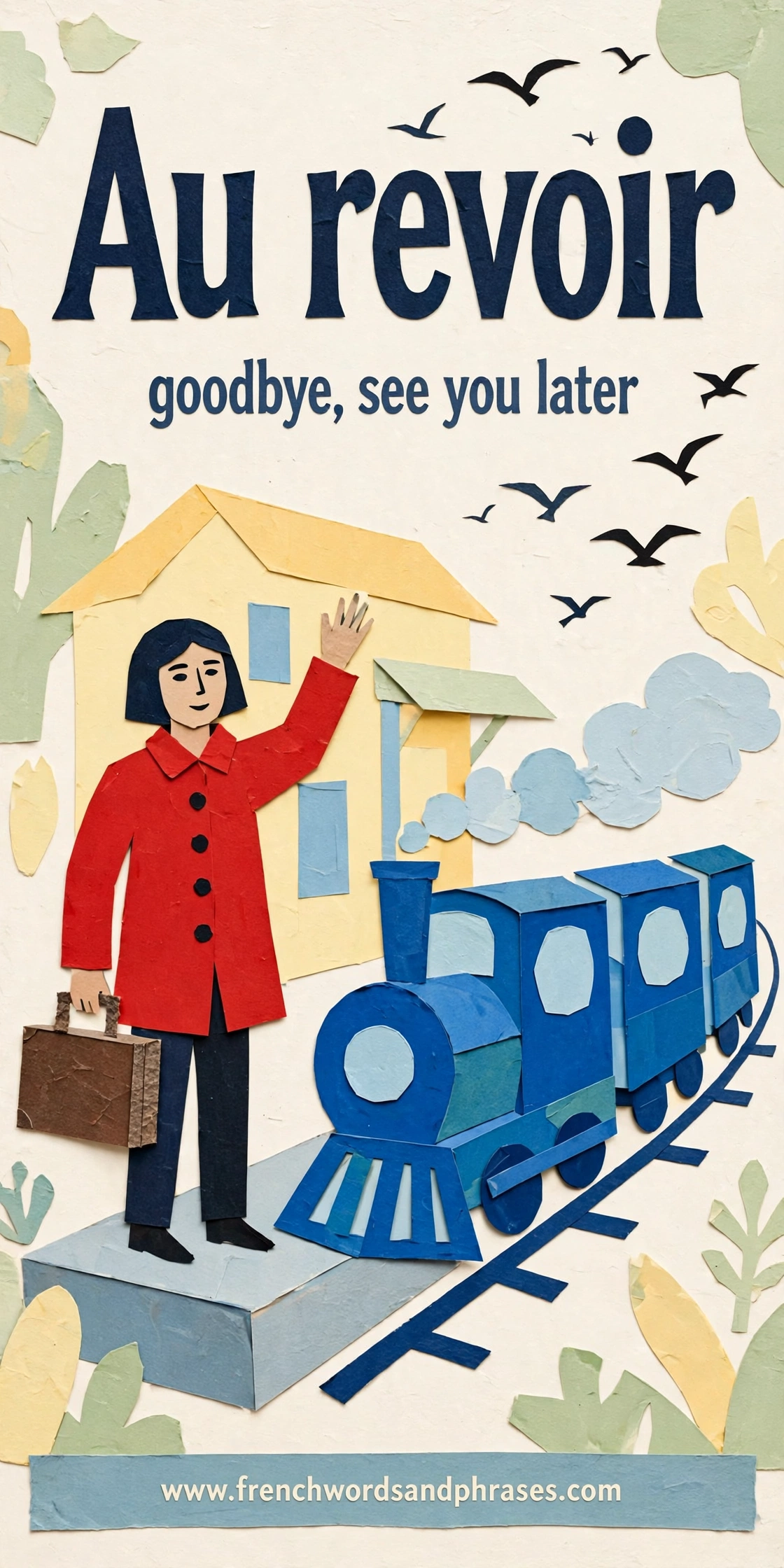
Imagine the last train leaving the village station: a hand from the window, a voice from the platform — « Au revoir ! » — two syllables of promise travelling with the train into the dark.
You have not ended anything. You have said: this meeting is over, and the story is not.
How to Use Au revoir in French: Complete Guide
Let’s explore how au revoir works in French, beginning with the whole phrase on one card.
Au revoir at a Glance
The Whole Phrase on One Card
Real meaning, literal picture, English twin and register — au revoir in five lines.
| Point | Au revoir |
|---|---|
| What it really means | goodbye — with the hope of meeting again inside it |
| Word for word | until the seeing-again (au + revoir) |
| English equivalent | goodbye; see you again |
| Register | neutral, polite — everyone, everywhere, any hour |
| Use it for | leaving shops, offices, visits, calls — the universal exit |
Example
Au revoir, monsieur, et merci pour votre aide.
Goodbye, sir, and thank you for your help.
Word by Word: Building the Phrase
Two pieces — a preposition of waiting, and a verb of seeing again.
| Word | Literal meaning | Its job in the phrase |
|---|---|---|
| au | until, to the | the waiting: until that future moment |
| revoir | seeing again (from re- + voir, to see again) | the promise: we will see each other again |
| au revoir | until the seeing-again | the whole farewell in two words |
Example
Au revoir, à la semaine prochaine.
Goodbye, see you next week.
Quick Quiz 1
What does revoir mean inside au revoir?
Reveal the answer
Seeing again — au revoir is literally « until the seeing-again ».
Au revoir, madame.
Goodbye, madam.
When You Say It: The Leaving Moments
Au revoir fires at exits — doors, counters, platforms, the end of calls.
| Situation | Example |
|---|---|
| Leaving a shop | merci, au revoir ! — thank you, goodbye |
| Ending a visit | au revoir, et merci pour le dîner |
| At the office door | au revoir, à lundi — goodbye, see you Monday |
| Ending a phone call | très bien, au revoir, madame |
| At the station | au revoir ! bon voyage ! |
Example
Au revoir, les enfants, à demain.
Goodbye, children, see you tomorrow.
Make It Yours: Au revoir in Its Frames
Au revoir takes titles, dates and good wishes — the frame changes, the phrase does not.
| Form | French | In English |
|---|---|---|
| With a title | au revoir, madame | goodbye, madam |
| With a date | au revoir, à demain | goodbye, see you tomorrow |
| With thanks | merci, au revoir | thank you, goodbye |
| With a wish | au revoir, bon retour | goodbye, have a good trip back |
| To a group | au revoir à tous | goodbye everyone |
Example
Au revoir à tous, et à la semaine prochaine.
Goodbye everyone, and see you next week.
Quick Quiz 2
Complete it: Merci, ______ , bonne journée !
Reveal the answer
au revoir — the classic shop exit pairs thanks with au revoir.
Merci, au revoir, bonne journée !
Thank you, goodbye, have a good day!
Everyday Expressions with Au revoir
Au revoir slots into these frames — each one ready to use as it stands.
| Frame | In English |
|---|---|
| dire au revoir à quelqu’un | to say goodbye to someone |
| au revoir, à bientôt | goodbye, see you soon |
| au revoir, à demain | goodbye, see you tomorrow |
| les au revoir | the goodbyes — the long moment of leave-taking |
| un au revoir rapide | a quick goodbye |
Example
Elle dit au revoir à ses élèves avant les vacances.
She says goodbye to her pupils before the holidays.
Close Cousins: The Other Farewells
French says goodbye by the calendar and by the heart — here is how the family divides the exits.
| Expression | The difference |
|---|---|
| à bientôt | see you soon — warm, expects a near meeting |
| à demain | see you tomorrow — the date is fixed |
| salut | bye — informal, between friends only |
| bonne journée | have a good day — a wish added to the goodbye |
| adieu | farewell forever — heavy, rare, almost never for daily use |
Example
On dit au revoir au bureau, et salut aux amis.
You say au revoir at the office, and salut to friends.
Quick Quiz 3
Which farewell means parting for good — au revoir or adieu?
Reveal the answer
Adieu — adieu is the heavy, final word; au revoir promises a next meeting.
Au revoir, pas adieu !
Goodbye — not farewell!
Au revoir and Its Neighbours
The words around the farewell — seeing, returning, and the calendar of next times.
| French | In English |
|---|---|
| revoir | to see again (the verb) |
| à bientôt | see you soon |
| à plus tard | see you later |
| bon retour | have a good journey back |
| se quitter | to part, to leave each other |
Example
J’espère vous revoir très bientôt.
I hope to see you again very soon.
Watch Out: The Traps Around Au revoir
The traps: the forever-word used by mistake, and the arrival-word used at the exit.
| Trap | The truth |
|---|---|
| Saying adieu | adieu sounds final — for daily goodbyes always au revoir |
| Saying bonjour on leaving | bonjour opens, au revoir closes; shops pair merci + au revoir |
| Dropping the title | with elders and officials, au revoir, madame keeps the courtesy whole |
| On the phone | au revoir ends calls too — never just hang up on the phrase’s watch |
Example
Au revoir, madame, merci et à bientôt.
Goodbye, madam, thank you and see you soon.
Quick Quiz 4
You are leaving a bakery. Give the complete, polite exit.
Reveal the answer
Merci, au revoir !
Thanks first, then au revoir — the two-word ceremony of every French shop door.
Merci, au revoir, bonne journée ! — Thank you, goodbye, have a good day!
Au revoir in Everyday French: Real-Life Examples
Now that you know the word, let’s see how au revoir appears in everyday French.
Example 1 — Leaving a shop
Merci, au revoir, bonne journée.
Thank you, goodbye, have a good day.
Example 2 — After a visit
Au revoir, et merci pour ce beau dîner.
Goodbye, and thank you for the lovely dinner.
Example 3 — At school
Au revoir, maîtresse, à demain.
Goodbye, teacher, see you tomorrow.
Example 4 — On the phone
D’accord, merci. Au revoir, monsieur.
All right, thank you. Goodbye, sir.
Example 5 — At the station
Au revoir ! Écris-moi quand tu arrives.
Goodbye! Write to me when you arrive.
Example 6 — At the office
Au revoir à tous, bon week-end.
Goodbye everyone, have a good weekend.
Beyond Translation: The Meaning of Au revoir
Au revoir is a small philosophy of parting: where English goodbye shrank from « God be with you », the French farewell shrank from a rendezvous — à vous revoir, until I see you again. The promise is the point. That is why French reserves adieu, « to God », for the partings that have no next time in this world, and why au revoir can be said a thousand times in a life without ever wearing out.
Au revoir is the farewell that believes in a next chapter.
Learn it beside à bientôt and à demain: au revoir closes the meeting, and its cousins name the next one.
How to Remember the French Phrase Au revoir
Remember it this way: Au revoir is au plus revoir — until the seeing-again: the polite goodbye for everyone, with a next meeting promised inside it.
- You hear the promise — revoir, to see again: au revoir n’est jamais un adieu.
- You pair it with thanks — merci, au revoir, la sortie de chaque boutique.
- You keep adieu away — adieu is forever; au revoir is until next time.
The key idea is au revoir = goodbye; au + revoir, until the seeing-again.
Test Your Knowledge of Au revoir
Let’s see how much you’ve learned. Try answering these questions before revealing the answers.
Question 1
What does au revoir mean?
Reveal the answer
Goodbye — literally, until the seeing-again.
Question 2
What is the difference between au revoir and adieu?
Reveal the answer
Au revoir expects a next meeting; adieu is final — farewell for good, and rarely used.
Question 3
Translate: Goodbye, madam, thank you.
Reveal the answer
Au revoir, madame, merci.
Question 4
Complete the sentence:
Merci, ______ , à demain !
Reveal the answer
au revoir
Merci, au revoir, à demain !
Thank you, goodbye, see you tomorrow!
Question 5
How do you say goodbye to a close friend, informally?
Reveal the answer
Salut — between friends, salut says bye as warmly as au revoir, without the ceremony.
Your Final Challenge
Can You Use It?
How would you say this in French?
“Goodbye, children, see you tomorrow at school.”
Reveal the answer
Au revoir, les enfants, à demain à l’école.
Goodbye, children, see you tomorrow at school.
A little French. A little curiosity. A richer everyday life.
LEARN FRENCH ONE WORD AT A TIME




