
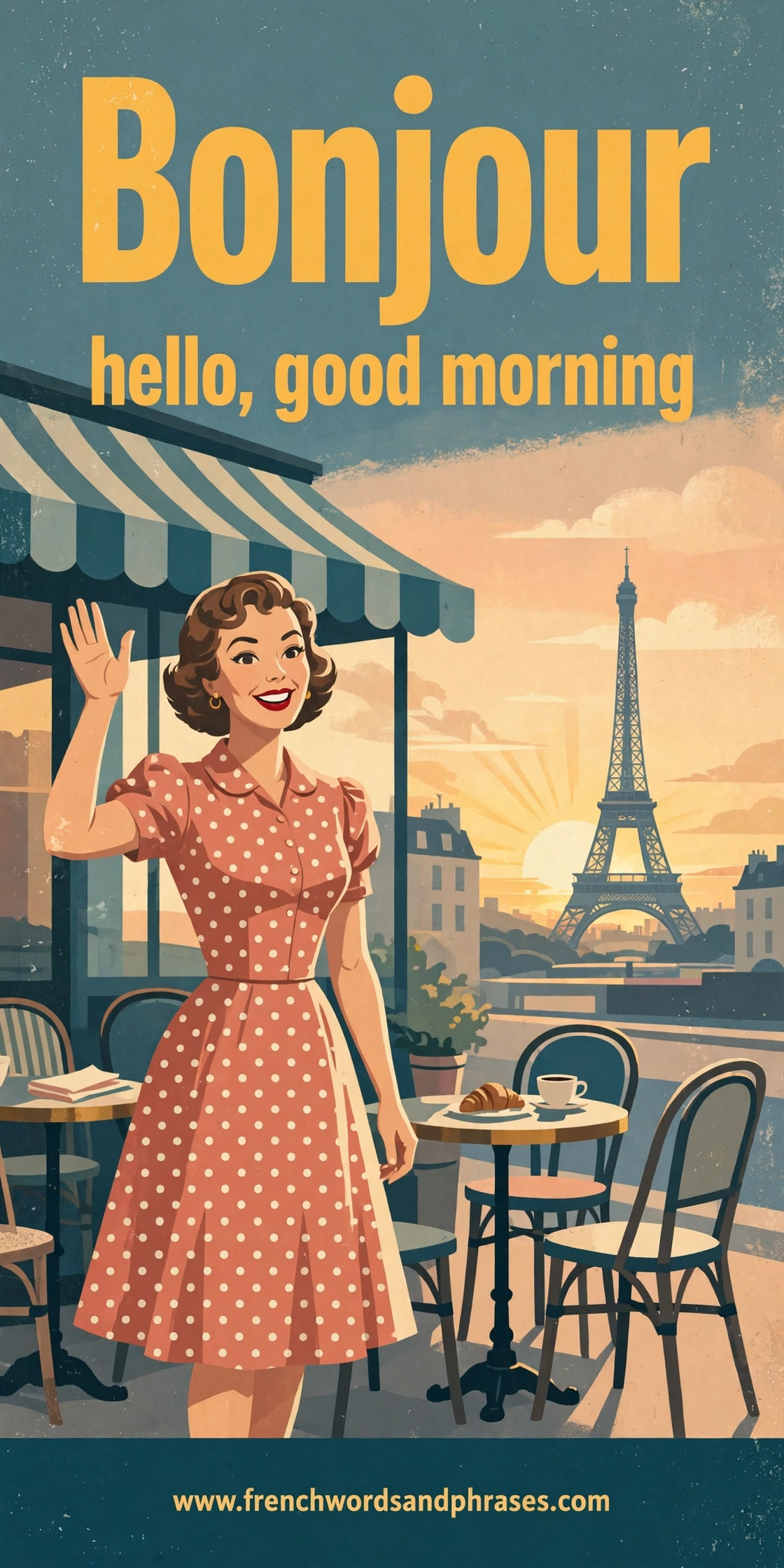
A French Word to Live By
Translate Bonjour to English
/bɔ̃.ʒuʁ/
Bonjour means hello, good morning.
The baker unlocks his shop at seven, the first customer pushes the door, and before anything else — before bread, before money — comes the word: « Bonjour ! » Bonjour is the key that opens every French encounter: hello, good morning, good day, the greeting owed to everyone you meet from sunrise until the evening takes over.
Let’s explore how bonjour works in French, beginning with the whole greeting on one card.
Understanding the French Interjection Bonjour
Bonjour is a French interjection — a greeting, invariable, built from bon (good) and jour (day): literally « good day ». It is the standard, polite hello for the whole daytime, used with strangers, shopkeepers, colleagues and friends alike. It is never shortened and never pluralised; the day may be good for one person or for a crowd, the word stays bonjour.
It means hello and good morning — and, later in the day, good afternoon too, because French has no separate everyday word for the afternoon greeting: bonjour covers the day from the first coffee to the early evening. « Bonjour, madame », « Bonjour à tous », hello everyone. At the end of an encounter it doubles as a polite goodbye in shops: « Merci, bonjour ! » — thanks, have a good day.
Type: Interjection — the universal daytime greeting
Answers the need: Opening any encounter politely, morning or afternoon
Register: Neutral and polite — safe with absolutely everyone
Strength: Warm but correct — the baseline of French courtesy
One important usage detail: in France you say bonjour on ENTERING — to the shopkeeper, the waiting room, the whole lift — and it comes before any request. Asking for something without bonjour first is felt as rude. Add the title when you can: « Bonjour, monsieur », « Bonjour, madame » — never a first name to a stranger, and never bonjour twice to the same person in one day: the second time, a smile and a nod will do, or rebonjour, said with a grin.
Experience the Word
Bonjour is the toll every French conversation pays at the gate — one word, and the door swings open; without it, the door stays politely shut.
Imagine the village bakery on a wet Tuesday: each customer who enters calls « Bonjour ! » to the whole shop, not just the baker — the greeting belongs to the room, and the room answers.
You have not just said hello. You have wished the other person a good day — and meant it as a promise of good manners.
How to Use Bonjour in French: Complete Guide
Let’s explore how bonjour works in French, beginning with the whole greeting on one card.
Bonjour at a Glance
The Whole Greeting on One Card
Meaning, job, register and strength — bonjour in four lines.
| Point | Bonjour |
|---|---|
| Meaning | hello, good morning, good afternoon — the daytime hello |
| Job | opens every encounter; unlocks requests, questions, business |
| Register | neutral-polite — strangers, elders, officials, friends |
| Strength | warm and correct; the minimum of courtesy, always enough |
Example
Bonjour, madame, je voudrais un pain au chocolat.
Hello, madam, I would like a pain au chocolat.
Word by Word: Building the Greeting
Two pieces — a wish and a day — welded into one word centuries ago.
| Word | Literal meaning | Its job in the greeting |
|---|---|---|
| bon | good | the wish: may it be good |
| jour | day | the span: the whole day ahead of you |
| bonjour | good day | one word, one breath — never split it |
Example
Bonjour à tous, asseyez-vous.
Hello everyone, sit down.
Quick Quiz 1
What two words is bonjour built from?
Reveal the answer
bon and jour — good and day.
Bonjour, monsieur.
Hello, sir — literally, good day.
When You Say It: The Greeting Moments
Bonjour fires at thresholds — doors, counters, desks, arrivals.
| Situation | Example |
|---|---|
| Entering a shop | bonjour ! — to the whole room, before anything else |
| Meeting a colleague | bonjour, Claire, tu as passé un bon week-end ? |
| At the doctor’s | bonjour, docteur, merci de me recevoir |
| Answering the phone at work | bonjour, vous êtes bien chez Martin et fils |
| Leaving a shop | merci, bonjour, à demain ! — thanks, goodbye, see you tomorrow |
Example
Bonjour, je cherche la rue des Lilas.
Hello, I’m looking for Rue des Lilas.
Make It Yours: Bonjour in Its Frames
Bonjour takes a title, a crowd, or a name — the frame changes, the word does not.
| Form | French | In English |
|---|---|---|
| With a title | bonjour, madame | hello, madam |
| To a group | bonjour à tous | hello everyone |
| To a friend | bonjour, Léa, ça va ? | hello, Léa, how are you? |
| Very warm | bonjour et bienvenue | hello and welcome |
| On leaving | merci, bonjour ! | thank you, goodbye (have a good day) |
Example
Bonjour à tous, et bienvenue à l’école.
Hello everyone, and welcome to the school.
Quick Quiz 2
Complete it: ______ , monsieur, une baguette, s’il vous plaît.
Reveal the answer
Bonjour — the greeting always comes before the request.
Bonjour, monsieur, une baguette, s’il vous plaît.
Hello, sir, a baguette, please.
Everyday Expressions with Bonjour
Bonjour slots into these frames — each one ready to use as it stands.
| Frame | In English |
|---|---|
| dire bonjour à quelqu’un | to say hello to someone |
| passe le bonjour à ta mère | give my regards to your mother |
| bonjour à tous | hello everyone |
| un bonjour rapide | a quick hello |
| bonjour, bienvenue | hello, welcome |
Example
Passe le bonjour à ton frère de ma part.
Say hello to your brother from me.
Close Cousins: The Other Greetings
French greets by the clock and by the relationship — here is how the family divides the day.
| Expression | The difference |
|---|---|
| salut | hi — informal, for friends and the young; also bye |
| bonsoir | good evening — the greeting after roughly six o’clock |
| coucou | hey there — playful, for close friends and children |
| enchanté | pleased to meet you — at introductions |
| bonjour à tous | the group form — meetings, classrooms, tours |
Example
Le matin on dit bonjour, le soir on dit bonsoir.
In the morning you say bonjour, in the evening you say bonsoir.
Quick Quiz 3
Which greeting do you use with the baker you have never met — salut or bonjour?
Reveal the answer
Bonjour — salut is for friends; bonjour is the polite, universal choice.
Bonjour, madame.
Hello, madam.
Bonjour and Its Neighbours
The words that live around the greeting — the day, the wish and the welcome.
| French | In English |
|---|---|
| le jour | the day |
| la journée | the day as a stretch of time |
| bon / bonne | good (masculine / feminine) |
| bienvenue | welcome |
| rebonjour | hello again — the joking second greeting of the day |
Example
On dit bonjour en entrant, toujours.
You say hello when you come in, always.
Quick Quiz 4
It is three in the afternoon and you enter a café. What do you say?
Reveal the answer
Bonjour
Bonjour covers the whole day until evening — there is no separate afternoon hello in everyday French.
Bonjour, un café, s’il vous plaît. — Hello, a coffee, please.
Bonjour in Everyday French: Real-Life Examples
Now that you know the word, let’s see how bonjour appears in everyday French.
Example 1 — At the bakery
Bonjour, madame, un croissant, s’il vous plaît.
Hello, madam, a croissant, please.
Example 2 — At the office
Bonjour à tous, la réunion commence.
Hello everyone, the meeting is starting.
Example 3 — At the doctor’s
Bonjour, docteur, merci de me voir si vite.
Hello, doctor, thank you for seeing me so quickly.
Example 4 — On the street
Bonjour, monsieur, vous pouvez m’aider ?
Hello, sir, can you help me?
Example 5 — Leaving the shop
Merci beaucoup, bonjour, au revoir.
Thank you very much, goodbye, see you.
Example 6 — Welcoming guests
Bonjour, entrez, bienvenue chez nous.
Hello, come in, welcome to our home.
Beyond Translation: The Meaning of Bonjour
Bonjour was once two words and a full wish: bon jour, may your day be good — the same wish English folded into goodbye, which began as God be with you. French kept the wish visible. The word also carries the weight of a social rule so strong that French children are corrected for forgetting it: dire bonjour is the first politeness a child learns, before merci, before s’il vous plaît.
Bonjour is not small talk — it is the handshake before the handshake, the sign that you see the other person.
Learn it with its evening twin bonsoir and its friendly cousin salut, and you can open any door in France.
How to Remember the French Interjection Bonjour
Remember it this way: Bonjour is bon plus jour — a good day wished to everyone you meet, from morning to early evening, always before anything else.
- You say it first — bonjour, then the request, never the other way round.
- You add the title — bonjour, madame, bonjour, monsieur, never a stranger’s first name.
- You switch at dusk — the day belongs to bonjour, the evening to bonsoir.
The key idea is bonjour = hello, good morning; bon + jour, the universal daytime greeting.
Test Your Knowledge of Bonjour
Let’s see how much you’ve learned. Try answering these questions before revealing the answers.
Question 1
What does bonjour mean?
Reveal the answer
Hello, good morning — the standard daytime greeting for everyone.
Question 2
What is bonjour made of?
Reveal the answer
Bon (good) + jour (day) — literally, good day.
Question 3
Translate: Hello, madam, a coffee, please.
Reveal the answer
Bonjour, madame, un café, s’il vous plaît.
Question 4
Complete the sentence:
En entrant dans la boutique, on dit ______ .
Reveal the answer
bonjour
En entrant dans la boutique, on dit bonjour.
When you enter the shop, you say hello.
Question 5
When do you stop saying bonjour?
Reveal the answer
In the evening — from about six o’clock, the greeting becomes bonsoir.
Your Final Challenge
Can You Use It?
How would you say this in French?
“Hello, sir, I am looking for the station.”
Reveal the answer
Bonjour, monsieur, je cherche la gare.
Hello, sir, I am looking for the station.
A little French. A little curiosity. A richer everyday life.
LEARN FRENCH ONE WORD AT A TIME




