A French Word to Live By
Translate Temps to English
/tɑ̃/
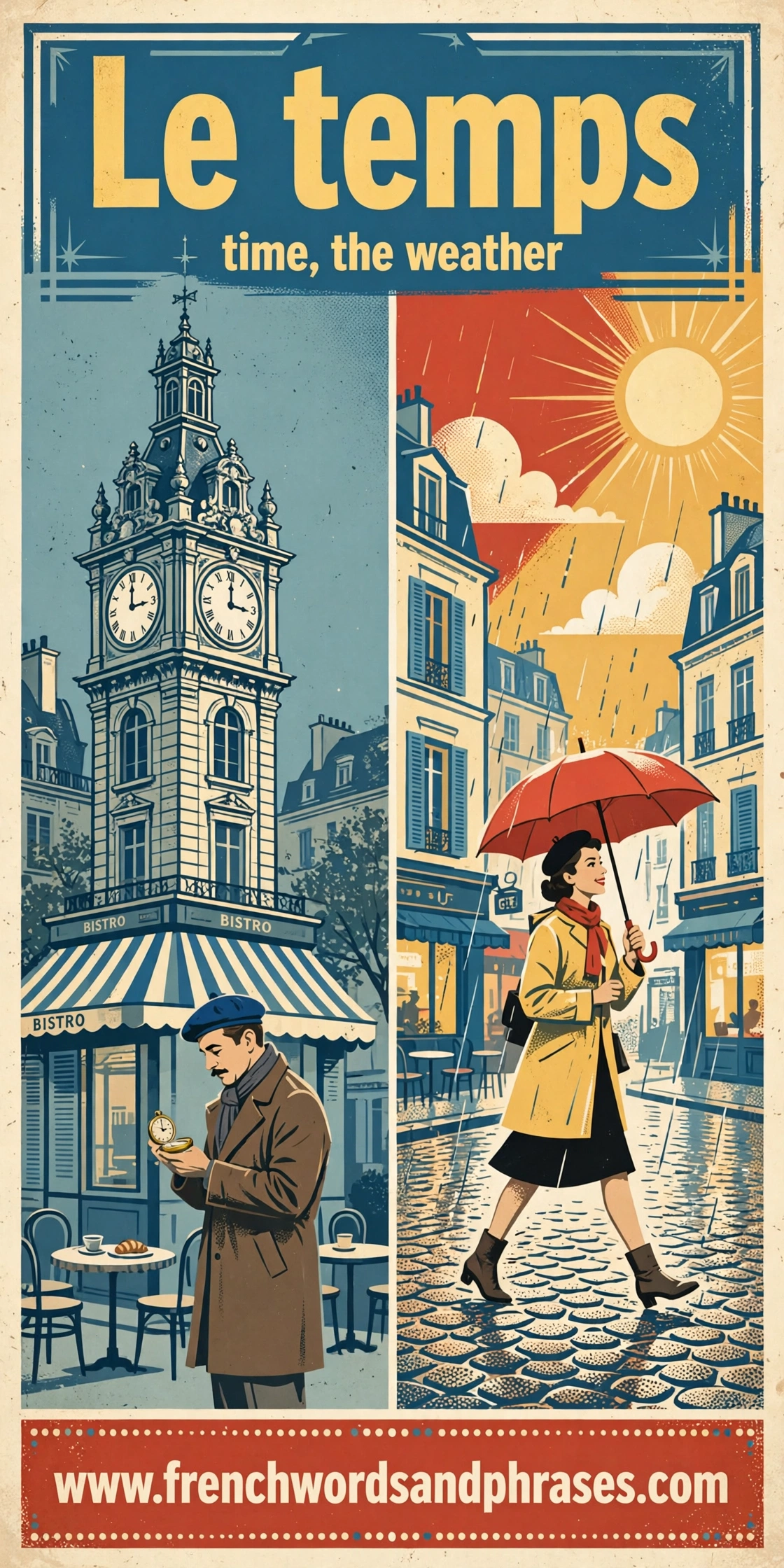
Le temps means time, the weather.
Grey clouds over the rooftops, a neighbour shaking his umbrella at the sky; the same neighbour, an hour later, sighing over his watch. Weather and hours in a single word — that is le temps.
In this guide, you’ll learn what temps means in English, how to use it with its articles, how to form its plural, and how it appears in everyday French. Explore French examples, English translations, and practice quizzes.
Understanding the French Noun Temps
Temps is a masculine French noun. It is learned together with its article: le temps. Unusually, it already ends in -s in the singular — and the plural looks exactly the same.
It means two of the biggest things in daily conversation: time — je n’ai pas le temps, I don’t have time — and the weather — quel temps fait-il ?, what is the weather like? Context separates them without effort: watches, hours and regrets belong to time; skies, rain and umbrellas belong to the weather. The two key phrases say it all: pas le temps for a busy day, et un temps de chien for a rainy one.
Gender: Masculine
Definite article: le — le temps (the time, the weather)
Indefinite article: un — un temps (a time, a spell of weather)
Partitive article: du — du temps (some time)
Plural: les temps (spelled the same)
English equivalents: Time; the weather.
One important usage detail: the key phrases split by meaning. For the sky, the question is Quel temps fait-il ? For the clock, the key phrase is avoir le temps de + verb — to have time to do something. Two meanings, two little doors: fait-il for the weather, avoir for the time.
Experience the Word
Temps is the word the French reach for all day long — glancing at the sky in the morning, sighing at the clock by noon.
Imagine a grandfather on his bench, watching the clouds and his grandchildren in the same gaze: he has seen beau temps and mauvais temps, in the sky and in his life, and he uses one word for both.
You have not just asked the hour or the forecast. You have named the river everything swims in.
How to Use Temps in French: Complete Guide
Let’s explore how temps works in French, beginning with its articles.
Temps with the Definite Article (Le, Les)
Used for time in general, and for the weather of the day — le temps is the clock and the sky at once.
| Number | French |
|---|---|
| Singular | le temps |
| Plural | les temps |
Example
Le temps passe vite pendant les vacances.
Time passes quickly during the holidays.
Temps with the Indefinite Article (Un, Des)
Used for a stretch of time, or a spell of weather — un temps magnifique, a spell of glorious weather.
| Number | French |
|---|---|
| Singular | un temps |
| Plural | des temps |
Example
Après la pluie, nous avons eu un temps magnifique.
After the rain, we had glorious weather.
Temps with the Partitive Article (Du — Some Time)
Used for time as a substance — the time you have, find or lose.
| Meaning | French |
|---|---|
| some time | du temps |
| free time | du temps libre |
| no time (after a negative) | de temps |
Example
Le dimanche, nous avons du temps libre.
On Sundays, we have free time.
Quick Quiz 1
How do you ask about the weather in French?
Reveal the answer
Quel temps fait-il ?
Quel temps fait-il aujourd’hui ?
What is the weather like today?
The Plural of Temps
Temps is spelled with an -s even in the singular, and the plural does not change at all — only the article moves: le temps, les temps.
| Number | French |
|---|---|
| Singular | le temps |
| Plural | les temps |
Example
Les temps changent, dit toujours mon grand-père.
Times are changing, my grandfather always says.
Temps with Possessive Adjectives (Mon, Ton, Son…)
Possessives agree with the noun — temps is masculine: mon temps, my time, the most precious thing you own.
| Owner | French |
|---|---|
| my | mon temps |
| your (tu) | ton temps |
| his / her | son temps |
| our | notre temps |
| your (vous) | votre temps |
| their | leur temps |
Example
Je passe mon temps à lire et à marcher.
I spend my time reading and walking.
Quick Quiz 2
Complete the sentence:
Nous n’avons pas ______ temps de tout finir. (the)
Reveal the answer
le
Nous n’avons pas le temps de tout finir.
We don’t have time to finish everything.
Temps with Demonstrative Adjectives (Ce, Ces)
Used to point at an era or a sky: ce temps-là, in those days; en ces temps difficiles, in these hard times.
| Number | French |
|---|---|
| Singular | ce temps |
| Plural | ces temps |
Example
En ce temps-là, le village n’avait pas d’électricité.
In those days, the village had no electricity.
Temps with Adjectives
Adjectives split by meaning: for the clock — libre, perdu; for the sky — beau, mauvais, pluvieux. Same noun, two families of words.
| Adjective | With Temps |
|---|---|
| libre (free — time) | le temps libre |
| perdu (wasted — time) | le temps perdu |
| beau (fine — weather) | le beau temps |
| mauvais (bad — weather) | le mauvais temps |
| pluvieux (rainy — weather) | un temps pluvieux |
| ensoleillé (sunny — weather) | un temps ensoleillé |
Example
Un temps pluvieux est annoncé pour demain.
Rainy weather is forecast for tomorrow.
Quick Quiz 3
Complete the sentence:
Le dimanche, nous avons du temps ______. (free)
Reveal the answer
libre
Le dimanche, nous avons du temps libre.
On Sundays, we have free time.
Everyday Expressions with Temps
Temps lives in some of the most useful phrases in French — for diaries, skies and small talk alike.
| Expression | In English |
|---|---|
| Quel temps fait-il ? | What is the weather like? |
| le temps passe vite | time flies |
| avoir le temps de | to have time to (do something) |
| à temps | in time, on time |
| de temps en temps | from time to time |
| un temps de chien | awful weather (literally, dog weather) |
Example
De temps en temps, elle relit ses vieux journaux.
From time to time, she rereads her old diaries.
Words from the Same Family as Temps
Seasons, pastimes and temperatures — the words that travel with temps.
| French | In English |
|---|---|
| le printemps | spring (the first season) |
| le passe-temps | a pastime, a hobby |
| la température | the temperature |
| temporaire | temporary |
| longtemps | a long time |
| le contretemps | a hitch, a mishap |
Example
Son passe-temps préféré, c’est le jardinage.
His favourite pastime is gardening.
Quick Quiz 4
What does un temps de chien mean?
Reveal the answer
Awful weather
Quel temps de chien aujourd’hui !
What awful weather today!
Temps in Everyday French: Real-Life Examples
Now that you know the word, let’s see how temps appears in everyday French.
Example 1 — No time
Désolée, je n’ai pas le temps de passer aujourd’hui !
Sorry, I don’t have time to come by today!
Example 2 — Awful weather
Quel temps de chien ce week-end !
What awful weather this weekend!
Example 3 — Asking the forecast
Quel temps fait-il demain ?
What will the weather be like tomorrow?
Example 4 — Free time
Le week-end, nous avons enfin du temps libre.
At the weekend, we finally have free time.
Example 5 — Time flying
Le temps passe vite quand on s’amuse.
Time flies when you are having fun.
Example 6 — From time to time
De temps en temps, je relis ses lettres.
From time to time, I reread his letters.
Beyond Translation: The Meaning of Temps
English keeps time and weather in separate boxes, but French trusts one word with both — and perhaps it is wiser: the rain that ruins the picnic and the hour that steals the afternoon are the same force, the one nobody can hold back.
To say le temps is to name the weather of a life.
It evokes the grandfather reading the sky, the traveller reading the timetable, Proust searching for lost time — le temps perdu — in a cup of tea. One word for the sky above and the river below.
How to Remember the French Noun Temps
Remember it this way: Temps is time and the weather in one word — masculine, spelled with an -s even in the singular.
- You are too busy — je n’ai pas le temps.
- You look at the sky — quel temps fait-il ?
- You curse the rain — quel temps de chien !
The key idea is avoir le temps for the clock, quel temps fait-il for the sky.
Test Your Knowledge of Temps
Let’s see how much you’ve learned. Try answering these questions before revealing the answers.
Question 1
Is temps masculine or feminine?
Reveal the answer
Masculine — le temps, un temps.
Question 2
What are the two meanings of temps?
Reveal the answer
Time and the weather — context tells you which.
Question 3
Translate: We don’t have time to finish everything.
Reveal the answer
Nous n’avons pas le temps de tout finir.
Question 4
What does un temps de chien mean?
Reveal the answer
Awful weather — literally, dog weather.
Question 5
Complete the sentence:
______ temps fait-il aujourd’hui ? (What)
Reveal the answer
Quel
Quel temps fait-il aujourd’hui ?
What is the weather like today?
Your Final Challenge
Can You Use It?
How would you say this in French?
“I don’t have time today, and the weather is awful.”
Reveal the answer
Je n’ai pas le temps aujourd’hui, et il fait un temps de chien.
I don’t have time today, and the weather is awful.
A little French. A little curiosity. A richer everyday life.
LEARN FRENCH ONE WORD AT A TIME