A French Word to Live By
Translate Molécule to English
/mo.le.kyl/
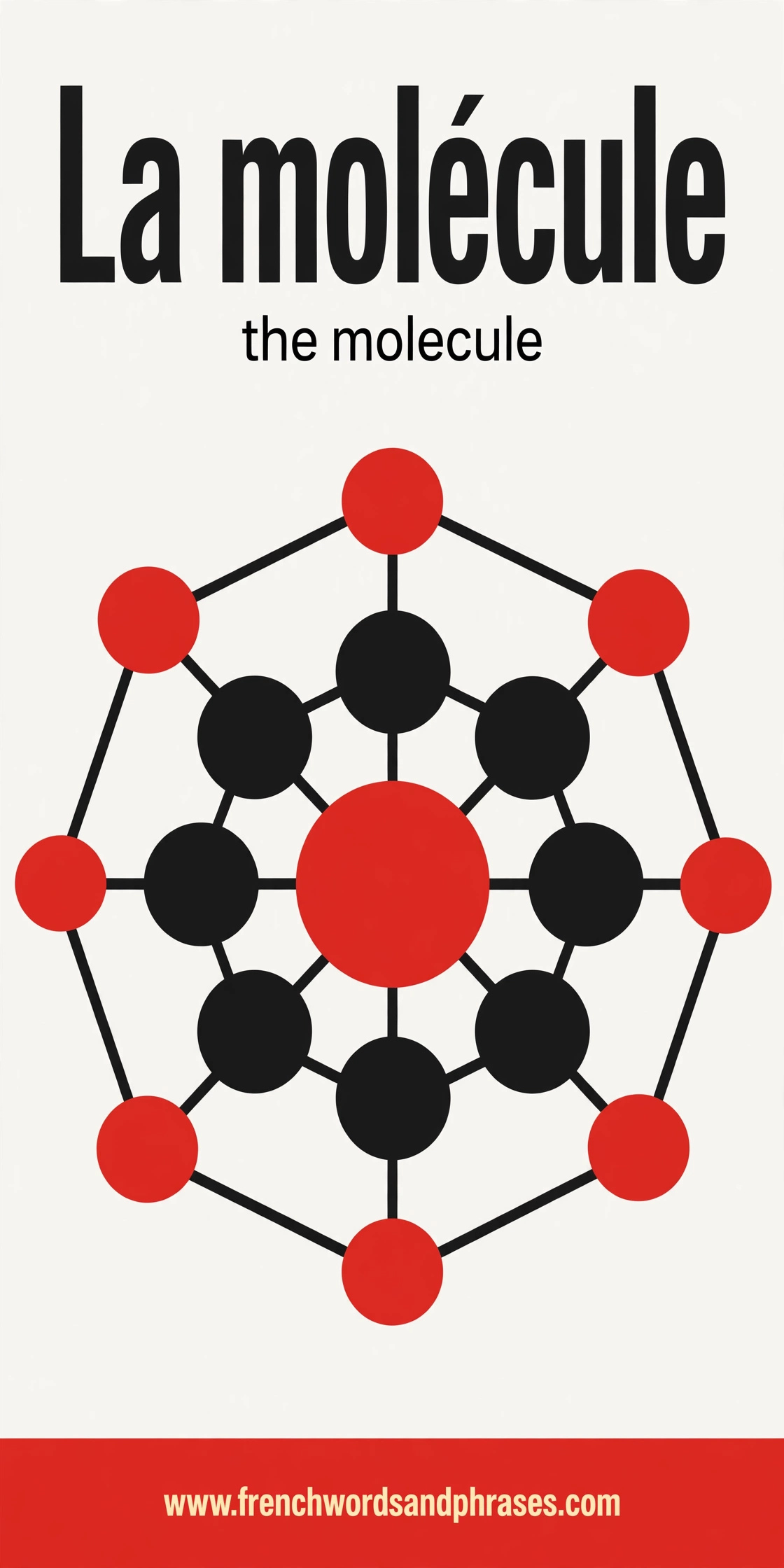
La molécule means the molecule.
Two atoms of hydrogen holding one of oxygen, a spiral of DNA in every cell, the scent of vanilla riding the air to your nose: la molécule, the molecule — the smallest parcel of a substance that is still itself, chemistry’s building block.
In this guide, you’ll learn what molécule means in English, how to use it with its articles, how to form its plural, and how it appears in everyday French. Explore French examples, English translations, and practice quizzes.
Understanding the French Noun Molécule
Molécule is a feminine French noun, learned with its article: la molécule, une molécule. It is a learned diminutive of the Latin moles, a mass — a little mass, coined by science for the tiny architecture of matter: atoms bound together, behaving as one.
It means a molecule — the smallest unit of a substance that keeps its chemical identity: une molécule d’eau, a water molecule, H₂O, une molécule d’ADN, a DNA molecule, les molécules d’un gaz, the molecules of a gas. Everything chemistry touches is counted in molécules: medicines are designed molécule par molécule, perfumes are molécules that reach the nose, and the cook’s browning crust is a storm of new molécules. Its partner word is l’atome, the atom — atoms are the bricks, the molécule is the little building.
Gender: Feminine — la molécule
Definite article: la — la molécule (the molecule)
Indefinite article: une — une molécule (a molecule)
Plural: les molécules — regular, with a simple -s
Spelling note: from Latin moles, a mass — une petite masse, a little mass of atoms
Partner word: l’atome — the atom; atoms join to build the molécule
English equivalents: The molecule.
Molécule is completed by the substance: une molécule d’eau, d’oxygène, de sucre. Adjectives place it in the laboratory: une molécule organique, une molécule stable, une grosse molécule — une macromolécule for the giants like proteins. The adjective for the scale is moléculaire: la biologie moléculaire, la cuisine moléculaire, molecular cooking, where chefs play with molécules on the plate.
Experience the Word
Molécule is the invisible made countable: you cannot see one, yet a single glass of water holds more molécules than there are glasses of water in all the oceans.
Imagine the perfume shop in Grasse, where the perfumer thinks in molécules the way a composer thinks in notes — a little more of this one, and the whole scent changes key.
You have not just named a particle. You have named matter’s smallest signature — la molécule, the molecule, the building that is still itself.
How to Use Molécule in French: Complete Guide
Let’s explore how molécule works in French, beginning with its articles — la molécule, une molécule, une molécule d’eau.
Molécule with the Definite Article (La, Les)
Used for a specific molecule — the one in the diagram, the one in the cell.
| Form | French |
|---|---|
| Feminine singular | la molécule |
| Plural | les molécules |
Example
La molécule d’eau contient deux atomes d’hydrogène.
The water molecule contains two atoms of hydrogen.
Molécule with the Indefinite Article (Une, Des)
Used for a molecule in general — any unit of any substance.
| Form | French |
|---|---|
| Feminine singular | une molécule |
| Plural | des molécules |
Example
Une molécule de sucre se dissout dans le thé.
A sugar molecule dissolves in the tea.
Molécule of Substances (D’eau, D’ADN…)
A molécule is named by its substance — de plus the matter it belongs to.
| Substance | French |
|---|---|
| a water molecule | une molécule d’eau |
| an oxygen molecule | une molécule d’oxygène |
| a DNA molecule | une molécule d’ADN |
| a sugar molecule | une molécule de sucre |
| a protein molecule | une molécule de protéine |
Example
La molécule d’ADN porte le code de la vie.
The DNA molecule carries the code of life.
Quick Quiz 1
Complete the sentence:
______ molécule d’eau est très simple. (the)
Reveal the answer
La
La molécule d’eau est très simple.
The water molecule is very simple — molécule is feminine, so la.
The Plural of Molécule
Molécule takes a regular plural in -s — counted in billions in every drop.
| Number | French |
|---|---|
| Singular | la molécule |
| Plural | les molécules |
Example
Les molécules d’un gaz bougent sans cesse.
The molecules of a gas move without stopping.
Molécule with Possessive Adjectives (Ma, Ta, Sa…)
Possessives agree with the noun: molécule is feminine, so ma, ta, sa in the singular.
| Owner | French |
|---|---|
| my | ma molécule |
| your (tu) | ta molécule |
| his / her | sa molécule |
| our | notre molécule |
| your (vous) | votre molécule |
| their | leur molécule |
Example
Le chimiste dessine sa molécule au tableau.
The chemist draws his molecule on the board.
Quick Quiz 2
Complete the sentence:
L’équipe a découvert ______ molécule après dix ans de travail. (its)
Reveal the answer
sa
L’équipe a découvert sa molécule après dix ans de travail.
The team discovered its molecule after ten years of work — sa, because molécule is feminine.
Molécule with Demonstrative Adjectives (Cette, Ces)
Used to point: cette molécule, this molecule — this structure, this formula.
| Form | French |
|---|---|
| Feminine singular | cette molécule |
| Plural | ces molécules |
Example
Cette molécule soigne une maladie rare.
This molecule treats a rare disease.
Molécule with Adjectives
Adjectives agree with molécule — feminine singular: une molécule organique, une molécule stable.
| Adjective | With Molécule |
|---|---|
| organique (organic) | une molécule organique |
| stable (stable) | une molécule stable |
| nouvelle (new) | une molécule nouvelle |
| géante (giant) | une molécule géante |
| active (active) | une molécule active |
Example
Une molécule stable ne se décompose pas facilement.
A stable molecule does not break down easily.
Quick Quiz 3
Complete the sentence:
Les chercheurs testent une molécule ______. (new)
Reveal the answer
nouvelle
Les chercheurs testent une molécule nouvelle.
The researchers are testing a new molecule — nouvelle, feminine, to agree with molécule.
Everyday Expressions with Molécule
Laboratories, kitchens and pharmacies — the molécule phrases of daily life.
| Expression | In English |
|---|---|
| une molécule d’eau | a water molecule (H₂O) |
| la biologie moléculaire | molecular biology |
| la cuisine moléculaire | molecular cooking |
| molécule par molécule | molecule by molecule |
| une macromolécule | a macromolecule — a giant molecule |
Example
Ce laboratoire travaille en biologie moléculaire.
This laboratory works in molecular biology.
Words from the Same Family as Molécule
Atoms and matter — the words that travel with molécule.
| French | In English |
|---|---|
| l’atome | the atom — the brick of the molécule |
| moléculaire | molecular (the adjective) |
| la chimie | chemistry |
| un élément | an element |
| la matière | matter, material |
Example
L’atome d’oxygène entre dans la molécule d’eau.
The oxygen atom enters into the water molecule.
Quick Quiz 4
What is la cuisine moléculaire?
Reveal the answer
Molecular cooking — the chef’s laboratory cuisine, built on the science of molécules.
Ce chef est célèbre pour sa cuisine moléculaire.
This chef is famous for his molecular cooking.
Molécule in Everyday French: Real-Life Examples
Now that you know the word, let’s see how molécule appears in everyday French.
Example 1 — Science class
La molécule d’eau s’écrit H₂O.
The water molecule is written H₂O.
Example 2 — Medicine
Cette molécule entre dans un nouveau médicament.
This molecule is part of a new medicine.
Example 3 — Perfume
Les molécules du parfum montent dans l’air.
The perfume’s molecules rise into the air.
Example 4 — The laboratory
Ils étudient la molécule depuis des années.
They have been studying the molecule for years.
Example 5 — Cooking
La cuisine moléculaire transforme les textures.
Molecular cooking transforms textures.
Example 6 — The cell
Chaque cellule contient des millions de molécules.
Every cell contains millions of molecules.
Beyond Translation: The Meaning of Molécule
Molécule is science inventing a word for what no eye had seen: from Latin moles, a mass, the chemists of the nineteenth century made a little mass — une petite masse — to name the smallest parcel of a substance that is still that substance. Split the molécule d’eau and you no longer have water, only gases. The word now runs from the pharmacy to the perfume shop to the chef’s laboratory, anywhere matter is taken apart and persuaded to become something new.
To say molécule is to hold the smallest piece that still has a name.
It evokes the model on the teacher’s desk, coloured balls on sticks, and the invisible crowds moving in every drop of rain.
How to Remember the French Noun Molécule
Remember it this way: Molécule is chemistry’s building block — feminine: la molécule, une molécule d’eau, built from atomes.
- Always feminine — la molécule, une molécule, ma molécule.
- Bricks and building — l’atome is the brick, la molécule is the little building.
- Named by substance — une molécule d’eau, d’ADN, de sucre.
The key idea is la molécule — the molecule, feminine; atoms are its bricks.
Test Your Knowledge of Molécule
Let’s see how much you’ve learned. Try answering these questions before revealing the answers.
Question 1
Is molécule masculine or feminine?
Reveal the answer
Feminine — la molécule, une molécule.
Question 2
How do you say a water molecule?
Reveal the answer
Une molécule d’eau — H₂O.
Question 3
Translate: The molecules of a gas move without stopping.
Reveal the answer
Les molécules d’un gaz bougent sans cesse.
Question 4
What is the difference between un atome and une molécule?
Reveal the answer
The atome is the single brick; the molécule is atoms bound together, the smallest unit that is still the substance.
Question 5
Complete the sentence:
______ molécules de ce parfum sont précieuses. (the)
Reveal the answer
Les
Les molécules de ce parfum sont précieuses.
The molecules of this perfume are precious.
Your Final Challenge
Can You Use It?
How would you say this in French?
“The water molecule contains two atoms of hydrogen.”
Reveal the answer
La molécule d’eau contient deux atomes d’hydrogène.
The water molecule contains two atoms of hydrogen.
A little French. A little curiosity. A richer everyday life.
LEARN FRENCH ONE WORD AT A TIME