A French Word to Live By
Translate Propriété to English
/pʁɔ.pʁi.je.te/
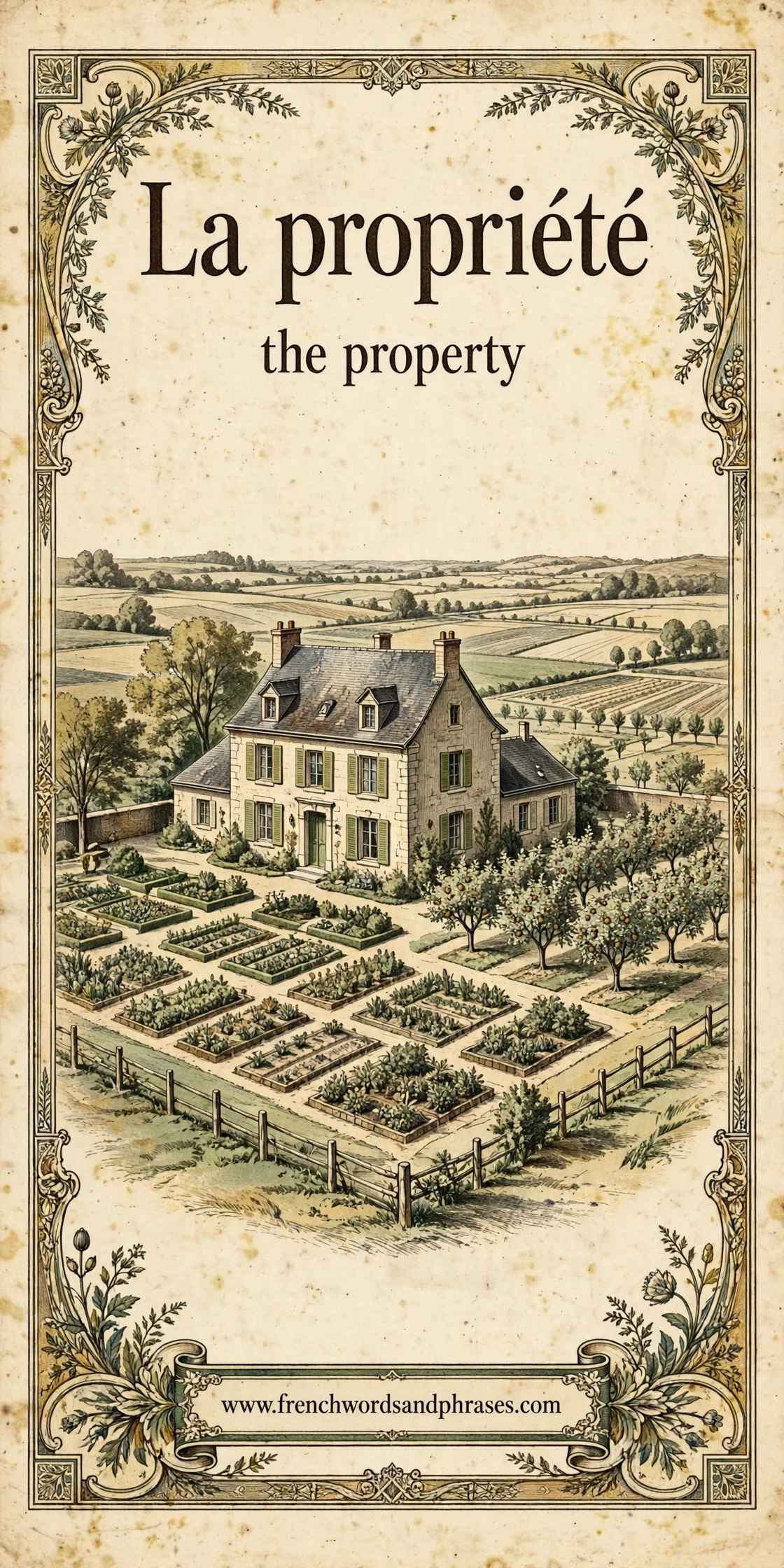
La propriété means the property.
A name on a deed, a fence round a garden, a house that is yours in law and in fact: la propriété, property — what you own, the owning itself, and the land that carries your name at the notary’s office.
In this guide, you’ll learn what propriété means in English, how to use it with its articles, how to form its plural, and how it appears in everyday French. Explore French examples, English translations, and practice quizzes.
Understanding the French Noun Propriété
Propriété is a feminine French noun, learned with its article: la propriété, une propriété. It comes from the Latin proprietas, ownership, from proprius, one’s own — the same root as propre, own and clean. The word does three jobs in French: the right of ownership, the thing owned, and the characteristic property of a substance.
It means property — first the legal fact: la propriété privée, private property, un titre de propriété, a title deed, être propriétaire, to be the owner. Then the thing itself, usually land or a house: une belle propriété à la campagne, a fine property in the country, la propriété est entourée de murs, the property is walled all round. And in science it changes coat: les propriétés de l’eau, the properties of water, une propriété chimique, a chemical property — what a thing is by nature.
Gender: Feminine — la propriété
Definite article: la — la propriété (the property)
Indefinite article: une — une propriété (a property)
Plural: les propriétés — regular, with a simple -s
Spelling note: from Latin proprius, one’s own — cousin of propre, own
Three lives: ownership (the right), a property (the place), a property (of a substance)
English equivalents: The property, the ownership.
The owner is le propriétaire (masculine) or la propriétaire — never confuse the person with the thing: la propriété is what he owns. Buying passes through fixed phrases: acheter une propriété, vendre sa propriété, and the tax is la taxe foncière on la propriété bâtie ou non bâtie, built or unbuilt property. In the laboratory the word is innocent of law: les propriétés physiques d’un métal.
Experience the Word
Propriété is the quiet pride of the deed in the drawer: the garden wall, the walnut tree, the gate that closes on what is yours.
Imagine the notary’s office in a small town, the acte de vente read aloud page by page, the keys changing hands across the desk — la propriété passes from one family’s century to another’s in a single signature.
You have not just named a thing owned. You have named ownership itself — la propriété, the property, one’s own made legal.
How to Use Propriété in French: Complete Guide
Let’s explore how propriété works in French, beginning with its articles — la propriété, une propriété, un titre de propriété.
Propriété with the Definite Article (La, Les)
Used for a specific property — the house, the right, the characteristic.
| Form | French |
|---|---|
| Feminine singular | la propriété |
| Plural | les propriétés |
Example
La propriété se trouve au bord de la rivière.
The property stands on the bank of the river.
Propriété with the Indefinite Article (Une, Des)
Used for a property in general — any house with land, any estate.
| Form | French |
|---|---|
| Feminine singular | une propriété |
| Plural | des propriétés |
Example
Ils cherchent une propriété avec un grand jardin.
They are looking for a property with a big garden.
Propriété in Its Three Lives (Droit, Maison, Science)
One word, three territories — the law, the land, and the laboratory.
| Sense | French |
|---|---|
| private property (the right) | la propriété privée |
| a title deed | un titre de propriété |
| a country property (the place) | une propriété à la campagne |
| the properties of water (science) | les propriétés de l’eau |
| a chemical property | une propriété chimique |
Example
Le titre de propriété date de 1890.
The title deed dates from 1890.
Quick Quiz 1
Complete the sentence:
______ propriété de mes grands-parents a un verger. (the)
Reveal the answer
La
La propriété de mes grands-parents a un verger.
My grandparents’ property has an orchard — propriété is feminine, so la.
The Plural of Propriété
Propriété takes a regular plural in -s — estates in the plural, properties in the laboratory.
| Number | French |
|---|---|
| Singular | la propriété |
| Plural | les propriétés |
Example
Les propriétés du village appartiennent à de vieilles familles.
The properties in the village belong to old families.
Propriété with Possessive Adjectives (Ma, Ta, Sa…)
Possessives agree with the noun: propriété is feminine, so ma, ta, sa in the singular.
| Owner | French |
|---|---|
| my | ma propriété |
| your (tu) | ta propriété |
| his / her | sa propriété |
| our | notre propriété |
| your (vous) | votre propriété |
| their | leur propriété |
Example
Il entretient sa propriété avec soin.
He looks after his property with care.
Quick Quiz 2
Complete the sentence:
Elle a vendu ______ propriété l’année dernière. (her)
Reveal the answer
sa
Elle a vendu sa propriété l’année dernière.
She sold her property last year — sa, because propriété is feminine.
Propriété with Demonstrative Adjectives (Cette, Ces)
Used to point: cette propriété, this property — this house, these grounds.
| Form | French |
|---|---|
| Feminine singular | cette propriété |
| Plural | ces propriétés |
Example
Cette propriété vaut une fortune aujourd’hui.
This property is worth a fortune today.
Propriété with Adjectives
Adjectives agree with propriété — feminine singular: une propriété privée, une grande propriété.
| Adjective | With Propriété |
|---|---|
| privée (private) | la propriété privée |
| grande (large) | une grande propriété |
| belle (beautiful) | une belle propriété |
| chimique (chemical) | une propriété chimique |
| voisine (neighbouring) | la propriété voisine |
Example
Une grande propriété entoure le château.
A large property surrounds the château.
Quick Quiz 3
Complete the sentence:
C’est une propriété ______ avec un parc immense. (beautiful)
Reveal the answer
belle
C’est une propriété belle avec un parc immense.
It is a beautiful property with an immense park — belle, feminine, to agree with propriété.
Everyday Expressions with Propriété
Notaries, neighbours and laboratories — the propriété phrases of daily life.
| Expression | In English |
|---|---|
| un titre de propriété | a title deed |
| la propriété privée | private property |
| être propriétaire | to be the owner |
| acheter une propriété | to buy a property |
| les propriétés d’un métal | the properties of a metal |
Example
Ils sont propriétaires de la maison depuis dix ans.
They have owned the house for ten years.
Words from the Same Family as Propriété
Owning and owners — the words that travel with propriété.
| French | In English |
|---|---|
| le propriétaire | the owner (the person — masculine form) |
| propre | own; clean (the adjective cousin) |
| posséder | to possess, to own (the verb) |
| le titre de propriété | the title deed |
| le notaire | the notary who records the sale |
Example
Le propriétaire signe l’acte chez le notaire.
The owner signs the deed at the notary’s.
Quick Quiz 4
What is un titre de propriété?
Reveal the answer
A title deed — the document that proves the property is yours.
Gardez le titre de propriété dans un lieu sûr.
Keep the title deed in a safe place.
Propriété in Everyday French: Real-Life Examples
Now that you know the word, let’s see how propriété appears in everyday French.
Example 1 — House hunting
Cette propriété a trois chambres et un verger.
This property has three bedrooms and an orchard.
Example 2 — At the notary’s
Le titre de propriété est signé demain.
The title deed is signed tomorrow.
Example 3 — The neighbour
La propriété voisine est à vendre.
The neighbouring property is for sale.
Example 4 — The law
La propriété privée est protégée par la loi.
Private property is protected by law.
Example 5 — Science class
Les propriétés de l’eau sont étonnantes.
The properties of water are astonishing.
Example 6 — Pride
Il montre sa propriété aux visiteurs avec fierté.
He shows his property to visitors with pride.
Beyond Translation: The Meaning of Propriété
Propriété is one of the words the Revolution argued over: the Declaration of the Rights of Man called it un droit inviolable et sacré, an inviolable and sacred right — while Proudhon answered that la propriété, c’est le vol, property is theft. Between those two sentences, French law and French novels have lived ever since: every Balzac inheritance, every notary’s deed, every village boundary dispute is propriété at work. And quietly, in the science classroom, the same word names what things are: les propriétés de l’eau.
To say propriété is to hold the deed and the definition at once.
It evokes the walled garden, the notary’s seal, and the laboratory bench — what is yours, and what a thing is.
How to Remember the French Noun Propriété
Remember it this way: Propriété is property in all its senses — feminine: la propriété, and the owner is le propriétaire.
- Always feminine — la propriété, une propriété, ma propriété.
- Not the person — the owner is le/la propriétaire; la propriété is the thing and the right.
- Three lives — ownership, a house with land, and a substance’s properties: les propriétés de l’eau.
The key idea is la propriété — the property, feminine; le propriétaire is the owner.
Test Your Knowledge of Propriété
Let’s see how much you’ve learned. Try answering these questions before revealing the answers.
Question 1
Is propriété masculine or feminine?
Reveal the answer
Feminine — la propriété, une propriété.
Question 2
How do you say the owner, the person?
Reveal the answer
Le propriétaire (la propriétaire for a woman) — propriété is the thing owned.
Question 3
Translate: They are looking for a property with a big garden.
Reveal the answer
Ils cherchent une propriété avec un grand jardin.
Question 4
What does propriété mean in a science lesson?
Reveal the answer
A characteristic — les propriétés de l’eau, the properties of water.
Question 5
Complete the sentence:
______ propriétés du quartier sont anciennes. (the)
Reveal the answer
Les
Les propriétés du quartier sont anciennes.
The properties in the neighbourhood are old.
Your Final Challenge
Can You Use It?
How would you say this in French?
“My grandparents’ property has an orchard.”
Reveal the answer
La propriété de mes grands-parents a un verger.
My grandparents’ property has an orchard.
A little French. A little curiosity. A richer everyday life.
LEARN FRENCH ONE WORD AT A TIME