A French Word to Live By
Translate Personne to English
/pɛʁ.sɔn/
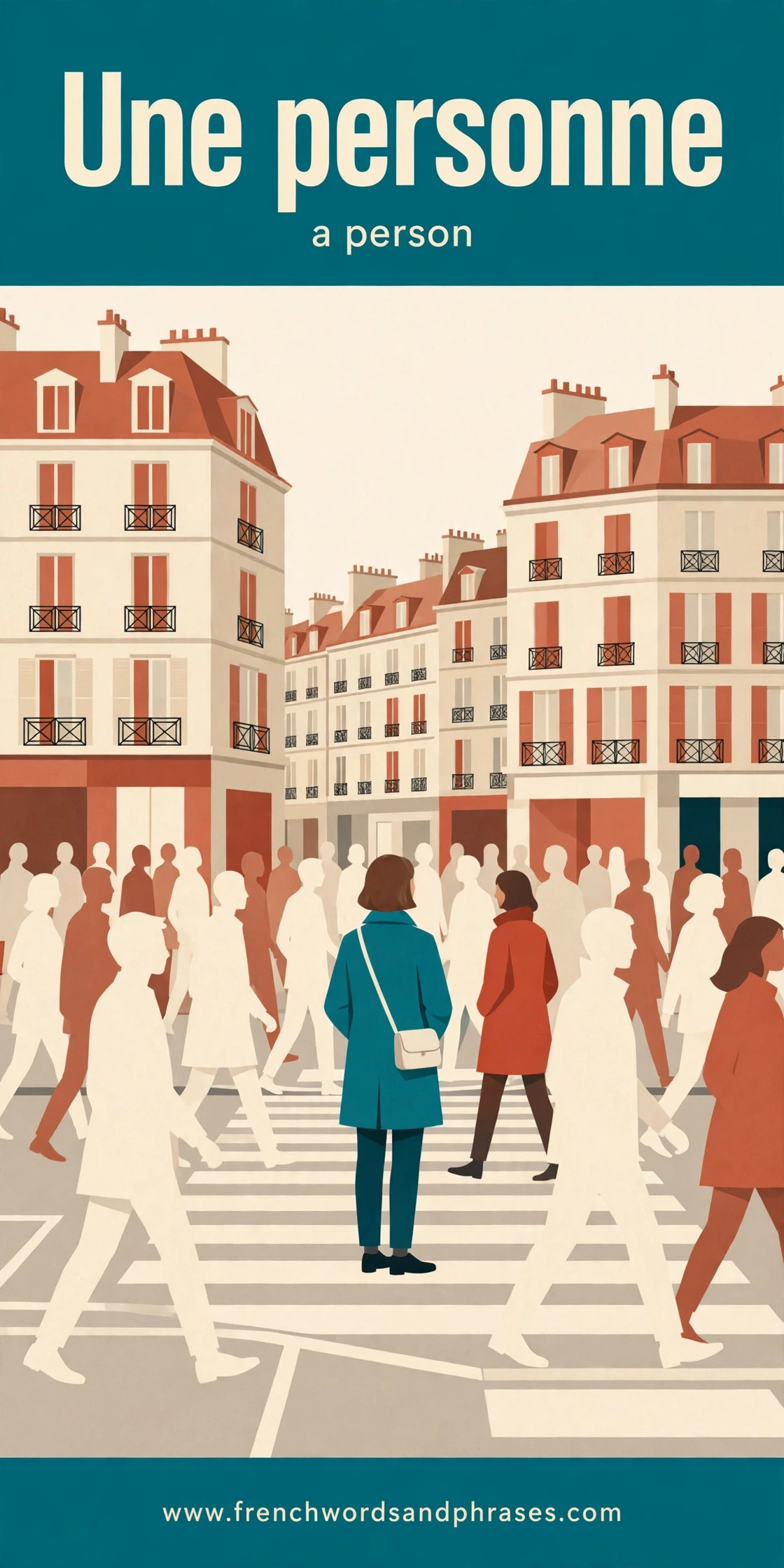
La personne means a person.
The waiting room is full, the clock ticks, and nobody says a word. Three strangers, three whole lives, side by side on plastic chairs — trois personnes, waiting.
In this guide, you’ll learn what personne means in English, how to use it with its articles, how to form its plural, and how it appears in everyday French. Explore French examples, English translations, and practice quizzes.
Understanding the French Noun Personne
Personne is a feminine French noun — always feminine, even when the person is a man. It is learned together with its article: la personne, une personne.
It means a person, one individual human being, of any age or gender: une personne âgée is an elderly person, une personne de confiance is a person you can trust. Personne also hides a famous second life: with ne, it means nobody — il n’y a personne, there is nobody there. One word for somebody, and for nobody at all.
Gender: Feminine (for men and women alike)
Definite article: la — la personne (the person)
Indefinite article: une — une personne (a person)
Plural: les personnes
English equivalents: A person; (with ne) nobody.
One important usage detail: personne never changes gender — a man is still une personne, and adjectives agree in the feminine: une personne célèbre, whoever he is. And watch for its double life: je vois une personne (I see a person), but je ne vois personne (I see nobody).
Experience the Word
Personne is the most democratic word in French. It asks nothing about age, job or gender — a person is a person, entire and equal.
Imagine the waiting room again: a grandmother, a student, a businessman with his briefcase — three personnes, three worlds, one bench.
You have not just counted heads. You have seen each one as a person.
How to Use Personne in French: Complete Guide
Let’s explore how personne works in French, beginning with its articles.
Personne with the Definite Article (La, Les)
Used for a particular person — the person at the desk, the person we spoke about.
| Number | French |
|---|---|
| Singular | la personne |
| Plural | les personnes |
Example
La personne à l’accueil va vous aider.
The person at reception will help you.
Personne with the Indefinite Article (Une, Des)
Used for a person you do not specify — someone, anyone, a person.
| Number | French |
|---|---|
| Singular | une personne |
| Plural | des personnes |
Example
Il y a une personne devant la porte.
There is a person in front of the door.
Counting People — and the Nobody Trap
Personne is the word for counting human beings — and, with ne, for saying there are none at all.
| Meaning | French |
|---|---|
| one person | une personne |
| three people | trois personnes |
| a lot of people | beaucoup de personnes |
| how many people? | combien de personnes ? |
| nobody (with ne) | personne |
Example
Il y a cinq personnes dans la file d’attente.
There are five people in the queue.
Quick Quiz 1
How do you say there is nobody in French?
Reveal the answer
Il n’y a personne
Il n’y a personne à la maison.
There is nobody at home.
The Plural of Personne
Personne adds an -s like most nouns — personnes — and it is the normal word for people when you count them.
| Number | French |
|---|---|
| Singular | la personne |
| Plural | les personnes |
Example
Dix personnes attendent devant la mairie.
Ten people are waiting in front of the town hall.
Personne with Possessive Adjectives (Ma, Ta, Sa…)
Possessives before personne are formal and rare — ma personne means my person, my self — but they follow the feminine pattern: ma, ta, sa.
| Owner | French |
|---|---|
| my | ma personne |
| your (tu) | ta personne |
| his / her | sa personne |
| our | notre personne |
| your (vous) | votre personne |
| their | leur personne |
Example
Il est venu en personne, pas par téléphone.
He came in person, not by phone.
Quick Quiz 2
Complete the sentence:
Il y a six ______ dans la salle d’attente.
Reveal the answer
personnes
Il y a six personnes dans la salle d’attente.
There are six people in the waiting room.
Personne with Demonstrative Adjectives (Cette, Ces)
Used to point: this person here, those people there.
| Number | French |
|---|---|
| Singular | cette personne |
| Plural | ces personnes |
Example
Cette personne est un médecin très connu.
This person is a very well-known doctor.
Personne with Adjectives
Adjectives agree with personne — always in the feminine, whoever the person is: une personne âgée, une personne gentille.
| Adjective | With Personne |
|---|---|
| âgée (elderly) | une personne âgée |
| gentille (kind) | une personne gentille |
| célèbre (famous) | une personne célèbre |
| intéressante (interesting) | une personne intéressante |
| de confiance (trustworthy) | une personne de confiance |
| handicapée (disabled) | une personne handicapée |
Example
Ma grand-mère est une personne âgée très active.
My grandmother is a very active elderly person.
Quick Quiz 3
Complete the sentence:
C’est ______ personne très gentille. (a)
Reveal the answer
une
C’est une personne très gentille.
She (or he) is a very kind person. (Personne is always feminine.)
Everyday Expressions with Personne
From waiting rooms to official forms, personne is everywhere people are counted, trusted or missing.
| Expression | In English |
|---|---|
| en personne | in person |
| une personne âgée | an elderly person |
| les personnes âgées | the elderly, senior citizens |
| une personne sur deux | one person in two |
| personne ne sait | nobody knows |
| une personne de confiance | a trustworthy person |
Example
Le directeur viendra en personne demain.
The director will come in person tomorrow.
Words from the Same Family as Personne
People, staff and personality — the words that travel with personne.
| French | In English |
|---|---|
| le personnel | the staff, the personnel |
| personnel | personal |
| la personnalité | personality |
| le personnage | a character (in a story or film) |
| personnellement | personally |
| impersonnel | impersonal |
Example
Le personnel de l’hôtel est très accueillant.
The hotel staff are very welcoming.
Quick Quiz 4
What does en personne mean?
Reveal the answer
In person
Elle est venue en personne.
She came in person.
Personne in Everyday French: Real-Life Examples
Now that you know the word, let’s see how personne appears in everyday French.
Example 1 — In the waiting room
Il y a quatre personnes dans la salle d’attente ce matin.
There are four people in the waiting room this morning.
Example 2 — An empty house
Il n’y a personne à la maison.
There is nobody at home.
Example 3 — In person
Le docteur vous verra en personne.
The doctor will see you in person.
Example 4 — An elderly person
Une personne âgée traverse la rue lentement.
An elderly person crosses the street slowly.
Example 5 — Counting guests
Combien de personnes viennent au dîner ?
How many people are coming to dinner?
Example 6 — A trustworthy person
C’est une personne de confiance, écoute-la.
She is a trustworthy person, listen to her.
Beyond Translation: The Meaning of Personne
English person is a plain, practical word, but French personne holds a small philosophical joke: the word for somebody is also, with one little ne, the word for nobody — as if language itself admitted that every person is also a mystery, present and unreachable at once.
To say une personne is to grant a whole inner world.
It evokes the queue at the prefecture, the stranger on the train, the official form counting its personnes — and the empty room where il n’y a personne, and the silence answers.
How to Remember the French Noun Personne
Remember it this way: Personne is a person — always feminine, whoever it describes — and with ne, it is nobody.
- You count the waiting room — trois personnes.
- You describe your grandfather — une personne âgée, et oui, une.
- You find the house empty — il n’y a personne.
The key idea is une personne for anybody at all — and personne with ne for nobody.
Test Your Knowledge of Personne
Let’s see how much you’ve learned. Try answering these questions before revealing the answers.
Question 1
Is personne masculine or feminine?
Reveal the answer
Feminine — always, even for a man: une personne célèbre.
Question 2
How do you say there are ten people in French?
Reveal the answer
Il y a dix personnes.
Question 3
Translate: There is nobody at home.
Reveal the answer
Il n’y a personne à la maison.
Question 4
What does une personne âgée mean?
Reveal the answer
An elderly person.
Question 5
Complete the sentence:
Le directeur est venu ______ personne. (in person)
Reveal the answer
en
Le directeur est venu en personne.
The director came in person.
Your Final Challenge
Can You Use It?
How would you say this in French?
“There is nobody in the waiting room, and the doctor sees everyone in person.”
Reveal the answer
Il n’y a personne dans la salle d’attente, et le docteur voit tout le monde en personne.
There is nobody in the waiting room, and the doctor sees everyone in person.
A little French. A little curiosity. A richer everyday life.
LEARN FRENCH ONE WORD AT A TIME