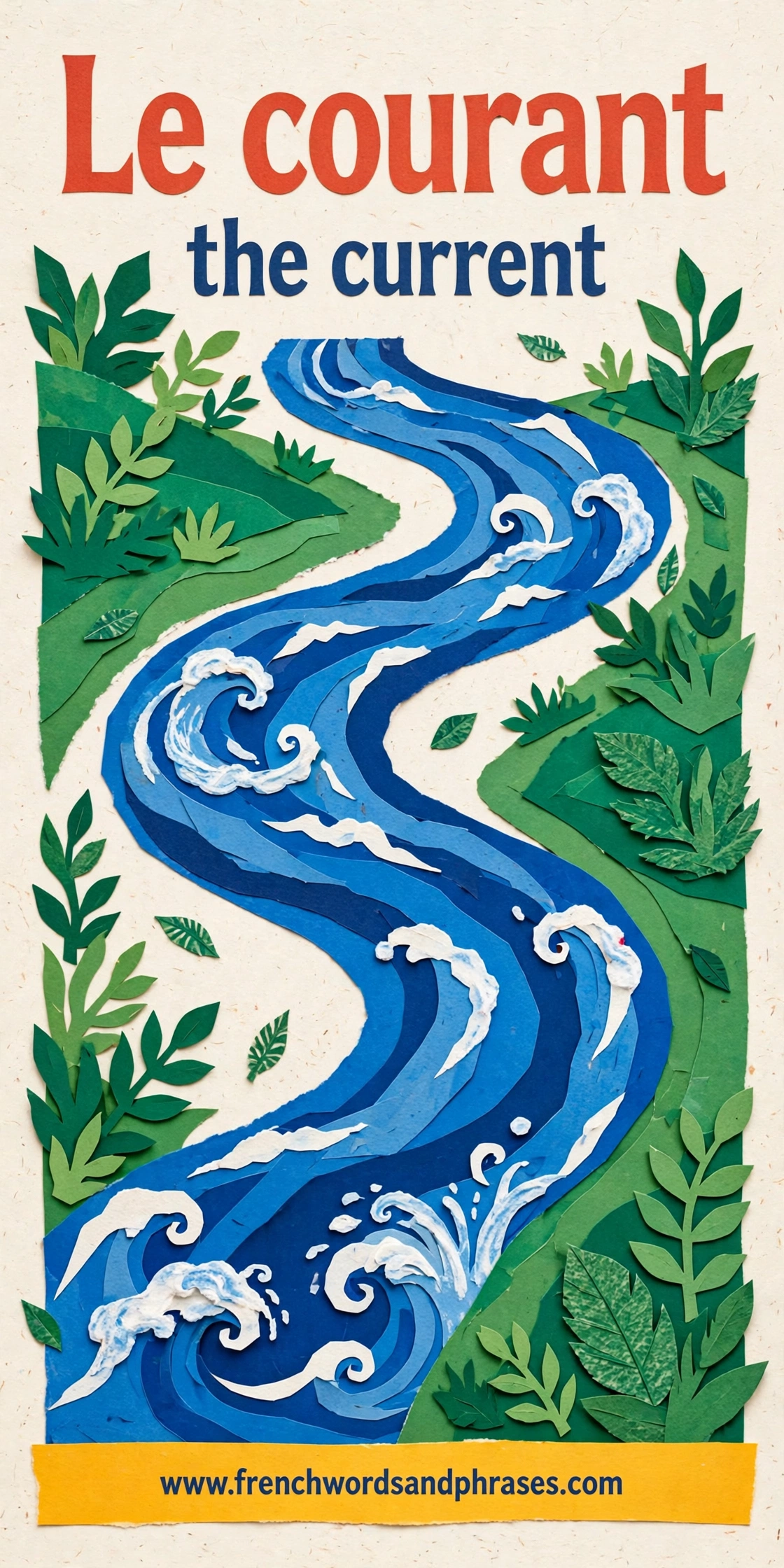
A French Word to Live By
Translate Courant to English
/ku.ʁɑ̃/
Le courant means the current.
It carries the swimmer gently sideways, turns the mill wheel, and lights the whole street when it flows through the wires: le courant, the current — movement you cannot see, only feel and use.
In this guide, you’ll learn what courant means in English, how to use it with its articles, how to form its plural, and how it appears in everyday French. Explore French examples, English translations, and practice quizzes.
Understanding the French Noun Courant
Courant is a masculine French noun, learned with its article: le courant, un courant. It is the present participle of courir, to run, turned into a noun: that which runs. The same word serves as an adjective — l’eau courante, running water, un mot courant, a common, everyday word — and the verb at its root, courir, has its own page on this site.
It means a current — first of water: le courant de la rivière, the river’s current, un courant marin, an ocean current, nager contre le courant, to swim against the current. Then of air: un courant d’air, a draught. Then of electricity: le courant électrique, and in everyday speech simply le courant — le courant est coupé, the power is off, il n’y a plus de courant, there is no power. Figuratively, ideas have their currents too: un courant de pensée, a school of thought.
Gender: Masculine — le courant
Definite article: le — le courant (the current)
Indefinite article: un — un courant (a current)
Plural: les courants — regular, with a simple -s
Spelling note: the running thing — from courir, to run; compare l’eau courante, running water
Key phrase: le courant est coupé — the power is off; un courant d’air, a draught
English equivalents: The current; the power (electricity, everyday).
In a French home, le courant means the electricity supply itself: couper le courant, to cut the power, remettre le courant, to switch it back on, une panne de courant, a power cut. As an adjective, courant means ordinary and fluent: un français courant, fluent French, des mots courants, everyday words, la semaine courante, the current week — handle both lives and the word never surprises you.
Experience the Word
Courant is invisible work: the river moving under the bridge, the draught under the door, the power waiting in the wall.
Imagine the storm at midnight — a crack, a flash, and the whole street goes dark. Plus de courant. Candles come out, the fridge ticks as it warms, and the neighbourhood discovers again everything the courant was quietly doing.
You have not just named moving water. You have named flow itself — le courant, the current, in the river, in the air and in the wires.
How to Use Courant in French: Complete Guide
Let’s explore how courant works in French, beginning with its articles — le courant, un courant, un courant d’air.
Courant with the Definite Article (Le, Les)
Used for a specific current — the river’s, the house’s power.
| Form | French |
|---|---|
| Masculine singular | le courant |
| Plural | les courants |
Example
Le courant de la rivière est fort après la pluie.
The river’s current is strong after the rain.
Courant with the Indefinite Article (Un, Des)
Used for a current in general — of water, of air, of ideas.
| Form | French |
|---|---|
| Masculine singular | un courant |
| Plural | des courants |
Example
Un courant d’air traverse la pièce.
A draught is crossing the room.
Courant by Element (De la rivière, Marin, Électrique…)
French sorts currents by what flows — water, air, electricity, thought.
| Quantity | French |
|---|---|
| a river current | le courant d’une rivière |
| an ocean current | un courant marin |
| a draught | un courant d’air |
| the electric current | le courant électrique |
| a school of thought | un courant de pensée |
Example
Les courants marins réchauffent les côtes de l’Europe.
Ocean currents warm the coasts of Europe.
Quick Quiz 1
Complete the sentence:
______ courant est coupé depuis l’orage. (the)
Reveal the answer
Le
Le courant est coupé depuis l’orage.
The power has been off since the storm — courant is masculine, so le.
The Plural of Courant
Courant takes a regular plural in -s — currents of the sea, currents of opinion.
| Number | French |
|---|---|
| Singular | le courant |
| Plural | les courants |
Example
Les courants du fleuve rendent la baignade dangereuse.
The river’s currents make swimming dangerous.
Courant with Possessive Adjectives (Mon, Ton, Son…)
Possessives agree with the noun: courant is masculine, so mon, ton, son in the singular.
| Owner | French |
|---|---|
| my | mon courant |
| your (tu) | ton courant |
| his / her | son courant |
| our | notre courant |
| your (vous) | votre courant |
| their | leur courant |
Example
Chaque courant de pensée a son époque et ses héros.
Every school of thought has its era and its heroes.
Quick Quiz 2
Complete the sentence:
Ferme la porte, il y a un ______ d’air. (current)
Reveal the answer
courant
Ferme la porte, il y a un courant d’air.
Shut the door, there is a draught — un courant d’air is the fixed phrase.
Courant with Demonstrative Adjectives (Ce, Ces)
Used to point: ce courant, this current — this flow in front of us.
| Form | French |
|---|---|
| Masculine singular | ce courant |
| Plural | ces courants |
Example
Ce courant emporte les branches vers la mer.
This current carries the branches towards the sea.
Courant with Adjectives
Adjectives agree with courant — masculine singular: un courant fort, un courant électrique.
| Adjective | With Courant |
|---|---|
| fort (strong) | un courant fort |
| marin (ocean, sea) | un courant marin |
| électrique (electric) | le courant électrique |
| contraire (opposing) | un courant contraire |
| chaud (warm) | un courant chaud |
Example
Un courant marin chaud longe la côte.
A warm ocean current runs along the coast.
Quick Quiz 3
Complete the sentence:
Ne nage pas ici, le courant est trop ______. (strong)
Reveal the answer
fort
Ne nage pas ici, le courant est trop fort.
Don’t swim here, the current is too strong — fort agrees with the masculine noun.
Everyday Expressions with Courant
Rivers, draughts and power cuts — the courant phrases of daily life.
| Expression | In English |
|---|---|
| le courant est coupé | the power is off |
| une panne de courant | a power cut |
| un courant d’air | a draught |
| nager contre le courant | to swim against the current |
| être au courant | to be informed, to be in the know |
Example
Tiens-moi au courant de tes résultats.
Keep me informed of your results.
Words from the Same Family as Courant
Running and flowing — the words that travel with courant.
| French | In English |
|---|---|
| courir | to run — the verb at the root |
| l’eau courante | running water (from the tap) |
| le courant électrique | the electric current |
| un interrupteur | a switch — that cuts le courant |
| le fil électrique | the electric wire |
Example
Cette maison n’a pas encore l’eau courante.
This house does not have running water yet.
Quick Quiz 4
What does être au courant mean?
Reveal the answer
To be informed, to be in the know — literally to be in the current of things.
Elle est au courant de la nouvelle.
She knows about the news.
Courant in Everyday French: Real-Life Examples
Now that you know the word, let’s see how courant appears in everyday French.
Example 1 — Swimming
Le courant est fort, restez près du bord.
The current is strong, stay near the edge.
Example 2 — At home
Le courant est coupé, sors les bougies.
The power is off, get the candles out.
Example 3 — Draughts
Ferme la fenêtre, je sens un courant d’air.
Shut the window, I feel a draught.
Example 4 — News
Tu es au courant pour le mariage de Léa ?
Have you heard about Léa’s wedding?
Example 5 — Fluency
Elle parle un français courant après deux ans à Paris.
She speaks fluent French after two years in Paris.
Example 6 — The sea
Les courants marins déplacent les bateaux dérivants.
Ocean currents move drifting boats.
Beyond Translation: The Meaning of Courant
Courant is the present participle of courir that escaped into everything that flows: French looked at rivers, winds, wires and ideas, and saw running everywhere. The electricity sense is the youngest — barely a century old — yet it has conquered the home: le courant est coupé is one of the first sentences a newcomer to France learns, usually by candlelight. And être au courant, to be in the current, remains the loveliest French picture of being informed: knowledge as a river you stand in.
To say courant is to feel the world moving past — water, air, power and news.
It evokes the swimmer carried sideways, the draught at the ankle, and the lights going out street by street.
How to Remember the French Noun Courant
Remember it this way: Courant is the current — masculine: le courant, from the river to the power supply to a courant d’air.
- Always masculine — le courant, un courant, ce courant.
- The home sense — le courant est coupé, the power is off; une panne de courant, a power cut.
- The idiom — être au courant, to be in the know; un courant d’air, a draught.
The key idea is le courant — the current, masculine; also the power supply and a draught (d’air).
Test Your Knowledge of Courant
Let’s see how much you’ve learned. Try answering these questions before revealing the answers.
Question 1
Is courant masculine or feminine?
Reveal the answer
Masculine — le courant, un courant.
Question 2
How do you say the power is off?
Reveal the answer
Le courant est coupé.
Question 3
Translate: Shut the door, there is a draught.
Reveal the answer
Ferme la porte, il y a un courant d’air.
Question 4
What does un français courant mean?
Reveal the answer
Fluent French — courant as an adjective means fluent, everyday, ordinary.
Question 5
Complete the sentence:
______ courants du fleuve sont dangereux. (the)
Reveal the answer
Les
Les courants du fleuve sont dangereux.
The river’s currents are dangerous.
Your Final Challenge
Can You Use It?
How would you say this in French?
“The power has been off since the storm.”
Reveal the answer
Le courant est coupé depuis l’orage.
The power has been off since the storm.
A little French. A little curiosity. A richer everyday life.
LEARN FRENCH ONE WORD AT A TIME