A French Word to Live By
Translate Viande to English
/vjɑ̃d/
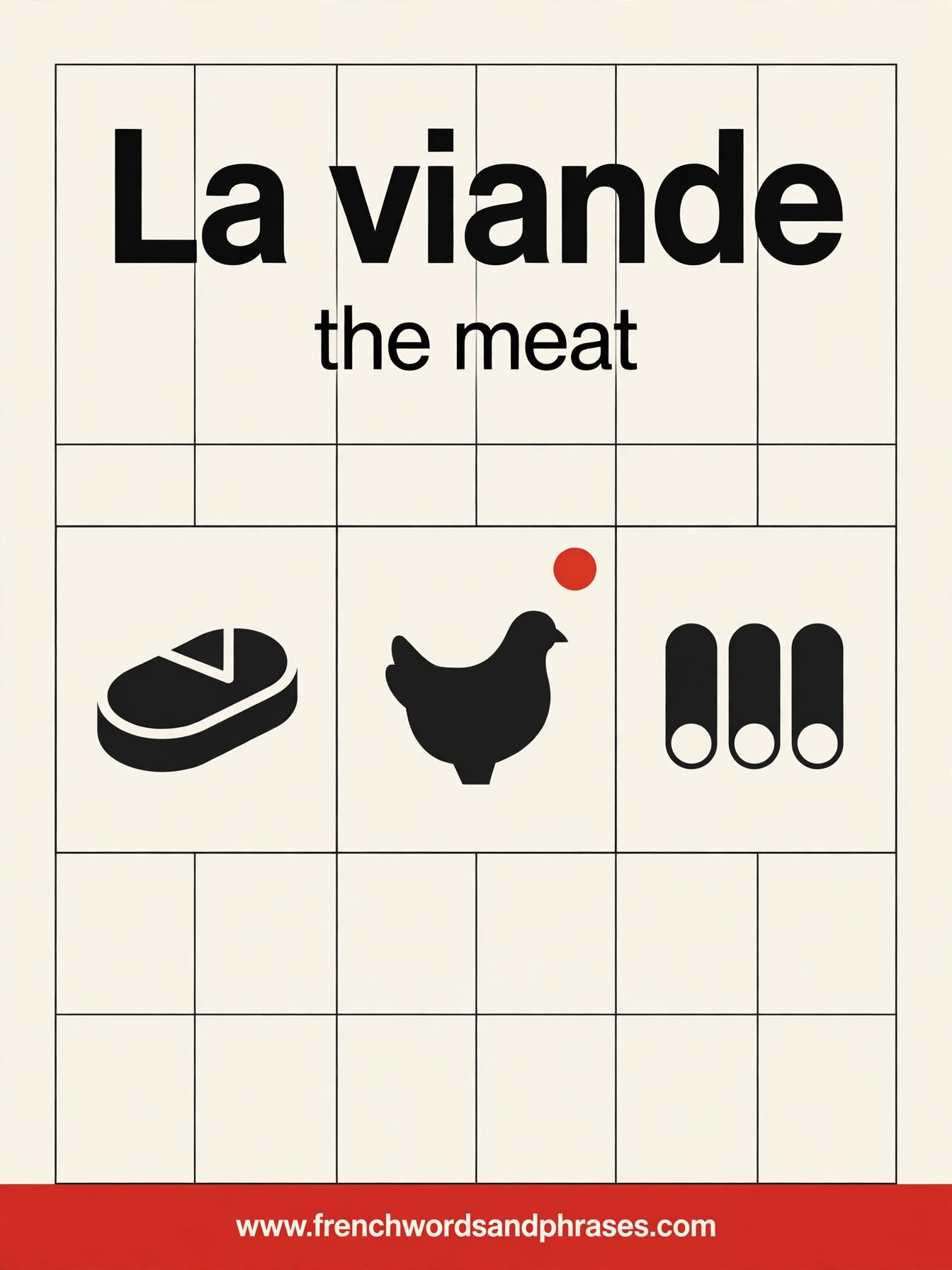
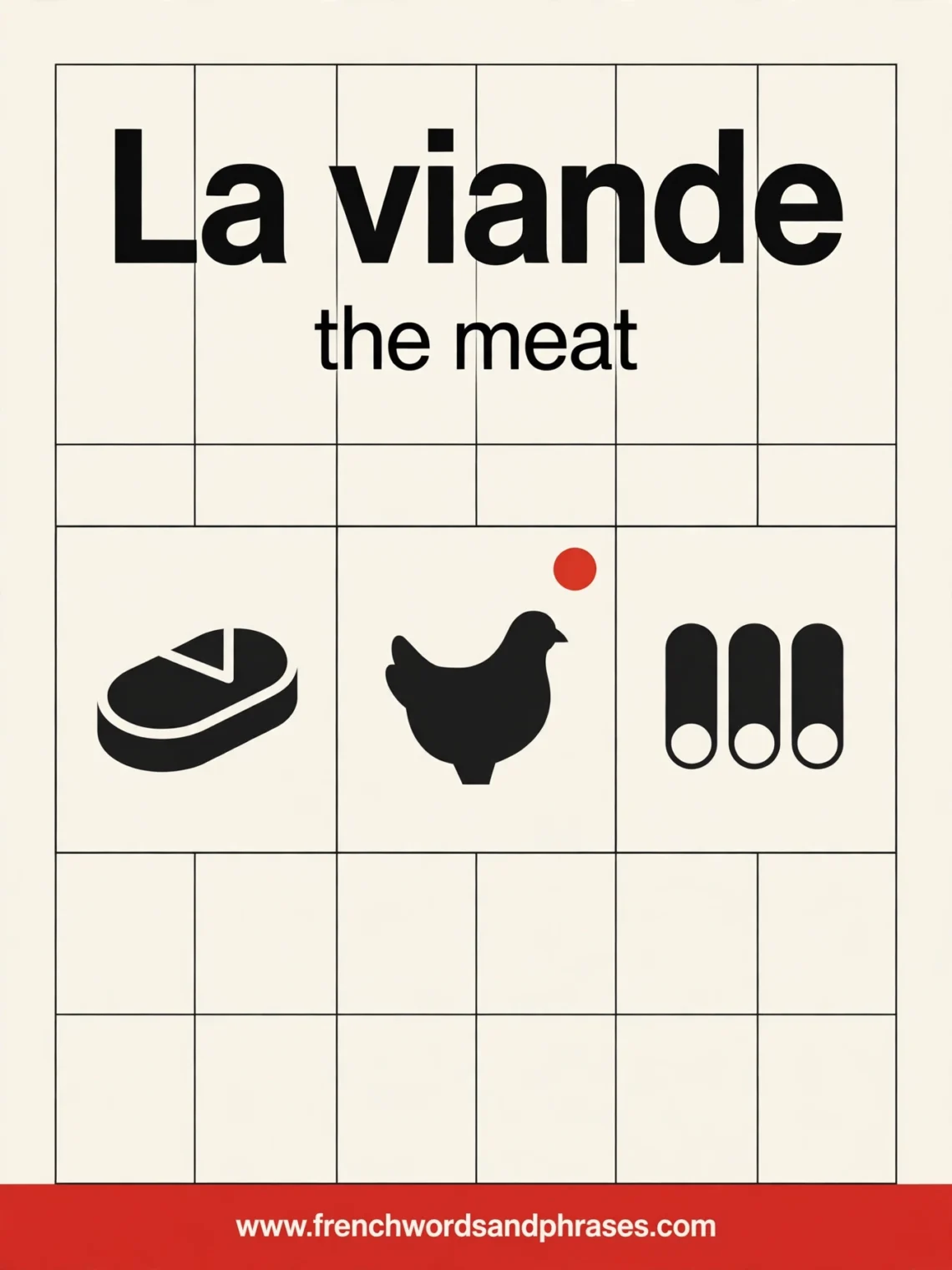
La viande means the meat.
The butcher’s marble counter, the roast tied with string, the Sunday smell already filling the stairwell: la viande, the meat — the centre of the traditional French plate, around which everything else is arranged.
In this guide, you’ll learn what viande means in English, how to use it with its articles, how to form its plural, and how it appears in everyday French. Explore French examples, English translations, and practice quizzes.
Understanding the French Noun Viande
Viande is a feminine French noun, learned with its article: la viande, de la viande. It comes from the Latin vivenda, things to live on — in Old French viande meant food in general, and the word only narrowed to meat over the centuries. It is a mass noun: you buy de la viande, some meat, and count it in cuts, not in viandes.
It means meat — the flesh of animals eaten as food: la viande de bœuf, beef, la viande de porc, pork, la viande rouge, red meat, la viande blanche, white meat. At the butcher’s you order by cut and weight: un kilo de viande hachée, a kilo of minced meat, une belle pièce de viande, a fine cut of meat. Someone who eats none is végétarien, and the dish cooked slowly in its sauce is une viande mijotée.
Gender: Feminine — la viande
Definite article: la — la viande (the meat)
Partitive article: de la — de la viande (some meat)
Plural: les viandes — used for kinds of meat, rarely for portions
Spelling note: from Latin vivenda, things to live on — viande once meant all food
Key frame: la viande de + animal — la viande de bœuf, beef
English equivalents: The meat.
Meat is served, not counted: tu veux de la viande ? uses the partitive, and quantities come in kilos, tranches and pièces. Cooking has its own scale: saignante (rare), à point (medium), bien cuite (well done) — the waiter will ask quelle cuisson pour la viande ? The shop is la boucherie, the butcher le boucher.
Experience the Word
Viande is the serious centre of the French table: the course the wine is chosen for, the one the sauce is built around.
Imagine the Sunday queue at the boucherie — numbers called, string snipped, the roast weighed and wrapped in paper while three generations debate the cuisson in the doorway.
You have not just named food. You have named the main event — la viande, the meat, tied, roasted and carved at the table.
How to Use Viande in French: Complete Guide
Let’s explore how viande works in French, beginning with its articles — la viande, de la viande, la viande de bœuf.
Viande with the Definite Article (La, Les)
Used for specific meat — the meat on the table, the meat in the recipe.
| Form | French |
|---|---|
| Feminine singular | la viande |
| Plural (kinds) | les viandes |
Example
La viande cuit lentement dans la cocotte.
The meat is cooking slowly in the casserole.
Viande with the Partitive Article (De la viande…)
Meat is a mass noun: some meat, more meat, no meat — the partitive does the work.
| Form | French |
|---|---|
| Feminine singular | de la viande |
| Plural | des viandes (kinds of meat) |
Example
Il ne mange plus de viande le vendredi.
He no longer eats meat on Fridays.
Viande by Animal (De bœuf, De porc, D’agneau…)
French names meat by its animal — the butcher’s counter in five lines.
| Quantity | French |
|---|---|
| beef | la viande de bœuf |
| pork | la viande de porc |
| lamb | la viande d’agneau |
| minced meat | la viande hachée |
| a kilo of meat | un kilo de viande |
Example
Je préfère la viande d’agneau au printemps.
I prefer lamb in spring.
Quick Quiz 1
Complete the sentence:
______ viande est tendre et juteuse. (the)
Reveal the answer
La
La viande est tendre et juteuse.
The meat is tender and juicy — viande is feminine, so la.
The Plural of Viande
Viande is a mass noun; its plural les viandes means kinds of meat, not helpings.
| Number | French |
|---|---|
| Singular | la viande |
| Plural | les viandes |
Example
Ce régime autorise les viandes blanches seulement.
This diet allows white meats only.
Viande with Possessive Adjectives (Ma, Ta, Sa…)
Possessives agree with the noun: viande is feminine, so ma, ta, sa in the singular.
| Owner | French |
|---|---|
| my | ma viande |
| your (tu) | ta viande |
| his / her | sa viande |
| our | notre viande |
| your (vous) | votre viande |
| their | leur viande |
Example
Chacun surveille sa viande sur le gril.
Everyone watches their meat on the grill.
Quick Quiz 2
Complete the sentence:
Tu veux encore de ______ viande ? (the)
Reveal the answer
la
Tu veux encore de la viande ?
Do you want some more meat? — de la, the partitive, for a mass noun.
Viande with Demonstrative Adjectives (Cette, Ces)
Used to point: cette viande, this meat — this cut at the counter.
| Form | French |
|---|---|
| Feminine singular | cette viande |
| Plural | ces viandes |
Example
Cette viande vient d’une ferme du village.
This meat comes from a farm in the village.
Viande with Adjectives
Adjectives agree with viande — feminine singular: une viande tendre, une viande rouge.
| Adjective | With Viande |
|---|---|
| tendre (tender) | une viande tendre |
| rouge (red) | la viande rouge |
| blanche (white) | la viande blanche |
| hachée (minced) | la viande hachée |
| mijotée (slow-cooked) | une viande mijotée |
Example
Une viande mijotée embaume toute la maison.
A slow-cooked meat dish perfumes the whole house.
Quick Quiz 3
Complete the sentence:
Il achète toujours de la viande ______ chez ce boucher. (tender)
Reveal the answer
tendre
Il achète toujours de la viande tendre chez ce boucher.
He always buys tender meat from this butcher — tendre, the same form for feminine.
Everyday Expressions with Viande
Butchers, grills and Sunday roasts — the viande phrases of daily life.
| Expression | In English |
|---|---|
| la viande hachée | minced meat, ground meat |
| un morceau de viande | a piece of meat |
| la cuisson de la viande | how the meat is cooked (rare, medium…) |
| saignant / à point / bien cuit | rare / medium / well done |
| une pièce de viande | a cut, a joint of meat |
Example
Pour moi, la viande à point, s’il vous plaît.
For me, the meat medium, please.
Words from the Same Family as Viande
Butchers and cuts — the words that travel with viande.
| French | In English |
|---|---|
| la boucherie | the butcher’s shop |
| le boucher | the butcher |
| un rôti | a roast |
| une côtelette | a cutlet, a chop |
| végétarien | vegetarian — who eats no viande |
Example
La boucherie ferme à treize heures le dimanche.
The butcher’s closes at one o’clock on Sundays.
Quick Quiz 4
What does à point mean for meat?
Reveal the answer
Medium — cooked just right, between saignant (rare) and bien cuit (well done).
Je voudrais la viande à point.
I would like the meat medium.
Viande in Everyday French: Real-Life Examples
Now that you know the word, let’s see how viande appears in everyday French.
Example 1 — At the butcher’s
Un kilo de viande hachée, s’il vous plaît.
A kilo of minced meat, please.
Example 2 — At the restaurant
Quelle cuisson pour la viande, monsieur ?
How would you like the meat cooked, sir?
Example 3 — At home
La viande mijote depuis deux heures.
The meat has been simmering for two hours.
Example 4 — Health
Le médecin lui conseille moins de viande rouge.
The doctor advises him to eat less red meat.
Example 5 — The grill
La viande grille doucement sur les braises.
The meat is grilling gently over the embers.
Example 6 — No meat
Le vendredi, on ne sert pas de viande à la cantine.
On Fridays, no meat is served in the canteen.
Beyond Translation: The Meaning of Viande
Viande began as the word for food itself — vivenda, the things one lives on — and meat inherited the title because, for centuries, it was the food that counted, the one the feast was judged by. The narrowing left traces everywhere: the butcher’s shop is a destination, the cuisson a small ceremony of preference, and a meal sans viande still defines itself against the absent centre.
To say viande is to name the historic heart of the French plate.
It evokes the marble counter, the tied roast, and the gravy being argued over at the table.
How to Remember the French Noun Viande
Remember it this way: Viande is the meat — feminine and a mass noun: la viande, de la viande, and la viande de bœuf for beef.
- Always feminine — la viande, de la viande, cette viande.
- The partitive — some meat is de la viande, never une viande at the table.
- The animals — viande de bœuf (beef), de porc (pork), d’agneau (lamb).
The key idea is la viande — the meat, feminine; a mass noun with de la viande.
Test Your Knowledge of Viande
Let’s see how much you’ve learned. Try answering these questions before revealing the answers.
Question 1
Is viande masculine or feminine?
Reveal the answer
Feminine — la viande, de la viande.
Question 2
How do you ask for a kilo of minced meat?
Reveal the answer
Un kilo de viande hachée, s’il vous plaît.
Question 3
Translate: The meat is tender and juicy.
Reveal the answer
La viande est tendre et juteuse.
Question 4
What do saignant, à point and bien cuit mean?
Reveal the answer
Rare, medium and well done — the three classic cuissons of meat.
Question 5
Complete the sentence:
Tu veux de ______ viande ? (the)
Reveal the answer
la
Tu veux de la viande ?
Do you want some meat? — the partitive de la.
Your Final Challenge
Can You Use It?
How would you say this in French?
“The meat is cooking slowly in the casserole.”
Reveal the answer
La viande cuit lentement dans la cocotte.
The meat is cooking slowly in the casserole.
A little French. A little curiosity. A richer everyday life.
LEARN FRENCH ONE WORD AT A TIME