A French Word to Live By
Translate Cloche to English
/klɔʃ/
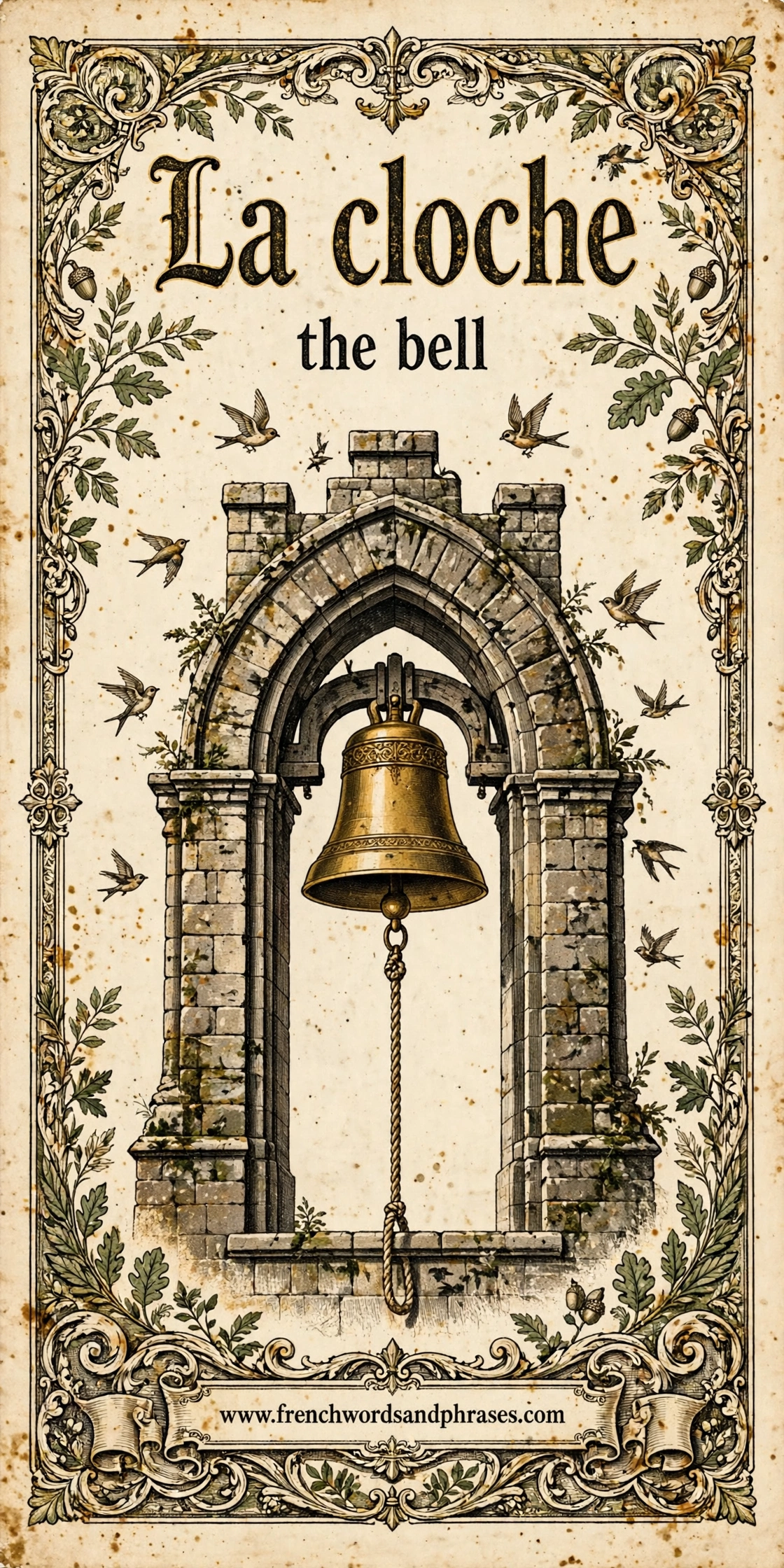
La cloche means the bell.
Eight o’clock over the rooftops, the Angelus rolling out from the village tower, every kitchen window timing its morning by it: la cloche, the bell — the voice a French village hears before it sees anything.
In this guide, you’ll learn what cloche means in English, how to use it with its articles, how to form its plural, and how it appears in everyday French. Explore French examples, English translations, and practice quizzes.
Understanding the French Noun Cloche
Cloche is a feminine French noun, learned with its article: la cloche, une cloche. It comes from the medieval Latin clocca, probably an echo of the sound itself. The big church bell is also called le bourdon when it is the deepest of the tower, and the little handbell on a desk or a cow’s neck is une clochette.
It means a bell — the hollow metal cup that rings when struck: la cloche de l’église, the church bell, sonner la cloche, to ring the bell, la cloche de l’école, the school bell. The word covers the glass dome that protects cheese or a dish in fine restaurants — une cloche à fromage, servir sous cloche — and in slang, un clochard is a tramp, and être cloche is to be a bit hopeless, a dunce.
Gender: Feminine — la cloche
Definite article: la — la cloche (the bell)
Indefinite article: une — une cloche (a bell)
Plural: les cloches — regular, with a simple -s
Spelling note: from medieval Latin clocca — a word that imitates the sound it names
Key Easter phrase: les cloches de Pâques — the Easter bells that bring the eggs
English equivalents: The bell.
The verb is sonner: la cloche sonne, the bell rings, and you ring it — sonner la cloche. At Easter, French children are told the church bells fly to Rome and return dropping eggs: les cloches de Pâques. To hear both sides of a story is entendre deux sons de cloche — two sounds of the bell — and a dish presented under its dome is sous cloche.
Experience the Word
Cloche is a village’s public voice: it announces mass, weddings, funerals and fire, and everyone within earshot is its parish.
Imagine the tower at noon on a wedding Saturday — the cloche swinging, the bronze note rolling over the market square, hats coming off, pigeons bursting upward in a grey fountain.
You have not just named an instrument. You have named the sound that organises a town — la cloche, the bell, time made audible.
How to Use Cloche in French: Complete Guide
Let’s explore how cloche works in French, beginning with its articles — la cloche, une cloche, sonner la cloche.
Cloche with the Definite Article (La, Les)
Used for a specific bell — the church bell, the school bell.
| Form | French |
|---|---|
| Feminine singular | la cloche |
| Plural | les cloches |
Example
La cloche de l’église sonne à midi.
The church bell rings at noon.
Cloche with the Indefinite Article (Une, Des)
Used for a bell in general — or the glass dome kind.
| Form | French |
|---|---|
| Feminine singular | une cloche |
| Plural | des cloches |
Example
Le fromage est gardé sous une cloche en verre.
The cheese is kept under a glass dome.
Cloche with Quantities and Places (De l’église, De l’école…)
Bells belong to towers, schools and necks — French names them by their post.
| Quantity | French |
|---|---|
| the church bell | la cloche de l’église |
| the school bell | la cloche de l’école |
| the Easter bells | les cloches de Pâques |
| a cowbell | une cloche de vache |
| a small handbell | une clochette |
Example
Les cloches de Pâques ont caché des œufs dans le jardin.
The Easter bells hid eggs in the garden.
Quick Quiz 1
Complete the sentence:
______ cloche sonne, c’est la fin des cours. (the)
Reveal the answer
La
La cloche sonne, c’est la fin des cours.
The bell is ringing, lessons are over — cloche is feminine, so la.
The Plural of Cloche
Cloche takes a regular plural in -s — a tower rarely keeps only one.
| Number | French |
|---|---|
| Singular | la cloche |
| Plural | les cloches |
Example
Les cloches du village sonnent pour le mariage.
The village bells are ringing for the wedding.
Cloche with Possessive Adjectives (Ma, Ta, Sa…)
Possessives agree with the noun: cloche is feminine, so ma, ta, sa in the singular.
| Owner | French |
|---|---|
| my | ma cloche |
| your (tu) | ta cloche |
| his / her | sa cloche |
| our | notre cloche |
| your (vous) | votre cloche |
| their | leur cloche |
Example
Le sonneur entretient sa cloche avec soin.
The bell-ringer looks after his bell carefully.
Quick Quiz 2
Complete the sentence:
Elle a accroché ______ cloche au cou de la chèvre. (her)
Reveal the answer
sa
Elle a accroché sa cloche au cou de la chèvre.
She hung her bell around the goat’s neck — sa, because cloche is feminine.
Cloche with Demonstrative Adjectives (Cette, Ces)
Used to point: cette cloche, this bell — the one we can hear.
| Form | French |
|---|---|
| Feminine singular | cette cloche |
| Plural | ces cloches |
Example
Cette cloche date du seizième siècle.
This bell dates from the sixteenth century.
Cloche with Adjectives
Adjectives agree with cloche — feminine singular: une cloche ancienne, une grosse cloche.
| Adjective | With Cloche |
|---|---|
| ancienne (old) | une cloche ancienne |
| grosse (big) | une grosse cloche |
| petite (small) | une petite cloche |
| en bronze (bronze) | une cloche en bronze |
| fêlée (cracked) | une cloche fêlée |
Example
Une cloche fêlée sonne faux, il faut la refondre.
A cracked bell rings false, it must be recast.
Quick Quiz 3
Complete the sentence:
C’est une cloche très ______, on l’entend à des kilomètres. (old)
Reveal the answer
ancienne
C’est une cloche très ancienne, on l’entend à des kilomètres.
It is a very old bell, you can hear it for kilometres — ancienne, feminine, to agree with cloche.
Everyday Expressions with Cloche
Towers, Easter gardens and fine dining — the cloche phrases of daily life.
| Expression | In English |
|---|---|
| sonner la cloche | to ring the bell |
| les cloches de Pâques | the Easter bells (that bring the eggs) |
| servir sous cloche | to serve under a dome (fine dining) |
| entendre deux sons de cloche | to hear two sides of a story |
| une cloche à fromage | a cheese dome |
Example
Avant de juger, écoute les deux sons de cloche.
Before judging, hear both sides of the story.
Words from the Same Family as Cloche
Bells and bell towers — the words that travel with cloche.
| French | In English |
|---|---|
| un clocher | a bell tower, a steeple |
| une clochette | a small bell, a handbell |
| sonner | to ring (the verb) |
| le bourdon | the great bell — the deepest bell of a tower |
| un carillon | a carillon, a set of tuned bells |
Example
Du clocher, on voit tout le village.
From the bell tower, you can see the whole village.
Quick Quiz 4
What are les cloches de Pâques?
Reveal the answer
The Easter bells — in the French tradition, the church bells fly to Rome and return on Easter morning dropping chocolate eggs in gardens.
Les cloches de Pâques passent dimanche matin.
The Easter bells come by on Sunday morning.
Cloche in Everyday French: Real-Life Examples
Now that you know the word, let’s see how cloche appears in everyday French.
Example 1 — In the village
La cloche sonne huit heures au clocher.
The bell strikes eight o’clock in the tower.
Example 2 — At school
Quand la cloche sonne, les élèves sortent en courant.
When the bell rings, the pupils run out.
Example 3 — At Easter
Les enfants cherchent les œufs des cloches de Pâques.
The children hunt for the Easter bells’ eggs.
Example 4 — At the restaurant
Le plat arrive sous cloche, comme autrefois.
The dish arrives under a dome, as in the old days.
Example 5 — In the Alps
Les vaches portent une cloche au cou.
The cows wear a bell around their necks.
Example 6 — Two versions
Il faut entendre les deux sons de cloche avant de décider.
You must hear both sides before deciding.
Beyond Translation: The Meaning of Cloche
Before clocks were common, the cloche was the village’s clock, newspaper and alarm in one bronze voice: it rang the hours, the Angelus, the tocsin for fire, and the slow toll for a funeral — each rhythm a message everyone could read by ear. The Easter story told to children, that the bells fall silent on Good Friday because they have flown to Rome, turns even silence into part of the bell’s job.
To say cloche is to hear a community keeping time together.
It evokes the tower over the square, the dome lifted at a grand table, and chocolate eggs appearing in the grass.
How to Remember the French Noun Cloche
Remember it this way: Cloche is the bell — feminine: la cloche, it sonne, and at Easter les cloches bring the eggs.
- Always feminine — la cloche, une cloche, cette cloche.
- The verb — sonner la cloche, to ring the bell; la cloche sonne, it rings.
- The story — les cloches de Pâques, the Easter bells that bring the eggs.
The key idea is la cloche — the bell, feminine; les cloches de Pâques = the Easter bells.
Test Your Knowledge of Cloche
Let’s see how much you’ve learned. Try answering these questions before revealing the answers.
Question 1
Is cloche masculine or feminine?
Reveal the answer
Feminine — la cloche, une cloche.
Question 2
How do you say to ring the bell?
Reveal the answer
Sonner la cloche.
Question 3
Translate: The church bell rings at noon.
Reveal the answer
La cloche de l’église sonne à midi.
Question 4
What is un clocher?
Reveal the answer
A bell tower — the steeple that holds the bells.
Question 5
Complete the sentence:
______ cloches du village sonnent pour le mariage. (the)
Reveal the answer
Les
Les cloches du village sonnent pour le mariage.
The village bells are ringing for the wedding.
Your Final Challenge
Can You Use It?
How would you say this in French?
“The village bells are ringing for the wedding.”
Reveal the answer
Les cloches du village sonnent pour le mariage.
The village bells are ringing for the wedding.
A little French. A little curiosity. A richer everyday life.
LEARN FRENCH ONE WORD AT A TIME