A French Word to Live By
Translate Insecte to English
/ɛ̃.sɛkt/
L’Insecte means the insect.
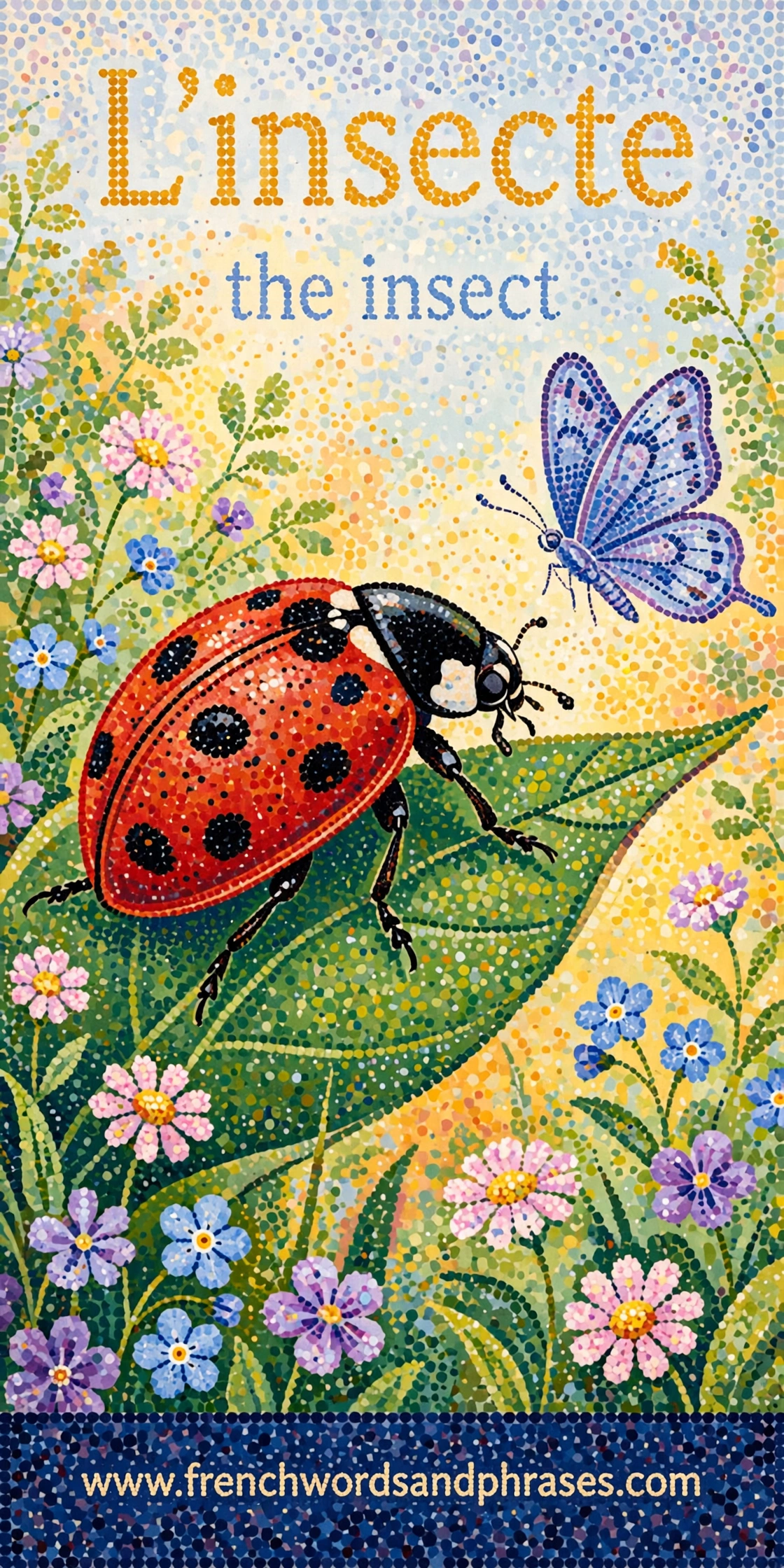
Six legs on the garden wall, wings folded like tiny fans, antennae tasting the summer air: l’insecte, the insect — the small armoured majority of the animal world, named in Latin for the cuts that divide its body into segments.
In this guide, you’ll learn what insecte means in English, how to use it with its articles, how to form its plural, and how it appears in everyday French. Explore French examples, English translations, and practice quizzes.
Understanding the French Noun Insecte
Insecte is a masculine French noun, learned with its article: l’insecte, un insecte. It begins with a vowel, so the article melts into it: l’insecte, never le insecte. It comes from the Latin insectum, cut into — a creature whose body is notched into three parts: head, thorax and abdomen, with six legs and, very often, wings.
It means an insect — any of the six-legged small creatures: un insecte volant, a flying insect, un insecte piqueur, a stinging insect, les insectes du jardin, the garden insects. Bees, ants, butterflies, beetles and grasshoppers are insectes; spiders are not — they have eight legs and belong to another family. In everyday French, any small creepy-crawly may loosely be called un insecte, but the careful word for the creature class is this one, and the study of them is l’entomologie.
Gender: Masculine — l’insecte
Definite article: l’ — l’insecte (the insect), melted before the vowel
Indefinite article: un — un insecte (an insect)
Plural: les insectes — regular, with a simple -s
Spelling note: from Latin insectum, cut into — the body in three notched parts
Watch the family: six legs = insecte; eight legs = une araignée, a spider — not an insect
English equivalents: The insect, a bug (in the loose everyday sense).
French children learn the rule early: un insecte a six pattes — an insect has six legs. So une araignée (a spider) and un mille-pattes (a centipede) are not insectes, however often everyday speech lumps them together. For a bite or sting, French says une piqûre d’insecte, and the spray that keeps them away is un insecticide or, for the skin, un produit anti-insectes.
Experience the Word
Insecte is the small print of the animal kingdom — a whole civilisation of wings, shells and antennae living at ankle height.
Imagine the naturalist at dawn with his net and his notebook, counting the insectes of a single meadow: beetles like polished stones, bees already at work, a butterfly opening its wings to the first sun.
You have not just named a bug. You have named the majority of life on earth — l’insecte, six legs and a suit of armour.
How to Use Insecte in French: Complete Guide
Let’s explore how insecte works in French, beginning with its articles — l’insecte, un insecte, une piqûre d’insecte.
Insecte with the Definite Article (L’, Les)
Used for a specific insect — the one on the leaf, the one in the jar.
| Form | French |
|---|---|
| Masculine singular | l’insecte |
| Plural | les insectes |
Example
L’insecte sur la feuille est une coccinelle.
The insect on the leaf is a ladybird.
Insecte with the Indefinite Article (Un, Des)
Used for an insect in general — any six-legged visitor.
| Form | French |
|---|---|
| Masculine singular | un insecte |
| Plural | des insectes |
Example
Un insecte est entré par la fenêtre ouverte.
An insect came in through the open window.
Insecte with Kinds (Volant, Piqueur, Nuisible…)
Insects are sorted by what they do — fly, sting, help or harm.
| Quantity | French |
|---|---|
| a flying insect | un insecte volant |
| a stinging insect | un insecte piqueur |
| a harmful insect | un insecte nuisible |
| a useful insect | un insecte utile |
| an insect bite | une piqûre d’insecte |
Example
Les abeilles sont des insectes utiles pour les fleurs.
Bees are useful insects for the flowers.
Quick Quiz 1
Complete the sentence:
______ insecte que tu vois est une libellule. (the)
Reveal the answer
L’
L’insecte que tu vois est une libellule.
The insect you see is a dragonfly — le melts into l’ before the vowel.
The Plural of Insecte
Insecte takes a regular plural in -s — and insects are almost always met in the plural.
| Number | French |
|---|---|
| Singular | l’insecte |
| Plural | les insectes |
Example
Les insectes jouent un rôle essentiel dans la nature.
Insects play an essential role in nature.
Insecte with Possessive Adjectives (Mon, Ton, Son…)
Possessives agree with the noun: insecte is masculine, so mon, ton, son in the singular.
| Owner | French |
|---|---|
| my | mon insecte |
| your (tu) | ton insecte |
| his / her | son insecte |
| our | notre insecte |
| your (vous) | votre insecte |
| their | leur insecte |
Example
L’enfant montre son insecte à toute la classe.
The child shows his insect to the whole class.
Quick Quiz 2
Complete the sentence:
Elle a dessiné ______ insecte préféré, le papillon. (her)
Reveal the answer
son
Elle a dessiné son insecte préféré, le papillon.
She drew her favourite insect, the butterfly — son, because insecte is masculine.
Insecte with Demonstrative Adjectives (Cet, Ces)
Used to point: cet insecte, this insect — cet, because the noun begins with a vowel.
| Form | French |
|---|---|
| Masculine singular | cet insecte |
| Plural | ces insectes |
Example
Cet insecte brillant est un scarabée.
This shiny insect is a beetle.
Insecte with Adjectives
Adjectives agree with insecte — masculine singular: un insecte volant, un petit insecte.
| Adjective | With Insecte |
|---|---|
| volant (flying) | un insecte volant |
| petit (small) | un petit insecte |
| nuisible (harmful) | un insecte nuisible |
| utile (useful) | un insecte utile |
| brillant (shiny) | un insecte brillant |
Example
Un petit insecte noir marche sur la nappe.
A small black insect is walking on the tablecloth.
Quick Quiz 3
Complete the sentence:
Une araignée n’est pas un ______, elle a huit pattes. (insect)
Reveal the answer
insecte
Une araignée n’est pas un insecte, elle a huit pattes.
A spider is not an insect, it has eight legs.
Everyday Expressions with Insecte
Gardens, bites and summer evenings — the insecte phrases of daily life.
| Expression | In English |
|---|---|
| une piqûre d’insecte | an insect bite |
| un produit anti-insectes | an insect repellent |
| les insectes pollinisateurs | pollinating insects |
| un hôtel à insectes | an insect hotel (for the garden) |
| un insecticide | an insecticide |
Example
Nous avons installé un hôtel à insectes dans le jardin.
We put an insect hotel in the garden.
Words from the Same Family as Insecte
Small creatures — the words that travel with insecte.
| French | In English |
|---|---|
| une abeille | a bee |
| un papillon | a butterfly |
| une araignée | a spider — eight legs, not an insect |
| une coccinelle | a ladybird |
| l’entomologie | entomology — the study of insects |
Example
Le papillon est l’insecte préféré des enfants.
The butterfly is the children’s favourite insect.
Quick Quiz 4
How many legs does un insecte have?
Reveal the answer
Six — six legs, three body parts: that is the rule of the insect family.
Un insecte a six pattes, une araignée en a huit.
An insect has six legs, a spider has eight.
Insecte in Everyday French: Real-Life Examples
Now that you know the word, let’s see how insecte appears in everyday French.
Example 1 — In the garden
Les insectes travaillent déjà dans les fleurs.
The insects are already at work in the flowers.
Example 2 — Summer evening
Un insecte tourne autour de la lampe.
An insect is circling the lamp.
Example 3 — A bite
Cette piqûre d’insecte me démange.
This insect bite is itching.
Example 4 — At school
Les élèves observent un insecte à la loupe.
The pupils are examining an insect under a magnifying glass.
Example 5 — Nature
Sans insectes, pas de pommes dans le verger.
Without insects, no apples in the orchard.
Example 6 — The rule
Un insecte a toujours six pattes.
An insect always has six legs.
Beyond Translation: The Meaning of Insecte
Insecte is a Latin X-ray of the animal itself: insectum, cut into — the creature arrives pre-divided into head, thorax and abdomen, as if nature had marked the joints with a knife.
To say insecte is to see the segments.
It evokes the meadow at dawn, the magnifying glass in the schoolyard, and the quiet fact that for every human on earth there are some two hundred million of them.
How to Remember the French Noun Insecte
Remember it this way: Insecte is the six-legged creature — masculine with a melted article: l’insecte, and spiders need not apply.
- Masculine, vowel first — l’insecte, un insecte, cet insecte.
- The six-leg rule — un insecte a six pattes; the spider’s eight disqualify her.
- The bite phrase — une piqûre d’insecte, an insect bite.
The key idea is l’insecte — the insect, masculine; six legs, three body parts.
Test Your Knowledge of Insecte
Let’s see how much you’ve learned. Try answering these questions before revealing the answers.
Question 1
Is insecte masculine or feminine?
Reveal the answer
Masculine — l’insecte, un insecte.
Question 2
How do you say an insect bite?
Reveal the answer
Une piqûre d’insecte.
Question 3
Translate: The insects are already at work in the flowers.
Reveal the answer
Les insectes travaillent déjà dans les fleurs.
Question 4
Why is a spider not an insecte?
Reveal the answer
It has eight legs — an insecte has six, and a body in three parts.
Question 5
Complete the sentence:
______ insecte sur la feuille est une coccinelle. (the)
Reveal the answer
L’
L’insecte sur la feuille est une coccinelle.
The insect on the leaf is a ladybird.
Your Final Challenge
Can You Use It?
How would you say this in French?
“An insect always has six legs.”
Reveal the answer
Un insecte a toujours six pattes.
An insect always has six legs.
A little French. A little curiosity. A richer everyday life.
LEARN FRENCH ONE WORD AT A TIME