A French Word to Live By
Translate Type to English
/tip/
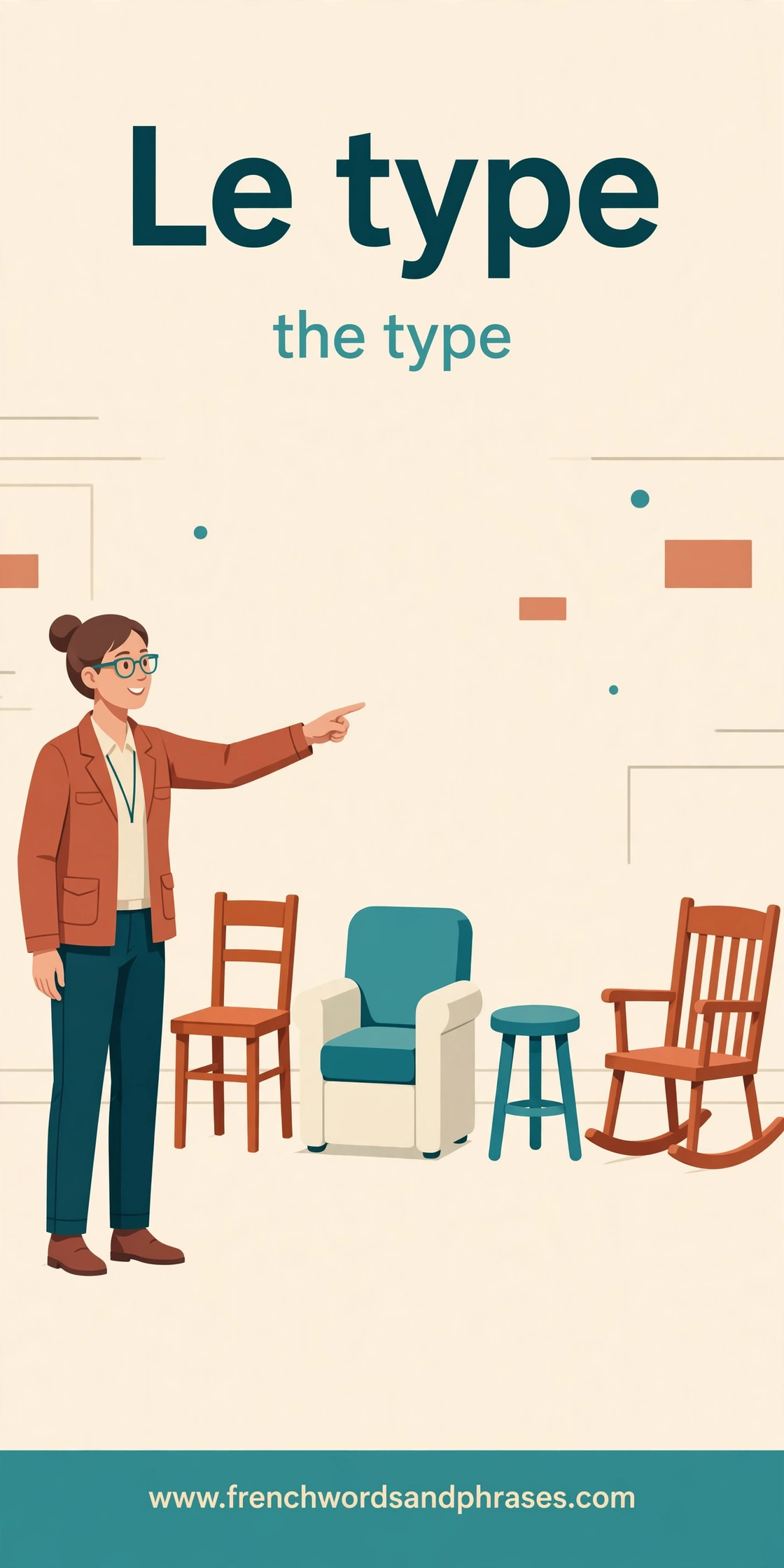
Le type means the type.
A kind, a model, a category of thing — and, in the street, simply a guy: le type is one of French’s hardest-working small words, sorting everything from engines to people into types.
In this guide, you’ll learn what type means in English, how to use it with its articles, how to form its plural, and how it appears in everyday French. Explore French examples, English translations, and practice quizzes.
Understanding the French Noun Type
Type is a masculine French noun, learned with its article: le type, un type. It comes from the Latin typus, a figure or model, itself from Greek. In familiar French it does a second job: un type is a fellow, a bloke — un type sympa, a nice guy.
It means a type — a kind or model of something: un type de moteur, a type of engine, quel type de voiture ?, what type of car? It also names the typical example itself: le type même du héros, the very type of the hero. And in everyday speech, un type is simply a man, a guy: je connais un type qui répare les vélos, I know a guy who repairs bikes. The adjective typique (typical) and the verb typer belong to the same family.
Gender: Masculine — le type
Definite article: le — le type (the type)
Indefinite article: un — un type (a type; also, a guy)
Plural: les types — regular, with a simple -s
Spelling note: from Latin typus, a model or figure — the y is pronounced like an i
Double life: a kind of thing, and in familiar French, a fellow: un type sympa, a nice guy
English equivalents: The type, the kind; (familiar) a guy, a bloke.
Ask quel type de… ? whenever English asks what type or kind of: quel type de musique écoutes-tu ? The familiar sense — un type, a guy — is friendly and everywhere in spoken French, but keep it out of formal writing. A woman in the same familiar register is une nana or simply une femme; type itself stays masculine.
Experience the Word
Type is the word French reaches for when the world needs sorting — every shelf, catalogue and crowd falls into types.
Imagine the mechanic wiping his hands, looking at your ancient car: « Ce type de moteur, on n’en fabrique plus. » The sentence is about a model of engine — but two minutes later he points down the street: « Demande au type là-bas, il connaît ça. » Same word, now a man.
You have not just named a category. You have named the pattern things follow — and, with a smile, the fellow next door.
How to Use Type in French: Complete Guide
Let’s explore how type works in French, beginning with its articles — le type, un type, quel type de…
Type with the Definite Article (Le, Les)
Used for a specific type — the model in question, the pattern everyone recognises.
| Form | French |
|---|---|
| Masculine singular | le type |
| Plural | les types |
Example
Le type de la maison est indiqué sur le plan.
The type of house is shown on the plan.
Type with the Indefinite Article (Un, Des)
Used for a type in general — and un type alone is the everyday word for a guy.
| Form | French |
|---|---|
| Masculine singular | un type |
| Plural | des types |
Example
Un type m’a aidé à porter la valise.
A guy helped me carry the suitcase.
Type with Questions (Quel type de… ?)
Quel type de… is the standard way to ask what kind of — at the shop, at the garage, at the library.
| Question | French |
|---|---|
| what type of car? | quel type de voiture ? |
| what type of music? | quel type de musique ? |
| this type of problem | ce type de problème |
| every type of weather | tous les types de temps |
| another type of fabric | un autre type de tissu |
Example
Quel type de pain voulez-vous ?
What type of bread would you like?
Quick Quiz 1
Complete the sentence:
______ type de fromage préfères-tu ? (what)
Reveal the answer
Quel
Quel type de fromage préfères-tu ?
What type of cheese do you prefer? — quel agrees with the masculine type.
The Plural of Type
Type takes a regular plural in -s — kinds multiply quickly in a catalogue.
| Number | French |
|---|---|
| Singular | le type |
| Plural | les types |
Example
Tous les types de billets sont en vente ici.
All types of tickets are on sale here.
Type with Possessive Adjectives (Mon, Ton, Son…)
Possessives agree with the noun: type is masculine, so mon, ton, son in the singular.
| Owner | French |
|---|---|
| my | mon type |
| your (tu) | ton type |
| his / her | son type |
| our | notre type |
| your (vous) | votre type |
| their | leur type |
Example
Ce n’est pas mon type de film, mais je viens quand même.
It’s not my type of film, but I’m coming anyway.
Quick Quiz 2
Complete the sentence:
Ce n’est pas ______ type de musique. (my)
Reveal the answer
mon
Ce n’est pas mon type de musique.
It’s not my type of music — mon, because type is masculine.
Type with Demonstrative Adjectives (Ce, Ces)
Used to point: ce type, this type — of problem, of weather, of man.
| Form | French |
|---|---|
| Masculine singular | ce type |
| Plural | ces types |
Example
Ce type de temps me rend toujours joyeux.
This type of weather always makes me happy.
Type with Adjectives
Adjectives agree with type — masculine singular: un type sympa, un type différent.
| Adjective | With Type |
|---|---|
| sympa (nice) | un type sympa |
| différent (different) | un type différent |
| nouveau (new) | un nouveau type |
| même (very, in the set phrase) | le type même du héros |
| bizarre (strange) | un type bizarre |
Example
Le gardien est un type vraiment sympa.
The caretaker is a really nice guy.
Quick Quiz 3
Complete the sentence:
C’est un type très ______, il aide tout le monde. (nice)
Reveal the answer
sympa
C’est un type très sympa, il aide tout le monde.
He’s a very nice guy, he helps everyone — sympa is invariable.
Everyday Expressions with Type
Shops, catalogues and street corners — the type phrases of daily life.
| Expression | In English |
|---|---|
| quel type de… ? | what type of…? |
| un type sympa | a nice guy |
| ce type de problème | this kind of problem |
| le type même de… | the very type of…, the epitome of… |
| un beau type | a handsome fellow (or a fine specimen) |
Example
Il est le type même du professeur distrait.
He is the very type of the absent-minded professor.
Words from the Same Family as Type
Sorting and describing — the words that travel with type.
| French | In English |
|---|---|
| typique | typical (the adjective) |
| typiquement | typically |
| un modèle | a model, a pattern |
| un genre | a kind, a sort — the close cousin |
| une catégorie | a category |
Example
C’est typique de lui d’arriver en retard.
It’s typical of him to arrive late.
Quick Quiz 4
In the street, what does un type usually mean?
Reveal the answer
A guy, a fellow — in familiar French, un type is simply a man.
Un type m’a indiqué la route.
A guy showed me the way.
Type in Everyday French: Real-Life Examples
Now that you know the word, let’s see how type appears in everyday French.
Example 1 — Shopping
Quel type de café cherchez-vous ?
What type of coffee are you looking for?
Example 2 — The garage
Ce type de moteur est très solide.
This type of engine is very sturdy.
Example 3 — In the street
Un type m’a aidé à retrouver mon chemin.
A guy helped me find my way.
Example 4 — Music
Ce n’est pas mon type de musique.
It’s not my type of music.
Example 5 — Weather
J’adore ce type de temps, frais et clair.
I love this type of weather, cool and clear.
Example 6 — People
Le nouveau voisin est un type très calme.
The new neighbour is a very quiet fellow.
Beyond Translation: The Meaning of Type
Type began as the printer’s word: the typus was the raised letter that stamped the same shape a thousand times — one model, endless copies. French kept both halves of that idea. A type is the model things are stamped from, and when the model is a person — le type même du héros — the word is almost a compliment to consistency. The familiar slide to « a guy » is natural: a type in the street is a man recognised at a glance, as if stamped from a familiar mould.
To say type is to say: I have seen this pattern before.
It evokes the catalogue, the workshop and the café terrace — everywhere French sorts the world, kindly or otherwise, into kinds.
How to Remember the French Noun Type
Remember it this way: Type is the kind, the model — masculine: le type. And in the street, un type is simply a guy.
- Always masculine — le type, un type, mon type.
- The question — quel type de… ?, what type of…?
- The double life — un type sympa, a nice guy, in familiar speech.
The key idea is le type — the type, masculine; un type = a guy (familiar).
Test Your Knowledge of Type
Let’s see how much you’ve learned. Try answering these questions before revealing the answers.
Question 1
Is type masculine or feminine?
Reveal the answer
Masculine — le type, un type.
Question 2
How do you ask What type of car?
Reveal the answer
Quel type de voiture ?
Question 3
Translate: A guy helped me.
Reveal the answer
Un type m’a aidé.
Question 4
What does le type même du héros mean?
Reveal the answer
The very type of the hero — the epitome, the perfect example.
Question 5
Complete the sentence:
______ types de tissus sont au fond du magasin. (the)
Reveal the answer
Les
Les types de tissus sont au fond du magasin.
The types of fabric are at the back of the shop.
Your Final Challenge
Can You Use It?
How would you say this in French?
“What type of music do you like?”
Reveal the answer
Quel type de musique aimes-tu ?
What type of music do you like?
A little French. A little curiosity. A richer everyday life.
LEARN FRENCH ONE WORD AT A TIME