A French Word to Live By
Translate Vitesse to English
/vi.tɛs/
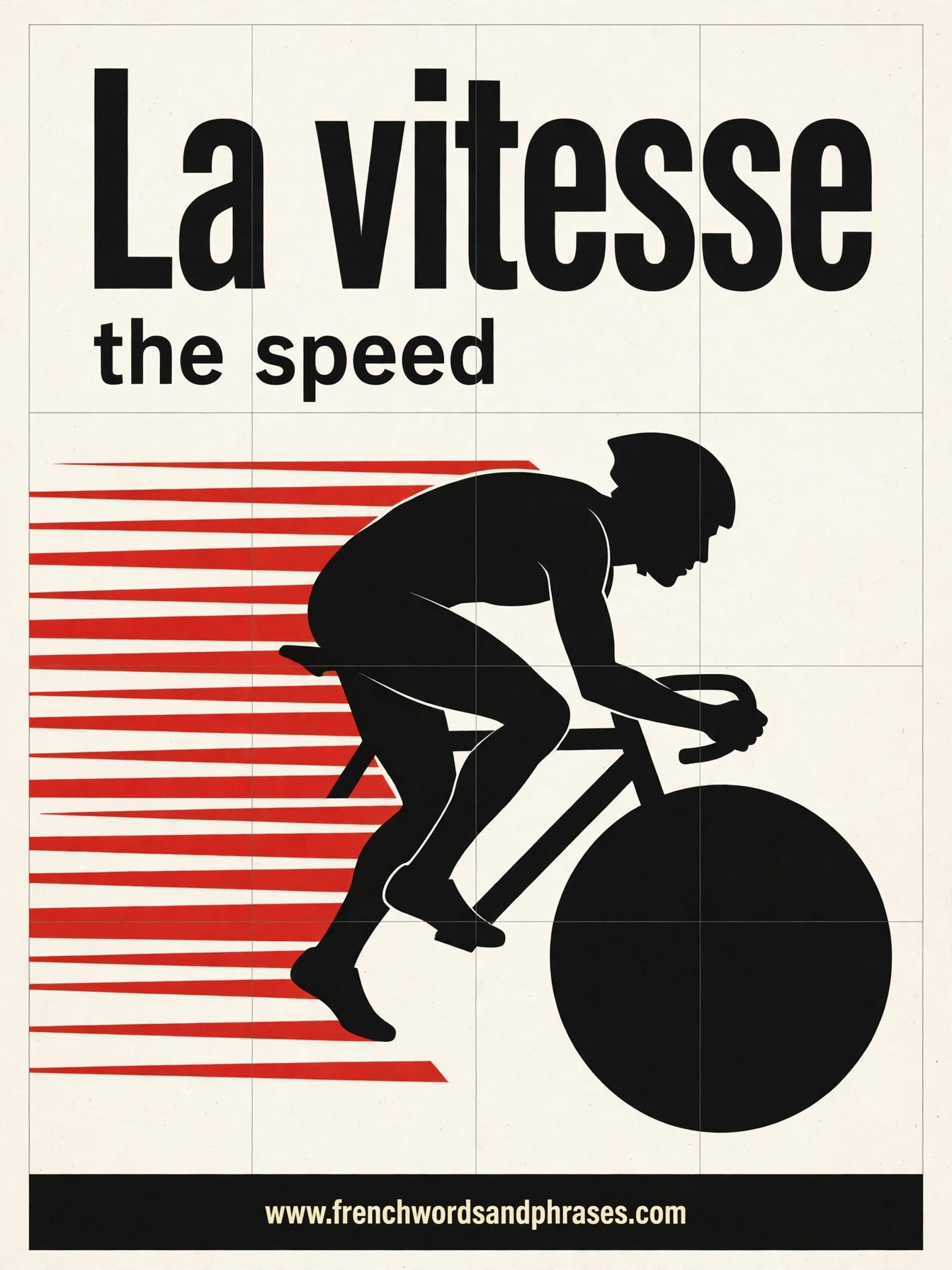
La vitesse means the speed.
The needle climbing on the dial, the landscape beginning to smear past the train window, the sprinter’s world narrowing to a tunnel of light: la vitesse, the speed — the word that measures how fast France moves, from the TGV at 300 an hour to the snail jokes of the motorway.
In this guide, you’ll learn what vitesse means in English, how to use it with its articles, how to form its plural, and how it appears in everyday French. Explore French examples, English translations, and practice quizzes.
Understanding the French Noun Vitesse
Vitesse is a feminine French noun, learned with its article: la vitesse, une vitesse. It is built on vite, fast — vite plus the noun ending -esse, like rich/esse and lent/lenteur’s cousins. One word covers speed itself, a gear of a car or bicycle, and the legal limits that govern both.
It means speed — how fast something moves: la vitesse du train, the train’s speed, une vitesse de 90 kilomètres à l’heure, a speed of 90 kilometres an hour, la limitation de vitesse, the speed limit, un excès de vitesse, speeding — literally an excess of speed. On a bicycle or in a car, les vitesses are the gears: changer de vitesse, to change gear, la première vitesse, first gear. And figuratively, à toute vitesse is at full speed, flat out.
Gender: Feminine — la vitesse
Definite article: la — la vitesse (the speed)
Indefinite article: une — une vitesse (a speed, a gear)
Plural: les vitesses — the speeds; also the gears
Spelling note: built on vite (fast): vite + -esse, like une promesse or la richesse
Key phrase: la limitation de vitesse — the speed limit; un excès de vitesse — speeding
English equivalents: The speed; (les vitesses) the gears.
French measures speed in kilomètres à l’heure — rouler à 130, to drive at 130. The car’s gearbox is la boîte de vitesses, and a bicycle’s gears are simply les vitesses: passer les vitesses. Beware the near-twin la rapidité, quickness of action — vitesse is measured speed, the number on the dial; rapidité is how promptly something gets done.
Experience the Word
Vitesse is the number that turns motion into a thrill or an offence: the same needle that delights the passenger fines the driver.
Imagine the TGV leaving the station, the fields beginning to flow, the display in the carriage lighting up: 300. Three hundred kilometres an hour, and the coffee does not even ripple. La vitesse, in France, is not a danger to be feared but a record to be polished — the train is a national argument that speed can be civilised.
You have not just named fastness. You have named its measure — la vitesse, the speed, needle, limit and gear in one.
How to Use Vitesse in French: Complete Guide
Let’s explore how vitesse works in French, beginning with its articles — la vitesse, une vitesse, à toute vitesse.
Vitesse with the Definite Article (La, Les)
Used for a specific vitesse — the train’s, the limit’s.
| Form | French |
|---|---|
| Feminine singular | la vitesse |
| Plural | les vitesses |
Example
La vitesse du train augmente après la gare.
The train’s speed increases after the station.
Vitesse with the Indefinite Article (Une, Des)
Used for a vitesse in general — a speed, a gear.
| Form | French |
|---|---|
| Feminine singular | une vitesse |
| Plural | des vitesses |
Example
Le vélo a dix vitesses.
The bicycle has ten gears.
Vitesse with Its Measures (Limite, Excès, Toute…)
Dial, law and gearbox — the vitesse in its three homes.
| Quantity | French |
|---|---|
| the speed limit | la limitation de vitesse |
| speeding | un excès de vitesse |
| at full speed | à toute vitesse |
| first gear | la première vitesse |
| the gearbox | la boîte de vitesses |
Example
Il a reçu une amende pour excès de vitesse.
He got a fine for speeding.
Quick Quiz 1
Complete the sentence:
______ vitesse maximale est de 130 sur l’autoroute. (the)
Reveal the answer
La
La vitesse maximale est de 130 sur l’autoroute.
The maximum speed is 130 on the motorway — vitesse is feminine, so la.
The Plural of Vitesse
Vitesse takes a regular plural in -s — les vitesses, which on a vehicle means the gears.
| Number | French |
|---|---|
| Singular | la vitesse |
| Plural | les vitesses |
Example
Les vitesses du vélo passent difficilement.
The bicycle’s gears shift with difficulty.
Vitesse with Possessive Adjectives (Ma, Ta, Sa…)
Possessives agree with the noun: vitesse is feminine, so ma, ta, sa in the singular.
| Owner | French |
|---|---|
| my | ma vitesse |
| your (tu) | ta vitesse |
| his / her | sa vitesse |
| our | notre vitesse |
| your (vous) | votre vitesse |
| their | leur vitesse |
Example
Le coureur a gardé sa vitesse jusqu’à la ligne.
The runner kept his speed up to the line.
Quick Quiz 2
Complete the sentence:
Elle a réduit ______ vitesse avant le virage. (her)
Reveal the answer
sa
Elle a réduit sa vitesse avant le virage.
She reduced her speed before the bend — sa, because vitesse is feminine.
Vitesse with Demonstrative Adjectives (Cette, Ces)
Used to point: cette vitesse, this speed — the one on the sign.
| Form | French |
|---|---|
| Feminine singular | cette vitesse |
| Plural | ces vitesses |
Example
À cette vitesse, nous arriverons à midi.
At this speed, we will arrive at noon.
Vitesse with Adjectives
Adjectives agree with vitesse — feminine singular: une vitesse limitée, une grande vitesse.
| Adjective | With Vitesse |
|---|---|
| limitée (limited) | la vitesse limitée |
| maximale (maximum) | la vitesse maximale |
| grande (great, high) | à grande vitesse |
| moyenne (average) | la vitesse moyenne |
| réduite (reduced) | une vitesse réduite |
Example
Le train roule à grande vitesse.
The train travels at high speed.
Quick Quiz 3
Complete the sentence:
Sur cette route, la vitesse est ______ à 50. (limited)
Reveal the answer
limitée
Sur cette route, la vitesse est limitée à 50.
On this road, the speed is limited to 50 — limitée, feminine, to agree with vitesse.
Everyday Expressions with Vitesse
Motorways, gearboxes and photo finishes — the vitesse phrases of daily life.
| Expression | In English |
|---|---|
| à toute vitesse | at full speed, flat out |
| un excès de vitesse | speeding (an excess of speed) |
| la limitation de vitesse | the speed limit |
| changer de vitesse | to change gear |
| prendre de la vitesse | to pick up speed |
Example
Le cycliste prend de la vitesse dans la descente.
The cyclist picks up speed on the descent.
Words from the Same Family as Vitesse
Fast and slow — the words that travel with vitesse.
| French | In English |
|---|---|
| vite | fast, quickly — the parent word |
| la rapidité | quickness, promptness |
| la lenteur | slowness — the opposite |
| un compteur de vitesse | a speedometer |
| accélérer | to accelerate (the verb) |
Example
Le compteur de vitesse indique 90.
The speedometer shows 90.
Quick Quiz 4
What does un excès de vitesse mean?
Reveal the answer
Speeding — literally an excess of speed, the offence on the fine.
L’amende pour excès de vitesse est de 68 euros.
The fine for speeding is 68 euros.
Vitesse in Everyday French: Real-Life Examples
Now that you know the word, let’s see how vitesse appears in everyday French.
Example 1 — Driving
Respecte la limitation de vitesse !
Keep to the speed limit!
Example 2 — The train
Le TGV roule à 300 kilomètres à l’heure.
The TGV travels at 300 kilometres an hour.
Example 3 — Cycling
Change de vitesse avant la côte.
Change gear before the hill.
Example 4 — The fine
Il a eu une amende pour excès de vitesse.
He got a fine for speeding.
Example 5 — Running
Elle court à toute vitesse vers la gare.
She is running at full speed towards the station.
Example 6 — The descent
La voiture prend de la vitesse dans la descente.
The car picks up speed on the way down.
Beyond Translation: The Meaning of Vitesse
Vitesse is vite dressed as a noun, and France made a national cult of it: the TGV turned la vitesse into a point of honour, a train doing 300 an hour with the coffee unspilt. The law answers with its own poetry — un excès de vitesse, an excess of speed, as if speed were a wine to be taken in measure. And the gearbox keeps the word’s second body: les vitesses, the gears, the steps by which engines and bicycles climb from stillness to flight.
To say vitesse is to read the dial of the modern world.
It evokes the blurred fields from the train window, the radar’s flash, the cyclist clicking through the gears — speed, measured, limited and loved.
How to Remember the French Noun Vitesse
Remember it this way: Vitesse is the speed — feminine: la vitesse, and les vitesses on a bike are the gears.
- Always feminine — la vitesse, une vitesse, ma vitesse.
- The law — la limitation de vitesse, the speed limit; un excès de vitesse, speeding.
- The gears — changer de vitesse, to change gear; à toute vitesse, at full speed.
The key idea is la vitesse — the speed, feminine; un excès de vitesse = speeding; les vitesses = the gears.
Test Your Knowledge of Vitesse
Let’s see how much you’ve learned. Try answering these questions before revealing the answers.
Question 1
Is vitesse masculine or feminine?
Reveal the answer
Feminine — la vitesse, une vitesse.
Question 2
How do you say the speed limit?
Reveal the answer
La limitation de vitesse.
Question 3
Translate: The train travels at high speed.
Reveal the answer
Le train roule à grande vitesse.
Question 4
On a bicycle, what are les vitesses?
Reveal the answer
The gears — changer de vitesse is to change gear.
Question 5
Complete the sentence:
______ vitesses du vélo sont bloquées. (the)
Reveal the answer
Les
Les vitesses du vélo sont bloquées.
The bicycle’s gears are stuck.
Your Final Challenge
Can You Use It?
How would you say this in French?
“At this speed, we will arrive at noon.”
Reveal the answer
À cette vitesse, nous arriverons à midi.
At this speed, we will arrive at noon.
A little French. A little curiosity. A richer everyday life.
LEARN FRENCH ONE WORD AT A TIME