A French Word to Live By
Translate Vache to English
/vaʃ/
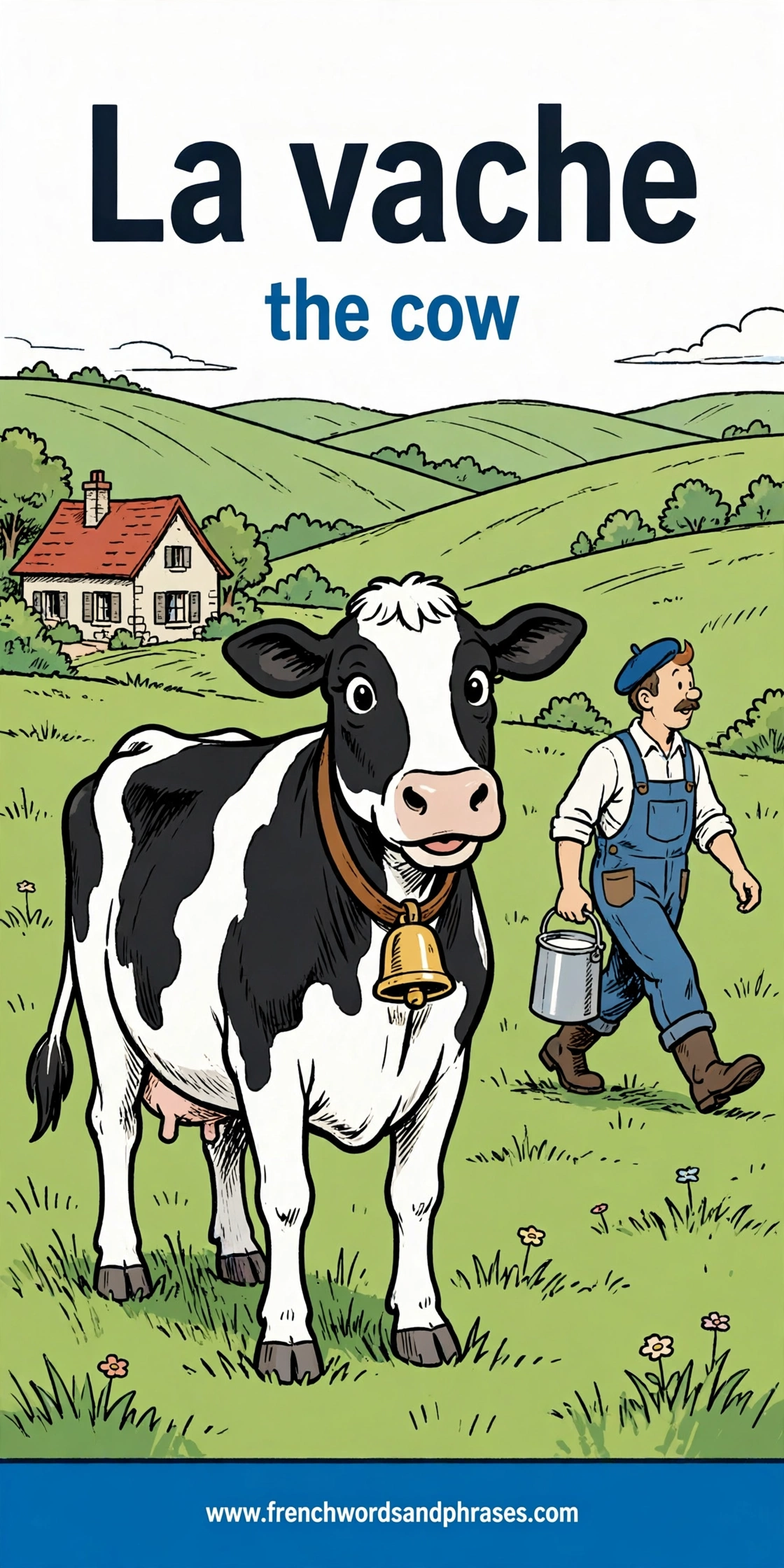
La vache means the cow.
Black and white in a green field, chewing slowly and watching the train go by: la vache, the cow — the patient heart of the French farm, giver of milk, cheese and a hundred expressions.
In this guide, you’ll learn what vache means in English, how to use it with its articles, how to form its plural, and how it appears in everyday French. Explore French examples, English translations, and practice quizzes.
Understanding the French Noun Vache
Vache is a feminine French noun, learned with its article: la vache, une vache. The male is le taureau, the bull, and the baby is le veau, the calf — the vache herself is the dairy cow, the mother of the herd.
It means a cow — the female bovine kept for milk: une vache laitière, a dairy cow, traire une vache, to milk a cow. The word escapes the farm constantly: la vache ! is an exclamation of surprise — gosh! — and a hard blow or a nasty trick can be un coup vache. As an adjective, vache means mean, nasty: il a été vache avec moi, he was rotten to me.
Gender: Feminine — la vache
Definite article: la — la vache (the cow)
Indefinite article: une — une vache (a cow)
Plural: les vaches — regular, with a simple -s
The family: le taureau (the bull), le veau (the calf), le bœuf (the ox; beef)
Second life: vache as adjective: mean, nasty — un coup vache, a dirty trick
English equivalents: The cow.
You milk a cow — traire une vache — morning and evening, and the herd is un troupeau de vaches. Listen for the exclamation la vache ! when a French speaker is stunned: it is surprise, never an insult aimed at an animal.
Experience the Word
Vache is the farm’s slow clock: she grazes, she chews, she gives, and the whole day of the village turns around her.
Imagine the meadow at dawn, mist on the grass, and thirty vaches walking in single file towards the milking shed, bells ringing softly.
You have not just named an animal. You have named patience itself — la vache, the cow, mother of milk and cheese.
How to Use Vache in French: Complete Guide
Let’s explore how vache works in French, beginning with its articles — la vache, une vache, traire une vache.
Vache with the Definite Article (La, Les)
Used for a specific cow — the one by the gate, the one that gives the most milk.
| Form | French |
|---|---|
| Feminine singular | la vache |
| Plural | les vaches |
Example
La vache brune donne beaucoup de lait.
The brown cow gives a lot of milk.
Vache with the Indefinite Article (Une, Des)
Used for a cow in general — any cow in the field.
| Form | French |
|---|---|
| Feminine singular | une vache |
| Plural | des vaches |
Example
Il a acheté une vache au marché.
He bought a cow at the market.
Vache with Quantities (Une, Deux, Assez de…)
Cows are counted one by one — by the farmer, herd by herd.
| Quantity | French |
|---|---|
| one cow | une vache |
| ten cows | dix vaches |
| a herd of cows | un troupeau de vaches |
| enough cows | assez de vaches |
| too many cows | trop de vaches |
Example
Le fermier a vingt vaches dans son étable.
The farmer has twenty cows in his barn.
Quick Quiz 1
Complete the sentence:
______ vache regarde passer le train. (the)
Reveal the answer
La
La vache regarde passer le train.
The cow watches the train go by — vache is feminine, so la.
The Plural of Vache
Vache takes a regular plural in -s — cows travel in herds.
| Number | French |
|---|---|
| Singular | la vache |
| Plural | les vaches |
Example
Les vaches rentrent à l’étable le soir.
The cows come back to the barn in the evening.
Vache with Possessive Adjectives (Ma, Ta, Sa…)
Possessives agree with the noun: vache is feminine, so ma, ta, sa in the singular.
| Owner | French |
|---|---|
| my | ma vache |
| your (tu) | ta vache |
| his / her | sa vache |
| our | notre vache |
| your (vous) | votre vache |
| their | leur vache |
Example
Ma vache préfère l’herbe de ce pré.
My cow prefers the grass of this meadow.
Quick Quiz 2
Complete the sentence:
Le fermier trait ______ vache à six heures. (his)
Reveal the answer
sa
Le fermier trait sa vache à six heures.
The farmer milks his cow at six o’clock — sa agrees with vache, feminine.
Vache with Demonstrative Adjectives (Cette, Ces)
Used to point: cette vache, this cow — usually the one being sold or milked.
| Form | French |
|---|---|
| Feminine singular | cette vache |
| Plural | ces vaches |
Example
Cette vache donne dix litres par jour.
This cow gives ten litres a day.
Vache with Adjectives
Adjectives agree with vache — feminine singular.
| Adjective | With Vache |
|---|---|
| laitière (dairy) | une vache laitière |
| tachetée (spotted) | une vache tachetée |
| brune (brown) | une vache brune |
| paisible (peaceful) | une vache paisible |
| énorme (huge) | une vache énorme |
Example
Une vache tachetée dort à l’ombre.
A spotted cow sleeps in the shade.
Quick Quiz 3
Complete the sentence:
C’est une vache ______, elle donne beaucoup de lait. (dairy)
Reveal the answer
laitière
C’est une vache laitière, elle donne beaucoup de lait.
It is a dairy cow, she gives a lot of milk — laitière, feminine, to agree with vache.
Everyday Expressions with Vache
Farms, surprises and dirty tricks — the vache phrases of daily life.
| Expression | In English |
|---|---|
| traire une vache | to milk a cow |
| un troupeau de vaches | a herd of cows |
| le lait de vache | cow’s milk |
| la vache ! | gosh! (exclamation of surprise) |
| un coup vache | a dirty trick, a nasty blow |
Example
La vache ! Tu as vu ce prix ?
Gosh! Did you see that price?
Words from the Same Family as Vache
The farmyard — the words that travel with vache.
| French | In English |
|---|---|
| le veau | the calf |
| le taureau | the bull |
| le lait | the milk |
| une étable | a cowshed, a stable |
| un pré | a meadow |
Example
Le veau reste près de sa mère.
The calf stays near its mother.
Quick Quiz 4
What does traire une vache mean?
Reveal the answer
To milk a cow.
On trait les vaches matin et soir.
Cows are milked morning and evening.
Vache in Everyday French: Real-Life Examples
Now that you know the word, let’s see how vache appears in everyday French.
Example 1 — In the field
La vache mange de l’herbe.
The cow eats grass.
Example 2 — Milking
Il trait sa vache à six heures.
He milks his cow at six o’clock.
Example 3 — Surprise
La vache ! Quelle histoire !
Gosh! What a story!
Example 4 — Counting
Nous avons douze vaches.
We have twelve cows.
Example 5 — At the market
Cette vache est à vendre.
This cow is for sale.
Example 6 — A dirty trick
Il m’a fait un coup vache.
He played a dirty trick on me.
Beyond Translation: The Meaning of Vache
France is a country that takes its cows seriously: dozens of protected cheeses begin with la vache and her milk, and her image — calm, spotted, bell at her neck — is the postcard of the French countryside. Yet the same word serves for astonishment (la vache !) and for meanness (un coup vache), as if the language could not decide whether she is a saint or a trickster.
She is both: the farm’s provider and its comedian.
Learn la vache and you learn the meadow, the cheese board and the exclamation in one word.
How to Remember the French Noun Vache
Remember it this way: Vache is the cow — feminine: la vache in the field, and la vache ! when you are astonished.
- Always feminine — la vache, une vache, ma vache.
- The family splits — le taureau the bull, le veau the calf, both masculine.
- Two escapes from the farm — la vache ! gosh! and un coup vache, a dirty trick.
The key idea is la vache — the cow, feminine; la vache ! = gosh!.
Test Your Knowledge of Vache
Let’s see how much you’ve learned. Try answering these questions before revealing the answers.
Question 1
Is vache masculine or feminine?
Reveal the answer
Feminine — la vache, une vache.
Question 2
How do you say a herd of cows in French?
Reveal the answer
Un troupeau de vaches.
Question 3
Translate: The brown cow gives a lot of milk.
Reveal the answer
La vache brune donne beaucoup de lait.
Question 4
What does the exclamation la vache ! express?
Reveal the answer
Surprise — gosh! It has nothing to do with an actual cow.
Question 5
Complete the sentence:
______ vaches rentrent à l’étable. (the)
Reveal the answer
Les
Les vaches rentrent à l’étable.
The cows come back to the barn.
Your Final Challenge
Can You Use It?
How would you say this in French?
“The cows come back to the barn in the evening.”
Reveal the answer
Les vaches rentrent à l’étable le soir.
The cows come back to the barn in the evening.
A little French. A little curiosity. A richer everyday life.
LEARN FRENCH ONE WORD AT A TIME