A French Word to Live By
Translate Poids to English
/pwa/
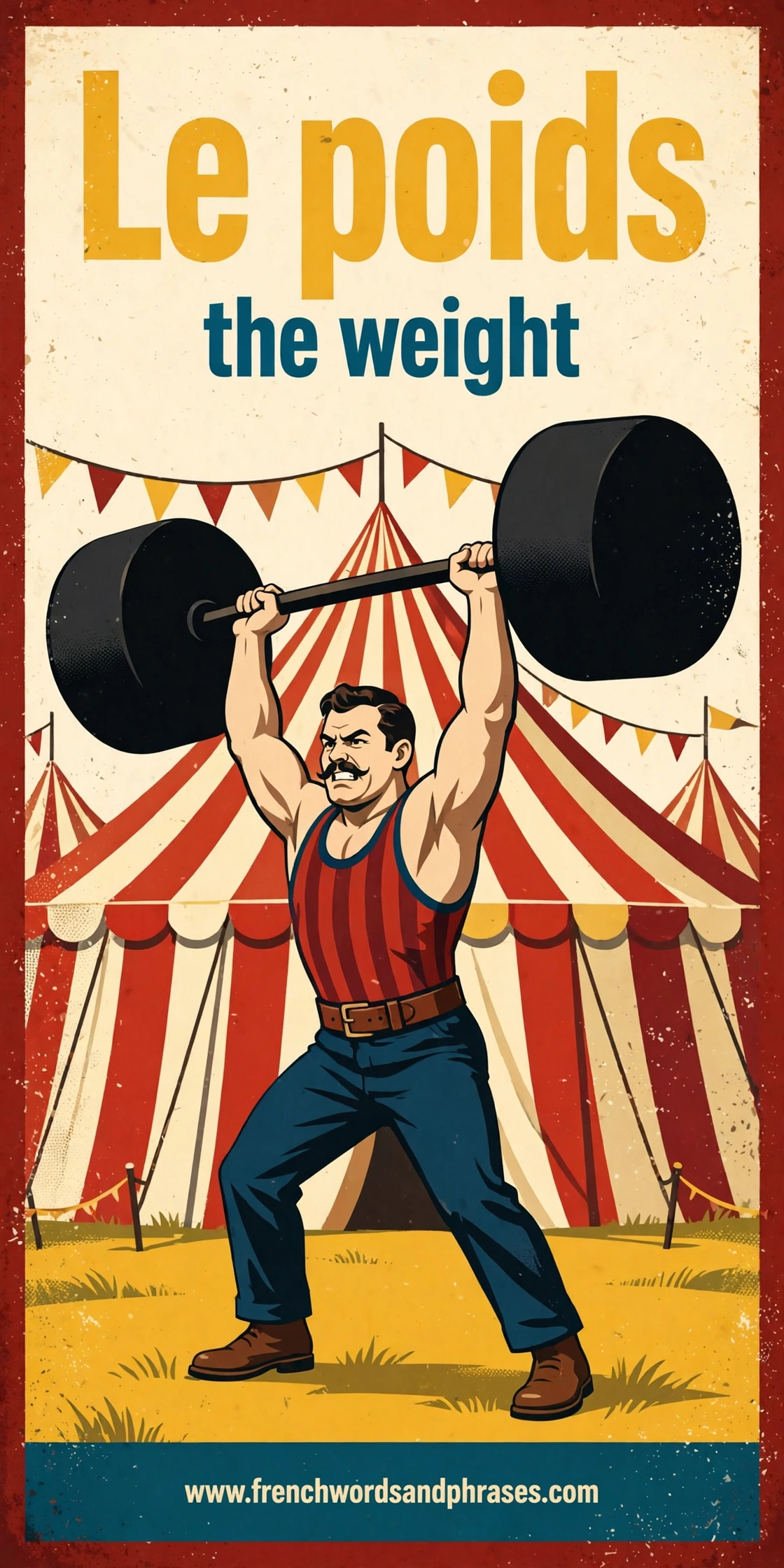
Le poids means the weight.
The suitcase on the bathroom scales, the boxer on the morning of the fight, the sack of flour on the market stall: le poids, the weight — how much of the world a thing carries in itself.
In this guide, you’ll learn what poids means in English, how to use it with its articles, how to form its plural, and how it appears in everyday French. Explore French examples, English translations, and practice quizzes.
Understanding the French Noun Poids
Poids is a masculine French noun, learned with its article: le poids, un poids. It comes from the Latin pensum, something weighed. Two spelling gifts for the learner: the final -ds is never pronounced, and the word never changes — le poids, les poids, written identically, because the s is already there in the singular.
It means weight — how heavy a thing is: le poids d’un colis, the weight of a parcel, perdre du poids, to lose weight, prendre du poids, to put on weight. Then the concrete weights themselves: des poids are the iron discs of the gym and the brass weights of the old balance. And figuratively, anything that presses: le poids des années, the weight of the years, un argument de poids, a weighty argument.
Gender: Masculine — le poids
Definite article: le — le poids (the weight)
Indefinite article: un — un poids (a weight)
Plural: les poids — written exactly like the singular; the s is already there
Spelling note: the final -ds is silent: say /pwa/, like pois without the s
Key verbs: perdre du poids (lose weight), prendre du poids (gain weight)
English equivalents: The weight; weights (for lifting).
For body weight, French uses the partitive pair: perdre du poids, prendre du poids — and asks quel est ton poids ? or, more politely, uses peser: tu pèses combien ? The gym sense is concrete: soulever des poids, to lift weights. Never add another s in the plural, and never pronounce the one that is there.
Experience the Word
Poids is honesty in kilos: the scales do not flatter, the suitcase does not negotiate, and the parcel costs what it weighs.
Imagine the old market balance — the grocer lays brass poids on one side, your apples climb on the other, and the needle trembles towards justice. Le poids juste, the fair weight, is a whole philosophy in two words.
You have not just named heaviness. You have named what things truly carry — le poids, the weight, of luggage, of years, of words.
How to Use Poids in French: Complete Guide
Let’s explore how poids works in French, beginning with its articles — le poids, un poids, perdre du poids.
Poids with the Definite Article (Le, Les)
Used for a specific weight — the parcel’s, the patient’s, the years’. The plural is written exactly like the singular.
| Form | French |
|---|---|
| Masculine singular | le poids |
| Plural | les poids |
Example
Le poids du colis dépasse dix kilos.
The weight of the parcel exceeds ten kilos.
Poids with the Indefinite Article (Un, Des)
Used for a weight in general — and, in the plural, for the iron weights you lift.
| Form | French |
|---|---|
| Masculine singular | un poids |
| Plural | des poids |
Example
Il soulève des poids tous les matins à la salle.
He lifts weights every morning at the gym.
Poids with the Partitive (Perdre du poids…)
Body weight is gained and lost with du — the partitive of a thousand January resolutions.
| Quantity | French |
|---|---|
| to lose weight | perdre du poids |
| to put on weight | prendre du poids |
| too much weight | trop de poids |
| the weight of the years | le poids des années |
| a heavy weight (boxing) | un poids lourd |
Example
Elle a perdu du poids grâce à la marche quotidienne.
She lost weight thanks to daily walking.
Quick Quiz 1
Complete the sentence:
______ poids de la valise est de vingt kilos. (the)
Reveal the answer
Le
Le poids de la valise est de vingt kilos.
The weight of the suitcase is twenty kilos — poids is masculine, so le.
The Plural of Poids
Poids is one of the French nouns that never change: the s belongs to the singular already, so the plural only changes the article.
| Number | French |
|---|---|
| Singular | le poids |
| Plural | les poids |
Example
Les poids de la vieille balance sont en laiton.
The weights of the old balance are made of brass.
Poids with Possessive Adjectives (Mon, Ton, Son…)
Possessives agree with the noun: poids is masculine, so mon, ton, son in the singular.
| Owner | French |
|---|---|
| my | mon poids |
| your (tu) | ton poids |
| his / her | son poids |
| our | notre poids |
| your (vous) | votre poids |
| their | leur poids |
Example
Le médecin surveille son poids chaque mois.
The doctor monitors his weight every month.
Quick Quiz 2
Complete the sentence:
Je surveille ______ poids depuis le printemps. (my)
Reveal the answer
mon
Je surveille mon poids depuis le printemps.
I have been watching my weight since spring — mon, because poids is masculine.
Poids with Demonstrative Adjectives (Ce, Ces)
Used to point: ce poids, this weight — this burden, this disc of iron.
| Form | French |
|---|---|
| Masculine singular | ce poids |
| Plural | ces poids |
Example
Ce poids est trop lourd pour l’étagère.
This weight is too heavy for the shelf.
Poids with Adjectives
Adjectives agree with poids — masculine singular: un poids lourd, un poids mort.
| Adjective | With Poids |
|---|---|
| lourd (heavy) | un poids lourd |
| léger (light) | un poids léger |
| net (net) | le poids net |
| brut (gross) | le poids brut |
| mort (dead) | un poids mort |
Example
Le poids net est écrit sur l’étiquette.
The net weight is written on the label.
Quick Quiz 3
Complete the sentence:
Un poids ______ est un boxeur de plus de quatre-vingt-onze kilos. (heavy)
Reveal the answer
lourd
Un poids lourd est un boxeur de plus de quatre-vingt-onze kilos.
A heavyweight is a boxer of over ninety-one kilos — lourd, masculine, to agree with poids.
Everyday Expressions with Poids
Scales, gyms and arguments — the poids phrases of daily life.
| Expression | In English |
|---|---|
| perdre du poids | to lose weight |
| prendre du poids | to put on weight |
| un poids lourd | a heavyweight |
| soulever des poids | to lift weights |
| un argument de poids | a weighty argument |
Example
Son témoignage est un argument de poids.
His testimony is a weighty argument.
Words from the Same Family as Poids
Weighing and carrying — the words that travel with poids.
| French | In English |
|---|---|
| peser | to weigh (the verb) |
| la pesée | the weighing |
| lourd | heavy (the adjective) |
| une charge | a load, a burden |
| un haltère | a dumbbell |
Example
La pesée des boxeurs a lieu la veille du combat.
The boxers’ weigh-in takes place the day before the fight.
Quick Quiz 4
How do you say to lose weight?
Reveal the answer
Perdre du poids — with the partitive du.
Elle veut perdre du poids avant l’été.
She wants to lose weight before the summer.
Poids in Everyday French: Real-Life Examples
Now that you know the word, let’s see how poids appears in everyday French.
Example 1 — At the airport
Le poids de ma valise dépasse la limite.
The weight of my suitcase exceeds the limit.
Example 2 — Health
Il a pris du poids pendant les fêtes.
He put on weight over the holidays.
Example 3 — At the gym
Elle soulève des poids de dix kilos.
She lifts ten-kilo weights.
Example 4 — The parcel
Le poids du colis décide du prix.
The weight of the parcel decides the price.
Example 5 — Figurative
Le poids des années se fait sentir.
The weight of the years makes itself felt.
Example 6 — Boxing
Le poids lourd défend son titre samedi.
The heavyweight defends his title on Saturday.
Beyond Translation: The Meaning of Poids
Poids began as a measure of fairness: the Latin pensum was the wool weighed out for a day’s spinning, and ever since, the word has stood for what is honestly due — no more, no less. French let it climb from the scale to the soul: a secret has du poids, an argument has du poids, and the years themselves acquire it. The boxer and the philosopher meet in this word — both are asking what a person can carry.
To say poids is to ask the world’s most honest question: how much does it weigh?
It evokes the trembling needle of the market balance, the silent scales in the bathroom, and the relief of setting a burden down.
How to Remember the French Noun Poids
Remember it this way: Poids is the weight — masculine: le poids, written with its s in the singular and plural alike, and never pronounced.
- Always masculine — le poids, un poids, mon poids.
- The invisible plural — les poids looks exactly like le poids; only the article changes.
- The body pair — perdre du poids, perdre; prendre du poids, prendre.
The key idea is le poids — the weight, masculine; plural identical; perdre du poids = to lose weight.
Test Your Knowledge of Poids
Let’s see how much you’ve learned. Try answering these questions before revealing the answers.
Question 1
Is poids masculine or feminine?
Reveal the answer
Masculine — le poids, un poids.
Question 2
How do you say to put on weight?
Reveal the answer
Prendre du poids.
Question 3
Translate: He lifts weights every morning.
Reveal the answer
Il soulève des poids tous les matins.
Question 4
What is unusual about the plural of poids?
Reveal the answer
It is written exactly like the singular — les poids; the s is part of the word and is never pronounced.
Question 5
Complete the sentence:
______ poids net est sur l’étiquette. (the)
Reveal the answer
Le
Le poids net est sur l’étiquette.
The net weight is on the label.
Your Final Challenge
Can You Use It?
How would you say this in French?
“She lost weight thanks to daily walking.”
Reveal the answer
Elle a perdu du poids grâce à la marche quotidienne.
She lost weight thanks to daily walking.
A little French. A little curiosity. A richer everyday life.
LEARN FRENCH ONE WORD AT A TIME