
A French Word to Live By
How to Conjugate Représenter in French
/ʁə.pʁe.zɑ̃.te/
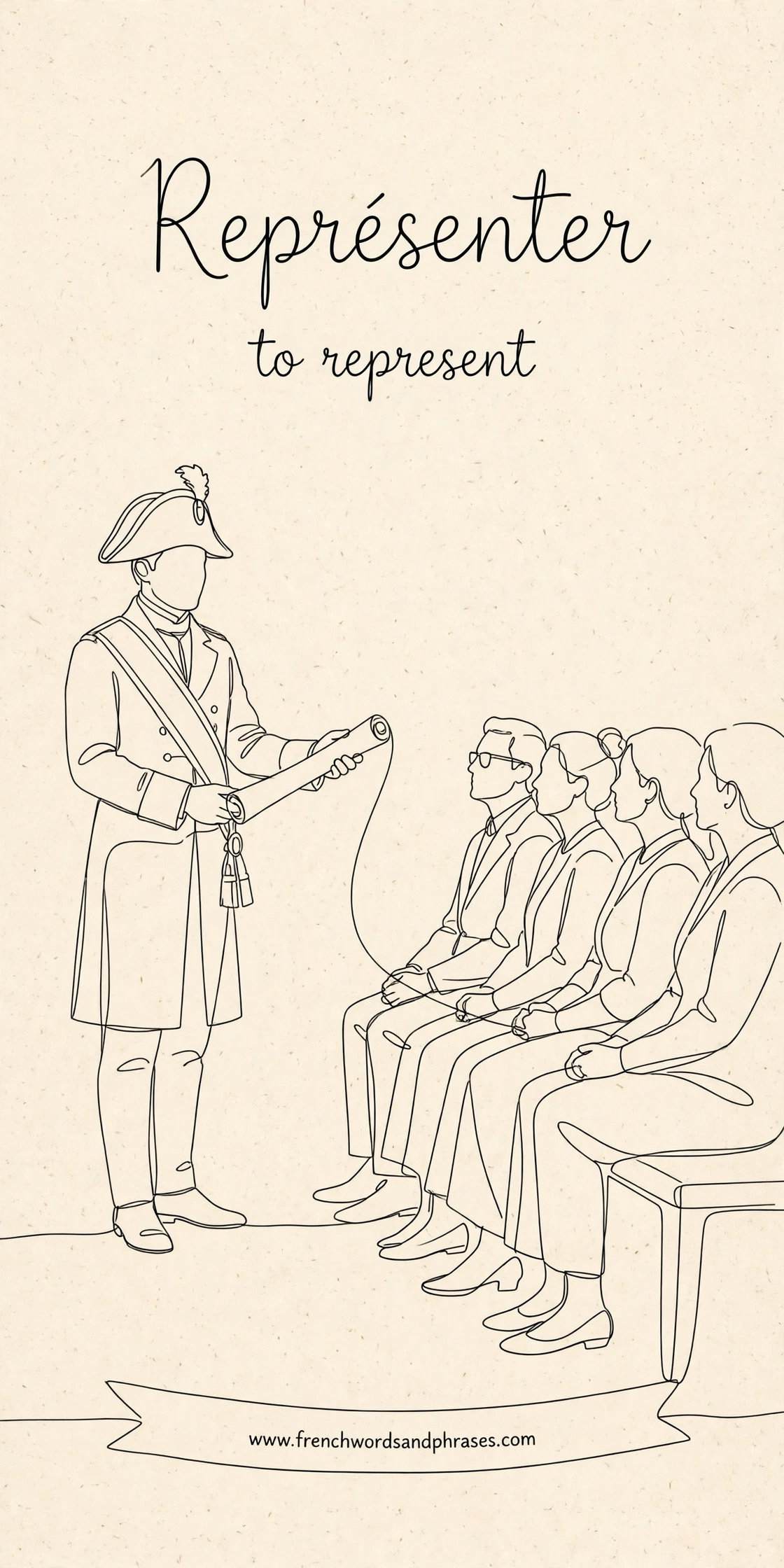
Représenter means to represent — to stand for something, to depict it in an image, or to act and speak on behalf of a person, a company or a country.
An ambassador in a foreign capital, a map on a classroom wall, a lawyer rising in court — représenter is the verb of standing in for something else: a person for a nation, an image for a place, a symbol for an idea.
In this guide, you’ll learn how to conjugate représenter in all the major French tenses and moods. Explore complete conjugation tables, French examples, English translations, and practice quizzes.
Understanding the French Verb Représenter
Représenter is a regular French verb belonging to the first group of verbs, those ending in-er.
It means to represent. The verb has three great theatres: diplomacy and law (représenter un client, représenter la France), images (ce tableau représente une chasse — this painting depicts a hunt), and symbols (la colombe représente la paix — the dove represents peace). Its reflexive, se représenter, means to picture something to oneself — and, of politicians, to stand for election again.
Verb classification: First group (-er)
Auxiliary verb: Avoir
Past participle: représenté
Present participle: représentant
English equivalents: To represent, to stand for, to depict; représenter un pays — to represent a country; représenter une scène — to depict a scene; se représenter — to imagine, to picture to oneself; to stand again (for election).
One important detail: représenter is perfectly regular — je représente, nous représentons, ils représentent, past participle représenté. The é of the stem never changes: even in the future, je représenterai keeps its é, because the following syllable is not a mute e. Do not confuse it with présenter, to introduce or present: représenter is to stand for, not to show for the first time.
Experience the Word
Représenter is the verb of the stand-in who carries the full weight of the absent — the ambassador is the country, the map is the land, the dove is peace itself.
Imagine the village schoolroom in winter: the teacher unrolls a great map above the blackboard — ce rectangle de papier représente la France entière, its rivers, its mountains, its thirty-six thousand villages, all standing quietly in coloured ink while the snow falls outside.
Paper for a country, ink for a river. That is représenter — one thing standing, faithfully, for another.
How to Conjugate Représenter: Complete French Conjugation Guide
Let’s explore every major conjugation of représenter, beginning with the indicative mood.
How to Conjugate Représenter in the Indicative Mood
The indicative mood is used to express facts, observations, actions, and events.
How to Conjugate Représenter in the Present Tense (Présent)
Used for actions happening now, habitual actions, and general truths.
| Subject | Conjugation |
|---|---|
| je | représente |
| tu | représentes |
| il / elle | représente |
| nous | représentons |
| vous | représentez |
| ils / elles | représentent |
Example
Cette carte représente la France au XVIIIe siècle.
This map represents France in the eighteenth century.
Quick Quiz 1
Complete the sentence:
La colombe ______ la paix.
Reveal the answer
représente
La colombe représente la paix.
The dove represents peace.
How to Conjugate Représenter in the Passé Composé
Used for completed actions in the past. Représenter takes the auxiliary verb avoir.
| Subject | Conjugation |
|---|---|
| j’ | ai représenté |
| tu | as représenté |
| il / elle | a représenté |
| nous | avons représenté |
| vous | avez représenté |
| ils / elles | ont représenté |
Example
Il a représenté son pays aux Jeux olympiques.
He represented his country at the Olympic Games.
How to Conjugate Représenter in the Imparfait (Imperfect Tense)
Used for habitual past actions, descriptions, and ongoing situations in the past.
| Subject | Conjugation |
|---|---|
| je | représentais |
| tu | représentais |
| il / elle | représentait |
| nous | représentions |
| vous | représentiez |
| ils / elles | représentaient |
Example
Ce tableau représentait une scène de chasse.
This painting depicted a hunting scene.
Quick Quiz 2
Choose the correct form:
He represented his country.
Il ______ son pays. (a représenté / est représenté)
Reveal the answer
a représenté
Il a représenté son pays.
Représenter takes avoir.
How to Conjugate Représenter in the Plus-que-parfait
Used to describe an action that had already been completed before another past event.
| Subject | Conjugation |
|---|---|
| j’ | avais représenté |
| tu | avais représenté |
| il / elle | avait représenté |
| nous | avions représenté |
| vous | aviez représenté |
| ils / elles | avaient représenté |
Example
Elle avait représenté la France à l’étranger pendant dix ans.
She had represented France abroad for ten years.
How to Conjugate Représenter in the Passé Simple
Primarily used in formal writing, literature, and historical narratives. It is rarely used in everyday conversation.
| Subject | Conjugation |
|---|---|
| je | représentai |
| tu | représentas |
| il / elle | représenta |
| nous | représentâmes |
| vous | représentâtes |
| ils / elles | représentèrent |
Example
Les députés représentèrent le peuple à l’assemblée.
The deputies represented the people at the assembly.
How to Conjugate Représenter in the Passé Antérieur
A literary tense used to express an action completed immediately before another past action, generally in the passé simple.
| Subject | Conjugation |
|---|---|
| j’ | eus représenté |
| tu | eus représenté |
| il / elle | eut représenté |
| nous | eûmes représenté |
| vous | eûtes représenté |
| ils / elles | eurent représenté |
Example
Quand il eut représenté son client, l’avocat se reposa.
When he had represented his client, the lawyer rested.
How to Conjugate Représenter in the Future Tense (Futur Simple)
Used to describe actions that will take place in the future.
| Subject | Conjugation |
|---|---|
| je | représenterai |
| tu | représenteras |
| il / elle | représentera |
| nous | représenterons |
| vous | représenterez |
| ils / elles | représenteront |
Example
Tu représenteras ton école au concours de poésie.
You will represent your school at the poetry competition.
How to Conjugate Représenter in the Futur Antérieur (Future Perfect)
Used for an action that will have been completed before a particular point in the future.
| Subject | Conjugation |
|---|---|
| j’ | aurai représenté |
| tu | auras représenté |
| il / elle | aura représenté |
| nous | aurons représenté |
| vous | aurez représenté |
| ils / elles | auront représenté |
Example
À la fin du procès, l’avocat aura représenté trois clients.
By the end of the trial, the lawyer will have represented three clients.
How to Conjugate Représenter in the Near Future (Futur Proche)
Used to describe something that is going to happen soon. Formed with aller + infinitive.
| Subject | Conjugation |
|---|---|
| je | vais représenter |
| tu | vas représenter |
| il / elle | va représenter |
| nous | allons représenter |
| vous | allez représenter |
| ils / elles | vont représenter |
Example
Ce symbole va représenter notre ville partout dans le monde.
This symbol is going to represent our town all over the world.
How to Conjugate Représenter in the Conditional Mood
The conditional mood expresses what would happen under certain circumstances. It is also frequently used to make polite requests or express wishes.
How to Conjugate Représenter in the Present Conditional
| Subject | Conjugation |
|---|---|
| je | représenterais |
| tu | représenterais |
| il / elle | représenterait |
| nous | représenterions |
| vous | représenteriez |
| ils / elles | représenteraient |
Example
Sans ce drapeau, le pays ne représenterait rien pour eux.
Without this flag, the country would represent nothing to them.
How to Conjugate Représenter in the Past Conditional
| Subject | Conjugation |
|---|---|
| j’ | aurais représenté |
| tu | aurais représenté |
| il / elle | aurait représenté |
| nous | aurions représenté |
| vous | auriez représenté |
| ils / elles | auraient représenté |
Example
Il aurait représenté la France s’il avait été sélectionné.
He would have represented France if he had been selected.
Représenter in the Literary Past Conditional Form
This less common literary form uses the imperfect subjunctive of avoir.
| Subject | Conjugation |
|---|---|
| j’ | eusse représenté |
| tu | eusses représenté |
| il / elle | eût représenté |
| nous | eussions représenté |
| vous | eussiez représenté |
| ils / elles | eussent représenté |
Example
Les ambassadeurs eussent représenté le roi avec dignité.
The ambassadors would have represented the king with dignity.
How to Conjugate Représenter in the Subjunctive Mood
The subjunctive is used to express wishes, emotions, doubts, necessity, and uncertainty. It frequently follows expressions such as il faut que (it is necessary that) or bien que (although).
How to Conjugate Représenter in the Present Subjunctive
| Subject | Conjugation |
|---|---|
| que je | représente |
| que tu | représentes |
| qu’il / qu’elle | représente |
| que nous | représentions |
| que vous | représentiez |
| qu’ils / qu’elles | représentent |
Example
Il faut que tu représentes ton lycée au concours.
You must represent your school at the competition.
Quick Quiz 3
Complete the sentence using the subjunctive:
Il faut que tu ______ ton lycée au concours.
Reveal the answer
représentes
Il faut que tu représentes ton lycée au concours.
You must represent your school at the competition.
How to Conjugate Représenter in the Imperfect Subjunctive
A literary tense, rarely encountered in modern spoken French.
| Subject | Conjugation |
|---|---|
| que je | représentasse |
| que tu | représentasses |
| qu’il / qu’elle | représentât |
| que nous | représentassions |
| que vous | représentassiez |
| qu’ils / qu’elles | représentassent |
Example
Le roi voulait qu’un seul homme le représentât au conseil.
The king wanted a single man to represent him at the council.
How to Conjugate Représenter in the Pluperfect Subjunctive
A literary construction used to express an action completed before another past action.
| Subject | Conjugation |
|---|---|
| que j’ | eusse représenté |
| que tu | eusses représenté |
| qu’il / qu’elle | eût représenté |
| que nous | eussions représenté |
| que vous | eussiez représenté |
| qu’ils / qu’elles | eussent représenté |
Example
On doutait qu’il eût représenté dignement son pays.
People doubted he had worthily represented his country.
How to Conjugate Représenter in the Past Subjunctive
| Subject | Conjugation |
|---|---|
| que j’ | aie représenté |
| que tu | aies représenté |
| qu’il / qu’elle | ait représenté |
| que nous | ayons représenté |
| que vous | ayez représenté |
| qu’ils / qu’elles | aient représenté |
Example
Je suis fier qu’elle ait représenté notre région.
I am proud that she represented our region.
How to Conjugate Représenter in the Imperative
The imperative is used to give commands, instructions, invitations, or suggestions. Subject pronouns are omitted.
How to Conjugate Représenter in the Present Imperative
| Person | Conjugation |
|---|---|
| (tu) | représente |
| (nous) | représentons |
| (vous) | représentez |
Example
Représente ton pays avec fierté !
Represent your country with pride!
Quick Quiz 4
How would you say Represent your country with pride (tu form)?
Reveal the answer
Représente ton pays avec fierté !
French Participles of Représenter
Participles are verb forms that can be used in compound tenses and other grammatical constructions.
Present Participle of Représenter
représentant
En représentant les absents, elle défend leurs intérêts.
By representing the absent, she defends their interests.
Past Participle of Représenter
représenté
Représentée par son avocat, elle n’a pas assisté au procès.
Represented by her lawyer, she did not attend the trial.
Représenter in Everyday French: Real-Life Examples
Now that you know the conjugations, let’s see how représenter appears in everyday French.
Example 1 — Present
La colombe représente la paix.
The dove represents peace.
Example 2 — Passé composé
Il a représenté son pays avec honneur.
He represented his country with honour.
Example 3 — Imparfait
Ce tableau représentait un village de montagne.
This painting depicted a mountain village.
Example 4 — Future
Tu représenteras ton école au printemps.
You will represent your school in the spring.
Example 5 — Conditional
Ce symbole représenterait bien notre ville.
This symbol would represent our town well.
Example 6 — Imperative
Représente ton équipe avec fierté !
Represent your team with pride!
Beyond Translation: The Meaning of Représenter
Représenter is built on a beautiful Latin idea: re-praesentare, to make present again — to bring the absent into the room. Every use keeps the magic: the ambassador makes the country present in a foreign hall, the painting makes the hunt present centuries later, the symbol makes peace visible as a bird.
To represent is to lend your presence to what cannot be there.
Learn it beside présenter, its near-twin: présenter shows a thing for the first time; représenter stands in its place ever after.
How to Remember the French Verb Représenter
Remember it this way: Représenter is about the map above the blackboard, standing faithfully for the whole country.
- Three theatres: a country, a client, a picture — représenter un pays, représenter un client, représenter une scène.
- Regular -er: je représente, nous représentons, past participle représenté — the é never changes.
- Not présenter: présenter introduces; représenter stands for.
The key idea is the map above the blackboard, standing faithfully for the whole country.
Test Your Knowledge of Représenter
Let’s see how much you’ve learned. Try answering these questions before revealing the answers.
Question 1
What are the three great uses of représenter?
Reveal the answer
To represent a person or country, to depict a scene, and to stand for an idea — diplomacy, images, symbols.
Question 2
How do you say This painting depicts a hunting scene in French?
Reveal the answer
Ce tableau représente une scène de chasse.
Question 3
Translate: He represented his country at the Olympic Games.
Reveal the answer
Il a représenté son pays aux Jeux olympiques.
Question 4
What is the past participle of représenter?
Reveal the answer
Représenté.
Question 5
Complete the sentence:
Il faut que tu ______ ton lycée au concours.
Reveal the answer
représentes
Il faut que tu représentes ton lycée au concours.
You must represent your school at the competition.
Your Final Challenge
Can You Use It?
How would you say this in French?
This map represents the whole of France, its rivers and its mountains.
Reveal the answer
Cette carte représente la France entière, ses fleuves et ses montagnes.
This map represents the whole of France, its rivers and its mountains.
A little French. A little curiosity. A richer everyday life.
LEARN FRENCH ONE WORD AT A TIME




