A French Word to Live By
Translate Intérêt to English
/ɛ̃.te.ʁɛ/
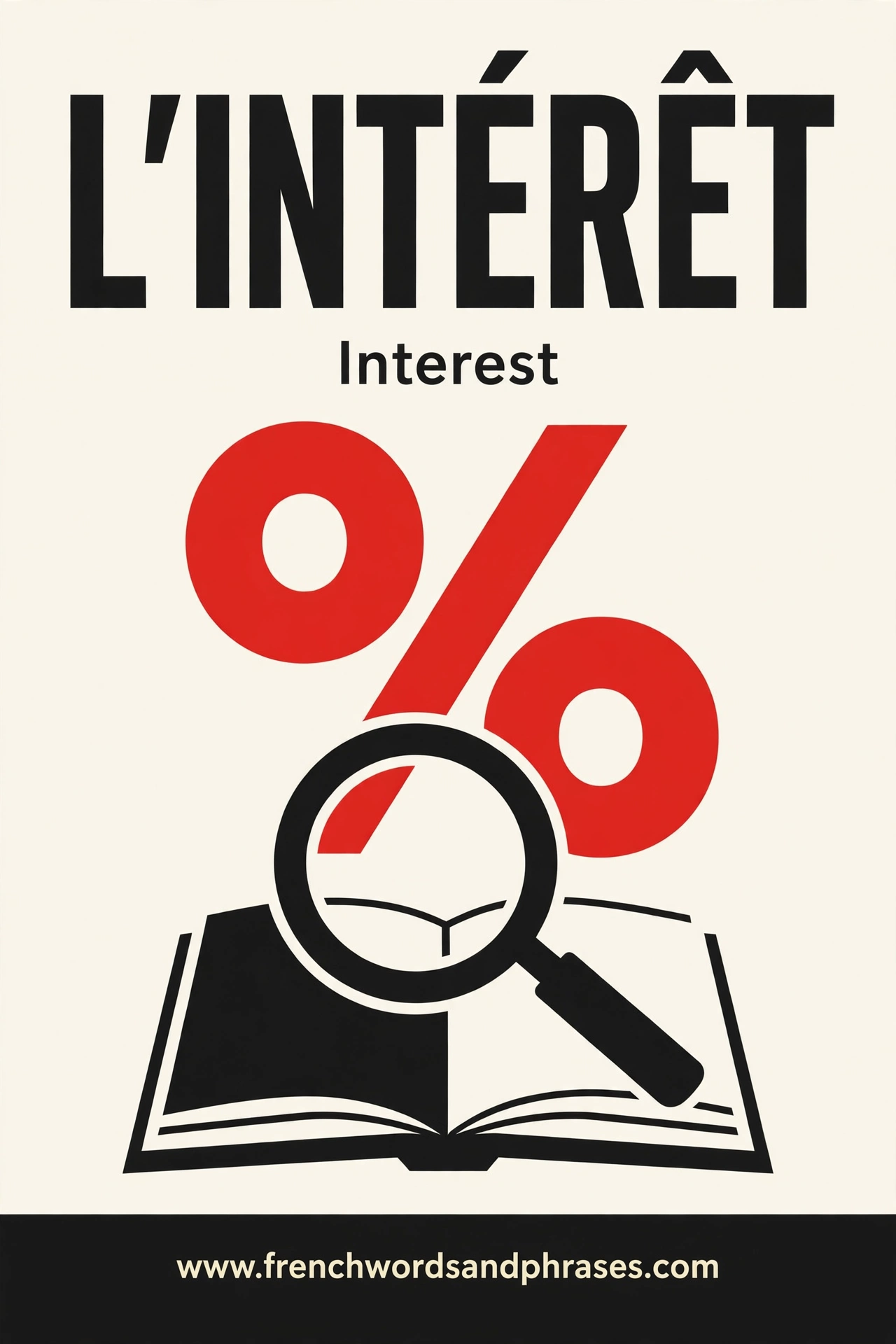
L’Intérêt means interest.
A child leans closer to the story; a saver watches the bank line grow, slowly, by itself; a detective asks who profits from the crime — three scenes, one engine: l’intérêt, interest, the word for curiosity, advantage and money’s rent at once.
In this guide, you’ll learn what intérêt means in English, how to use it with its articles, how to form its plural, and how it appears in everyday French. Explore French examples, English translations, and practice quizzes.
Understanding the French Noun Intérêt
Intérêt is a masculine French noun, learned with its article: l’intérêt, un intérêt. It begins with a vowel, so the article melts into it: l’intérêt, never le intérêt. It comes from the Latin interesse, to be between, to matter — what lies between you and a thing and pulls you towards it. French gives it three great senses: curiosity (l’intérêt pour l’histoire), advantage (dans son intérêt, in his interest), and finance (les intérêts, the interest on money, usually plural).
It means interest in all its English senses, and keeps them tidier than English does. Curiosity: porter de l’intérêt à quelque chose, to take an interest in something, avec intérêt, with interest, un vif intérêt, a keen interest. Advantage: agir dans l’intérêt de quelqu’un, to act in someone’s interest, avoir intérêt à faire quelque chose, to have an interest in doing something — it pays you to do it. Money: un taux d’intérêt, an interest rate, toucher des intérêts, to earn interest, un prêt à intérêt, an interest-bearing loan.
Gender: Masculine — l’intérêt
Definite article: l’ — l’intérêt (the interest), melted before the vowel
Indefinite article: un — un intérêt (an interest)
Plural: les intérêts — the interest (money); interests (stakes)
Spelling note: the circumflex on intérêt marks an old lost s: Latin interesse
Key phrases: avoir intérêt à (to have an interest in, to be wise to), dans l’intérêt de (in the interest of)
English equivalents: Interest — curiosity, advantage, and the interest on money.
Because intérêt begins with a vowel, possessives keep the masculine forms mon, ton, son — son intérêt — and the demonstrative is cet intérêt. Watch the frames: curiosity takes pour — l’intérêt pour la musique; advantage takes dans — dans ton intérêt, for your own good; and the practical avoir intérêt à + infinitive means it is in your interest to: tu as intérêt à partir tôt, you’d be wise to leave early. Money’s interest is almost always plural: les intérêts.
Experience the Word
Intérêt is the noun of the pull — whatever draws the mind, the heart or the wallet towards a thing.
Imagine the notary reading the will in the quiet office: every face is polite, every ear is sharpened, because l’intérêt is in the room — not curiosity now, but stakes, shares, futures. French does not need a second word; the same intérêt that leaned a child into a story leans the heirs towards the desk.
You have not just named a feeling. You have named the magnet — l’intérêt, interest, what makes things matter to someone.
How to Use Intérêt in French: Complete Guide
Let’s explore how intérêt works in French, beginning with its articles — l’intérêt, un intérêt, avoir intérêt à.
Intérêt with the Definite Article (L’, Les)
Used for a specific interest — this curiosity, these stakes. The vowel opening makes le melt into l’.
| Form | French |
|---|---|
| Masculine singular | l’intérêt |
| Plural | les intérêts |
Example
L’intérêt des enfants pour les dinosaures est sans fin.
The children’s interest in dinosaurs is endless.
Intérêt with the Indefinite Article (Un, Des)
Used for an interest in general — one interest among a person’s many.
| Form | French |
|---|---|
| Masculine singular | un intérêt |
| Plural | des intérêts |
Example
Il a un intérêt évident pour la musique ancienne.
He has an obvious interest in early music.
Intérêt with Quantities (Un vif intérêt, Aucun intérêt…)
Interest is graded in French like heat — keen, growing, or none at all.
| Quantity | French |
|---|---|
| a keen interest | un vif intérêt |
| a growing interest | un intérêt croissant |
| great interest | un grand intérêt |
| no interest at all | aucun intérêt |
| common interests | des intérêts communs |
Example
Le public montre un intérêt croissant pour ce sujet.
The public shows a growing interest in this subject.
Quick Quiz 1
Complete the sentence:
______ intérêt de ce livre est dans son dernier chapitre. (the)
Reveal the answer
L’
L’intérêt de ce livre est dans son dernier chapitre.
The interest of this book lies in its last chapter — le melts into l’ before the vowel.
The Plural of Intérêt
In the plural, intérêts is above all the bank’s word: the interest money earns, and the stakes people defend.
| Number | French |
|---|---|
| Singular | l’intérêt |
| Plural | les intérêts |
Example
Les intérêts de son épargne augmentent chaque année.
The interest on her savings grows every year.
Intérêt with Possessive Adjectives (Mon, Ton, Son…)
Possessives agree with the noun: intérêt is masculine, so mon, ton, son in the singular.
| Owner | French |
|---|---|
| my | mon intérêt |
| your (tu) | ton intérêt |
| his / her | son intérêt |
| our | notre intérêt |
| your (vous) | votre intérêt |
| their | leur intérêt |
Example
Son intérêt pour les langues a commencé très tôt.
His interest in languages began very early.
Quick Quiz 2
Complete the sentence:
Tu as ______ à vérifier l’heure du train. (interest — it is in your interest)
Reveal the answer
intérêt
Tu as intérêt à vérifier l’heure du train.
It is in your interest to check the train time — avoir intérêt à, the practical frame.
Intérêt with Demonstrative Adjectives (Cet, Ces)
Used to point: cet intérêt, this interest — cet, because the noun begins with a vowel.
| Form | French |
|---|---|
| Masculine singular | cet intérêt |
| Plural | ces intérêts |
Example
Cet intérêt soudain pour la politique étonne sa famille.
This sudden interest in politics surprises his family.
Intérêt with Adjectives
Adjectives agree with intérêt — masculine singular: un vif intérêt, un intérêt particulier.
| Adjective | With Intérêt |
|---|---|
| vif (keen, lively) | un vif intérêt |
| grand (great) | un grand intérêt |
| particulier (particular) | un intérêt particulier |
| commun (shared, common) | un intérêt commun |
| croissant (growing) | un intérêt croissant |
Example
Elle écoute la conférence avec un vif intérêt.
She listens to the lecture with keen interest.
Quick Quiz 3
Complete the sentence:
Ils partagent un intérêt ______ pour la voile. (shared)
Reveal the answer
commun
Ils partagent un intérêt commun pour la voile.
They share a common interest in sailing — commun, masculine, to agree with intérêt.
Everyday Expressions with Intérêt
Curiosity, good advice and the bank — the intérêt phrases of daily life.
| Expression | In English |
|---|---|
| avoir intérêt à faire quelque chose | to have an interest in doing something, to be wise to do it |
| dans l’intérêt de quelqu’un | in someone’s interest, for their good |
| un taux d’intérêt | an interest rate |
| porter de l’intérêt à | to take an interest in |
| avec intérêt | with interest, attentively |
Example
Vous avez intérêt à réserver tôt cette année.
You would be wise to book early this year.
Words from the Same Family as Intérêt
Mattering and profiting — the words that travel with intérêt.
| French | In English |
|---|---|
| intéresser | to interest (the verb) |
| intéressant | interesting (adjective) |
| intéressé | interested; self-interested |
| le profit | the profit, the benefit |
| un avantage | an advantage |
Example
Ce qui m’intéresse, c’est l’histoire de ce village.
What interests me is the history of this village.
Quick Quiz 4
What does tu as intérêt à partir tôt mean?
Reveal the answer
It is in your interest to leave early — you’d be wise to leave early.
Tu as intérêt à partir tôt, la route est longue.
You’d be wise to leave early, the road is long.
Intérêt in Everyday French: Real-Life Examples
Now that you know the word, let’s see how intérêt appears in everyday French.
Example 1 — Curiosity
Elle lit cet article avec un grand intérêt.
She reads this article with great interest.
Example 2 — Good advice
Tu as intérêt à emporter un parapluie.
You’d be wise to take an umbrella.
Example 3 — At the bank
Le taux d’intérêt de ce prêt est élevé.
The interest rate on this loan is high.
Example 4 — For your good
Je te dis cela dans ton intérêt.
I am telling you this in your interest.
Example 5 — A hobby
Son intérêt pour la photo grandit chaque année.
Her interest in photography grows every year.
Example 6 — Shared ground
Nous avons beaucoup d’intérêts communs.
We have many interests in common.
Beyond Translation: The Meaning of Intérêt
Intérêt is Latin interesse cut in half: inter, between, and esse, to be — the thing that stands between a person and the world and makes the world matter to them. French kept all three children of that idea in one word: the curiosity that leans you forward, the advantage that leans you towards a choice, and the interest that money earns while it waits. English borrowed the same word and split the senses across contexts; French lets the phrases do the sorting — pour for curiosity, dans for advantage, the plural for the bank.
To say intérêt is to say what a thing is worth to someone.
It evokes the leaning child, the careful saver and the detective’s question — cui bono, who profits — in a single noun.
How to Remember the French Noun Intérêt
Remember it this way: Intérêt is interest in all its senses — masculine with a melted article: l’intérêt, and three frames to keep the senses apart.
- Masculine, vowel first — l’intérêt, un intérêt, son intérêt, cet intérêt.
- The frames — l’intérêt pour (curiosity), dans l’intérêt de (advantage), les intérêts (money).
- The advice — avoir intérêt à, to be wise to do something.
The key idea is l’intérêt — interest, masculine; avoir intérêt à = to be wise to.
Test Your Knowledge of Intérêt
Let’s see how much you’ve learned. Try answering these questions before revealing the answers.
Question 1
Is intérêt masculine or feminine?
Reveal the answer
Masculine — l’intérêt, un intérêt.
Question 2
How do you say an interest rate?
Reveal the answer
Un taux d’intérêt.
Question 3
Translate: It is in your interest to leave early.
Reveal the answer
Tu as intérêt à partir tôt.
Question 4
In the plural, what are les intérêts at the bank?
Reveal the answer
The interest on money — what savings earn and loans cost.
Question 5
Complete the sentence:
______ intérêt des élèves pour ce jeu est énorme. (the)
Reveal the answer
L’
L’intérêt des élèves pour ce jeu est énorme.
The pupils’ interest in this game is enormous.
Your Final Challenge
Can You Use It?
How would you say this in French?
“You’d be wise to take an umbrella.”
Reveal the answer
Tu as intérêt à emporter un parapluie.
You’d be wise to take an umbrella.
A little French. A little curiosity. A richer everyday life.
LEARN FRENCH ONE WORD AT A TIME