A French Word to Live By
Translate Sol to English
/sɔl/
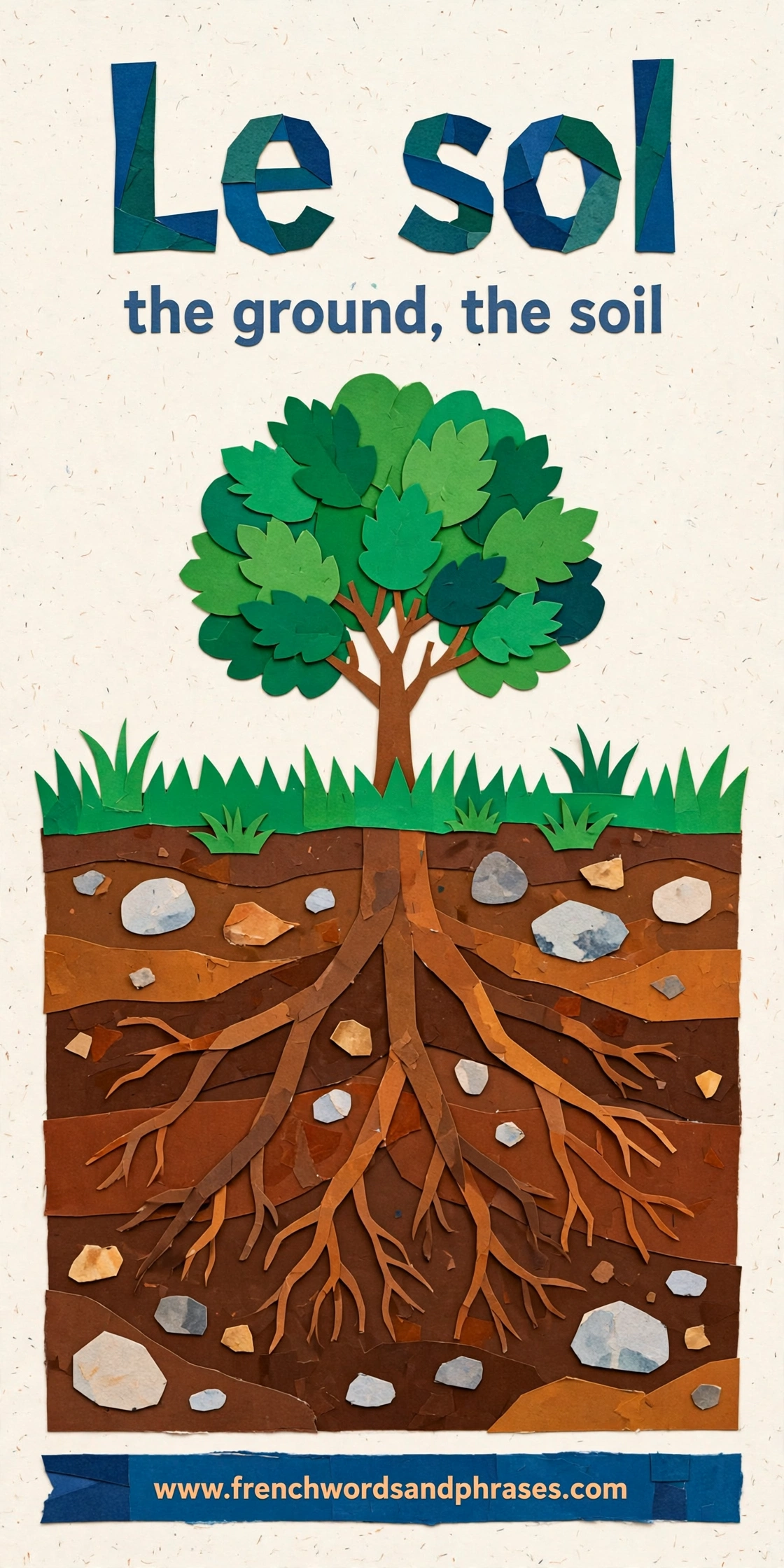
Le sol means the ground, the soil.
Boots on frozen earth in January, a spade turning the dark garden bed in April, a gymnast landing clean on the mat — under everything stands one small word: le sol, the ground, the soil, the floor of the world.
In this guide, you’ll learn what sol means in English, how to use it with its articles, how to form its plural, and how it appears in everyday French. Explore French examples, English translations, and practice quizzes.
Understanding the French Noun Sol
Sol is a masculine French noun, learned with its article: le sol, un sol. It comes from the Latin solum, the ground, the bottom. It names both the surface we stand on — au sol, on the ground — and the earth itself as a material: un sol riche, a rich soil, un sol argileux, a clay soil. French distinguishes it from le plancher, the wooden floor inside a house, and from la terre, earth in the grand sense. One homonym to enjoy: sol is also the musical note G in French.
It means the ground and the soil: le sol gelé, the frozen ground, travailler le sol, to work the soil, un sol fertile, fertile soil. Inside and in sport, it is the floor surface: tomber au sol, to fall to the ground, des exercices au sol, floor exercises. Gardeners and farmers grade it — sol sableux, sandy soil, sol calcaire, chalky soil — because everything that grows begins in the sol.
Gender: Masculine — le sol
Definite article: le — le sol (the ground)
Indefinite article: un — un sol (a soil, a ground)
Plural: les sols — regular, with a simple -s
Spelling note: from Latin solum; homonym: sol is also the note G in music
Ground or floor?: le sol is the ground/soil; le plancher is a house’s wooden floor
English equivalents: The ground, the soil; the floor (surface).
The fixed preposition is au sol: tomber au sol, poser au sol, au niveau du sol, at ground level. For soil types, sol takes its adjectives after it — sol argileux, sol riche, sol pauvre — and the plural les sols appears in agriculture and geology: les sols de la région. Do not confuse the gardener’s sol with la terre: terre is earth, land, the planet; sol is the actual ground under your boots and the soil in the bed.
Experience the Word
Sol is the noun of contact — the one surface every step, every seed and every fall must negotiate with.
Imagine the gardener in March, kneeling, taking a handful of earth and rubbing it between her fingers: un sol riche, dark and crumbly, smelling of rain. She nods before she plants anything — the sol has already given its verdict.
You have not just named dirt. You have named the foundation — le sol, the ground that holds everything up and feeds everything that grows.
How to Use Sol in French: Complete Guide
Let’s explore how sol works in French, beginning with its articles — le sol, un sol, au sol.
Sol with the Definite Article (Le, Les)
Used for a specific ground — the one under your feet, the soil of this field.
| Form | French |
|---|---|
| Masculine singular | le sol |
| Plural | les sols |
Example
Le sol est encore gelé ce matin.
The ground is still frozen this morning.
Sol with the Indefinite Article (Un, Des)
Used for a soil in general — each soil judged by what it grows.
| Form | French |
|---|---|
| Masculine singular | un sol |
| Plural | des sols |
Example
Un sol riche donne de beaux légumes.
A rich soil gives fine vegetables.
Sol and Its Kinds (Argileux, Sableux, Calcaire…)
Gardeners name soils like wines — by what the earth is made of.
| Kind | French |
|---|---|
| clay soil | un sol argileux |
| sandy soil | un sol sableux |
| chalky soil | un sol calcaire |
| fertile soil | un sol fertile |
| poor soil | un sol pauvre |
Example
Un sol sableux convient bien aux carottes.
A sandy soil suits carrots well.
Quick Quiz 1
Complete the sentence:
______ sol de ce champ est très riche. (the)
Reveal the answer
Le
Le sol de ce champ est très riche.
The soil of this field is very rich — sol is masculine, so le.
The Plural of Sol
Sol takes a regular plural in -s — the soils of a region, compared field by field.
| Number | French |
|---|---|
| Singular | le sol |
| Plural | les sols |
Example
Les sols de la vallée sont parfaits pour la vigne.
The soils of the valley are perfect for vines.
Sol with Possessive Adjectives (Mon, Ton, Son…)
Possessives agree with the noun: sol is masculine, so mon, ton, son in the singular.
| Form | French |
|---|---|
| my | mon sol |
| your (tu) | ton sol |
| his / her | son sol |
| our | notre sol |
| your (vous) | votre sol |
| their | leur sol |
Example
Le paysan connaît son sol par cœur.
The farmer knows his soil by heart.
Quick Quiz 2
Complete the sentence:
Elle a posé le vase ______ sol, près de la porte. (on the)
Reveal the answer
au
Elle a posé le vase au sol, près de la porte.
She put the vase on the ground, near the door — au sol is the fixed phrase, à + le.
Sol with Demonstrative Adjectives (Ce, Ces)
Used to point: ce sol, this ground — the patch being dug, tested or danced on.
| Form | French |
|---|---|
| Masculine singular | ce sol |
| Plural | ces sols |
Example
Ce sol dur demande une bonne bêche.
This hard ground needs a good spade.
Sol with Adjectives
Adjectives agree with sol — masculine singular: un sol fertile, le sol gelé.
| Adjective | With Sol |
|---|---|
| gelé (frozen) | le sol gelé |
| fertile (fertile) | un sol fertile |
| riche (rich) | un sol riche |
| dur (hard) | un sol dur |
| mouillé (wet) | le sol mouillé |
Example
Le sol mouillé garde les traces de pas.
The wet ground keeps the footprints.
Quick Quiz 3
Complete the sentence:
Les enfants sont tombés sur le sol ______. (frozen)
Reveal the answer
gelé
Les enfants sont tombés sur le sol gelé.
The children fell on the frozen ground — gelé, masculine, to agree with sol.
Everyday Expressions with Sol
Gardens, gyms and landings — the sol phrases of daily life.
| Expression | In English |
|---|---|
| au sol | on the ground, on the floor |
| tomber au sol | to fall to the ground |
| travailler le sol | to work the soil |
| au niveau du sol | at ground level |
| des exercices au sol | floor exercises (gymnastics) |
Example
La gymnaste commence ses exercices au sol.
The gymnast begins her floor exercises.
Words from the Same Family as Sol
Earth and foundations — the words that travel with sol.
| French | In English |
|---|---|
| la terre | the earth, the land — the grand word |
| le sous-sol | the subsoil; the basement |
| le plancher | the (wooden) floor of a house |
| le terrain | the ground, the plot, the pitch |
| ensoleillé | sunny — from soleil, a different family that sounds close |
Example
Le sous-sol de la maison reste frais en été.
The basement of the house stays cool in summer.
Quick Quiz 4
What does au sol mean?
Reveal the answer
On the ground, on the floor — the fixed phrase for anything at ground level.
Pose le sac au sol.
Put the bag on the ground.
Sol in Everyday French: Real-Life Examples
Now that you know the word, let’s see how sol appears in everyday French.
Example 1 — In the garden
Le sol est trop sec pour planter.
The soil is too dry for planting.
Example 2 — Winter
Le sol gelé craque sous les pas.
The frozen ground crunches underfoot.
Example 3 — In the gym
Les exercices au sol demandent de la souplesse.
Floor exercises require suppleness.
Example 4 — A fall
Il a glissé et il est tombé au sol.
He slipped and fell to the ground.
Example 5 — Farming
Ce sol calcaire plaît à la vigne.
This chalky soil pleases the vines.
Example 6 — At home
Ne laisse pas tes chaussures au sol dans l’entrée.
Don’t leave your shoes on the floor in the hall.
Beyond Translation: The Meaning of Sol
Sol is Latin solum — the bottom, the base, the ground of everything — and French still builds on it: le sous-sol below, the rez-de-chaussée at its level, the farmer’s whole calendar written in its kinds. English speakers meet the word twice without knowing: in soil, its direct descendant, and in the gardener’s patience it demands. A French gardener does not ask what a plant wants; she asks what the sol is — argileux, sableux, riche — because in French, character begins at ground level.
To say sol is to start from the bottom, where everything starts.
It evokes the spade in March, the frozen field in January, and the gymnast’s clean landing — the ground, judged and trusted.
How to Remember the French Noun Sol
Remember it this way: Sol is the ground and the soil — masculine: le sol, and the fixed phrase au sol for anything on it.
- Always masculine — le sol, un sol, mon sol.
- The fixed phrase — au sol, on the ground; tomber au sol, to fall to the ground.
- Not the house floor — that is le plancher; sol is ground and soil.
The key idea is le sol — the ground, the soil, masculine; au sol = on the ground.
Test Your Knowledge of Sol
Let’s see how much you’ve learned. Try answering these questions before revealing the answers.
Question 1
Is sol masculine or feminine?
Reveal the answer
Masculine — le sol, un sol.
Question 2
How do you say on the ground?
Reveal the answer
Au sol.
Question 3
Translate: The soil of this field is very rich.
Reveal the answer
Le sol de ce champ est très riche.
Question 4
What is un sol argileux?
Reveal the answer
A clay soil — one of the gardener’s named kinds of sol.
Question 5
Complete the sentence:
______ sols de la région sont fertiles. (the)
Reveal the answer
Les
Les sols de la région sont fertiles.
The soils of the region are fertile.
Your Final Challenge
Can You Use It?
How would you say this in French?
“The farmer knows his soil by heart.”
Reveal the answer
Le paysan connaît son sol par cœur.
The farmer knows his soil by heart.
A little French. A little curiosity. A richer everyday life.
LEARN FRENCH ONE WORD AT A TIME