A French Word to Live By
How to Conjugate Enseigner in French
/ɑ̃.se.ɲe/
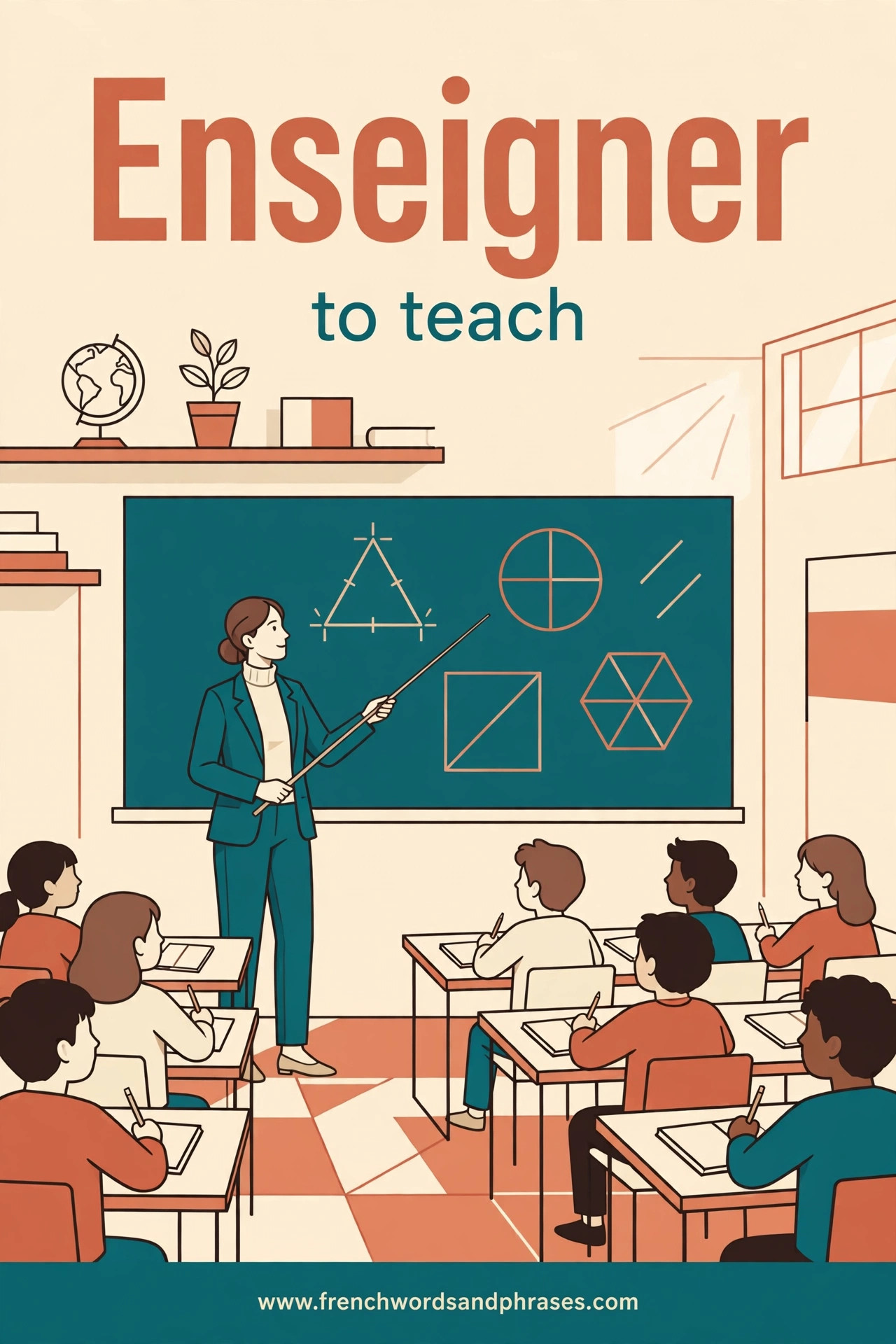
Enseigner means to teach — to pass on knowledge or a skill in an organised way: a teacher teaches children at school, a master teaches an apprentice a trade, and experience itself teaches the rest of us.
Chalk on fingers, a trade shown hand over hand at the workbench, a grandmother demonstrating the exact fold of the pastry — enseigner is the verb of transmission: what one generation knows, handed carefully to the next.
In this guide, you’ll learn how to conjugate enseigner in all the major French tenses and moods. Explore complete conjugation tables, French examples, English translations, and practice quizzes.
Understanding the French Verb Enseigner
Enseigner is a regular French verb belonging to the first group of verbs, those ending in-er.
It means to teach. Enseigner is the professional, structured word: one enseigne a subject, in a school, as a career — elle enseigne les mathématiques depuis vingt ans. Its nouns run the whole French school system: l’enseignement (teaching, education), un enseignant / une enseignante (a teacher). What life teaches takes the same verb with pride: l’expérience nous enseigne la patience.
Verb classification: First group (-er)
Auxiliary verb: Avoir
Past participle: enseigné
Present participle: enseignant
English equivalents: To teach; enseigner le français — to teach French; enseigner à quelqu’un à lire — to teach someone to read; enseigner dans une école — to teach in a school; l’enseignement — teaching, education; un enseignant — a teacher.
One important detail: enseigner is a perfectly regular -er verb — j’enseigne, nous enseignons, ils enseignent, past participle enseigné. Its construction has two doors: enseigner quelque chose à quelqu’un (to teach something to someone) and enseigner à quelqu’un à faire quelque chose (to teach someone to do something). Do not confuse it with apprendre, which means both to learn and, with à, to teach informally: je lui apprends à nager.
Experience the Word
Enseigner is the verb of the hand extended backwards — knowledge reaching down the years to lift the next climber.
Imagine the old cabinet-maker’s workshop: the apprentice watches the plane’s angle for the hundredth time, then the master’s hand closes over his to correct it by a hair — enseigner, in that room, is not spoken at all. It is shown, guided, and finally let go.
The hand withdraws. The skill remains — enseigné, transmitted, and now owned by younger hands.
How to Conjugate Enseigner: Complete French Conjugation Guide
Let’s explore every major conjugation of enseigner, beginning with the indicative mood.
How to Conjugate Enseigner in the Indicative Mood
The indicative mood is used to express facts, observations, actions, and events.
How to Conjugate Enseigner in the Present Tense (Présent)
Used for actions happening now, habitual actions, and general truths.
| Subject | Conjugation |
|---|---|
| je | enseigne |
| tu | enseignes |
| il / elle | enseigne |
| nous | enseignons |
| vous | enseignez |
| ils / elles | enseignent |
Example
Elle enseigne le français aux enfants du village.
She teaches French to the village children.
Quick Quiz 1
Complete the sentence:
Nous ______ la lecture aux petits.
Reveal the answer
enseignons
Nous enseignons la lecture aux petits.
We teach the little ones to read.
How to Conjugate Enseigner in the Passé Composé
Used for completed actions in the past. Enseigner takes the auxiliary verb avoir.
| Subject | Conjugation |
|---|---|
| j’ | ai enseigné |
| tu | as enseigné |
| il / elle | a enseigné |
| nous | avons enseigné |
| vous | avez enseigné |
| ils / elles | ont enseigné |
Example
Il a enseigné l’histoire pendant quarante ans.
He taught history for forty years.
How to Conjugate Enseigner in the Imparfait (Imperfect Tense)
Used for habitual past actions, descriptions, and ongoing situations in the past.
| Subject | Conjugation |
|---|---|
| je | enseignais |
| tu | enseignais |
| il / elle | enseignait |
| nous | enseignions |
| vous | enseigniez |
| ils / elles | enseignaient |
Example
Mon grand-père enseignait la menuiserie aux apprentis.
My grandfather taught carpentry to the apprentices.
Quick Quiz 2
Choose the correct form:
He taught French in London.
Il ______ le français à Londres. (a enseigné / est enseigné)
Reveal the answer
a enseigné
Il a enseigné le français à Londres.
Enseigner takes avoir.
How to Conjugate Enseigner in the Plus-que-parfait
Used to describe an action that had already been completed before another past event.
| Subject | Conjugation |
|---|---|
| j’ | avais enseigné |
| tu | avais enseigné |
| il / elle | avait enseigné |
| nous | avions enseigné |
| vous | aviez enseigné |
| ils / elles | avaient enseigné |
Example
Elle avait enseigné dans trois écoles avant celle-ci.
She had taught in three schools before this one.
How to Conjugate Enseigner in the Passé Simple
Primarily used in formal writing, literature, and historical narratives. It is rarely used in everyday conversation.
| Subject | Conjugation |
|---|---|
| je | enseignai |
| tu | enseignas |
| il / elle | enseigna |
| nous | enseignâmes |
| vous | enseignâtes |
| ils / elles | enseignèrent |
Example
Il enseigna les mathématiques jusqu’à sa retraite.
He taught mathematics until his retirement.
How to Conjugate Enseigner in the Passé Antérieur
A literary tense used to express an action completed immediately before another past action, generally in the passé simple.
| Subject | Conjugation |
|---|---|
| j’ | eus enseigné |
| tu | eus enseigné |
| il / elle | eut enseigné |
| nous | eûmes enseigné |
| vous | eûtes enseigné |
| ils / elles | eurent enseigné |
Example
Quand il eut enseigné la dernière leçon, il ferma son cartable.
When he had taught the last lesson, he closed his satchel.
How to Conjugate Enseigner in the Future Tense (Futur Simple)
Used to describe actions that will take place in the future.
| Subject | Conjugation |
|---|---|
| je | enseignerai |
| tu | enseigneras |
| il / elle | enseignera |
| nous | enseignerons |
| vous | enseignerez |
| ils / elles | enseigneront |
Example
Tu enseigneras la patience à tes propres enfants.
You will teach patience to your own children.
How to Conjugate Enseigner in the Futur Antérieur (Future Perfect)
Used for an action that will have been completed before a particular point in the future.
| Subject | Conjugation |
|---|---|
| j’ | aurai enseigné |
| tu | auras enseigné |
| il / elle | aura enseigné |
| nous | aurons enseigné |
| vous | aurez enseigné |
| ils / elles | auront enseigné |
Example
À la retraite, elle aura enseigné à mille élèves.
By retirement, she will have taught a thousand pupils.
How to Conjugate Enseigner in the Near Future (Futur Proche)
Used to describe something that is going to happen soon. Formed with aller + infinitive.
| Subject | Conjugation |
|---|---|
| je | vais enseigner |
| tu | vas enseigner |
| il / elle | va enseigner |
| nous | allons enseigner |
| vous | allez enseigner |
| ils / elles | vont enseigner |
Example
Le nouveau professeur va enseigner la chimie cette année.
The new teacher is going to teach chemistry this year.
How to Conjugate Enseigner in the Conditional Mood
The conditional mood expresses what would happen under certain circumstances. It is also frequently used to make polite requests or express wishes.
How to Conjugate Enseigner in the Present Conditional
| Subject | Conjugation |
|---|---|
| je | enseignerais |
| tu | enseignerais |
| il / elle | enseignerait |
| nous | enseignerions |
| vous | enseigneriez |
| ils / elles | enseigneraient |
Example
Avec un diplôme de plus, il enseignerait à l’université.
With one more degree, he would teach at university.
How to Conjugate Enseigner in the Past Conditional
| Subject | Conjugation |
|---|---|
| j’ | aurais enseigné |
| tu | aurais enseigné |
| il / elle | aurait enseigné |
| nous | aurions enseigné |
| vous | auriez enseigné |
| ils / elles | auraient enseigné |
Example
Elle aurait enseigné le piano si elle avait eu le temps.
She would have taught the piano if she had had the time.
Enseigner in the Literary Past Conditional Form
This less common literary form uses the imperfect subjunctive of avoir.
| Subject | Conjugation |
|---|---|
| j’ | eusse enseigné |
| tu | eusses enseigné |
| il / elle | eût enseigné |
| nous | eussions enseigné |
| vous | eussiez enseigné |
| ils / elles | eussent enseigné |
Example
Le maître eût enseigné encore, si la guerre n’eût fermé l’école.
The master would have taught still, had the war not closed the school.
How to Conjugate Enseigner in the Subjunctive Mood
The subjunctive is used to express wishes, emotions, doubts, necessity, and uncertainty. It frequently follows expressions such as il faut que (it is necessary that) or bien que (although).
How to Conjugate Enseigner in the Present Subjunctive
| Subject | Conjugation |
|---|---|
| que je | enseigne |
| que tu | enseignes |
| qu’il / qu’elle | enseigne |
| que nous | enseignions |
| que vous | enseigniez |
| qu’ils / qu’elles | enseignent |
Example
Il faut qu’elle enseigne la prudence aux enfants.
She must teach the children caution.
Quick Quiz 3
Complete the sentence using the subjunctive:
Je suis heureux que vous ______ à mon fils.
Reveal the answer
ayez enseigné
Je suis heureux que vous ayez enseigné à mon fils.
I am glad you taught my son.
How to Conjugate Enseigner in the Imperfect Subjunctive
A literary tense, rarely encountered in modern spoken French.
| Subject | Conjugation |
|---|---|
| que je | enseignasse |
| que tu | enseignasses |
| qu’il / qu’elle | enseignât |
| que nous | enseignassions |
| que vous | enseignassiez |
| qu’ils / qu’elles | enseignassent |
Example
On souhaitait qu’il enseignât encore une année.
People hoped he would teach one more year.
How to Conjugate Enseigner in the Pluperfect Subjunctive
A literary construction used to express an action completed before another past action.
| Subject | Conjugation |
|---|---|
| que j’ | eusse enseigné |
| que tu | eusses enseigné |
| qu’il / qu’elle | eût enseigné |
| que nous | eussions enseigné |
| que vous | eussiez enseigné |
| qu’ils / qu’elles | eussent enseigné |
Example
On racontait que le vieux maître eût enseigné à trois générations.
People said the old master had taught three generations.
How to Conjugate Enseigner in the Past Subjunctive
| Subject | Conjugation |
|---|---|
| que j’ | aie enseigné |
| que tu | aies enseigné |
| qu’il / qu’elle | ait enseigné |
| que nous | ayons enseigné |
| que vous | ayez enseigné |
| qu’ils / qu’elles | aient enseigné |
Example
Je suis heureux qu’elle ait enseigné à mon fils.
I am glad she taught my son.
How to Conjugate Enseigner in the Imperative
The imperative is used to give commands, instructions, invitations, or suggestions. Subject pronouns are omitted.
How to Conjugate Enseigner in the Present Imperative
| Person | Conjugation |
|---|---|
| (tu) | enseigne |
| (nous) | enseignons |
| (vous) | enseignez |
Example
Enseigne-lui à nager avant l’été !
Teach him to swim before the summer!
Quick Quiz 4
How would you say Teach me this dance step (tu form)?
Reveal the answer
Enseigne-moi ce pas de danse !
French Participles of Enseigner
Participles are verb forms that can be used in compound tenses and other grammatical constructions.
Present Participle of Enseigner
enseignant
En enseignant chaque jour, on apprend soi-même sans cesse.
By teaching every day, one learns oneself endlessly.
Past Participle of Enseigner
enseigné
Enseignée par sa grand-mère, la recette n’a jamais été écrite.
Taught by her grandmother, the recipe was never written down.
Enseigner in Everyday French: Real-Life Examples
Now that you know the conjugations, let’s see how enseigner appears in everyday French.
Example 1 — Present
Elle enseigne les mathématiques au collège.
She teaches mathematics at the middle school.
Example 2 — Passé composé
Il a enseigné le français à Londres.
He taught French in London.
Example 3 — Imparfait
Mon père enseignait la géographie.
My father taught geography.
Example 4 — Future
Tu enseigneras un jour à ton tour.
You will teach one day in your turn.
Example 5 — Conditional
J’enseignerais la musique si je savais jouer.
I would teach music if I could play.
Example 6 — Imperative
Enseigne-moi ce pas de danse !
Teach me this dance step!
Beyond Translation: The Meaning of Enseigner
Enseigner carries a sign inside it: Latin insignire and the old French enseigne — a sign, a mark, a shop’s hanging sign — because teaching was first a showing: point at the sign, show the thing, mark it in the memory. The word grew into the whole architecture of French education: l’enseignement primaire, secondaire, supérieur. And French keeps a proverb’s respect for it: c’est en enseignant qu’on apprend — it is by teaching that one learns.
To enseigner is to hold the lamp so that other eyes can read.
Learn it beside apprendre, its mirror: the same lesson, seen from the two ends of the desk.
How to Remember the French Verb Enseigner
Remember it this way: Enseigner is about the master’s hand guiding the apprentice’s, then letting go.
- Enseigner is regular -er: j’enseigne, nous enseignons, past participle enseigné.
- Two doors: enseigner quelque chose à quelqu’un; enseigner à quelqu’un à faire quelque chose.
- Its family runs the school system: l’enseignement, un enseignant, une enseignante.
The key idea is the master’s hand guiding the apprentice’s, then letting go.
Test Your Knowledge of Enseigner
Let’s see how much you’ve learned. Try answering these questions before revealing the answers.
Question 1
How do you say She teaches French to the village children in French?
Reveal the answer
Elle enseigne le français aux enfants du village.
Question 2
What is the past participle of enseigner?
Reveal the answer
Enseigné.
Question 3
Translate: He taught history for forty years.
Reveal the answer
Il a enseigné l’histoire pendant quarante ans.
Question 4
What is a teacher called, from this verb’s family?
Reveal the answer
Un enseignant / une enseignante — and teaching itself is l’enseignement.
Question 5
Complete the sentence:
Il faut qu’elle ______ la prudence aux enfants.
Reveal the answer
enseigne
Il faut qu’elle enseigne la prudence aux enfants.
She must teach the children caution.
Your Final Challenge
Can You Use It?
How would you say this in French?
By teaching every day, one learns oneself endlessly.
Reveal the answer
En enseignant chaque jour, on apprend soi-même sans cesse.
By teaching every day, one learns oneself endlessly.
A little French. A little curiosity. A richer everyday life.
LEARN FRENCH ONE WORD AT A TIME