A French Word to Live By
Translate Reste to English
/ʁɛst/
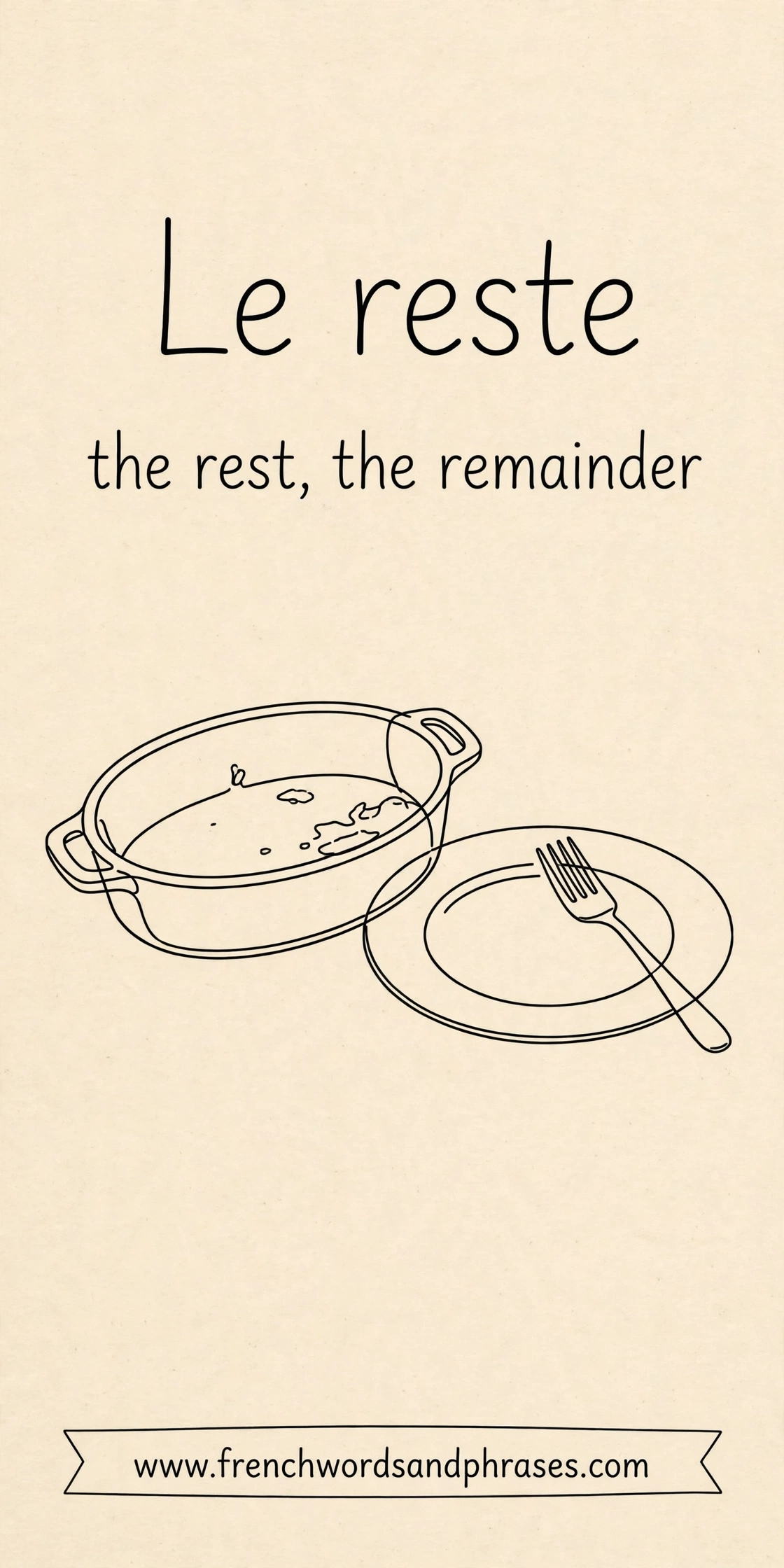
Le reste means the rest, the remainder.
The cake is cut, the guests have taken their slices, and one generous piece still waits on the plate: le reste, the rest — everything that remains when the first share has gone, the part that stays behind and still belongs to somebody.
In this guide, you’ll learn what reste means in English, how to use it with its articles, how to form its plural, and how it appears in everyday French. Explore French examples, English translations, and practice quizzes.
Understanding the French Noun Reste
Reste is a masculine French noun, learned with its article: le reste, un reste. It is the noun of the verb rester, to stay, to remain — a reste is literally what has stayed. In the plural, les restes takes on a second, very everyday life: the leftovers of a meal, and also remains in the solemn sense, les restes d’un château, the remains of a castle.
It means the rest, the remainder — what is left of something after part has been taken or used: le reste de la journée, the rest of the day, le reste de l’argent, the rest of the money, garder le reste, to keep the change. In the plural, les restes are leftovers: les restes du dîner, warmed up the next day, and les restes d’un mur, the remains of a wall. Two small phrases matter: du reste, moreover, besides, and pour le reste, as for the rest.
Gender: Masculine — le reste
Definite article: le — le reste (the rest)
Indefinite article: un — un reste (a remainder, a remnant)
Plural: les restes — leftovers; remains
Spelling note: the noun of rester, to remain — a reste is what has stayed
Key phrases: du reste (moreover), pour le reste (as for the rest)
English equivalents: The rest, the remainder; (plural) the leftovers, the remains.
Singular and plural lead different lives: le reste is the abstract remainder — le reste du temps, le reste de ma vie — while les restes are concrete: the food left in the dish and the stones left of a ruin. At the table, il y a des restes means there are leftovers; at the market, gardez le reste is keep the change. And du reste adds a thought: du reste, il a raison — besides, he is right.
Experience the Word
Reste is the noun of what survives the sharing — the last slice, the last hour, the money still in the envelope after the bills are paid.
Imagine the Sunday lunch finished, the table cleared, and in the fridge a small dish covered with a plate: les restes. Tomorrow they will be a soup, and the cook who planned it that way calls it not economy but wisdom.
You have not just named a leftover. You have named everything that remains — le reste, the rest, what time and appetite have not yet taken.
How to Use Reste in French: Complete Guide
Let’s explore how reste works in French, beginning with its articles — le reste, un reste, les restes.
Reste with the Definite Article (Le, Les)
Used for a specific remainder — the rest of this day, of this money.
| Form | French |
|---|---|
| Masculine singular | le reste |
| Plural | les restes |
Example
Le reste de la journée est libre.
The rest of the day is free.
Reste with the Indefinite Article (Un, Des)
Used for a remainder in general — a scrap, a remnant of something larger.
| Form | French |
|---|---|
| Masculine singular | un reste |
| Plural | des restes |
Example
Il ne subsiste qu’un reste du vieux mur.
Only a remnant of the old wall survives.
Reste with Quantities (Tout le reste, Le reste de…)
The rest is measured against the whole — all of it, half of it, none of it.
| Quantity | French |
|---|---|
| all the rest | tout le reste |
| the rest of the money | le reste de l’argent |
| the rest of the day | le reste de la journée |
| half of the rest | la moitié du reste |
| nothing remains | il ne reste rien |
Example
Elle a dépensé la moitié et gardé le reste de l’argent.
She spent half and kept the rest of the money.
Quick Quiz 1
Complete the sentence:
______ reste du gâteau est pour toi. (the)
Reveal the answer
Le
Le reste du gâteau est pour toi.
The rest of the cake is for you — reste is masculine, so le.
The Plural of Reste
In the plural, restes becomes concrete: leftovers on the table, remains on the hill.
| Number | French |
|---|---|
| Singular | le reste |
| Plural | les restes |
Example
Les restes du château dominent encore la vallée.
The remains of the castle still overlook the valley.
Reste with Possessive Adjectives (Mon, Ton, Son…)
Possessives agree with the noun: reste is masculine, so mon, ton, son in the singular.
| Owner | French |
|---|---|
| my | mon reste |
| your (tu) | ton reste |
| his / her | son reste |
| our | notre reste |
| your (vous) | votre reste |
| their | leur reste |
Example
Prends mon reste de tarte, je n’ai plus faim.
Take my remaining piece of pie, I’m not hungry any more.
Quick Quiz 2
Complete the sentence:
Il a mangé ______ reste de pain avec la soupe. (his)
Reveal the answer
son
Il a mangé son reste de pain avec la soupe.
He ate his remaining piece of bread with the soup — son, because reste is masculine.
Reste with Demonstrative Adjectives (Ce, Ces)
Used to point: ce reste, this remainder — what is left, there, in front of you.
| Form | French |
|---|---|
| Masculine singular | ce reste |
| Plural | ces restes |
Example
Ce reste de tissu suffira pour une poche.
This remnant of cloth will be enough for a pocket.
Reste with Adjectives
Adjectives agree with reste — masculine singular: un reste précieux, le reste entier.
| Adjective | With Reste |
|---|---|
| entier (whole, entire) | le reste entier |
| petit (small) | un petit reste |
| précieux (precious) | un reste précieux |
| froid (cold) | des restes froids |
| unique (only, sole) | le reste unique |
Example
Un petit reste de soupe attend au réfrigérateur.
A small remainder of soup is waiting in the fridge.
Quick Quiz 3
Complete the sentence:
Nous avons mangé les restes ______ du dîner d’hier. (cold)
Reveal the answer
froids
Nous avons mangé les restes froids du dîner d’hier.
We ate the cold leftovers from yesterday’s dinner — froids, masculine plural, to agree with restes.
Everyday Expressions with Reste
Fridges, ruins and afterthoughts — the reste phrases of daily life.
| Expression | In English |
|---|---|
| les restes | the leftovers (of a meal) |
| garder le reste | to keep the change |
| du reste | moreover, besides |
| pour le reste | as for the rest |
| le reste de la journée | the rest of the day |
Example
Du reste, personne n’avait vraiment faim.
Besides, nobody was really hungry.
Words from the Same Family as Reste
Remaining and keeping — the words that travel with reste.
| French | In English |
|---|---|
| rester | to stay, to remain (the verb) |
| le restant | the remainder (formal, banking) |
| un surplus | a surplus |
| les débris | the debris, the wreckage |
| conserver | to keep, to preserve (the verb) |
Example
Il reste un peu de soupe pour demain.
A little soup remains for tomorrow.
Quick Quiz 4
What does du reste mean?
Reveal the answer
Moreover, besides — a small phrase for adding a thought.
Du reste, il avait déjà payé sa part.
Besides, he had already paid his share.
Reste in Everyday French: Real-Life Examples
Now that you know the word, let’s see how reste appears in everyday French.
Example 1 — At the table
Il y a des restes si tu as encore faim.
There are leftovers if you are still hungry.
Example 2 — Shopping
Gardez le reste, merci.
Keep the change, thank you.
Example 3 — Planning
Le reste de la semaine sera calme.
The rest of the week will be quiet.
Example 4 — The ruin
Les restes du mur datent du Moyen Âge.
The remains of the wall date from the Middle Ages.
Example 5 — Money
Elle met le reste de l’argent de côté.
She puts the rest of the money aside.
Example 6 — Afterthought
Du reste, nous partons tôt demain.
Besides, we are leaving early tomorrow.
Beyond Translation: The Meaning of Reste
Reste is the noun form of one of French’s most useful verbs, rester — to stay. Everything the word touches is defined by not having gone: the rest of the day is the part the morning did not use, the restes of a castle are the stones the centuries did not carry away, and les restes in the fridge are dinner’s second chance. French even parks its afterthoughts in the word: du reste, moreover — what remains to be said.
To say reste is to point at what is still there.
It evokes the covered dish in the fridge, the last page of the letter, and the ruin on the hill — survival, in noun form.
How to Remember the French Noun Reste
Remember it this way: Reste is the rest — masculine: le reste. Singular for the abstract remainder, plural les restes for leftovers and remains.
- Always masculine — le reste, un reste, mon reste.
- Two lives — le reste, the remainder; les restes, the leftovers, the remains.
- The afterthought — du reste, moreover, besides.
The key idea is le reste — the rest, masculine; les restes = the leftovers.
Test Your Knowledge of Reste
Let’s see how much you’ve learned. Try answering these questions before revealing the answers.
Question 1
Is reste masculine or feminine?
Reveal the answer
Masculine — le reste, un reste.
Question 2
What are les restes at the table?
Reveal the answer
The leftovers — what remains of the meal, kept for later.
Question 3
Translate: Keep the change, thank you.
Reveal the answer
Gardez le reste, merci.
Question 4
How do you say the rest of the day?
Reveal the answer
Le reste de la journée.
Question 5
Complete the sentence:
______ restes du château sont sur la colline. (the)
Reveal the answer
Les
Les restes du château sont sur la colline.
The remains of the castle are on the hill.
Your Final Challenge
Can You Use It?
How would you say this in French?
“The rest of the day is free.”
Reveal the answer
Le reste de la journée est libre.
The rest of the day is free.
A little French. A little curiosity. A richer everyday life.
LEARN FRENCH ONE WORD AT A TIME