A French Word to Live By
Translate Domaine to English
/dɔ.mɛn/
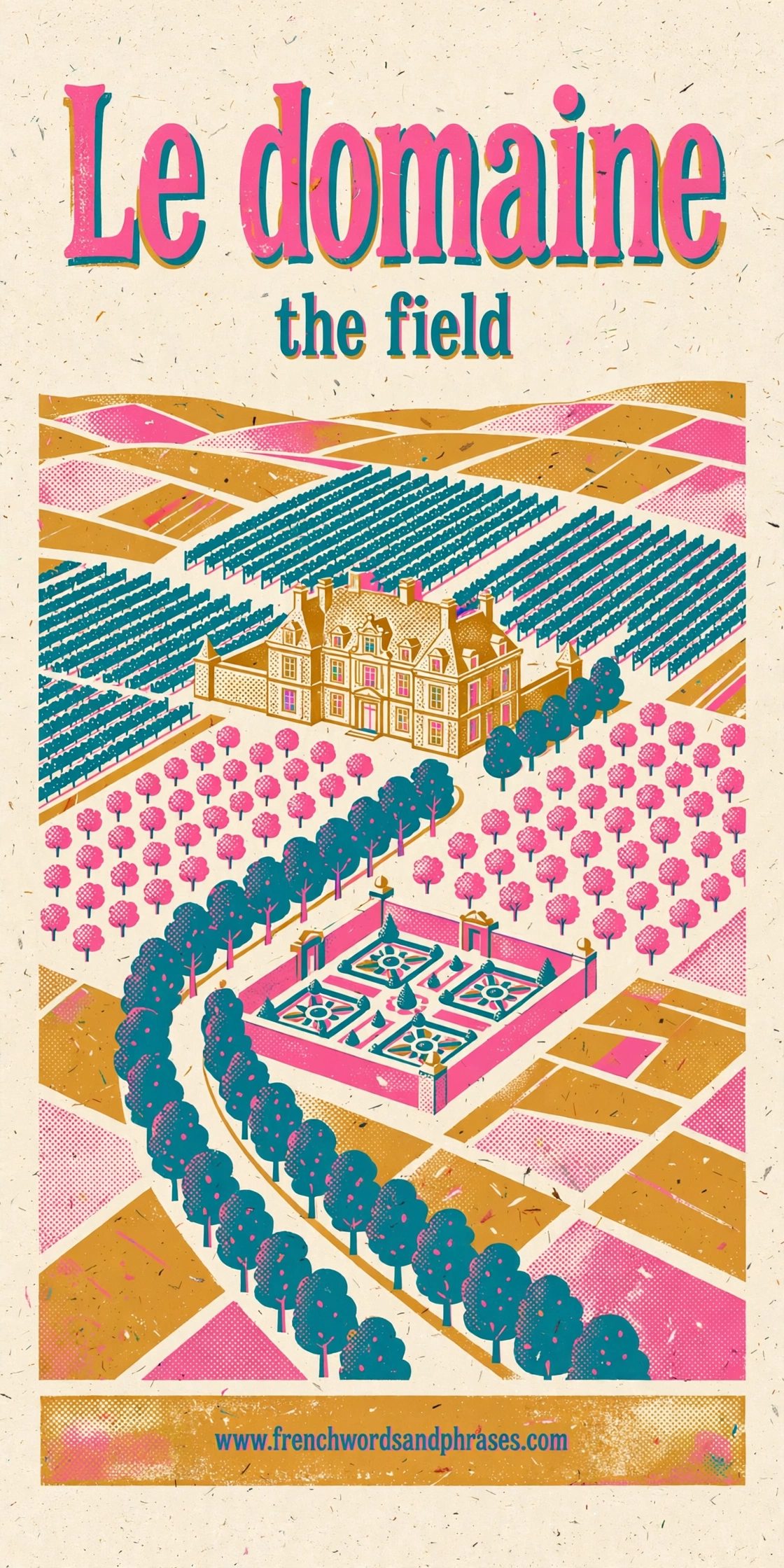
Le domaine means the field, the domain.
A wine estate behind its iron gates, a scholar’s life-work mapped on one shelf, the king’s own lands marked on the old map: le domaine, the domain — the field, the estate, the territory a person, a family or a science calls its own.
In this guide, you’ll learn what domaine means in English, how to use it with its articles, how to form its plural, and how it appears in everyday French. Explore French examples, English translations, and practice quizzes.
Understanding the French Noun Domaine
Domaine is a masculine French noun, learned with its article: le domaine, un domaine. It comes from the Latin dominium, ownership, from dominus, the master of the house — a domaine is, in its bones, what a master holds: land first, then any field where someone is master.
It means a domain in three great senses. Land and property: un domaine viticole, a wine estate, le domaine royal, the royal domain, un grand domaine of forests and fields. A field of knowledge or activity: le domaine de la science, the field of science, dans le domaine médical, in the medical field, c’est son domaine, that is his field, his speciality. And public ownership: le domaine public, the public domain — land belonging to the state, and works whose copyright has ended: tomber dans le domaine public, to enter the public domain.
Gender: Masculine — le domaine
Definite article: le — le domaine (the domain)
Indefinite article: un — un domaine (a domain, an estate)
Plural: les domaines — regular, with a simple -s
Spelling note: from Latin dominium, ownership — the master’s holding
Three lives: an estate of land; a field of knowledge; the public domain
English equivalents: The domain; the field; an estate.
For a subject-field, French uses domaine where English uses field: dans son domaine, in his field. A wine estate is un domaine viticole — the bottle’s label will say mis en bouteille au domaine, bottled at the estate. And the internet borrowed the word whole: un nom de domaine, a domain name.
Experience the Word
Domaine is the word for mastered territory — the land a family has pruned for six generations, the subject a scholar can walk blindfold.
Imagine the gates of a Burgundy estate at harvest: rows of vines to the hill, the house in the middle, the name on the gate older than the road. C’est le domaine, dit le vigneron — the estate, the field, the whole of a life’s competence poured into one word.
You have not just named property. You have named the ground of mastery — le domaine, where a person is sovereign.
How to Use Domaine in French: Complete Guide
Let’s explore how domaine works in French, beginning with its articles — le domaine, un domaine, dans le domaine public.
Domaine with the Definite Article (Le, Les)
Used for a specific domain — the estate on the hill, the field of a science.
| Form | French |
|---|---|
| Masculine singular | le domaine |
| Plural | les domaines |
Example
Le domaine s’étend jusqu’à la rivière.
The estate stretches as far as the river.
Domaine with the Indefinite Article (Un, Des)
Used for a domain in general — any estate, any field of work.
| Form | French |
|---|---|
| Masculine singular | un domaine |
| Plural | des domaines |
Example
Ils ont acheté un domaine dans le Sud pour y planter des vignes.
They bought an estate in the South to plant vines there.
The Domaines (Viticole, Public, Médical…)
Domaine names estates, specialities and the commons — learn its great partnerships.
| Domain | French |
|---|---|
| a wine estate | un domaine viticole |
| the public domain | le domaine public |
| a field of study | un domaine d’étude |
| the medical field | le domaine médical |
| a ski area | le domaine skiable |
Example
Le domaine skiable relie trois villages de montagne.
The ski area links three mountain villages.
Quick Quiz 1
Complete the sentence:
______ domaine public commence après soixante-dix ans. (the)
Reveal the answer
Le
Le domaine public commence après soixante-dix ans.
The public domain begins after seventy years — domaine is masculine, so le.
The Plural of Domaine
Domaine takes a regular plural in -s — estates of wine, fields of research.
| Number | French |
|---|---|
| Singular | le domaine |
| Plural | les domaines |
Example
Les domaines viticoles de la région ouvrent leurs caves en été.
The wine estates of the region open their cellars in summer.
Domaine with Possessive Adjectives (Mon, Ton, Son…)
Possessives agree with the noun: domaine is masculine, so mon, ton, son in the singular — son domaine is also the proud phrase for a speciality.
| Owner | French |
|---|---|
| my | mon domaine |
| your (tu) | ton domaine |
| his / her | son domaine |
| our | notre domaine |
| your (vous) | votre domaine |
| their | leur domaine |
Example
La grammaire, c’est son domaine, demandez-lui.
Grammar is his field, ask him.
Quick Quiz 2
Complete the sentence:
Les mathématiques, c’est ______ domaine, il y excelle. (his)
Reveal the answer
son
Les mathématiques, c’est son domaine, il y excelle.
Mathematics is his field, he excels at it — son, because domaine is masculine.
Domaine with Demonstrative Adjectives (Ce, Ces)
Used to point: ce domaine, this domain — this estate, this field of work.
| Form | French |
|---|---|
| Masculine singular | ce domaine |
| Plural | ces domaines |
Example
Ce domaine produit le meilleur vin de la vallée.
This estate produces the best wine in the valley.
Domaine with Adjectives
Adjectives agree with domaine — masculine singular: un grand domaine, un domaine viticole.
| Adjective | With Domaine |
|---|---|
| grand (large) | un grand domaine |
| viticole (wine-growing) | un domaine viticole |
| public (public) | le domaine public |
| royal (royal) | le domaine royal |
| privé (private) | un domaine privé |
Example
Un grand domaine de chasse entoure le château.
A large hunting estate surrounds the castle.
Quick Quiz 3
Complete the sentence:
C’est un domaine ______, les vignes descendent jusqu’au fleuve. (wine-growing)
Reveal the answer
viticole
C’est un domaine viticole, les vignes descendent jusqu’au fleuve.
It is a wine estate, the vines run down to the river.
Everyday Expressions with Domaine
Estates, expertise and the commons — the domaine phrases of daily life.
| Expression | In English |
|---|---|
| le domaine public | the public domain |
| tomber dans le domaine public | to enter the public domain |
| un domaine viticole | a wine estate |
| c’est son domaine | that is his field, his speciality |
| un nom de domaine | a domain name (internet) |
Example
Les œuvres de cet auteur sont tombées dans le domaine public.
This author’s works have entered the public domain.
Words from the Same Family as Domaine
Land and mastery — the words that travel with domaine.
| French | In English |
|---|---|
| une propriété | a property, an estate (legal) |
| un vignoble | a vineyard |
| un champ | a field (of land; also of study) |
| un secteur | a sector, an area of activity |
| dominer | to dominate, to overlook (the verb) |
Example
Le vignoble du domaine couvre vingt hectares.
The estate’s vineyard covers twenty hectares.
Quick Quiz 4
What does c’est son domaine mean, said of a scholar?
Reveal the answer
That is his field — his speciality, the territory of his mastery.
L’histoire médiévale, c’est son domaine.
Medieval history is his field.
Domaine in Everyday French: Real-Life Examples
Now that you know the word, let’s see how domaine appears in everyday French.
Example 1 — Wine
Ce domaine produit un vin rouge célèbre.
This estate produces a famous red wine.
Example 2 — Work
Dans le domaine médical, tout change très vite.
In the medical field, everything changes very fast.
Example 3 — Books
Ce roman ancien est dans le domaine public.
This old novel is in the public domain.
Example 4 — Expertise
La cuisine, c’est le domaine de ma grand-mère.
Cooking is my grandmother’s field.
Example 5 — Skiing
Le domaine skiable ouvre en décembre.
The ski area opens in December.
Example 6 — Internet
Le nom de domaine du site est simple à retenir.
The site’s domain name is easy to remember.
Beyond Translation: The Meaning of Domaine
Domaine carries the feudal map inside the modern sentence: the dominus held his dominium, and the word still smells of gates, boundaries and competence — the land you may enter only by invitation, the subject you may speak on only by mastery. French democracy nationalised one corner of it — le domaine public, where Racine and Hugo now belong to everyone — and the internet, arriving late, found the word waiting for its addresses.
To say domaine is to draw the border of a mastery.
It evokes the vigneron at his gate, the scholar among his shelves, and the commons where the classics lie open — every territory where someone, or everyone, is at home.
How to Remember the French Noun Domaine
Remember it this way: Domaine is the domain — an estate, a field of knowledge, the public domain: le domaine, always masculine.
- Always masculine — le domaine, un domaine, son domaine.
- The three lives — un domaine viticole (an estate), le domaine médical (a field), le domaine public (the commons).
- The proud phrase — c’est son domaine, that is his field, his speciality.
The key idea is le domaine — the domain, the field, the estate, masculine; le domaine public = the public domain.
Test Your Knowledge of Domaine
Let’s see how much you’ve learned. Try answering these questions before revealing the answers.
Question 1
Is domaine masculine or feminine?
Reveal the answer
Masculine — le domaine, un domaine.
Question 2
How do you say a wine estate in French?
Reveal the answer
Un domaine viticole.
Question 3
Translate: Cooking is my grandmother’s field.
Reveal the answer
La cuisine, c’est le domaine de ma grand-mère.
Question 4
What does tomber dans le domaine public mean?
Reveal the answer
To enter the public domain — to become free of copyright, everyone’s property.
Question 5
Complete the sentence:
______ domaines viticoles ouvrent leurs caves en été. (the)
Reveal the answer
Les
Les domaines viticoles ouvrent leurs caves en été.
The wine estates open their cellars in summer.
Your Final Challenge
Can You Use It?
How would you say this in French?
“Medieval history is his field.”
Reveal the answer
L’histoire médiévale, c’est son domaine.
Medieval history is his field.
A little French. A little curiosity. A richer everyday life.
LEARN FRENCH ONE WORD AT A TIME