
A French Word to Live By
Translate Chaleur to English
/ʃa.lœʁ/
La chaleur means the heat.
The August pavement trembling at noon, the cat stretched in the one square of sun, the welcome in a voice that makes a stranger feel at home: la chaleur, the heat — of the summer, of the fire, and of the human heart.
In this guide, you’ll learn what chaleur means in English, how to use it with its articles, how to form its plural, and how it appears in everyday French. Explore French examples, English translations, and practice quizzes.
Understanding the French Noun Chaleur
Chaleur is a feminine French noun, learned with its article: la chaleur, une chaleur. It is built on the Latin calor, heat, with the French suffix -eur that names so many states and sensations: la douleur, la peur, la fraîcheur — its cool opposite — and chaleur herself.
It means heat — first the weather’s: une chaleur étouffante, stifling heat, la chaleur de l’été, the summer heat, par cette chaleur, in this heat. Then the fire’s and the body’s: la chaleur du four, the heat of the oven, la chaleur du corps, body heat. And French lends it to feeling: la chaleur de sa voix, the warmth of her voice, un accueil plein de chaleur, a warm welcome — the same word carries the thermometer and the embrace. A spell of extreme heat is la canicule, the heatwave.
Gender: Feminine — la chaleur
Definite article: la — la chaleur (the heat)
Indefinite article: une — une chaleur (a heat)
Plural: les chaleurs — used for spells of hot weather: les grandes chaleurs
Spelling note: one of the -eur state nouns, all feminine: la chaleur, la douleur, la peur
Figurative life: warmth of feeling: la chaleur d’un accueil, a warm welcome
English equivalents: The heat; warmth (of a welcome, a voice).
Chaleur is the noun; the adjective is chaud — il fait chaud, it is hot (weather), le café est chaud, the coffee is hot. Use chaleur when heat itself is the subject or the object: je ne supporte pas la chaleur, I can’t bear the heat. For a person feeling warm, French says avoir chaud — never être chaleur.
Experience the Word
Chaleur is the noun of the south wind — the force that ripens the grapes, empties the streets at noon and fills the voice of a friend.
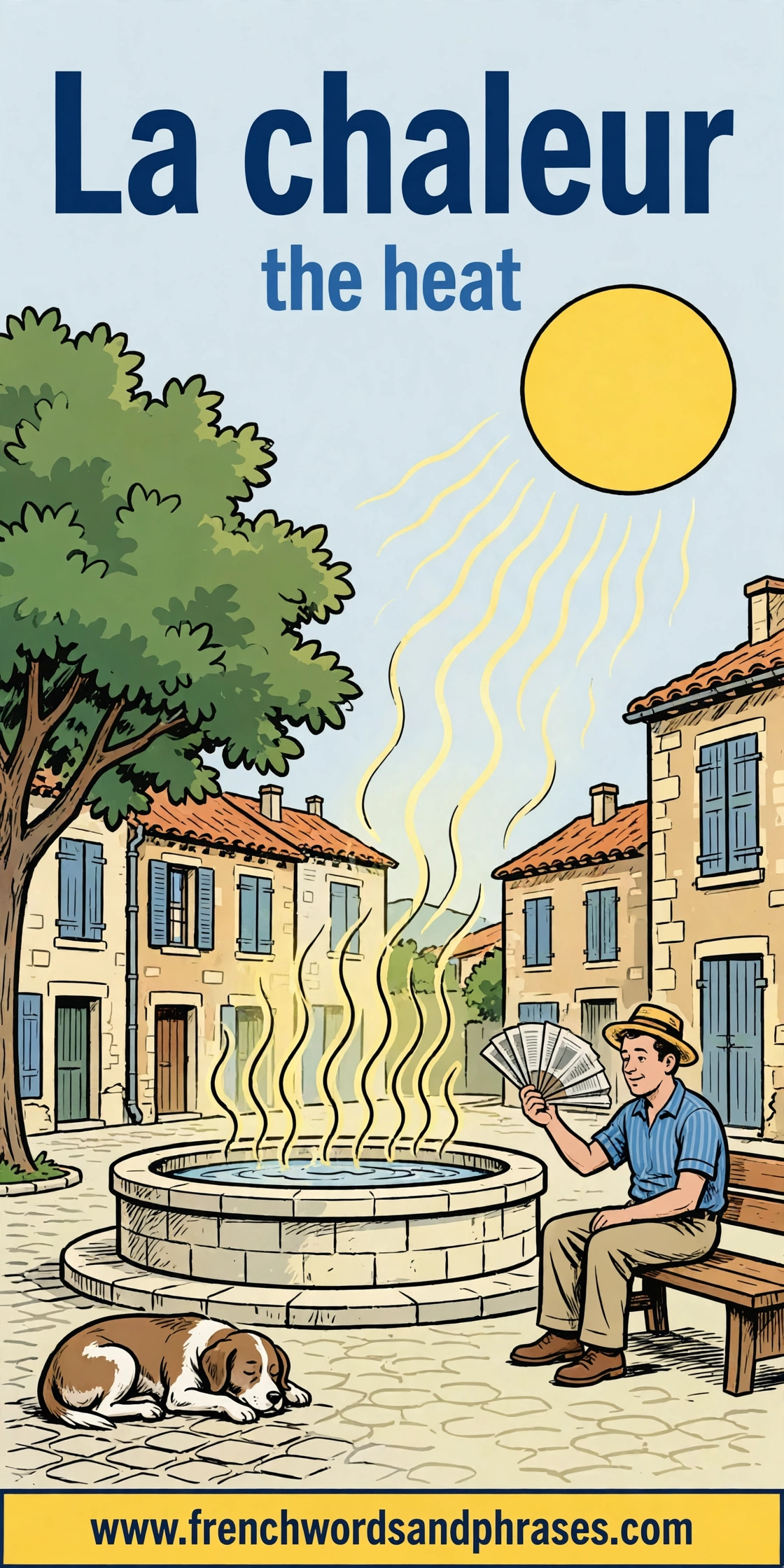
Imagine the village square at two in August: shutters closed, the fountain’s trickle the only sound, even the dog asleep in the thin shade of the wall. La chaleur règne, the heat reigns — and the whole of life politely waits for evening.
You have not just named a temperature. You have named summer’s government — la chaleur, heat that rules and warmth that welcomes.
How to Use Chaleur in French: Complete Guide
Let’s explore how chaleur works in French, beginning with its articles — la chaleur, une chaleur, par cette chaleur.
Chaleur with the Definite Article (La, Les)
Used for the heat everyone is feeling — the heat of this summer, of this room.
| Form | French |
|---|---|
| Feminine singular | la chaleur |
| Plural | les chaleurs |
Example
La chaleur de l’été fait mûrir les raisins.
The summer heat ripens the grapes.
Chaleur with the Indefinite Article (Une, Des)
Used for a heat of a kind — a stifling heat, a gentle heat from the stove.
| Form | French |
|---|---|
| Feminine singular | une chaleur |
| Plural | des chaleurs |
Example
Une chaleur douce sort du poêle en fonte.
A gentle heat comes from the cast-iron stove.
Chaleur in the Weather (Canicule, Étouffante…)
Heat is graded in French summers — from pleasant warmth to the official heatwave.
| Kind | French |
|---|---|
| stifling heat | une chaleur étouffante |
| a heatwave | une vague de chaleur, la canicule |
| the heat of the sun | la chaleur du soleil |
| great heats (hot spells) | les grandes chaleurs |
| a heatstroke | un coup de chaleur |
Example
En pleine canicule, la chaleur dépasse quarante degrés.
In the middle of the heatwave, the heat exceeds forty degrees.
Quick Quiz 1
Complete the sentence:
______ chaleur est insupportable aujourd’hui. (the)
Reveal the answer
La
La chaleur est insupportable aujourd’hui.
The heat is unbearable today — chaleur is feminine, so la.
The Plural of Chaleur
Chaleur usually lives in the singular; the plural les chaleurs names spells and waves of hot weather.
| Number | French |
|---|---|
| Singular | la chaleur |
| Plural | les chaleurs |
Example
Les grandes chaleurs arrivent en juillet cette année.
The great heats are arriving in July this year.
Chaleur with Possessive Adjectives (Ma, Ta, Sa…)
Possessives agree with the noun: chaleur is feminine, so ma, ta, sa in the singular — body heat is the usual owner.
| Owner | French |
|---|---|
| my | ma chaleur |
| your (tu) | ta chaleur |
| his / her | sa chaleur |
| our | notre chaleur |
| your (vous) | votre chaleur |
| their | leur chaleur |
Example
Le chat cherche la chaleur du poêle toute la journée.
The cat seeks the stove’s heat all day long.
Quick Quiz 2
Complete the sentence:
Le bébé dort contre ______ chaleur de sa mère. (the)
Reveal the answer
la
Le bébé dort contre la chaleur de sa mère.
The baby sleeps against his mother’s warmth — la, because chaleur is feminine.
Chaleur with Demonstrative Adjectives (Cette, Ces)
Used to point: cette chaleur, this heat — the heat of today, complained about by everyone.
| Form | French |
|---|---|
| Feminine singular | cette chaleur |
| Plural | ces chaleurs |
Example
Cette chaleur ne nous empêchera pas de marcher.
This heat will not stop us from walking.
Chaleur with Adjectives
Adjectives agree with chaleur — feminine singular: une chaleur étouffante, une douce chaleur.
| Adjective | With Chaleur |
|---|---|
| étouffante (stifling) | une chaleur étouffante |
| douce (gentle) | une douce chaleur |
| forte (strong, intense) | une forte chaleur |
| humaine (human) | la chaleur humaine |
| accablante (oppressive) | une chaleur accablante |
Example
La chaleur humaine de cette famille réchauffe la maison.
This family’s human warmth warms the house.
Quick Quiz 3
Complete the sentence:
C’est une chaleur ______, on respire à peine. (stifling)
Reveal the answer
étouffante
C’est une chaleur étouffante, on respire à peine.
It is stifling heat, you can barely breathe — étouffante, feminine, to agree with chaleur.
Everyday Expressions with Chaleur
Weather, welcomes and warnings — the chaleur phrases of daily life.
| Expression | In English |
|---|---|
| par cette chaleur | in this heat |
| un coup de chaleur | a heatstroke, sunstroke |
| la canicule | the heatwave |
| un accueil plein de chaleur | a warm welcome |
| en chaleur | in heat (of an animal) |
Example
Par cette chaleur, il faut boire beaucoup d’eau.
In this heat, you must drink a lot of water.
Words from the Same Family as Chaleur
Heat and its opposites — the words that travel with chaleur.
| French | In English |
|---|---|
| chaud | hot (the adjective) |
| chauffer | to heat, to warm up |
| la fraîcheur | the coolness — the opposite sister |
| se réchauffer | to warm oneself up |
| la température | the temperature |
Example
On se réchauffe près du feu après la marche dans la neige.
We warm up by the fire after the walk in the snow.
Quick Quiz 4
What is un coup de chaleur?
Reveal the answer
A heatstroke — the body’s dangerous answer to too much heat and sun.
Sans chapeau, il a eu un coup de chaleur.
Without a hat, he got heatstroke.
Chaleur in Everyday French: Real-Life Examples
Now that you know the word, let’s see how chaleur appears in everyday French.
Example 1 — Weather
La chaleur est insupportable depuis trois jours.
The heat has been unbearable for three days.
Example 2 — Advice
Par cette chaleur, restez à l’ombre et buvez.
In this heat, stay in the shade and drink.
Example 3 — At home
La chaleur du poêle rend la cuisine agréable.
The stove’s heat makes the kitchen pleasant.
Example 4 — Welcome
Merci pour votre accueil plein de chaleur.
Thank you for your warm welcome.
Example 5 — The cat
Le chat dort au soleil, il adore la chaleur.
The cat sleeps in the sun, it loves the heat.
La canicule ferme les écoles l’après-midi.
The heatwave closes the schools in the afternoon.
Beyond Translation: The Meaning of Chaleur
Chaleur is one of French’s great double agents: the same word that empties the streets at noon fills the voice of a friend. The language trusts the body to know which is meant — heat is what the skin meets, in weather and in welcome alike — and the -eur family it belongs to (douleur, peur, fraîcheur) is French’s cabinet of sensations, every one of them feminine, every one felt rather than seen.
To say chaleur is to measure the world by what the skin knows.
It evokes the trembling pavement, the stove’s kind breath and the host who takes your coat like a relative — heat, in all its governments.
How to Remember the French Noun Chaleur
Remember it this way: Chaleur is the heat — feminine, one of the -eur sensation nouns: la chaleur, and chaud is its adjective.
- Always feminine — la chaleur, une chaleur, cette chaleur.
- Noun versus adjective — la chaleur is the heat; chaud is hot: il fait chaud.
- Two lives — la chaleur de l’été, the summer heat; la chaleur d’un accueil, a warm welcome.
The key idea is la chaleur — the heat and the warmth, feminine; il fait chaud for the weather.
Test Your Knowledge of Chaleur
Let’s see how much you’ve learned. Try answering these questions before revealing the answers.
Question 1
Is chaleur masculine or feminine?
Reveal the answer
Feminine — la chaleur, une chaleur.
Question 2
How do you say it is hot (weather) in French?
Reveal the answer
Il fait chaud — with the adjective chaud, not the noun chaleur.
Question 3
Translate: In this heat, you must drink a lot of water.
Reveal the answer
Par cette chaleur, il faut boire beaucoup d’eau.
Question 4
What is la canicule?
Reveal the answer
The heatwave — a spell of extreme, dangerous heat.
Question 5
Complete the sentence:
______ chaleurs de juillet font mûrir les tomates. (the)
Reveal the answer
Les
Les chaleurs de juillet font mûrir les tomates.
The July heats ripen the tomatoes.
Can You Use It?
How would you say this in French?
“In this heat, stay in the shade and drink.”
Reveal the answer
Par cette chaleur, restez à l’ombre et buvez.
In this heat, stay in the shade and drink.
A little French. A little curiosity. A richer everyday life.
LEARN FRENCH ONE WORD AT A TIME




