
A French Word to Live By
How to Conjugate Assimiler in French
/a.si.mi.le/
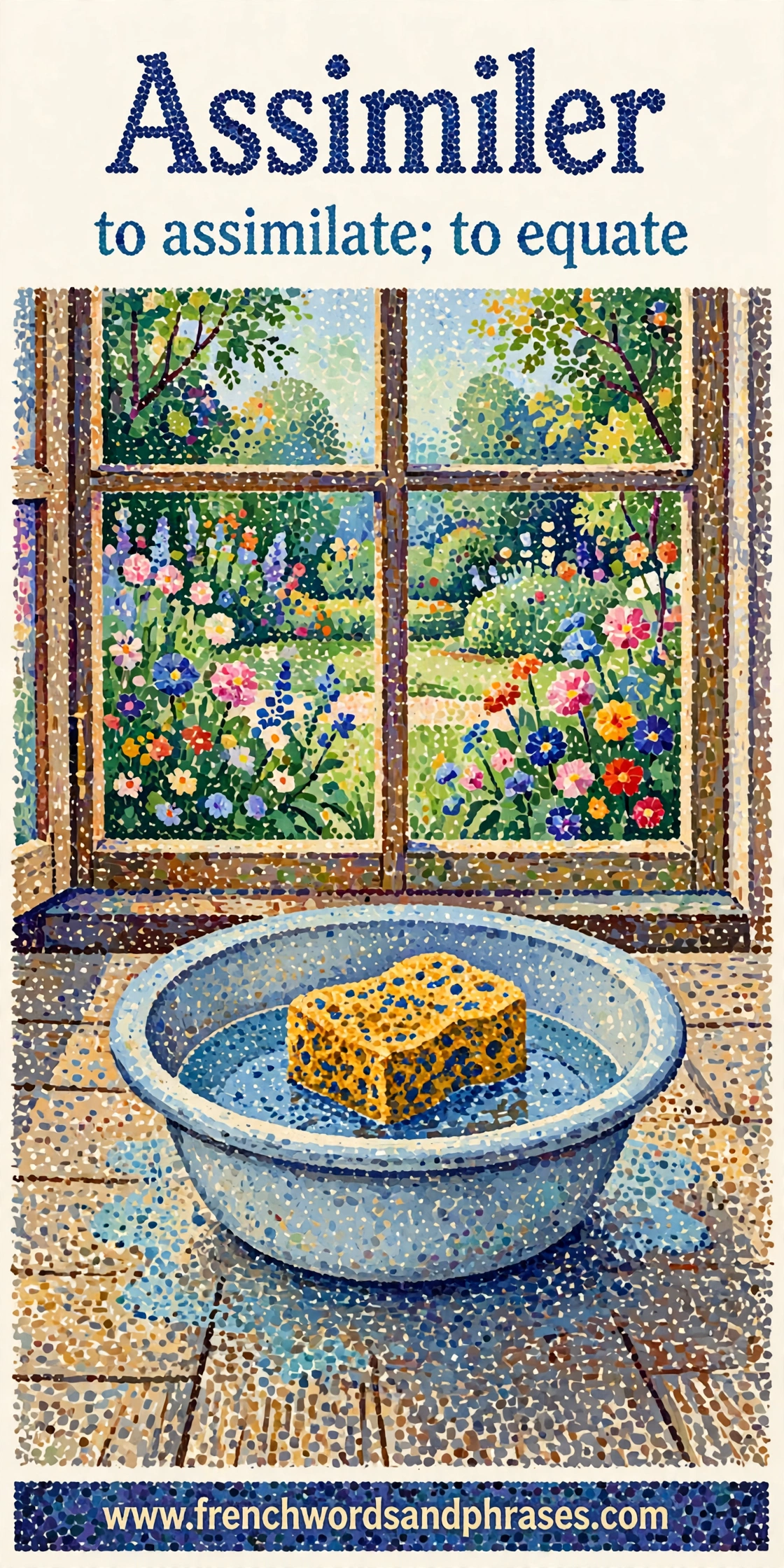
Assimiler means to assimilate — to take something foreign in and make it one’s own: food by the body, knowledge by the mind, customs by the newcomer; and, in argument, to equate one thing with another.
A body turning bread into strength, a student turning rules into reflexes, a newcomer turning a strange town into home — assimiler is the verb of patient absorption, the slow alchemy by which the outside becomes the inside.
In this guide, you’ll learn how to conjugate assimiler in all the major French tenses and moods. Explore complete conjugation tables, French examples, English translations, and practice quizzes.
Understanding the French Verb Assimiler
Assimiler is a regular French verb belonging to the first group of verbs, those ending in-er.
It means to assimilate; to equate. The word works at three levels of French life: the body (assimiler les protéines), the school (assimiler une règle de grammaire — not just learn it, but make it second nature), and society, where l’assimilation names the absorbing of newcomers into a culture — a word of French public debate for two centuries. What is merely appris is learned; what is assimilé is owned.
Verb classification: First group (-er)
Auxiliary verb: Avoir
Past participle: assimilé
Present participle: assimilant
English equivalents: To assimilate, to absorb, to digest; assimiler une leçon — to take in a lesson fully; assimiler la nourriture — to assimilate food; assimiler quelque chose à autre chose — to equate something with something else; s’assimiler à — to blend into, to become like.
One important detail: assimiler is perfectly regular — j’assimile, nous assimilons, ils assimilent, past participle assimilé — with its double s kept in every form. Its constructions carry the meanings: assimiler quelque chose (to absorb it) versus assimiler quelque chose à autre chose (to liken it to something else) — the little à changes absorbing into equating.
Experience the Word
Assimiler is the verb of the border crossed quietly — food, words and customs entering until they are no longer foreign.
Imagine the new student in October, lost in the French classroom, copying endings she does not feel. By June the same girl corrects her little brother at breakfast — elle a assimilé la langue, she has assimilated the language: it no longer visits her, it lives in her.
Nothing was memorised in a day. It was absorbed, day by day — assimilé — until outside became inside.
How to Conjugate Assimiler: Complete French Conjugation Guide
Let’s explore every major conjugation of assimiler, beginning with the indicative mood.
How to Conjugate Assimiler in the Indicative Mood
The indicative mood is used to express facts, observations, actions, and events.
How to Conjugate Assimiler in the Present Tense (Présent)
Used for actions happening now, habitual actions, and general truths.
| Subject | Conjugation |
|---|---|
| je | assimile |
| tu | assimiles |
| il / elle | assimile |
| nous | assimilons |
| vous | assimilez |
| ils / elles | assimilent |
Example
Le corps assimile lentement ce repas riche.
The body slowly assimilates this rich meal.
Quick Quiz 1
Complete the sentence:
Nous ______ la règle en une semaine.
Reveal the answer
assimilons
Nous assimilons la règle en une semaine.
We assimilate the rule in one week.
How to Conjugate Assimiler in the Passé Composé
Used for completed actions in the past. Assimiler takes the auxiliary verb avoir.
| Subject | Conjugation |
|---|---|
| j’ | ai assimilé |
| tu | as assimilé |
| il / elle | a assimilé |
| nous | avons assimilé |
| vous | avez assimilé |
| ils / elles | ont assimilé |
Example
Les élèves ont assimilé la règle en une semaine.
The pupils assimilated the rule in one week.
How to Conjugate Assimiler in the Imparfait (Imperfect Tense)
Used for habitual past actions, descriptions, and ongoing situations in the past.
| Subject | Conjugation |
|---|---|
| je | assimilais |
| tu | assimilais |
| il / elle | assimilait |
| nous | assimilions |
| vous | assimiliez |
| ils / elles | assimilaient |
Example
Il assimilait les langues avec une facilité étonnante.
He assimilated languages with astonishing ease.
Quick Quiz 2
Choose the correct form:
The pupils assimilated the rule.
Les élèves ______ la règle. (ont assimilé / sont assimilés)
Reveal the answer
ont assimilé
Les élèves ont assimilé la règle.
Assimiler takes avoir.
How to Conjugate Assimiler in the Plus-que-parfait
Used to describe an action that had already been completed before another past event.
| Subject | Conjugation |
|---|---|
| j’ | avais assimilé |
| tu | avais assimilé |
| il / elle | avait assimilé |
| nous | avions assimilé |
| vous | aviez assimilé |
| ils / elles | avaient assimilé |
Example
Elle avait assimilé toutes les coutumes du pays.
She had assimilated all the country’s customs.
How to Conjugate Assimiler in the Passé Simple
Primarily used in formal writing, literature, and historical narratives. It is rarely used in everyday conversation.
| Subject | Conjugation |
|---|---|
| je | assimilai |
| tu | assimilas |
| il / elle | assimila |
| nous | assimilâmes |
| vous | assimilâtes |
| ils / elles | assimilèrent |
Example
Le peuple assimila les nouveaux venus en une génération.
The people assimilated the newcomers in one generation.
How to Conjugate Assimiler in the Passé Antérieur
A literary tense used to express an action completed immediately before another past action, generally in the passé simple.
| Subject | Conjugation |
|---|---|
| j’ | eus assimilé |
| tu | eus assimilé |
| il / elle | eut assimilé |
| nous | eûmes assimilé |
| vous | eûtes assimilé |
| ils / elles | eurent assimilé |
Example
Dès qu’il eut assimilé la méthode, il travailla seul.
As soon as he had assimilated the method, he worked alone.
How to Conjugate Assimiler in the Future Tense (Futur Simple)
Used to describe actions that will take place in the future.
| Subject | Conjugation |
|---|---|
| je | assimilerai |
| tu | assimileras |
| il / elle | assimilera |
| nous | assimilerons |
| vous | assimilerez |
| ils / elles | assimileront |
Example
Tu assimileras ces mots en les utilisant chaque jour.
You will assimilate these words by using them every day.
How to Conjugate Assimiler in the Futur Antérieur (Future Perfect)
Used for an action that will have been completed before a particular point in the future.
| Subject | Conjugation |
|---|---|
| j’ | aurai assimilé |
| tu | auras assimilé |
| il / elle | aura assimilé |
| nous | aurons assimilé |
| vous | aurez assimilé |
| ils / elles | auront assimilé |
Example
À la fin du trimestre, vous aurez assimilé l’essentiel.
By the end of the term, you will have assimilated the essentials.
How to Conjugate Assimiler in the Near Future (Futur Proche)
Used to describe something that is going to happen soon. Formed with aller + infinitive.
| Subject | Conjugation |
|---|---|
| je | vais assimiler |
| tu | vas assimiler |
| il / elle | va assimiler |
| nous | allons assimiler |
| vous | allez assimiler |
| ils / elles | vont assimiler |
Example
Je vais assimiler cette leçon avant l’examen.
I am going to assimilate this lesson before the exam.
How to Conjugate Assimiler in the Conditional Mood
The conditional mood expresses what would happen under certain circumstances. It is also frequently used to make polite requests or express wishes.
How to Conjugate Assimiler in the Present Conditional
| Subject | Conjugation |
|---|---|
| je | assimilerais |
| tu | assimilerais |
| il / elle | assimilerait |
| nous | assimilerions |
| vous | assimileriez |
| ils / elles | assimileraient |
Example
Avec plus de pratique, on assimilerait mieux la grammaire.
With more practice, we would assimilate the grammar better.
How to Conjugate Assimiler in the Past Conditional
| Subject | Conjugation |
|---|---|
| j’ | aurais assimilé |
| tu | aurais assimilé |
| il / elle | aurait assimilé |
| nous | aurions assimilé |
| vous | auriez assimilé |
| ils / elles | auraient assimilé |
Example
Ils auraient assimilé le programme sans les grèves.
They would have assimilated the syllabus without the strikes.
Assimiler in the Literary Past Conditional Form
This less common literary form uses the imperfect subjunctive of avoir.
| Subject | Conjugation |
|---|---|
| j’ | eusse assimilé |
| tu | eusses assimilé |
| il / elle | eût assimilé |
| nous | eussions assimilé |
| vous | eussiez assimilé |
| ils / elles | eussent assimilé |
Example
Le moine eût assimilé la règle sans les doutes de sa jeunesse.
The monk would have assimilated the rule, had it not been for the doubts of his youth.
How to Conjugate Assimiler in the Subjunctive Mood
The subjunctive is used to express wishes, emotions, doubts, necessity, and uncertainty. It frequently follows expressions such as il faut que (it is necessary that) or bien que (although).
How to Conjugate Assimiler in the Present Subjunctive
| Subject | Conjugation |
|---|---|
| que je | assimile |
| que tu | assimiles |
| qu’il / qu’elle | assimile |
| que nous | assimilions |
| que vous | assimiliez |
| qu’ils / qu’elles | assimilent |
Example
Il faut que l’enfant assimile ces notions doucement.
The child must assimilate these notions gently.
Quick Quiz 3
Complete the sentence using the subjunctive:
Je suis fier que tu ______ tant de choses cette année.
Reveal the answer
aies assimilé
Je suis fier que tu aies assimilé tant de choses cette année.
I am proud you assimilated so much this year.
How to Conjugate Assimiler in the Imperfect Subjunctive
A literary tense, rarely encountered in modern spoken French.
| Subject | Conjugation |
|---|---|
| que je | assimilasse |
| que tu | assimilasses |
| qu’il / qu’elle | assimilât |
| que nous | assimilassions |
| que vous | assimilassiez |
| qu’ils / qu’elles | assimilassent |
Example
Le maître voulait que nous assimilassions les tables par cœur.
The teacher wanted us to assimilate the tables by heart.
How to Conjugate Assimiler in the Pluperfect Subjunctive
A literary construction used to express an action completed before another past action.
| Subject | Conjugation |
|---|---|
| que j’ | eusse assimilé |
| que tu | eusses assimilé |
| qu’il / qu’elle | eût assimilé |
| que nous | eussions assimilé |
| que vous | eussiez assimilé |
| qu’ils / qu’elles | eussent assimilé |
Example
On admirait qu’elle eût assimilé trois langues en cinq ans.
People admired that she had assimilated three languages in five years.
How to Conjugate Assimiler in the Past Subjunctive
| Subject | Conjugation |
|---|---|
| que j’ | aie assimilé |
| que tu | aies assimilé |
| qu’il / qu’elle | ait assimilé |
| que nous | ayons assimilé |
| que vous | ayez assimilé |
| qu’ils / qu’elles | aient assimilé |
Example
Je suis fier que tu aies assimilé tant de choses cette année.
I am proud you assimilated so much this year.
How to Conjugate Assimiler in the Imperative
The imperative is used to give commands, instructions, invitations, or suggestions. Subject pronouns are omitted.
How to Conjugate Assimiler in the Present Imperative
| Person | Conjugation |
|---|---|
| (tu) | assimile |
| (nous) | assimilons |
| (vous) | assimilez |
Example
Assimilez d’abord les bases, le reste suivra !
Assimilate the basics first, the rest will follow!
Quick Quiz 4
How would you say Assimilate the basics first (vous form)?
Reveal the answer
Assimilez d’abord les bases !
French Participles of Assimiler
Participles are verb forms that can be used in compound tenses and other grammatical constructions.
Present Participle of Assimiler
assimilant
En assimilant chaque jour dix mots, on progresse vite.
By assimilating ten words a day, you progress fast.
Past Participle of Assimiler
assimilé
Assimilées lentement, ces règles deviennent naturelles.
Assimilated slowly, these rules become natural.
Assimiler in Everyday French: Real-Life Examples
Now that you know the conjugations, let’s see how assimiler appears in everyday French.
Example 1 — Present
Le corps assimile lentement ce repas riche.
The body slowly assimilates this rich meal.
Example 2 — Passé composé
Les élèves ont assimilé la règle en une semaine.
The pupils assimilated the rule in one week.
Example 3 — Imparfait
Il assimilait les langues avec facilité.
He assimilated languages with ease.
Example 4 — Future
Tu assimileras ces mots en les utilisant.
You will assimilate these words by using them.
Example 5 — Conditional
On assimilerait mieux avec plus de pratique.
We would assimilate better with more practice.
Example 6 — Imperative
Assimilez d’abord les bases !
Assimilate the basics first!
Beyond Translation: The Meaning of Assimiler
Assimiler is Latin assimilare — to make similar — and the word still performs its definition: to assimilate is to make the foreign similar to oneself, until the border disappears. French philosophy of education loves the distinction it allows: apprendre fills the shelf, assimiler stocke le corps — what is assimilated is no longer consulted, it is lived.
Assimiler is learning that has moved in.
Learn it beside digérer and intégrer, and you can grade absorption — of meals, of lessons, of whole cultures — with a connoisseur’s scale.
How to Remember the French Verb Assimiler
Remember it this way: Assimiler is about the new student who by June corrects her brother at breakfast — the language has moved in.
- Assimiler quelque chose = to absorb it; assimiler A à B = to equate A with B — the à changes the meaning.
- Three homes: the body (food), the mind (lessons), society (customs and newcomers).
- Regular -er with avoir: j’assimile, nous assimilons, past participle assimilé, double s everywhere.
The key idea is the new student who by June corrects her brother at breakfast — the language has moved in.
Test Your Knowledge of Assimiler
Let’s see how much you’ve learned. Try answering these questions before revealing the answers.
Question 1
What are the two great meanings of assimiler?
Reveal the answer
To assimilate, to absorb — and, with à, to equate one thing with another.
Question 2
How do you say to assimilate a lesson in French?
Reveal the answer
Assimiler une leçon.
Question 3
Translate: The pupils assimilated the rule in one week.
Reveal the answer
Les élèves ont assimilé la règle en une semaine.
Question 4
What is the past participle of assimiler?
Reveal the answer
Assimilé.
Question 5
Complete the sentence:
Il faut que l’enfant ______ ces notions doucement.
Reveal the answer
assimile
Il faut que l’enfant assimile ces notions doucement.
The child must assimilate these notions gently.
Your Final Challenge
Can You Use It?
How would you say this in French?
You do not learn a language in a day: you assimilate it, word by word, meal by meal.
Reveal the answer
On n’apprend pas une langue en un jour : on l’assimile, mot à mot, repas à repas.
You do not learn a language in a day: you assimilate it, word by word, meal by meal.
A little French. A little curiosity. A richer everyday life.
LEARN FRENCH ONE WORD AT A TIME




