A French Word to Live By
Translate Classe to English
/klas/
La classe means the class.
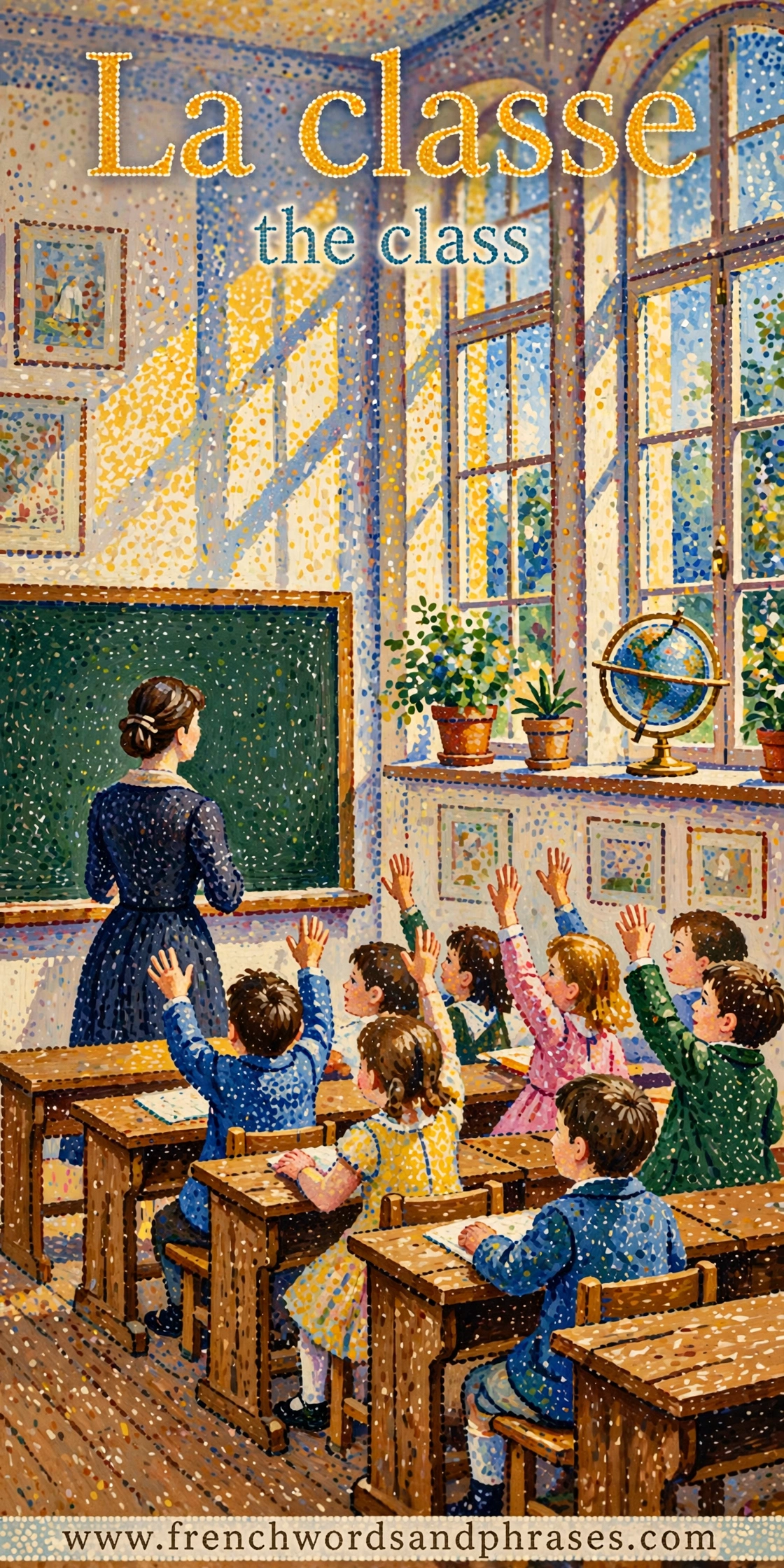
Thirty chairs, one blackboard, and a teacher opening the register: la classe, the class — the room, the pupils and the lesson all wearing one word, and beyond the school gates, the word French reaches for whenever anything is sorted, ranked or simply stylish.
In this guide, you’ll learn what classe means in English, how to use it with its articles, how to form its plural, and how it appears in everyday French. Explore French examples, English translations, and practice quizzes.
Understanding the French Noun Classe
Classe is a feminine French noun, learned with its article: la classe, une classe. It comes straight from the Latin classis, a division of citizens called up by rank. French kept both halves of the inheritance: the schoolroom division, and the ranking itself — whence la classe as pure elegance in familiar speech: elle a de la classe, she has class.
It means a class — first at school: une classe de trente élèves, a class of thirty pupils, la salle de classe, the classroom, en classe, in class. Then a category: la classe moyenne, the middle class, la première classe, first class on the train. Then a school year level: être en classe de sixième. And in admiring slang, style itself: avoir la classe, to have class, to be effortlessly elegant.
Gender: Feminine — la classe
Definite article: la — la classe (the class)
Indefinite article: une — une classe (a class)
Plural: les classes — regular, with a simple -s
Spelling note: from Latin classis, a ranked division of citizens
Double life: the school class, and pure style: avoir la classe
English equivalents: The class.
At school the prepositions matter: you are en classe during the lesson, in la salle de classe the room, and a pupil belongs to une classe de plus the level. On the train, book en première classe or en seconde classe. For society, the compounds do the work: la classe moyenne, la classe ouvrière. And for the compliment, remember it is avoir: il a la classe — never être.
Experience the Word
Classe is the word that lines people up — by age in the schoolyard, by ticket on the platform, by elegance in the eye of the beholder.
Imagine the first morning of September: thirty strangers with new satchels become, by the simple act of sharing one room and one teacher, une classe — a small society with its own jokes, ranks and legends by Christmas.
You have not just named a lesson. You have named belonging itself — la classe, the class, ranked, gathered and, at its best, effortlessly stylish.
How to Use Classe in French: Complete Guide
Let’s explore how classe works in French, beginning with its articles — la classe, une classe, en classe.
Classe with the Definite Article (La, Les)
Used for a specific class — your class, this year’s class.
| Form | French |
|---|---|
| Feminine singular | la classe |
| Plural | les classes |
Example
La classe écoute le professeur en silence.
The class listens to the teacher in silence.
Classe with the Indefinite Article (Une, Des)
Used for a class in general — any roomful of pupils, any category.
| Form | French |
|---|---|
| Feminine singular | une classe |
| Plural | des classes |
Example
C’est une classe de vingt-cinq élèves.
It’s a class of twenty-five pupils.
Classe in Its Territories (De sixième, Moyenne, Première…)
Classe is completed by its territory — school level, society or railway carriage.
| Quantity | French |
|---|---|
| in class (during the lesson) | en classe |
| the classroom | la salle de classe |
| the middle class | la classe moyenne |
| first class (train) | la première classe |
| to have class, style | avoir la classe |
Example
Nous voyageons en première classe, c’est plus calme.
We travel first class, it’s quieter.
Quick Quiz 1
Complete the sentence:
______ classe de ma fille compte trente élèves. (the)
Reveal the answer
La
La classe de ma fille compte trente élèves.
My daughter’s class has thirty pupils — classe is feminine, so la.
The Plural of Classe
Classe takes a regular plural in -s — a whole school of them, a whole society of them.
| Number | French |
|---|---|
| Singular | la classe |
| Plural | les classes |
Example
Les classes de l’école défilent dans la cour.
The school’s classes parade in the yard.
Classe with Possessive Adjectives (Ma, Ta, Sa…)
Possessives agree with the noun: classe is feminine, so ma, ta, sa in the singular.
| Owner | French |
|---|---|
| my | ma classe |
| your (tu) | ta classe |
| his / her | sa classe |
| our | notre classe |
| your (vous) | votre classe |
| their | leur classe |
Example
Ma classe prépare une pièce de théâtre.
My class is preparing a play.
Quick Quiz 2
Complete the sentence:
Il retrouve ______ classe après la récréation. (his)
Reveal the answer
sa
Il retrouve sa classe après la récréation.
He rejoins his class after break — sa, because classe is feminine.
Classe with Demonstrative Adjectives (Cette, Ces)
Used to point: cette classe, this class — this year’s group.
| Form | French |
|---|---|
| Feminine singular | cette classe |
| Plural | ces classes |
Example
Cette classe est particulièrement douée en maths.
This class is particularly gifted in maths.
Classe with Adjectives
Adjectives agree with classe — feminine singular: la classe moyenne, une classe entière.
| Adjective | With Classe |
|---|---|
| moyenne (middle) | la classe moyenne |
| ouvrière (working) | la classe ouvrière |
| entière (whole) | la classe entière |
| première (first) | la première classe |
| bruyante (noisy) | une classe bruyante |
Example
La classe entière part en voyage scolaire.
The whole class is going on a school trip.
Quick Quiz 3
Complete the sentence:
C’est une classe très ______, le professeur soupire. (noisy)
Reveal the answer
bruyante
C’est une classe très bruyante, le professeur soupire.
It’s a very noisy class, the teacher sighs — bruyante, feminine, to agree with classe.
Everyday Expressions with Classe
Schoolrooms, trains and compliments — the classe phrases of daily life.
| Expression | In English |
|---|---|
| en classe | in class, in the classroom |
| la salle de classe | the classroom |
| la classe moyenne | the middle class |
| en première classe | in first class |
| avoir la classe | to have class, to be stylish |
Example
En classe, on écoute et on lève la main.
In class, you listen and raise your hand.
Words from the Same Family as Classe
School and sorting — the words that travel with classe.
| French | In English |
|---|---|
| un élève | a pupil |
| un cours | a lesson, a course |
| classer | to classify, to file (the verb) |
| un niveau | a level |
| un classement | a ranking, a league table |
Example
Le classement des équipes change chaque semaine.
The teams’ ranking changes every week.
Quick Quiz 4
What does avoir la classe mean?
Reveal the answer
To have class — to be effortlessly elegant and stylish.
Avec son chapeau et son sourire, il a la classe.
With his hat and his smile, he has class.
Classe in Everyday French: Real-Life Examples
Now that you know the word, let’s see how classe appears in everyday French.
Example 1 — At school
Les élèves entrent en classe à huit heures.
The pupils go into class at eight.
Example 2 — The room
La salle de classe est au premier étage.
The classroom is on the first floor.
Example 3 — Travel
Un billet de première classe, s’il vous plaît.
A first-class ticket, please.
Example 4 — Society
La classe moyenne grandit dans ce pays.
The middle class is growing in this country.
Example 5 — A compliment
Cette actrice a vraiment la classe.
That actress really has class.
Example 6 — Levels
Mon fils est en classe de quatrième.
My son is in the fourth-year class (Year 9).
Beyond Translation: The Meaning of Classe
Classe began as Rome’s census: the classis was the rank into which a citizen was called, by wealth, for war. Two thousand years later the word still ranks — pupils by age, travellers by ticket, citizens by income. But French slang performed one beautiful theft: it took the ranking word and made it the supreme compliment of unrankable worth. Avoir la classe cannot be bought by the ticket; it is the one class that has nothing to do with classes.
To say classe is to line the world up — and then to praise the one who rises above the line.
It evokes the register call, the quiet first-class carriage, and the hat worn exactly right.
How to Remember the French Noun Classe
Remember it this way: Classe is the class — la classe: the pupils, the room, the category, and in slang, style itself.
- Always feminine — la classe, une classe, ma classe.
- The school set — en classe (in class), la salle de classe (the classroom).
- The compliment — avoir la classe, to have class; it uses avoir, never être.
The key idea is la classe — the class, feminine; avoir la classe = to have style.
Test Your Knowledge of Classe
Let’s see how much you’ve learned. Try answering these questions before revealing the answers.
Question 1
Is classe masculine or feminine?
Reveal the answer
Feminine — la classe, une classe.
Question 2
How do you say the classroom?
Reveal the answer
La salle de classe.
Question 3
Translate: We travel first class.
Reveal the answer
Nous voyageons en première classe.
Question 4
How do you say the middle class?
Reveal the answer
La classe moyenne.
Question 5
Complete the sentence:
______ classes de l’école sont en sortie aujourd’hui. (the)
Reveal the answer
Les
Les classes de l’école sont en sortie aujourd’hui.
The school’s classes are on an outing today.
Your Final Challenge
Can You Use It?
How would you say this in French?
“The whole class is going on a school trip.”
Reveal the answer
La classe entière part en voyage scolaire.
The whole class is going on a school trip.
A little French. A little curiosity. A richer everyday life.
LEARN FRENCH ONE WORD AT A TIME